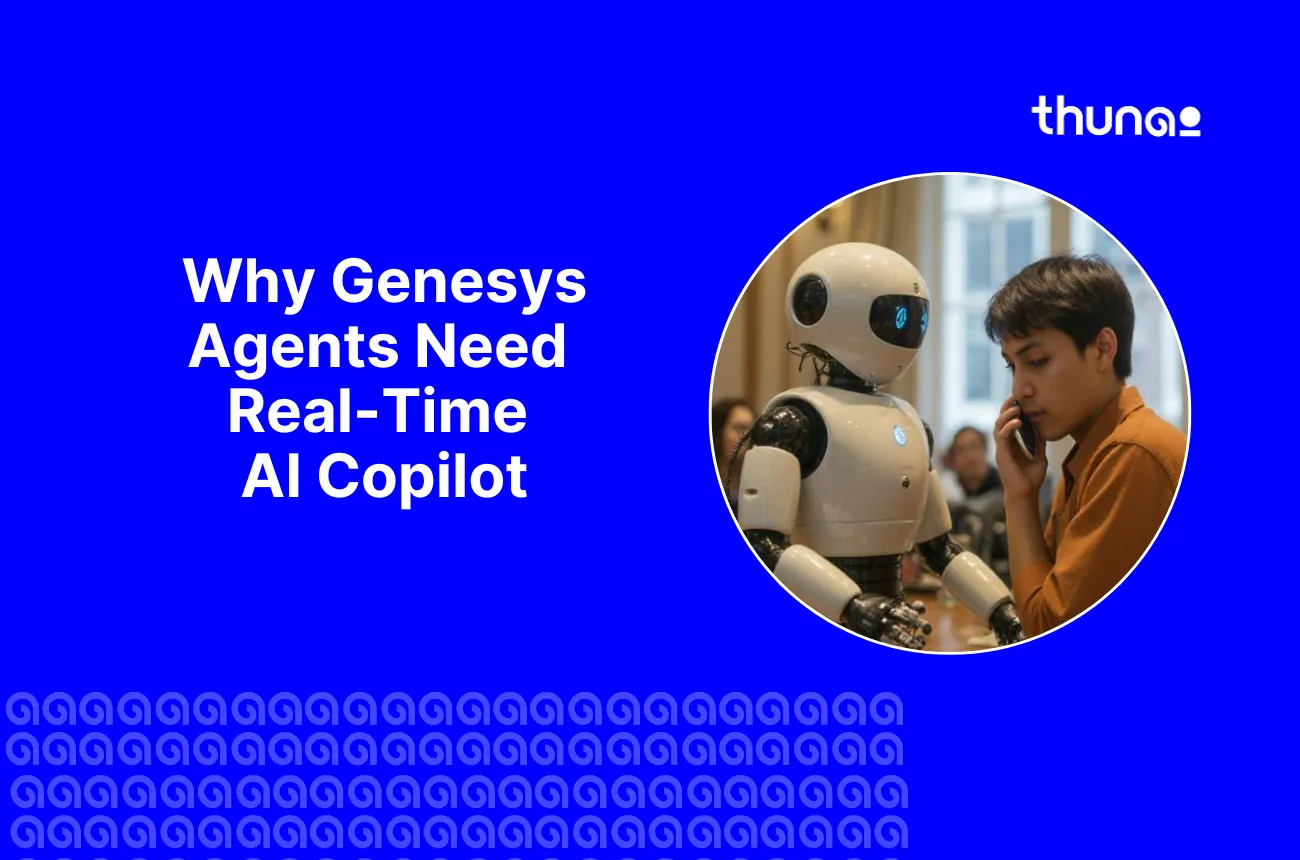

Do your contact center agents struggle with too many open tabs and difficult queries?
Imagine your Genesys agents feeling supported during hard calls and delivering accurate answers without stress.
This leads to lower handle times, less burnout, and happier customers.
Do you want to know how to improve your support operations? This guide explains the ways to change your Genesys environment with a real-time AI partner.
Why Genesys Agents Need a Real-Time AI Partner
The modern contact center agent faces a different workload than their counterpart from a decade ago. Basic bots and self-service portals now handle simple password resets.
As a result, the interactions that reach a human agent are complex and often involve upset customers.
- Consumer preference now favors digital self-service for simple questions. This leaves agents managing nuanced issues that require deep problem-solving skills. This difficulty gap means every interaction a human agent handles is important for customer loyalty,
- which is why understanding what is Genesys and its role in experience orchestration is the first step toward improving these outcomes.
- Also, agents in 97 percent of surveyed contact centers must use multiple screens to do their jobs.
- Forty percent of agents use four or more systems at the same time. This screen switching forces agents to move data manually between CRMs and billing systems.
- This manual work increases Average Handle Times and error rates. A real-time AI partner is the only way to join this context instantly.

Why the Agent Copilot Needed to Change
The move to modern Agent Copilots happened because previous technologies failed to handle human communication. If you tried legacy Agent Assist tools, you likely found them reactive and distracting.
These tools used keyword spotting and static decision trees. They listened for specific phrases like 'cancel account' and showed a generic policy document.
This error led many agents to ignore the assist sidebar. The launch of Large Language Models required the shift from Assist to Copilot. Unlike older tools, LLMs understand context and sentiment with high accuracy.
This function allows the system to handle unstructured data like notes and chat logs. It uses Retrieval-Augmented Generation to pull insights from past interaction histories to help with the current call.
From Scripts and Playbooks to Real-Time Agent Assistance
The change from scripted interactions to real-time AI assistance removes the strict management model and replaces it with a guidance model.
In the past, managers used rigid scripts to make sure agents followed unnatural conversation flows. When customers asked unexpected questions or expressed complex emotions, the script failed. This resulted in a stiff service experience.
Real-time assistance changes this dynamic through:
- Live Listening and Intent Mining: Modern systems transcribe voice data instantly and feed it into an NLU engine that looks for intent rather than just recording words.
- Sentiment Analysis: The AI examines acoustic qualities like pitch and tone to measure customer sentiment. It acts as an emotional gauge that can suggest de-escalation scripts.
- Dynamic Prompting: Instead of a static script, agents receive dynamic prompts that fit the conversation flow. If a customer mentions a competitor, the Copilot instantly shows a comparison card or retention deal.
What Makes a Modern AI Agent Copilot Different
Many vendors say they have AI, but true modern Agent Copilots possess distinct traits that separate them from basic chatbots or legacy assist tools. The difference lies in autonomy, connection depth, and the ability to create rather than just retrieve.
It is important to distinguish between Conversational AI and Generative AI. Conversational AI simulates human dialogue and understands intent. Generative AI agent Copilots work well for defined tasks like checking a balance. Generative AI creates new content, such as summarizing a long call into three bullet points or writing a personal follow-up email.
A modern AI agent Copilots uses Conversational AI to understand the context and Generative AI to produce the solution.
This combination allows for autonomous behavior where the AI observes context and starts actions. For example, if a customer complains about a defect, an autonomous AI agent Copilot might start a refund process in the background while waiting for agent approval.
Instant Knowledge During Live Calls
A main part of modern support is the concept of instant knowledge powered by Retrieval-Augmented Generation. RAG allows the AI to combine the fluency of an LLM with the accuracy of your proprietary data.
- In the old model, knowledge stayed in disconnected places like SharePoint, PDFs, and physical binders. Agents had to search through these separate sources while managing the customer's emotions.
- RAG allows the AI to read data from all these sources and get only the relevant pieces of information based on the live conversation.
- This makes sure that the agent's answers are not just empathetic but factually accurate and compliant. The AI prepares the necessary tools and information before the agent asks for them.
How Thunai Acts as a Real-Time Knowledge Base for Genesys Agents
To set up this instant knowledge concept within a Genesys environment, you need a main intelligence system. This is where Thunai Brain helps.
Thunai Brain is not just a simple database. This AI agent Copilot is a living, combined knowledge system that acts as the central intelligence for your whole operation. It reads any file type including documents, spreadsheets, videos, and audio. It also connects with your live application data instantly.
For Genesys agents, Thunai gives specific advantages:
- Contradiction Resolution: Thunai Brain finds contextual conflicts across your documents and shows them for human resolution. This makes sure your agents never give conflicting advice.
- AI voice agents for Genesys: Thunai helps provide AI agents for Genesys that reduce cognitive load and resolve complex queries faster than manual searching.
- Intelligent Chat Interface: Agents can use Ask Thunai to chat with their enterprise data just like they would with ChatGPT but securely and accurately.
- Co-Pilot Intelligence: Through Thunai Omni, the system gets relevant customer history and context during live calls. This AI agent copilot gives answers directly from the Thunai Brain.
AI-Powered Agent Assistance That Learns From Every Interaction
A static system is a dying system. Modern AI partners must improve over time through active learning and feedback systems.
When an agent accepts, rejects, or edits an AI agent Copilots suggestion, that data should go back into the model. This creates a cycle where the AI learns the details of your specific domain. This effectively turns your agents into the trainers of the AI.
Thunai Omni and Thunai Reflect AI assist with this dynamic:
- Live Sentiment Analysis: Omni tracks customer sentiment instantly. AI agent copilots alerts supervisors or starts specific workflows if it finds negative sentiment.
- Closed-Loop Feedback: Thunai Reflect gathers insights from customer chats and feedback platforms to find product health issues.
- Trend Analysis: It identifies regressions or hotspots and notifies relevant teams. It converts insights into tickets to close the loop on recurring issues.
Beyond Answering Questions: Building Smarter Agents at Scale
An AI partner must do more than just answer questions. AI agent copilots must run workflows that span multiple systems. The modern AI agent Copilot creates a coordination layer that connects with billing, shipping, and technical support systems via APIs.
Thunai Common Agent acts as this engine. It is a visual system for creating smart AI agents that manage actions across all your tools.
You can design workflows with a drag-and-drop interface or build them by using AI prompts. These agents use Thunai MCP (Multi-Connect Protocol) which is a deep connection layer that allows for a true two-way flow of information.
- Bidirectional Sync: Get and update information between systems instantly.
- Connection: Connect instantly with over 35 popular enterprise apps. This makes sure no system is left behind.
- Custom Connectors: Build connectors for unsupported apps and convert their APIs into OpenAPI specifications.
Why Real-Time AI Copilots Are Becoming Necessary
The use of AI Agent Copilots happens because of financial data that proves they are necessary. Operational gains come mainly from lower handle times and the deflection of routine work, a trend that is currently reshaping how leading CCaaS providers in 2025 design their agent-facing tools.
For example, Best Buy Canada reported a 19 percent decrease in Average Handle Time and a 40 percent decline in call transfers after they set up real-time insights. Similarly, Eir saved up to one minute per voice call using auto-summarization.
Operational Impact of AI Copilots
Below is a breakdown of the specific operational improvements companies see with AI agent Copilots setup:
Beyond speed, the financial cost of agent attrition is severe. The cost to replace a single agent ranges from 10,000 to 20,000 dollars when counting recruitment and training. AI agent Copilots help with this by removing the repetitive work of after-call tasks. This leads 79 percent of support agents to feel supported rather than overwhelmed.
The High Cost of Doing Nothing
Failing to address agent burnout has a distinct price tag. The table below outlines the economics of agent turnover in a standard 100-seat model:
How Thunai Turns Real-Time AI Agent Copilots Into Reality
Stop leaving your Genesys agents to struggle with disconnected systems and high cognitive load. Start building a support operation that is proactive and efficient.
By connecting your Genesys environment with Thunai, you access a suite of modules designed to change your support:
- Thunai Omni: Handle all channels including voice, chat, and email from one workspace with live transcription and AI assistance.
- Thunai Meeting Assistant: Get perfect searchable records of every call including summaries, action items, and speaker labels.
- Thunai Revenue AI: Automatically find new deals and opportunities from your calls. This makes sure your sales team never misses a lead.
Do you want to see how an autonomous AI partner can change your Genesys workflow? Try Thunai for free and support your agents today.
FAQs on Real-Time AI Copilots
What is the difference between an AI Copilot and a chatbot?
A chatbot typically handles direct customer interactions for simple queries using conversational AI. An AI agent Copilot acts as a digital partner for the human agent. It uses Generative AI to give real-time guidance, summarize calls, and run workflows across internal systems.
How does RAG improve agent accuracy?
Retrieval-Augmented Generation allows the AI to get specific information from your proprietary documents like PDFs and SharePoint instantly. This makes sure answers are factually accurate and based on your data. This lessens the risk of AI hallucinations.
Can AI Copilots help with agent burnout?
Yes. By automating repetitive administrative tasks like call summarization and data entry, AI agent Copilots lower the cognitive load on agents. This allows agents to concentrate on complex problem-solving. This significantly lowers stress and attrition.