What is Genesys? Is it a good contact center platform for your company?
Genesys provides customer service solutions through voice, digital channels, and AI technologies. However, before making a final decision, you have to get acquainted with their product range, pricing, integrations, AI technologies, time of implementation, and alternatives.
In this guide, we explain how Genesys works, what it costs, who it suits, and other contact center solutions you can use.
What Is Genesys?
The company began in Silicon Valley, where Gregory Shenkman and Alec Miloslavsky founded it in October 1990 to build software that connected office phone switches to computer databases.
Ownership has moved around since then. Alcatel bought Genesys in late 1999 for $1.5 billion, and in 2012 Permira Funds and Technology Crossover Ventures took it private in a $1.5 billion carve-out. Hellman & Friedman later picked up a large stake at a $3.8 billion valuation, and Salesforce and ServiceNow have invested in the business as well.
So what is Genesys today? It is a major player, very well funded, bringing in over $2.0 billion in revenue per year, with cloud revenues over $2.6 billion annually. It has its headquarters located in Menlo Park, California, with over 6,000 employees serving over 8,000 customers worldwide.

What Does Genesys Actually Do?
IT leaders often ask what Genesys is doing while a call is live, and the plain answer is that it catches every request, whether it arrives by phone, website, app, or message. It retrieves all information on the customer, identifies which staff members are working at any given time, and instantly matches them with an agent qualified for the job.
This is what Genesys does on a daily basis: it replaces several different dialing, call recording, and quality systems with one comprehensive system.
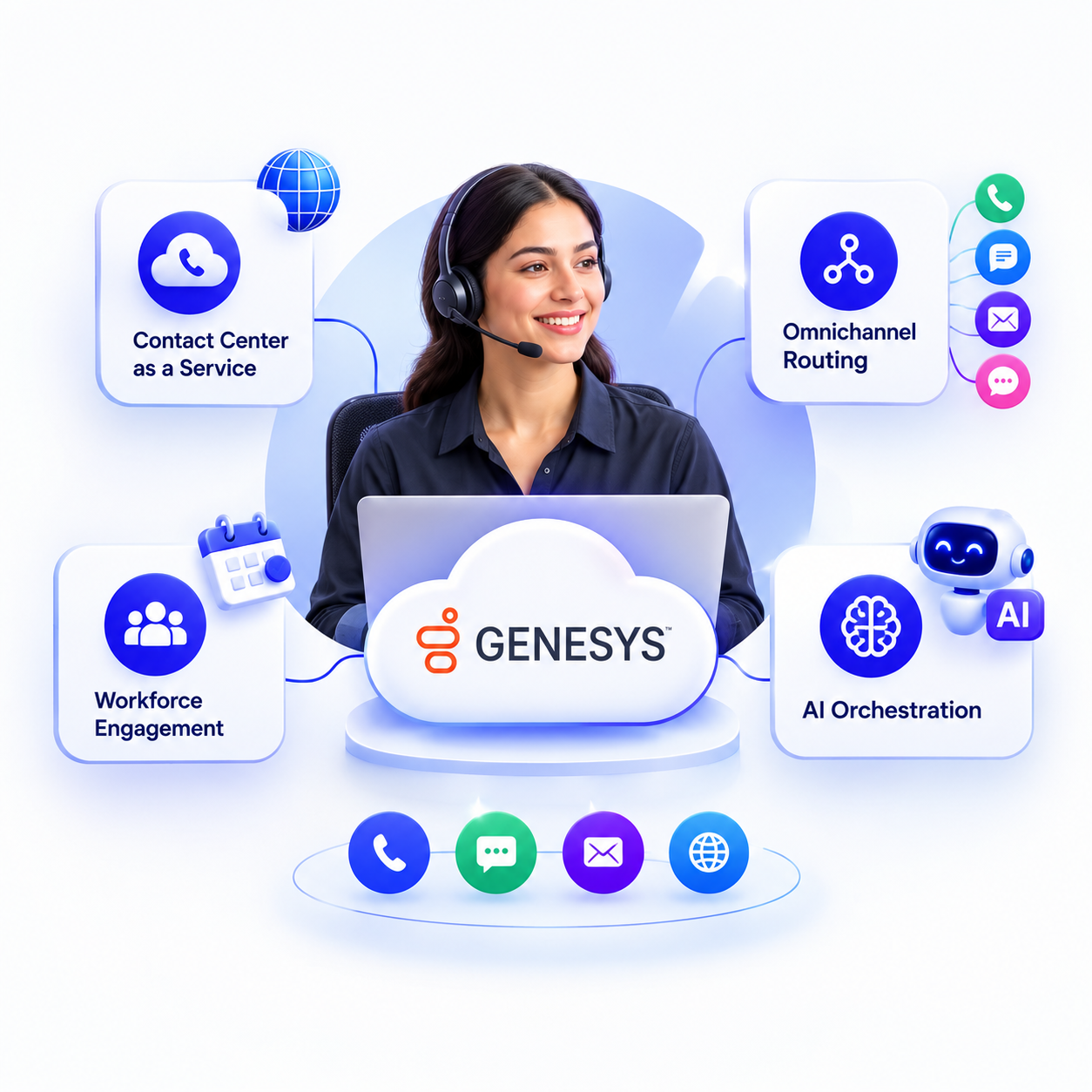
Contact center as a service, routing, workforce engagement, AI orchestration
Four pieces of the platform matter most to buyers.
- First, Contact Center as a Service.
You get global voice service, SIP trunking, and browser-based softphones, so agents can answer or place calls from anywhere they can get online. If you want to see how other vendors compare, read our look at leading CCaaS providers.
- Second, omnichannel routing.
Business rules decide which agent gets each request, and inside the Architect flow designer, administrators build logic trees that look at caller history, language, and the reason for the call. Calls, emails, and chats all share one queue, which means less waiting around and fewer blind transfers.
- Third, workforce engagement.
Managers can forecast call volume, build shift schedules, and grade calls with built-in scoring forms.
- Fourth, AI orchestration.
Bots and people share the work, while machine learning picks up on a caller's mood, transcribes speech as it happens, and nudges agents toward good answers.
Genesys Products Explained
The catalog makes more sense once you see how it divides by deployment type, because Genesys used to sell software that ran on your own servers and now puts most of its energy into the cloud.
Genesys Cloud CX
- What is Genesys Cloud CX? It is a platform built on AWS from small, modular services, and you may remember its earlier name, PureCloud. Many customers share the same platform, and it moves millions of calls every day.
- The modular design pays off in updates, which land every week with no planned downtime.
- Open REST APIs let your engineers connect internal tools to the system, and the AppFoundry marketplace offers hundreds of tested connectors for CRMs, data warehouses, and desktop widgets.
Genesys Engage (legacy on-prem) and the migration path
What is Genesys Engage? It is the older on-site system that Genesys sold for years as PureEngage, and it handled huge call centers with heavily customized phone setups.
- Running physical servers is very expensive, and hence Genesys would like to see its customers switch from running physical servers to Genesys Cloud CX.
- The switch takes real effort, because your team must rebuild routing trees, transfer years of call data, and retrain the agents. Plenty of firms look at other options before they commit.
- These top Avaya alternatives and competitors can help you decide whether a full rebuild is worth it or a lighter cloud step will get you there faster.
Genesys AI / agentic capabilities
Now, what is Genesys AI, and where do its limits sit? The platform covers predictive engagement, conversational voice bots, and automatic call summaries.
Here is the catch. Most CCaaS AI works to assist human agents rather than replace them; hence, when asked to resolve a complicated multi-step ticket on its own, it will often stall.
A typical bot will be able to answer basic questions, collect routing information, and transfer the customer to an agent.
Agentic platforms like Thunai aim higher by working across your business software, pulling data from your systems, and finishing tasks with no human involved.
Genesys Cloud CX Pricing
Everyone wants to know what Genesys pricing is for named and concurrent seats, and the short answer is that it is a subscription sold in four tiers.
Two rules catch people off guard. First, there is a $2,000 monthly minimum, which shuts out very small teams. Second, you cannot mix tiers on one account, because everyone gets the same base tier and you buy add-ons for individual users.
The cost of a Genesys license should be computed by adding the cost of the license to the cost of phone use.
Concurrent licenses allow shift workers to share a single seat but at an additional cost, with Genesys charging $110 per month for Tier 1 users, $170 per month for Tier 2 users, $230 for Tier 3 users, and $360 for Tier 4 users. Phone usage will incur its own cost.
Who Uses Genesys? Company Size and Industry Fit
What is Genesys customer fit? Start by counting your agents, because the sweet spot runs from about 200 seats up to several thousand, which means large enterprises and the upper mid-market.
Regulation plays a part as well. It is a big reason for Genesys adoption in banking, insurance, telecom, healthcare, and government, since the platform meets standards such as SOC 2 Type II, PCI DSS, HIPAA, and the EU Digital Operational Resilience Act.
If you want a broader look at the field, try this guide to the best enterprise contact center solutions.
Genesys Pros and Cons (From Real Reviews)
When it comes to reviews about what Genesys is, the results appear to be somewhat conflicting, with G2 awarding Genesys Cloud CX 4.4/5 based on over 1,500 reviews and Gartner Peer Insights awarding the same product 4.6/5 on 1,100 reviews.
Cite G2 / Gartner Peer Insights ratings and verbatim user quotes
Supervisors like the stability, the phone reliability, and the big AppFoundry catalog. One verified enterprise user on Gartner Peer Insights put it this way:
"First and foremost, I love the Genesys community. It is fun and engaging, and I have found more answers searching their message boards than trying to Google answers... All the different paths of communication all in one platform. The amount of additional apps that we can hook into our Genesys platform extremely easily from the AppFoundry."
The complaints are just as clear: since admin work is heavy, the learning curve is steep, and the reports feel rigid, and on G2 administrators say that custom metrics take advanced data skills. Another verified Gartner reviewer wrote:
"Dislikes: Back office capabilities, along with a lack of heavily integrated workforce management and reporting capabilities."
Genesys vs. NICE CXone vs. Five9 vs. Amazon Connect
The people asking what Genesys is want to see it compared to its competition, which is understandable because every competitor in the industry is playing its own game.
- NICE CXone: The closest competitor for large-scale projects with comprehensive workforce management capabilities and compliance scores using its Enlighten AI system, but with difficult pricing, lengthy rollout periods, and a cluttered interface.
- Five9: Designed to handle heavy outgoing call volumes using its predictive dialer, keeping agents on the phone, while its inbound processes aren’t as customizable as Genesys Architect.
- Amazon Connect: You pay by the phone minute instead of the seat, and it connects deeply with AWS Lambda and Bedrock, but even a basic queue takes real engineering time. See this overview of what is Amazon Connect.
- Thunai: An agentic AI layer that sits on top of your phone system, so your switches stay in place. It goes live in under two days, resolves up to 80% of routine Tier-1 requests, and cuts handle times by 70%.
Genesys versus Amazon Connect boils down to a single question: do you want packaged software or raw cloud APIs?
Genesys Alternatives Worth Considering
More buyers are now researching what is Genesys alternatives want AI that actually resolves issues, which a bigger suite does not do, and you do not always need a new phone carrier to clear a productivity bottleneck.
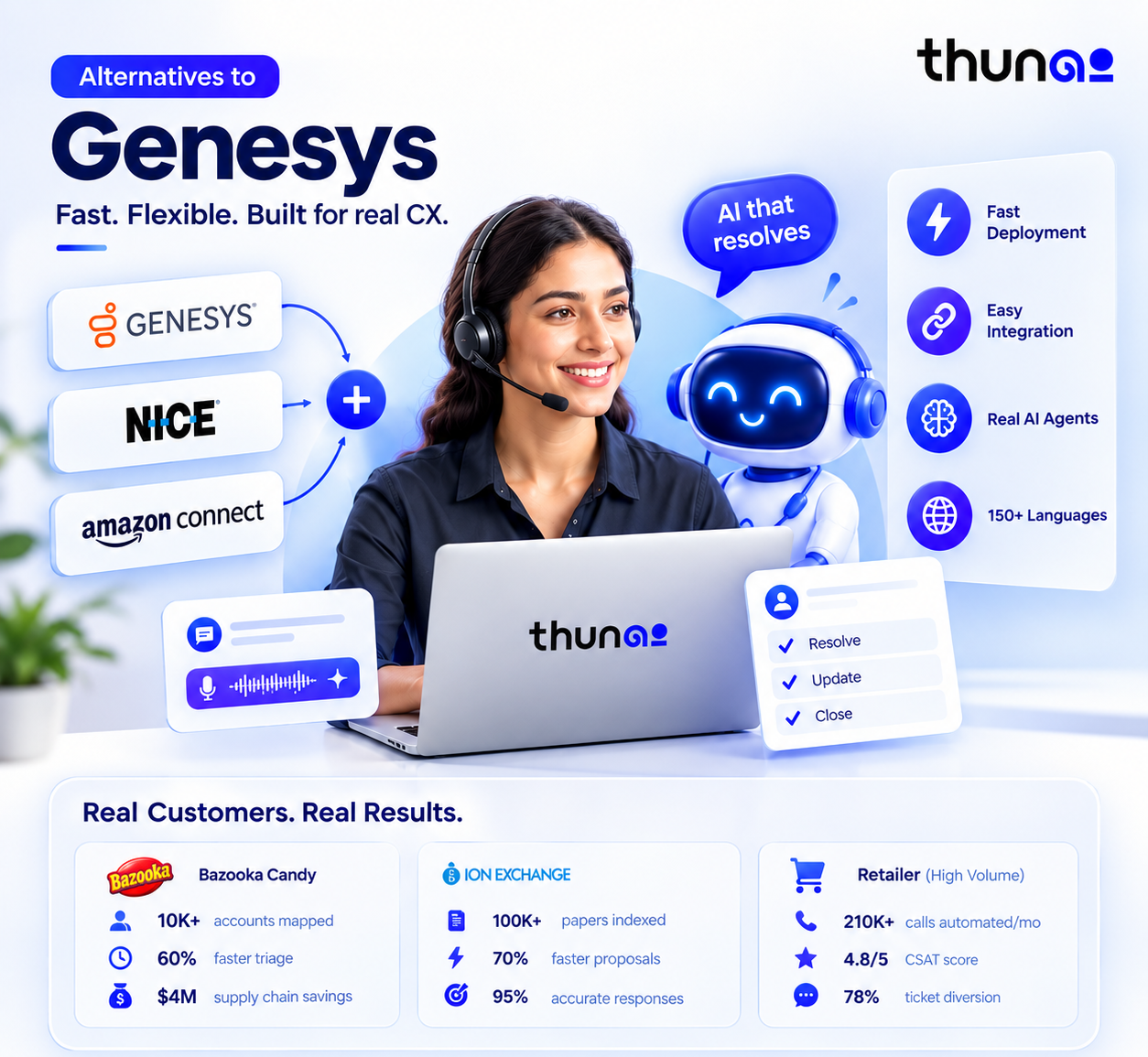
Thunai is one quick route, because CCaaS upgrades often eat months of pricey integration work while Thunai sits on top of Genesys, NICE, or Amazon Connect and can go live in under 48 hours. Check Thunai's plans and pricing, and if you want to know how it stays current with live data, read this Confluent write-up.
Here is what customers have seen:
- Bazooka Candy mapped more than 10,000 commercial accounts with Thunai, cut ticket triage time by 60%, and spotted $4 million in projected supply chain savings.
- Ion Exchange indexed more than 100,000 technical papers, generated proposals 70% quicker, and responded accurately to 95% of the technical questions.
- A high-volume retailer automated over 210,000 phone calls per month, maintained a CSAT score of 4.8 out of 5, and diverted 78% of the repeated ticket calls.
Thunai pulls your scattered knowledge into one place called the Thunai Brain. Its voice, chat, and email agents speak more than 150 languages while they issue refunds, update account records, and close issues on their own.
When a person takes an escalated call, Thunai listens in, suggests prompts, and writes the post-call summary, which cuts handle times by 65%.
Ready to make your contact center more autonomous?
See how Thunai works with Genesys and your existing systems to automate routine support, resolve Tier-1 requests, and help agents handle complex conversations faster.
FAQs
Is Genesys considered a CRM or a CCaaS platform?
It is a CCaaS platform, not a CRM. Tools like Salesforce and Microsoft Dynamics hold account history, deals, and contact records. Genesys handles the phone and chat side by routing calls, managing chats, and running queues. It then connects to your CRM to log calls and show customer details on the agent's screen.
Can Genesys completely replace an enterprise office phone system?
Yes, because Genesys Cloud CX can replace on-site PBX switches and business phone systems. You can port your current numbers to Genesys Cloud Voice, or you can bring your own carrier over SIP trunking and keep your contracts as they are.
What separates Genesys Cloud CX from Genesys Engage?
Engage is the legacy option that runs on your servers or a private cloud, which means you handle the upkeep and upgrades. Cloud CX is a shared SaaS platform on AWS that comes with weekly updates, public REST APIs, and one web admin screen.
How does concurrent agent licensing work in Genesys?
Agents who work different shifts share one license, and each concurrent license costs roughly 40% to 50% more than a named license ($110 versus $75 for Tier 1). Even so, a 24/7 center can come out ahead, since three agents on three shifts can use a single license.
Does Genesys support integrations with Microsoft Teams and Salesforce?
Yes, and both sit in the AppFoundry marketplace. The Salesforce tool puts call controls right inside the Salesforce screen, and the Teams connector shows who is available, lets agents pull in experts, and moves calls between departments.
How long does a typical migration to Genesys Cloud CX take?
Most moves from old PBX hardware run between 6 and 12 weeks, and that time covers rebuilding call flows in Architect, setting up carrier SIP, testing CRM links, and training agents.
What artificial intelligence tools are included in Genesys Cloud CX?
You get Predictive Engagement, which offers proactive chat to site visitors, along with voice and chat self-service bots, call transcription, and sentiment scoring. Agent Copilot also suggests knowledge articles during live calls.
Can enterprises deploy Thunai on top of an existing Genesys contact center?
Yes. Thunai works with Genesys Cloud CX and older phone switches, so there is no carrier change. It connects through standard SIP and APIs to resolve routine Tier-1 issues on its own in more than 150 languages.