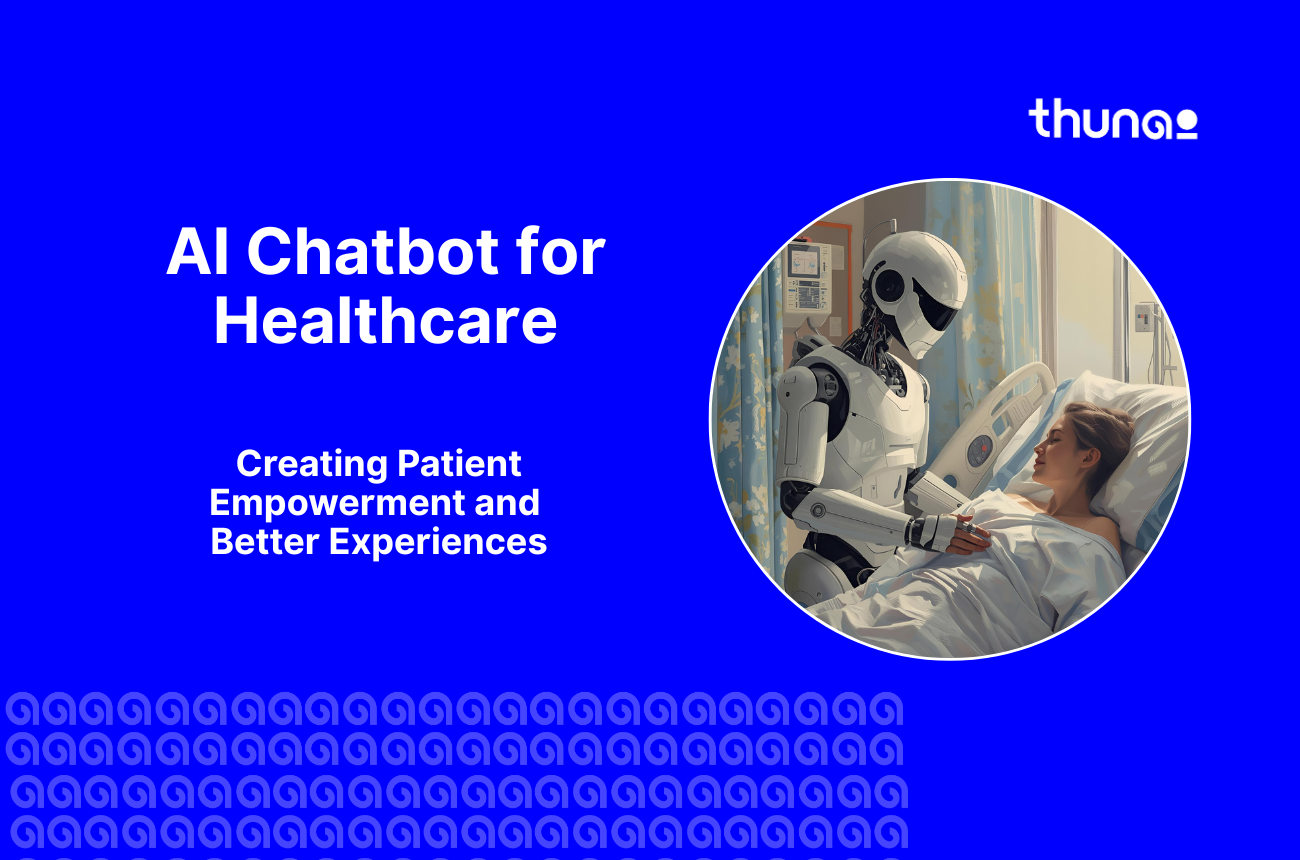

Is patient access hard, and admin work too heavy? Do you face challenges with all-day support?
A smart plan would be using AI to help! This works for both clinical and office jobs with AI healthcare chatbots using advanced NLP tools to understand patient questions, not just sticking to strict scripts.
AI Chatbots give a real way to lower team stress - for better patient access
Newer AI chatbots for healthcare, like Thunai, do A LOT more than simple bots!
They understand what patients need, book visits, collect facts (Even handling almost one third of normal messages) - here’s what you need to know about them to automate clinics and healthcare practices.
Understanding AI Healthcare Chatbots
AI chatbots in healthcare act as smart digital helpers.
AI healthcare chatbots use advanced Machine Learning, making sure to communicate just like humans. They provide quick help and even handle daily office tasks automatically.
The main goal is to make patient interest higher while making office flows smoother.
They act as the first step. They handle the first questions from patients.
Moreover, healthcare AI chatbots stay open 24 hours a day, making care faster and easier to get.
These AI chatbots for healthcare give constant 24/7 support (normal clinics cannot do this). In doing so, this constant access is a key trait that makes using AI chatbots for healthcare a trusted digital partner for healthcare practitioners

Types of AI Chatbots in Healthcare
AI chatbots for healthcare have different jobs. We can group them by how hard they are. We can group them by technology. We can group AI chatbots for healthcare by use, as you typically use different ones for office work and medical consulting.
Key Benefits of Healthcare AI Chatbots
Companies use AI chatbots in healthcare for clear reasons. Here are the main good points of AI chatbots in healthcare:
- 24/7 access and sorting: AI chatbots for healthcare do not sleep. Patients can check symptoms anytime. They can book visits anytime. This speed lowers useless visits. It guides patients to the right care.
- Lower admin workload: AI chatbots for healthcare do daily tasks automatically. This saves time for the team. Doctors can work on hard cases. These cases need human thought or feeling. For example, an AI chatbot checks open slots. It sends instructions later. No human needs to help.
- Better patient interest: Personal notes help patients follow care plans.
- Faster fact-finding: AI chatbots for doctors find patient files fast. They find lab results. They find rule summaries. They ask the records system. This speeds up medical choices.
- Personal care paths: Bots connect with patient files. They change advice based on age. They look at the condition. They look at language. This makes the advice fit better. It helps patients follow rules.
Common Use Cases and Applications for AI Healthcare Chatbots
AI chatbots for healthcare have many jobs in the patient journey:
Using AI for Checking and Sorting Symptoms
Patients describe their symptoms and physical health, and the bot asks questions. The AI chatbots for healthcare may then suggest home care or point them towards meeting a doctor.
Appointment Management Using AI Healthcare Chatbots
Patients can book visits and can change visit timings based on the doctor's availability. They can cancel visits in the chat, connecting with booking tools - even showing available timings and confirming bookings. After doing this, the AI chatbot for healthcare sends automatic invites and notes to the concerned physician.
Medicine Management
Chatbots send dose notes. They check for bad drug mixes. They tell doctors about missed doses. They check if patients follow the rules. This helps get better results.
Patient Intake and Registration Using AI Chatbots for Healthcare
Before a visit, an AI chatbot for healthcare collects health history. After, this it can then asks about allergies and why the patient is visiting. This uses chat forms.
This makes the front desk work shorter. One study says AI agents turn a 15 minute intake into a 2 minute note for doctors.
Chronic Disease Management
AI chatbots for healthcare give ongoing coaching for things like diabetes. They track numbers, send lifestyle tips, and even alert doctors about unhealthy or concerning trends.
This uses constant watching and fixes the holes in planned treatment plans that manual methods can typically miss.
Mental Health Support
AI chatbots for mental health give mental exercises. They track moods. They teach calm techniques. This adds to therapy. Human therapists still have the final say.
Clinical Documentation
Voice agents record doctor conversations and make structured notes automatically - if needed, these also make notes of billing codes.
This saves doctors time, and in doing so, the AI chatbot for healthcare writes and sums up in real time meeting notes in SOAP formatting and even automates clinical documentation.
Post Discharge Follow-up and Health Education
After hospital stays, bots check on healing. They catch problems early.
Automatic checks can lower return visits. They make sure patients follow home rules. AI chatbots for healthcare give custom learning content. They explain conditions. They explain test results clearly.
They answer questions about lab tests. They coach patients on lifestyle changes. They use data from a person's chart. Each use case must meet safety rules. Thunai does this.
AI Chatbots vs Traditional Healthcare Support
We see differences between AI chatbots for healthcare and human support.
- Availability: AI chatbots for healthcare work 24/7. Old support needs staff hours.
- Cost: AI chatbots for healthcare grow cheaply. Human staff costs grow with demand.
- Consistency: Bots give the same info. Humans may change.
- Complex judgment: Doctors make hard choices well. Chatbots do daily tasks best.
- Empathy: Humans give true feeling. Advanced AI chatbots for healthcare can seem kind. But they do not replace human care.
- Compliance and liability: Human support has clear laws. Chatbots bring new rule questions.
Leading groups say chatbots need clear policies. Staff must know which cases are automatic. They must know when bots must stop for humans.
Technology Behind Healthcare AI Chatbots
An AI chatbot for healthcare is a safe AI tool. It runs in a safe cloud. It manages these parts. It gives true support in real time. New healthcare bots combine several different technology:
- Natural Language Understanding NLU: This turns patient text into data, and via this, medical bots learn clinical words (lists like SNOMED CT). This lets the system know the symptoms, treatments, and disease names.
- Knowledge Bases and Medical Ontologies: Safe stores of checked medical facts. These connect to make sure bot answers are medically right. Thunai uses a platform like this. It puts company files into its Brain. This makes sure facts stay the same.
- Large language models LLMs: Healthcare uses strict models to stop fake answers. They use a method called RAG. AI chatbots for healthcare find exact text from trusted sources. Then they use creative models. This agent style answers open questions. The answers are still safe and checkable.
- Connection layers: Software links connect the bot to the records. They connect to booking tools. They connect to video visit tools. The bot can read live data. It can write actions back.
- Analytics and monitoring: This is key to getting better. It tracks success rates. It tracks user happiness. It reviews logs for safety errors. This constant watching keeps quality high.
AI Healthcare Chatbot Set Up Strategy for Healthcare Groups
Experts say that for AI healthcare chatbots, which must be safe, thier process must be explainable. They must be trained for healthcare, and only then should they help facilitate patients' access. Setting up an AI chatbot safely needs a planned path:
- Map Workflows: Understand current steps. Find where the bot will help. Find where it must stop for humans. Decide when a patient must speak to a live person.
- Choose the right technology: Match the bot to the risk. A simple bot works for booking. Use rule logic for health sorting. Do not use open AI for this.
- Connect with systems: Link the AI chatbots for healthcare safely to the records. Link it to booking. Link it to messaging apps. This might use FHIR links, and a proper connection gives the bot the right data context. It can also write back.
- Validate Clinically: Have medical staff check the bot's knowledge. Check the decision logic. Run tests. Compare patient responses. This makes sure it is safe. Fix it based on feedback.
- Pilot and Measure: Start in a small place. Track numbers. Check how many questions the bot answers fully. Check happiness. Check error rates. Check safety issues. Watch for unfair answers.
- Iterate and Expand: Use data to make the bot better. Fix the text tools. Update scripts. Fix holes. Once it is stable, add new uses. Add new departments.
- Train staff and set governance: Teach everyone how the bot works. Teach them its limits. Set up rules for watchfulness. Set up content reviews. Set up plans for errors.
Privacy, Security, and Compliance Considerations
Handling health data means meeting high privacy standards. Here are key guards:
1. Data Privacy
Collect only what is needed. Use codes to lock messages. Use codes to lock databases.
Use strict access rules. Only allowed people can see health data. Require two steps to log in for doctors.
2. Regulatory Compliance
Make sure to follow HIPAA rules in the US. Follow GDPR in Europe.
Get signed agreements with the bot seller. Do formal risk checks. Allow data moving. Allow data deletion.
A safe AI chatbot for healthcare must record logs. It must protect health data.
3. Clinical Safety
Clearly state what the AI chatbot for healthcare does. Write down what it will not handle. Do not let it handle emergencies. Always allow an easy switch to humans. Ask if they want a nurse. Review chats often for errors.
A full audit trail is needed. HIPAA rules ask for logs of all data use. Log who asked what. Log what the chatbot said. This lets you check any issue.
4. Bias and Fairness
Test the AI healthcare chatbot with different groups. Test different ages. Test different languages. Check for unequal work. Make sure symptom checks work in all languages.
Update the model to fix unfairness. Studies show AI can show unfair views. Active checks are needed.
5. Transparency
Always tell users they are talking to a bot. Provide a privacy note. Let them leave easily. Let them switch to staff. Rules say accountability must be clear. This builds trust.
6. Vendor Due Diligence
Check the security of outside AI sellers. Check their certificates. Make sure they use safe clouds. Check their plans for data leaks.
These protections are not just legal needs. They build patient trust. Strong rules let AI healthcare chatbots become safe parts of care.
Using Thunai AI Healthcare Chat and Voice Agents
Thunai’s AI agents revolutionize healthcare engagement by autonomously managing voice, email, and chat interactions, making sure no patient query goes unanswered while drastically reducing administrative strain.
More importantly, Thunai automates patient note-taking and updating notepads and EHR records accordingly:
- Intelligent Triage and Empathy: Thunai Omni uses real-time sentiment analysis to detect distressed patients instantly, allowing staff to prioritize urgent cases while the AI handles routine scheduling and intake.
- Unified Clinical Intelligence: The Thunai Brain ingests and organizes fragmented files—from insurance policies to patient records—creating a single, secure "source of truth" that clinicians can query instantly.
- Safety and Human Oversight: To make sure there is a reliable experience and compliance, safety, the "barge-in" feature allows human agents to monitor live AI conversations and instantly take control if a complex medical judgment is required
Want to know more? Try Thunai for free!
FAQs on Healthcare AI Chatbots
What is an AI Chatbot in healthcare?
An AI chatbot for healthcare is an intelligent AI-powered assistant. It uses machine learning to communicate like a human and provide quicker help. It does office tasks automatically all day.
Are AI healthcare chatbots used for diagnosis?
AI chatbots for healthcare can give health help like Thunai. They can sort urgency. They suggest next steps. They do not replace a final answer from a doctor, doctors always approve and go over the final answer.
What are the main benefits of using AI healthcare chatbots?
Patients get access all day. Staff have less office work. This frees them for hard tasks mking communication more personal and allowin makes patient interest higher.
What is the biggest risk of using AI chatbots in healthcare?
Clinical safety is a risk. Data security is a risk. Rules must govern AI healthcare chatbots. This stops fake info and they must follow laws like HIPAA to lock patient data.
How do AI chatbots in healthcare handle patient data?
AI chatbots for healthcare use safe connection layers. These link to the health record. All data uses strict locking codes. Access is controlled. Audit trails exist. This follows the better compliance and data privacy.


.png)