
The core focus of healthcare should be on patients, not administrative tasks.
But the fact is that hospital leaders face growing stress, costs are going up, staff is constantly tired, and moreover, administrative work can get too difficult to manage.
AI for clinicians can help smooth this out and make workflows easier…
Meaning, doctors get back precious time, hospitals work better, and care quality improves as well. AI medical tools make this possible, and here’s how…
What Is AI for Clinicians?
AI for Clinicians refers to artificial intelligence technology that assists doctors in automating administrative work, decision-making, and the patient treatment process.
Different from traditional health care systems, current AI agents are not just managing the data; they are performing the job for the clinician.
These systems can:
- Generate SOAP notes during consultations
- Retrieve patient history from the EHR
- Identify potential drug interactions
- Complete prior authorization requests
- Schedule appointments automatically
- Send follow-up reminders and patient education
- Surface relevant clinical guidelines during consultations
Since AI does not replace any existing healthcare system but just integrates with it, AI agents minimize administrative work and enable clinicians to concentrate on other critical activities.
The Growing Role of AI for Clinicians
- AI is now a main part of medicine. Staff shortages and too much paperwork push this change.
- Agentic AI for doctors and clinicians' first job is to help doctors.
- It manages repeated, routine tasks.
- This lets them spend more time talking to patients and makes care more human.
- This bigger work capacity results in good patient results with fewer patient readmissions.
- The FDA has said yes to over 1,200 AI/ML medical devices since 1995. This proves AI's quickly growing and important part in diagnosis help and decision support.
How to Use Thunai (AI for Clinicians) in Your Practice for Better Outcomes
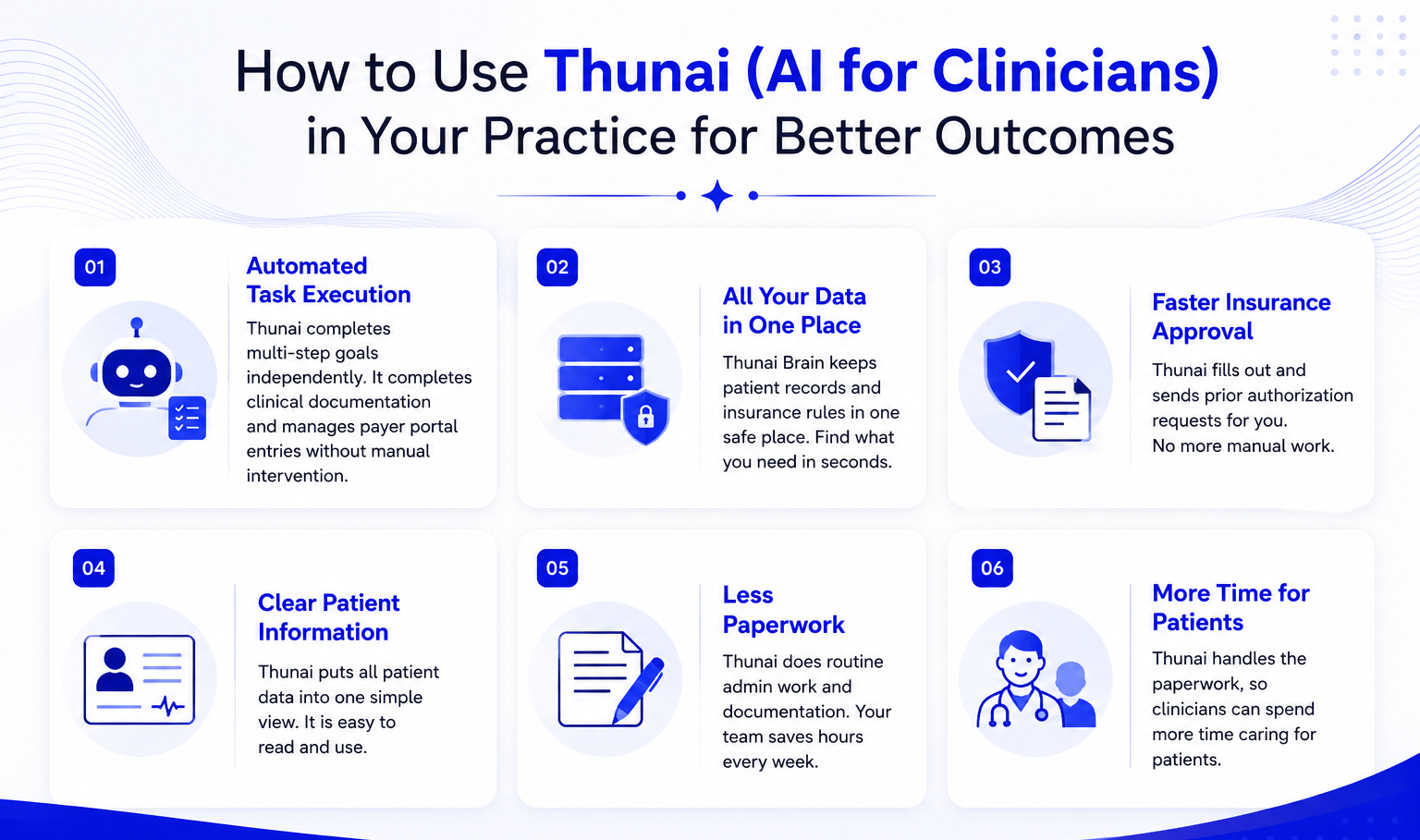
- Automated Task Execution: Thunai completes multi-step goals independently. It completes clinical documentation and manages payer portal entries without manual intervention.
- All Your Data in One Place: Thunai Brain keeps patient records and insurance rules in one safe place. Find what you need in seconds.
- Faster Insurance Approval: Thunai fills out and sends prior authorization requests for you. No more manual work.
- Clear Patient Information: Thunai puts all patient data into one simple view. It is easy to read and use.
- Less Paperwork: Thunai does routine admin work and documentation. Your team saves hours every week.
- More Time for Patients: Thunai handles the paperwork, so clinicians can spend more time caring for patients.
Want to see an AI that works for Clinicians in Acton? Book a free demo call!
5 AI Workflow Areas Transforming Medical Practices in 2026
AI in healthcare has evolved past simple text generation. Today, agentic AI takes independent action to manage complex administrative tasks. Medical practices use these tools across five core operational areas to reduce costs and eliminate staff burnout.
Clinical Workflow and Time Savings Overview
#1: AI Medical Scribe — The Biggest Time Saver
In 2026, the AI medical scribe represents the most rapidly growing use case of clinical AI.
The traditional dictation tool just turns doctors' speech into text; the doctor himself has to make sense of it all.
Ambient AI scribes work differently. They listen to the natural conversation between a doctor and a patient, understand the medical context, filter out small talk, and automatically generate structured SOAP notes.
The operational impact of this technology is immense:
- The Permanente Medical Group conducted a large-scale study showing that ambient AI saved 15,791 hours across 7,260 physicians in a single year.
- Prior to the use of AI, studies have found that up to 69% of physicians’ time was spent on after hours EHR activity.
- Among popular AI products are those that perfectly integrate with leading Electronic Health Record (EHR) software such as Epic, Cerner, athenahealth, and NextGen.
Platforms like Thunai Reflect act as a silent clinical partner. Thunai uses advanced voice AI
and screen sharing capabilities to build accurate clinical records in real time. Doctors simply review, edit, and sign off on the note immediately after the consultation.
Top market tools like Freed, DeepScribe, Nuance DAX, and Thunai ensure documentation quality improves by 85% to 90%, freeing doctors from hours of typing.
#2: AI for Patient Scheduling & Intake
- The causes of inefficiencies in practice are normally due to bottlenecks at the reception area.
- The web based scheduling and voice agents of AI deal with all the calls from patients throughout the day.
- The scheduling of appointments, sending text messages with electronic intake forms to patients, and filling up of the EHR before the patient visits is done by the system.
The Impact on Attendance: The use of automated and context based reminders using AI reduces patient no-shows by an average of 28%.
Traditional vs. AI-Automated Intake Workflow
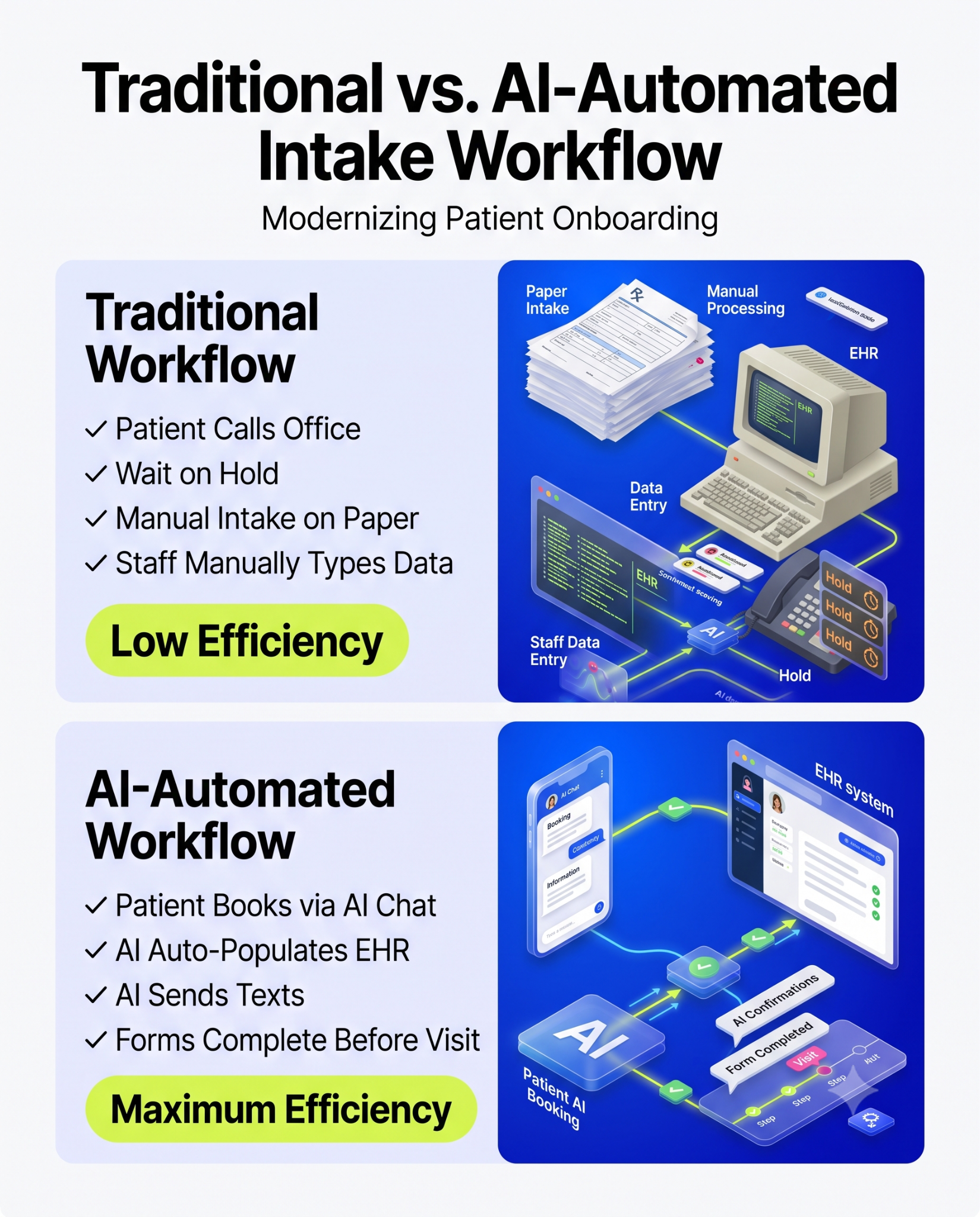
Such systems have the capability of integrating easily with patient portal platforms like Epic MyChart, Zocdoc, and Athena.
#3: Prior Authorization Automation
Manual prior authorizations are one of the biggest pain points for medical practices. In general, it takes more than 2 hours to process a single claim from the clinic's side. It involves looking up the patient chart, accessing the payer portals, and going on hold.
Prior authorization automation powered by AI reduces the time needed for the process to 14 minutes. The AI bot automates 3 key steps:
- Eligibility Checking: Checks insurance guidelines in real-time.
- Documentation Retrieval: Retrieves the required documentation from the EHR.
- Portal Submission: Bypasses payer portal sites and completes the submission.
The automation brings ROI in terms of saved money on administrative personnel ($70k per physician annually).
#4: EHR Data Lookup & Clinical Decision Support
Doctors spend hours searching through old patient records. They look for lab results, specialist notes, and past treatments. This takes time away from patient care.
AI agents make this easy. They find the right information in seconds.
- Tools like Thunai Brain bring patient records and insurance rules into one secure place. During a visit, the AI can quickly show medical history, warn about unsafe drug combinations, and suggest the latest care guidelines.
- Thunai is a service that integrates with the already existing EHR solutions. Thunai is compatible with Cerner FHIR, athenahealth, and eClinicalWorks. Your team will get the information it needs without altering the existing system.
#5: AI for Patient Communication & Follow-up
The care mustn’t stop once a patient leaves the clinic building. AI-powered patient communications platform automates after visit communications. It sends automated discharge information, monitors patients' recovery, and controls medications reminders.
- Better Patient Care: Medication adherence is increased by 34% through the provision of automated follow ups.
- Global Accessibility: These solutions overcome any form of language barrier as they interact in more than 150 languages.
- Safety Features: Platforms like Thunai feature live monitoring dashboards. If a patient describes severe or complex symptoms to the chatbot, human staff can step in and take control of the conversation immediately.
HIPAA, HITECH & ONC Compliance for Clinical AI
The critical issues while buying AI tools for clinical use are safety and compliance. It is essential to ensure that the chosen AI vendor has signed the Business Associate Agreement (BAA) and operates data securely.
Moreover, AI providers need to be compliant with the ONC information blocking policy. Finally, with the new EU AI Act, medical AI systems are deemed high risk, and thus need rigorous testing.
Compliance and Security Checklist
Implementation Guide: How to Add AI to Your Practice
Moving on to the agent AI does not have to be a hindrance for your practice in the clinic. A phased approach is guaranteed to ensure smooth adaptation and quick ROI.
5 Step AI Deployment Process
- Step 1: Identify Burdening Workflows.
- Conduct a quick time audit.
- Check whether your employees spend more time on documentations of patients or prior authorizations.
- Step 2: Determine HIPAA Compliant Vendor.
- Check to ensure the vendor is authorized for security concerns and BAA integration.
- Step 3: Pilot with One Use Case.
- Do not launch everything at once. Start with a single pilot group using an ambient AI scribe.
- Step 4: Integrate with the EHR.
- Connect the software using standard medical APIs to allow auto population of clinical fields.
- Step 5: Train Staff and Evaluate ROI.
- Train healthcare practitioners about the process of reviewing AI notes. Calculate the time saved during 90 days.
ROI: What Results Can Medical Practices Expect?
Adopting medical AI workflow tools yields clear, quantifiable financial and operational advantages:
- Time Saving: The time required for documentation gets reduced by 2.5 hours per day for each doctor.
- Cost Saving: In a 5 doctor office, about $240,000 savings get generated annually due to decreased administrative fat and more efficient staffing.
- Clinical Efficiency Improvement: Prior Authorization processing time gets reduced from 2 hours to 14 minutes and there is 28% decrease in no-show patients.
The broader medical market reflects this shift. The generative AI healthcare market is projected to grow from $3.3 billion to $39.8 billion, showing a 28% compound annual growth rate. AI is no longer an optional luxury; it is becoming a standard partner in modern clinical practice.
FAQs on AI for Clinicians
Is the use of AI clinical applications safe?
Yes. Clinical applications powered by AI are safe for clinical use in cases when mandatory supervision by a human is required. AI technology helps gather data and write the notes, while the licensed clinician is responsible for reviewing, editing, and signing all notes and decisions.
Does Thunai comply with HIPAA?
Yes. Thunai is HIPAA and HITECH compliant. It ensures secure storage of information during its movement and while being stored and executes a BAA with each individual medical practice.
Which EHR systems are integrated by Thunai?
The leading EHR solutions which are integrated to Thunai via API integration include Epic, Cerner, athenahealth, NextGen and eClinicalWorks.
What is an AI medical scribe?
AI medical scribe is a background software application that records physician patient conversation in a secure way. The technology applies natural language processing to separate chitchat from the clinical information and organize it in SOAP notes.




.png)