



Nobody wants to hear "press 1 for billing" anymore.
Callers can tell within two seconds if they've reached a rigid decision tree or something that can actually think.
So what's the real difference between an AI voice agent and an old-school IVR?
Agentic AI takes multi-step actions, like verifying an account and updating a CRM in the same call.
Here are the 8 ai voice agents for contact centers doing that best in 2026.
How We Selected the Top AI Voice Agents
We didn't just watch demo reels. Polished demos flatter every product on the market. So we lined every AI voice agent for contact centers up against six criteria.
These are the things that actually predict whether the best AI voice agent survives contact with real, messy callers:
- Latency and turn-taking. Anything over 800 milliseconds starts to feel broken. Callers talk over a laggy agent within seconds.
- Resolution depth. Can it take real action, like updating an account or booking a slot? Or does it just answer a question and hang up?
- Voice quality and emotion. A flat, robotic tone breaks trust fast. This matters most on a hard, emotional call.
- Integrations and ecosystem. The AI needs to reach your CRM, your phone system, and your helpdesk. Only then can it actually get things done.
- Security and compliance. SOC 2, HIPAA, and GDPR aren't optional once you handle regulated calls
- Governance and auditability. Buyers are moving from chasing deflection to proving resolution. A platform that can't show you what it did on a call is a real risk.
Comparison of Top AI Voice Agents in 2026
Before the deep dives, here's the full top ai voice agents for contact centers' lineup side by side.
8 Top AI Voice Agents for Contact Centers in 2026
Here's the full breakdown, tool by tool. We cover the features, pros, and cons that matter most once you're past the sales deck.
1. Thunai AI
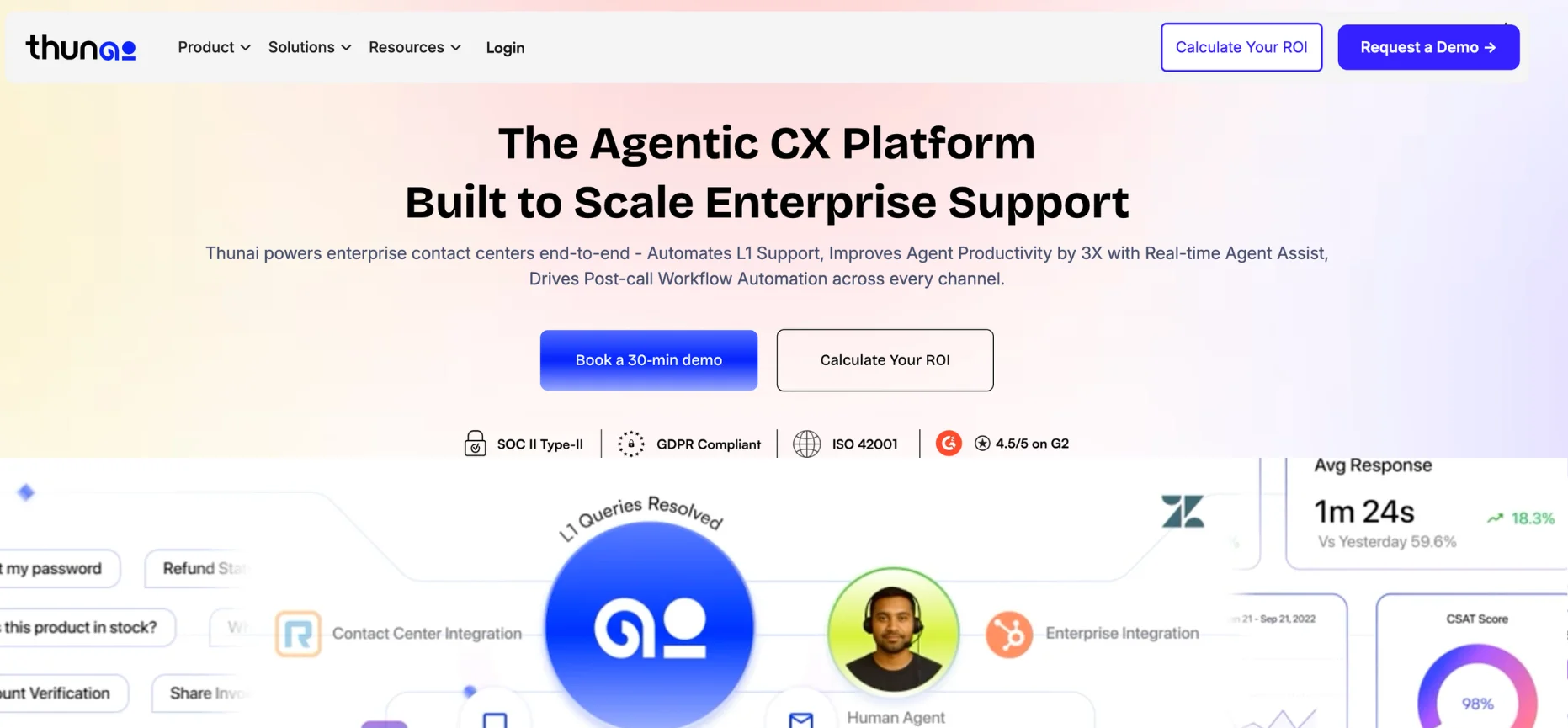
Thunai acts like a digital coworker, not a script reader. Thunai’s ai voice agents for contact centers join the ticket lifecycle before, during, and after the call to actually resolve the request.
Aside from being one of the best AI voice agents for contact centers, Thunai is also capable of automating all L1 support with AI voice, chat, and email agents.
Not to mention it comes with AI voice agents capable of screensharing - meaning automating L1 is a lot easier.
Features:
- Thunai Brain. A live, constantly updated knowledge system that pulls from every paper, ticket, and past talk to keep agents grounded in the right answer.
- Real-Time Agent Assist. Listens across voice and digital talks at once, surfaces exact policy terms and upsell cues, and cuts out the need to place a customer on hold to go hunting.
- Thunai Omni: Thunai has a no-code AI agent platform that allows you to build AI voice, chat, and email agents with low-latency responses.
- 100% Call Scoring + QA: Thunai captures your conversations in real time to help score all calls in one unified dashboard. With this, you can also add scoring criteria based on your own internal SOPs and compliance protocols.
- Automated post-call workflows. Writes the summary, updates the CRM, and assigns follow-ups the second the talk ends, cutting out manual after-call work.
Pros:
- It resolves 60 to 95 percent of Tier 1 requests on its own. A 0.8-second resolution time means callers rarely feel stuck in a queue.
Cons:
- Heavy accents or very fast speech can still cause small transcription slips. These need a quick manual check.
2. Amazon Connect
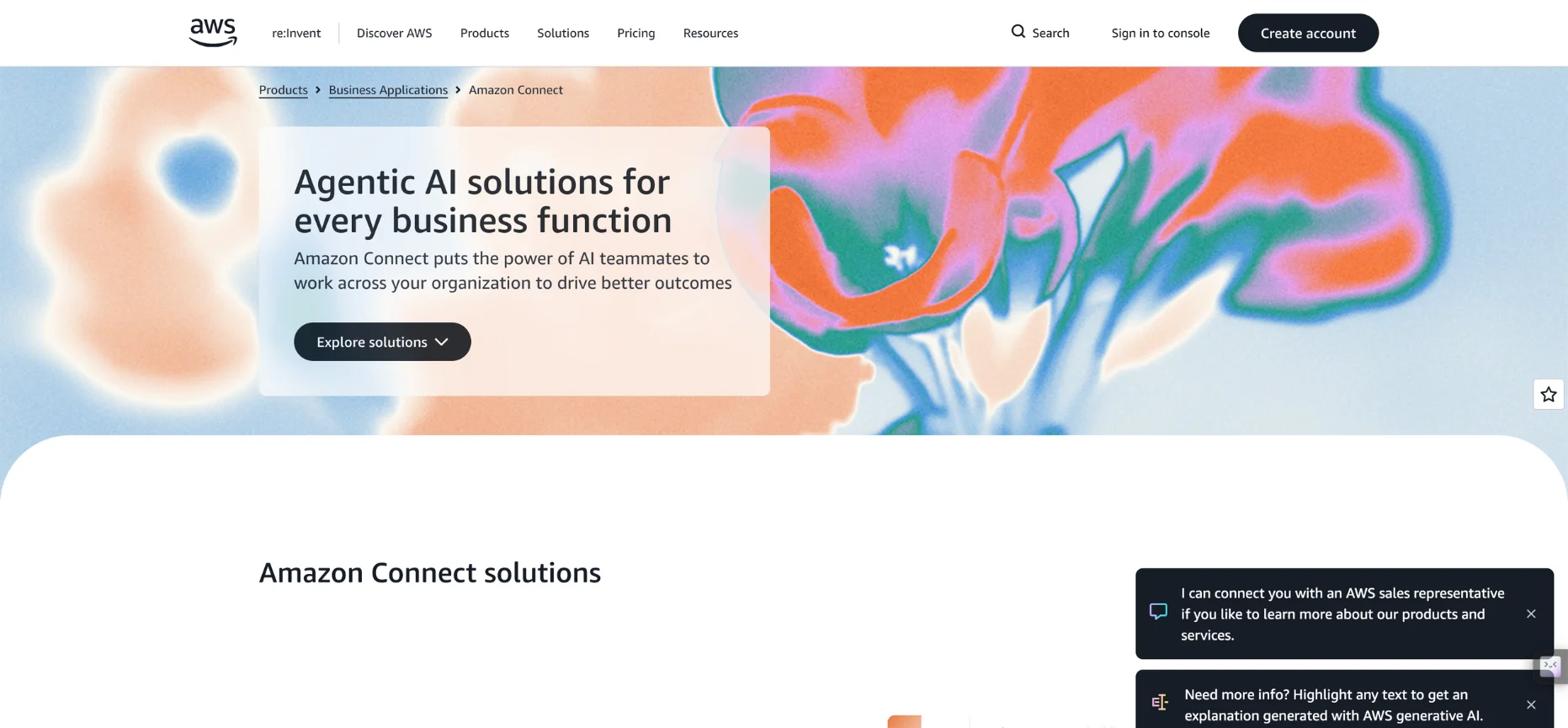
Amazon Connect skips hardware and long carrier contracts. These AI voice agents for contact centers run on a pure pay-as-you-go AWS model built for engineering-heavy teams.
Amazon Connect leans on Amazon Lex for its language layer. So the AI is only as good as the AWS setup around it.
Features:
- Contact Lens analytics. Real-time speech analytics, sentiment scores, and automatic call tagging.
- Amazon Lex. Natural language understanding plus dynamic self-service IVR.
- Deep AWS extensibility. Lambda, DynamoDB, and S3 let you build custom backend logic.
Pros:
- Scaling is nearly limitless, with no seat licenses. The browser-based agent workspace, built on WebRTC, stays stable.
Cons:
- The learning curve is steep. You need dedicated AWS-certified developers to build past the basics.
- Cost gets hard to track fast. Telephony, storage, and Lex fees stack up on one AWS bill, a much messier picture than Thunai's flat rate.
3. ElevenLabs (ElevenAgents)

ElevenLabs built its name on the most realistic synthetic voice on the market. Then it pivoted that engine toward full contact center automation.
If brand voice matters more than deep operational tools, this platform for ai voice agents and contact centers gets you there fastest.
Features:
- Flash v2.5 model. Voice synthesis latency as low as 75 milliseconds.
- Proprietary turn-taking. It detects pauses and breath sounds to handle interruptions well.
- Baked-in RAG. Upload a knowledge base directly, plus zero-shot voice cloning for brand-specific voices.
Pros:
- The audio realism leads the industry, across 5,000-plus voices and 70-plus languages.
Cons:
- Billing runs on characters, which causes real "credit burn." Users report live costs running close to three times the advertised rate.
- It lacks native contact center tools. CRM and phone system links still need custom builds, unlike Thunai's ready-made CCaaS connections.
4. Genesys Cloud CX
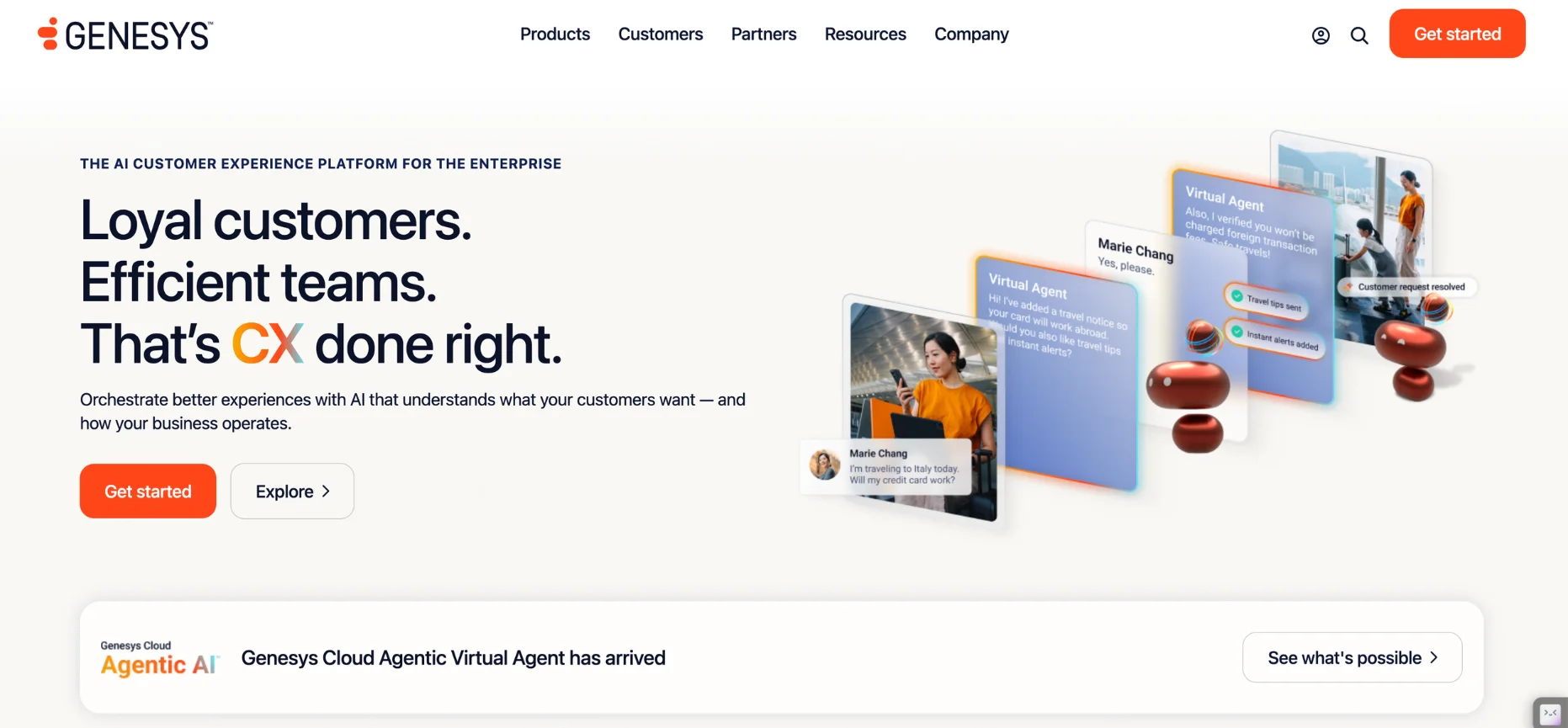
Genesys is the legacy heavyweight that made the jump to true cloud-native. This set of ai voice agents for contact centers is built for Fortune 500 floors that need massive scale and deep workforce tools.
Few platforms pack in this much depth in one suite.
That's also why it's so hard for a small team to learn.
Features:
- Architect. A visual flow builder for complex routing across voice and digital channels.
- Agent Copilot. Real-time knowledge and guided responses.
- Native Workforce Engagement Management. Scheduling, coaching, and compliance checks in one place.
Pros:
- It's an all-in-one suite covering routing, IVR, workforce tools, and analytics, with rock-solid stability at scale.
Cons:
- The "AI Experience Token" system is opaque. Heavy AI use can balloon costs fast.
- Setup takes months and needs dedicated IT staff. That's a lot of tool for a mid-market team, next to Thunai's much faster rollout.
5. Synthflow
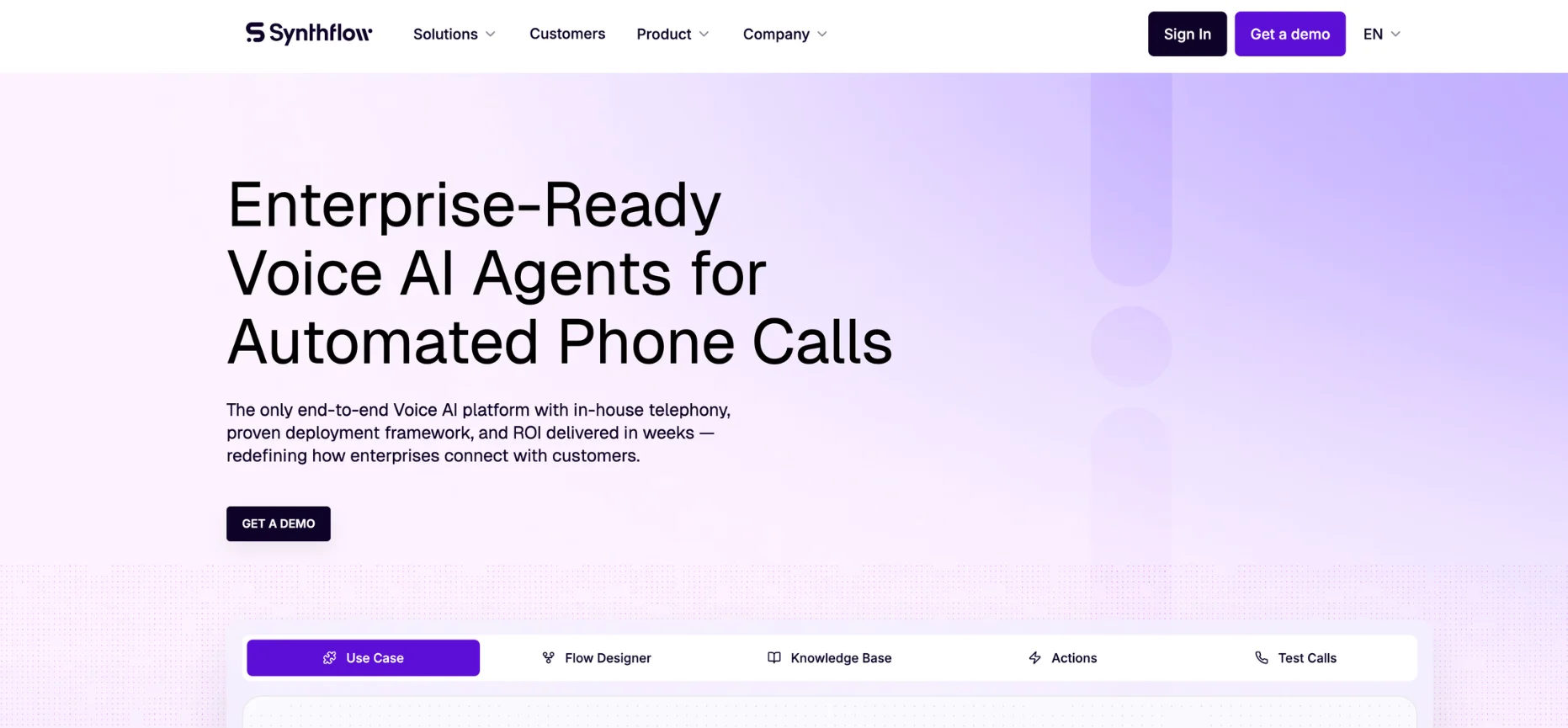
Synthflow goes after the other end of the market. These ai voice agents for contact centers give non-technical teams a no-code way to launch a working voice agent in under an hour.
Marketing agencies like it because they can resell voice AI to their own clients under their own brand.
Features:
- A drag-and-drop builder. Build prompts, routing logic, and webhook links visually.
- Deep white-labeling. Custom domains plus built-in reseller billing for agencies.
- Native integrations. GoHighLevel, HubSpot, and Salesforce for booking and CRM updates.
Pros:
- It's genuinely fast for SMBs and agencies with no engineering team.
Cons:
- Rigid logic hits a hard wall on complex, multi-turn talks. This can cause "voice drift" back toward robotic phrasing.
- Per-minute fees add up fast at high volume. Limited local number coverage can mean pricey upgrades for global teams.
6. IBM Watson (watsonx Assistant)
IBM basically built enterprise conversational AI a decade ago. Watsonx is made for teams that need full data control above all else.
Banks, hospitals, and government agencies use these ai voice agents for contact centers because it can run entirely on their own systems if that's what compliance needs.
Features:
- Hybrid NLU plus generative LLMs. Fixed dialogue rules plus complex backend workflows.
- On-premises or private cloud deployment. Via RedHat OpenShift, so sensitive data stays off the public internet.
- watsonx. governance. An automated risk log that tracks bias and data sources for audits.
Pros:
- It's the gold standard for compliance, oversight, and legal protection in regulated fields.
Cons:
- The learning curve is genuinely steep, and voice latency lags behind platforms built just for voice.
- Heavy reliance on IBM consulting for setup drives total cost way higher than Thunai's self-service model.
7. Cognigy
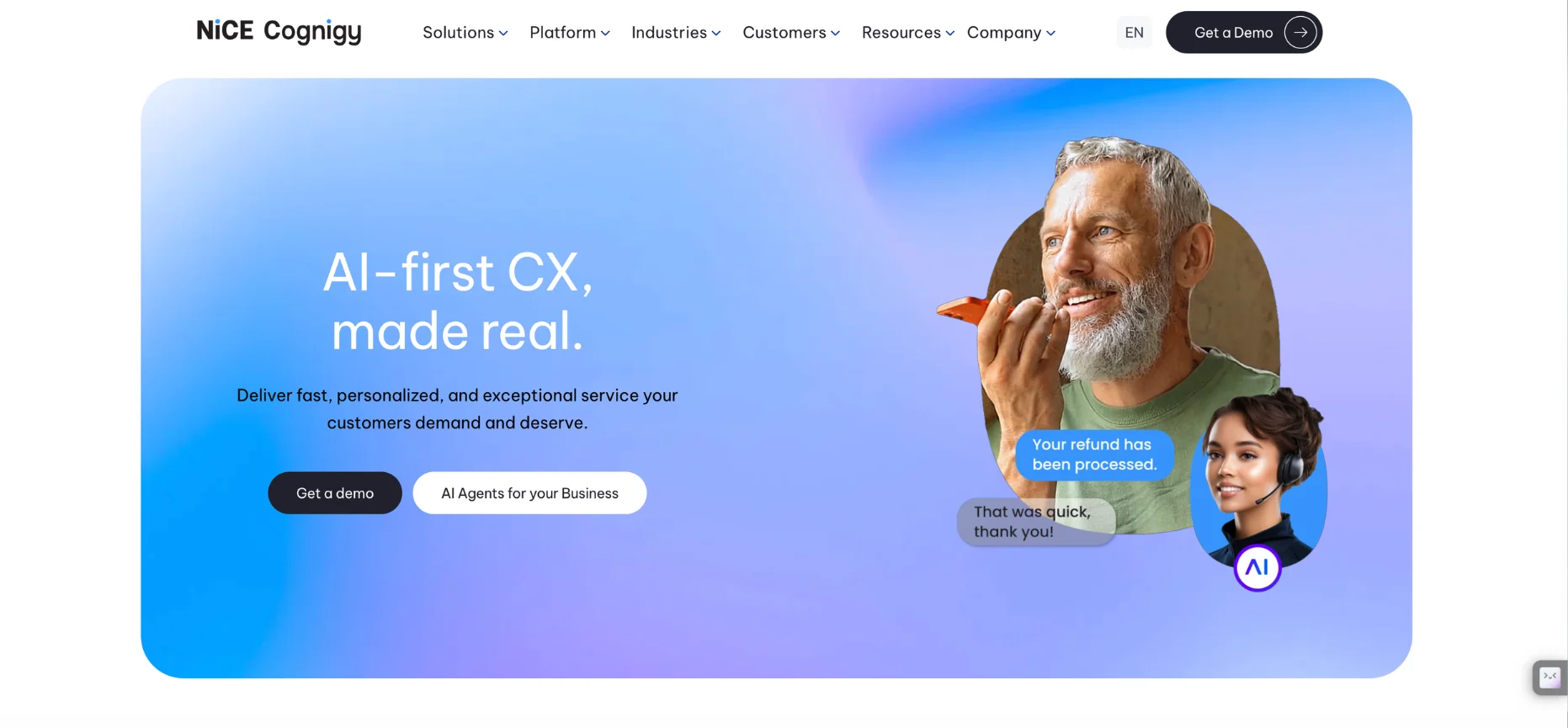
Cognigy, now owned by NICE, is built for the biggest global floors on earth. Think tens of thousands of calls at once, without a hitch.
Airlines and global banks reach for it when nothing smaller can handle the volume.
Features:
- A Voice Gateway. Sub-500ms latency even at massive scale.
- A Hybrid NLU Engine. Fixed logic blended with generative fluency.
- A Human-in-the-Loop Handover Node. Passes full call context to agents on transfer.
Pros:
- Latency and stability are excellent at scale. Real deployments handle millions of calls a year.
Cons:
- Total cost can cross $700,000 in year one, once you add licensing, services, and staff.
- It's a "blank canvas" build. You need certified developers, a much heavier lift than Thunai's ready-made agents.
8. Google Cloud Contact Center AI (CCAI)
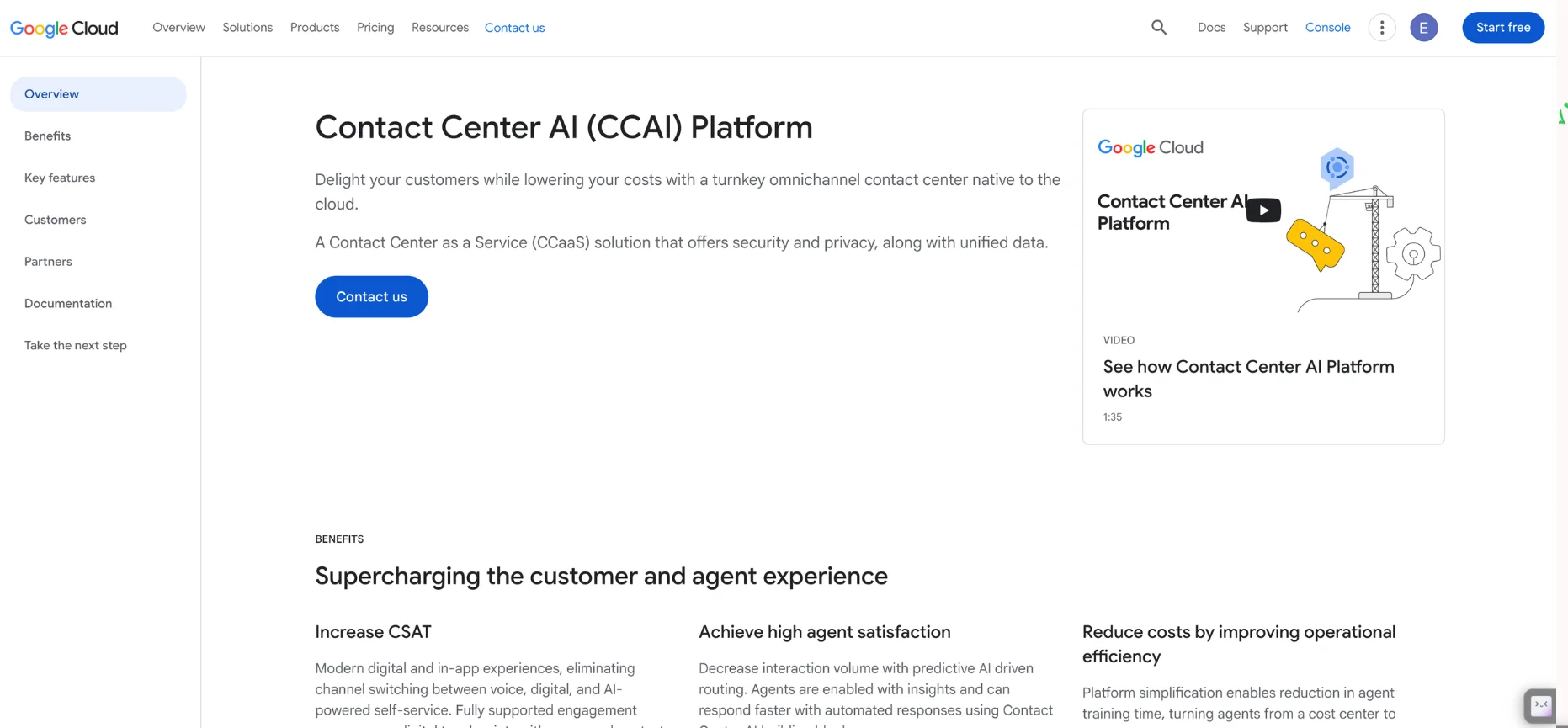
Google's Dialogflow CX now anchors its wider CCAI suite. It's built for engineering teams that want deep, native ties to Gemini and Vertex AI.
This set AI voice agents for contact centers rewards a team that already lives in Google Cloud, and it's harder on one that doesn't.
Features:
- Generative Playbooks. Gemini handles open-ended reasoning next to fixed flows.
- Vertex AI Search. Enterprise RAG grounded in your own data and documents.
- A state-machine setup. Built for tightly structured, multi-turn talks.
Pros:
- NLU accuracy leads the industry. Infrastructure auto-scales and is backed by Google's SLAs.
Cons:
- The developer experience feels split across separate tools for voice, RAG, and flows.
- Billing runs per request, which makes budgets hard to predict for busy bots, a far less steady model than Thunai's flat pricing.
Also worth watching: Five9. It rolled out its own agentic AI Agents suite in 2026. It's worth a look if your team is already deep in that ecosystem.
How to Choose the Best AI Voice Agent for You
Picking the right ai voice agents for contact centers isn't about finding the single best platform on paper. It's about matching the tool to how your team actually works:
- Developer-heavy teams with strong engineers should look at Amazon Connect or Google CCAI for raw, buildable infrastructure.
- Enterprises already deep in a CCaaS stack get the smoothest handoffs from Thunai, Genesys or Cognigy, though vendor lock-in is real.
- Highly regulated industries like banking, healthcare, or government should look at IBM WatsonX for private, on-site deployment.
- SMBs and agencies that want speed without code should start with Thunai or Synthflow.
- Teams that want a clear, resolution-first layer that deploys fast and can prove its own work belong with Thunai.
AI Voice Agent Trends in 2026
From Deflection to Resolution
The old scoreboard for the best ai voice agents for contact centers measured how many calls a bot kept away from a human. That's over now. Salesforce data shows 30 percent of service cases were solved by AI on their own in 2026.
That number is set to hit 50 percent by 2027. And 89 percent of service pros say AI is lifting self-service resolution rates. What this means for buyers: ask every vendor for their resolution rate, not their deflection rate, before you sign anything.
Governance Is the New Gate
As AI voice agents for contact centers takes on more of the live call, leaders feel real pressure to prove what it did. Gartner says 91 percent of customer service leaders feel pressure from their own bosses to roll out AI in 2026.
For buyers this means that, ANY platform that can't hand you a clean record on every call is a risk waiting to surface later.
The End of Tool Sprawl
The market for AI voice agents for contact centers is consolidating fast. NICE's roughly $955 million buyout of Cognigy is one sign of this.
Meaning, you’ll need to weigh how many separate vendors you'll need to connect, versus one platform that already connects to your phone system, CRM, and QA stack.
Agentic AI and AI Workers
The shift from simple question-and-answer bots to true agentic AI is the big story of 2026. These systems don't just answer a question.
They check an ID, look up a bill, and fix the issue in the same call, reasoning through it the way a real rep would.
And for the user, this means that you need to test a platform on a genuinely messy, multi-step request before you buy it. Don't just watch a scripted FAQ demo.
Augmenting Agents, Not Replacing Them
More than 80 percent of businesses plan to grow human agent roles, not shrink them. They use AI to soak up routine volume while people move into harder, more emotional work. The best setups for ai voice agents pair AI resolution with a real-time assist layer for the agents still on the line. It's not a plan to clear out the floor.
Buyers want an AI layer that can act, prove what it did, and work next to the humans still on the floor. Not one that just quietly hides calls from the queue.
Thunai AI: The Top AI Voice Agent for Contact Centers
Check Thunai against everything in this guide, and it lines up with where 2026 buyers are headed. Thunai’s ai voice agents for contact centers knowledge-first, easy to govern, and built to prove resolution instead of just deflection.
The Thunai Brain keeps every answer grounded in your own data. The Automated QA layer gives leaders a full record instead of a thin sample. And the whole platform deploys without the long timeline or six-figure quote most rivals on this list ask for.
Thunai AI voice agents for contact centers allow instant l1 resolutions and fixe call center shrinkage but more importantly solves users face unhuman sounding AI resolutions.
- For teams on Microsoft Teams Phone, Genesys, Nice, or any other CCaaS, CX automation using THunai AI voice agents in 240+ languages makes solving L1 support a whole lot easier with AI voice translation.
- Thunai Brain sits at the center of the platform, pulling data from more than 35 enterprise systems, CRMs, wikis, telephony, and policy documents that you add to the system. With a contradiction resolution engine, this also allows your team to spot and confirm any contradictory information in your system.
- Thunai MCP (Multi-Connect Protocol) also helps resolve conflicting pulling information across platforms and sources. But more importantly, pushes the accurate info back into your CRM or ticketing system automatically.
Want to see how Thunai AI voice agents can help your team? Book a free demo!
FAQs for AI Voice Agents for Contact Centers
What is an AI voice agent?
An AI voice agent is software that holds a live spoken chat and finishes multi-step tasks over the phone. It reasons through the request instead of just routing it somewhere else.
What is the difference between an AI voice agent and IVR?
An IVR routes callers down a fixed menu, and it fails the moment someone goes off script. An AI voice agent understands natural speech and solves the request directly.
What is agentic AI in a contact center?
Agentic AI takes multi-step action. It might check an ID and update a CRM in the same call, instead of just answering one question and stopping.
Can AI voice agents replace human agents?
Not fully. The strongest 2026 setups use AI to handle routine volume. Human agents then move into harder, more emotional cases that still need a real person.
How much do AI voice agents cost?
The cost of ai voice agents for contact centers depends on the model. Per-seat platforms run about $75 to $250 a user a month. Pay-as-you-go voice pricing runs about $0.02 to $0.15 a minute, plus any add-on fees.
Are AI voice agents secure for regulated industries?
Look for SOC 2, HIPAA, and GDPR coverage, plus a real audit trail. Do this before you trust a platform with regulated or financial calls.
Does it integrate with my existing CRM or CCaaS platform?
Most ai voice agents for contact centers connect to tools like Salesforce, Genesys, and Amazon Connect. How deep that link goes varies a lot by vendor, so test it yourself before you sign.
How long does it take to deploy an AI voice agent?
Timelines range widely. A lean, ready-made platform can deploy in under two days. A heavy enterprise build can take three to six months of custom work.



.png)
