



Is your booking system actually converting conversations into revenue, or just answering questions while guests slip away to book on an OTA?
The conflict never revolves around cost. The problem is that traditional chatbots can speak, but they cannot verify live availability, calculate true rates, and confirm a booking.
This article explains the approach used by AI-based hotel reservation systems to solve the problem through integration with your property management system and booking engine, natural language processing, and booking confirmation through dialogue, supported by five real case studies and an ROI calculation.
What Is an AI Hotel Booking System?
An AI hotel booking system is a smart software platform that automates guest support and manages the reservation process, acting as a digital agent, working around the clock to help guests plan and buy their stays.
What differs between a traditional hotel chatbot to AI Booking System

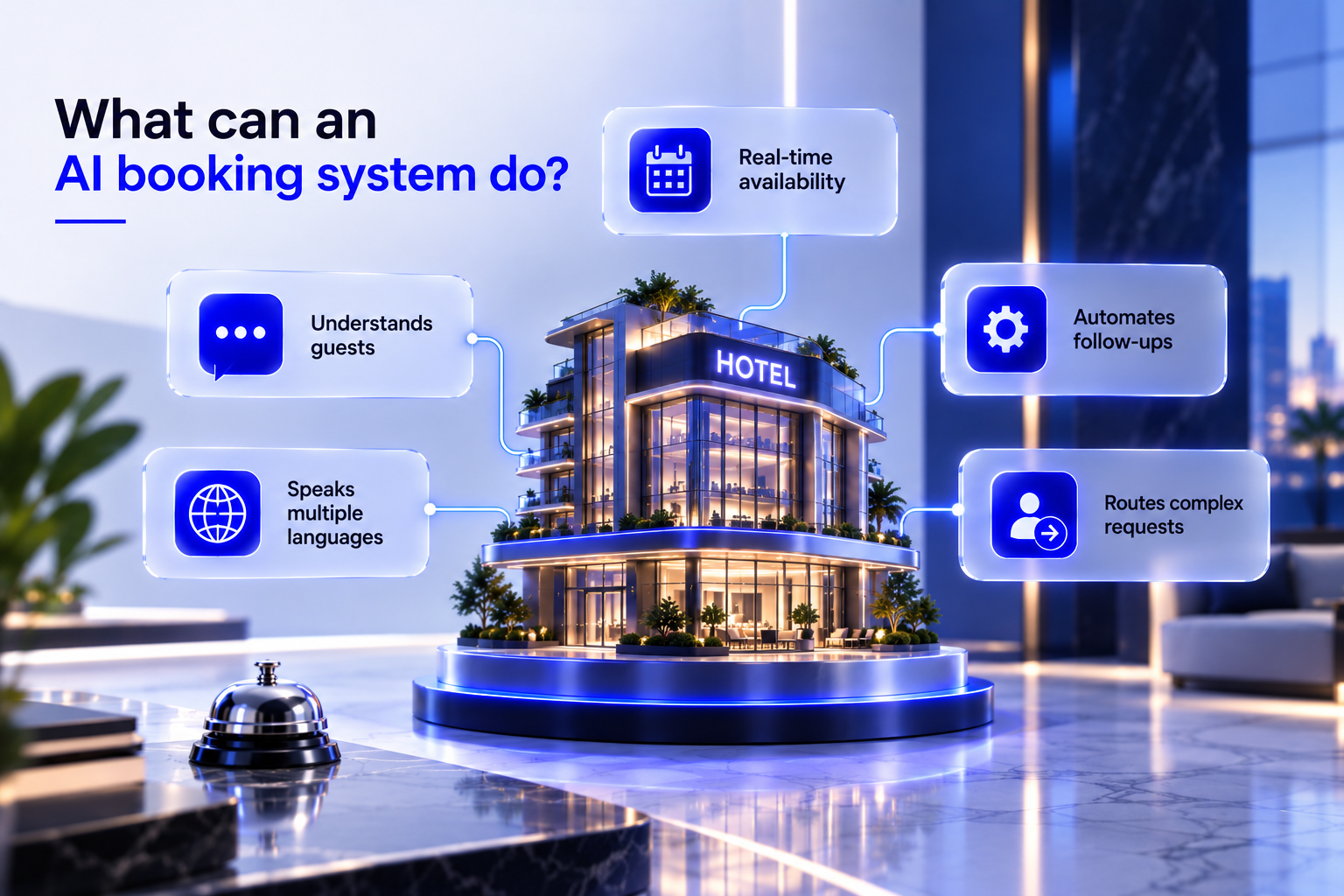
What can an AI booking system do?
The AI reservation system integrates with the property management system (PMS), booking engine, and inventory API to obtain real-time data about the availability of rooms and rates.
NLP helps translate the requirements of the guests into machine language.
Multilingual models process languages such as Tamil, English, and Hindi without separate agents.
Workflow automation triggers abandoned-booking follow-ups and personalized upsell offers for rooms or spa services.
The system can also apply intent and sentiment detection to identify complex cases and route them to human agents, transferring the conversation history and relevant booking context.
Key Technologies Behind AI Hotel Booking Systems
A top-tier tool for guests stands on three main legs: speed, links, and knowing the story.
IBM reports that almost 70% of respondents agree that empathy and trust will always require human involvement in customer care.
In many hotel AI booking system case studies, we see that tools linked to platforms like Opera or Mews update room lists every minute. This stops the bad dream of overbooking.
Why Are Hotels Investing in AI Booking Systems?
CX Optimization with AI Agents with the help of AI agents, hotels can offer fast resolutions, deal with increasing labor costs, compete with third-party booking portals, and maintain profit margins.
PwC report says that 44% of consumers use AI tools to compare prices, and one-third use AI agents or bots to book parts of their trip.
- Enhance direct booking: Immediate responses help minimize booking difficulties and inspire guests to make direct bookings.
- Minimize booking abandonments: AI can answer queries on the spot at the time of checkout and save abandoned bookings.
- Minimize routine tasks: AI takes care of routine reservation queries and allows staff to focus on guest service.
- Optimize guest experience: Multilingual AI support available 24/7 helps with live rates and availability along with booking.
Hotel AI Booking Systems Case Studies
The most effective way to understand hotel AI booking is to look at real deployments. The following five hotel AI case studies highlight how different brands use the technology to solve unique business challenges and drive revenue.
Case Study 1 - Hilton
Problem: Hilton had a lot of guest data across thousands of hotels, but lack of integration among these systems posed a challenge for personalization.
AI Solution: Hilton implemented an AI planner and hospitality platform, along with a generative AI-driven Hilton AI Planner to assist travelers with planning their stay via conversational interactions.
How it worked: The AI leveraged data from hotels, customers, and local sources, giving guests the ability to discover locations, compare hotels, and engage with the booking engine.
Case Study 2 - Hyatt
Problem: The conventional hotel booking engine depended on inflexible dropdowns, which made it difficult to search naturally.
AI Solution: Hyatt used an AI-driven hotel discovery system along with an application specific to the ChatGPT ecosystem.
How it worked: Guests could provide their preferences in conversational language like a romantic vacation for two people.
Case Study 3 - Wyndham
Challenge: High volumes of routine calls strained front desk staff, while unanswered calls led to lost direct bookings and poor guest service.
AI solution: Wyndham deployed an AI voice system across its hotel portfolio.
How it worked: The AI answered guest calls, provided property information, and assisted with reservations. It securely integrated with central booking systems for accurate data handling.
Case Study 4 - IHG
Problem: IHG needed to involve the guest before check-in and promote upgrades without resorting to aggressive front desk sales.
AI solution: IHG leveraged AI chat and attribute-based upselling via its mobile app and messaging platforms.
How it worked: The AI chatbot confirmed stay details and offered room attributes, such as higher floors or better views, based on live inventory.
Case Study 5 - Thunai
Problem: A global booking center faced high support costs, long wait times, and scattered information.
AI solution: Thunai’s agentic AI unified guest support and automated booking workflows across text, voice, and email.
How it worked: Thunai Brain combined local guides, policies, and live property data into one knowledge base. It resolved routine requests instantly and escalated complex cases to human agents with conversation summaries.
What These Hotel AI Case Studies Tell Us
The evidence from these large-scale deployments provides four clear lessons for hospitality leaders looking to adopt AI.
Live hotel data matters
AI models require accurate availability, current rates, and updated property information. Without live data, the system guesses or invents false answers.
A bot that hallucinates a lower price creates massive operational problems at the front desk.
Integration matters more than the chatbot
A chatbot that cannot access the booking engine has very limited value. Successful platforms connect conversational interfaces directly to the property management system.
If a tool cannot write data to the core system, it just creates more manual work for the staff. Gartner's survey shows that 85% of customer service leaders will explore or pilot a customer-facing conversational GenAI solution in 2025.
Direct booking is the real business goal
AI should reduce dependence on OTA channels rather than simply act as a digital brochure. Conversational tools must protect and grow direct revenue margins.
AI for direct hotel bookings only works if it can close the sale.
Human escalation still matters
Routine requests must transition smoothly to human staff for complex issues. This unified approach is the foundation of true Omnichannel Customer Service.
If the direct booking infrastructure is disconnected, the guest will simply leave the site and book through an OTA.
McKinsey’s report shows that almost 70% of respondents agree that empathy and trust will always require human involvement in customer care.
How Much Does an AI Hotel Booking System Cost?
Pricing varies widely across the industry. Rather than offering a single flat fee, technology vendors typically use modular pricing frameworks based on the specific size and needs of the property.
What determines AI booking system cost?
Total costs depend on several specific variables. The table below outlines the primary factors that influence the final price of an AI system.
Because these factors vary so much, hotels must request custom quotes rather than relying on universal price estimates.
How to Calculate Hotel AI Booking ROI?
Measuring the return on investment (ROI) requires a simple financial framework. Use this simple formula:
AI ROI = (Additional revenue + operational savings − AI cost) ÷ AI cost × 100
To calculate this accurately, operators must track two distinct categories. First, look at revenue gains. Second, look at operational cost savings.
The table below shows the specific metrics hoteliers should measure.
This dual impact on both revenue and operational efficiency directly fulfills the promise of hotel booking automation.
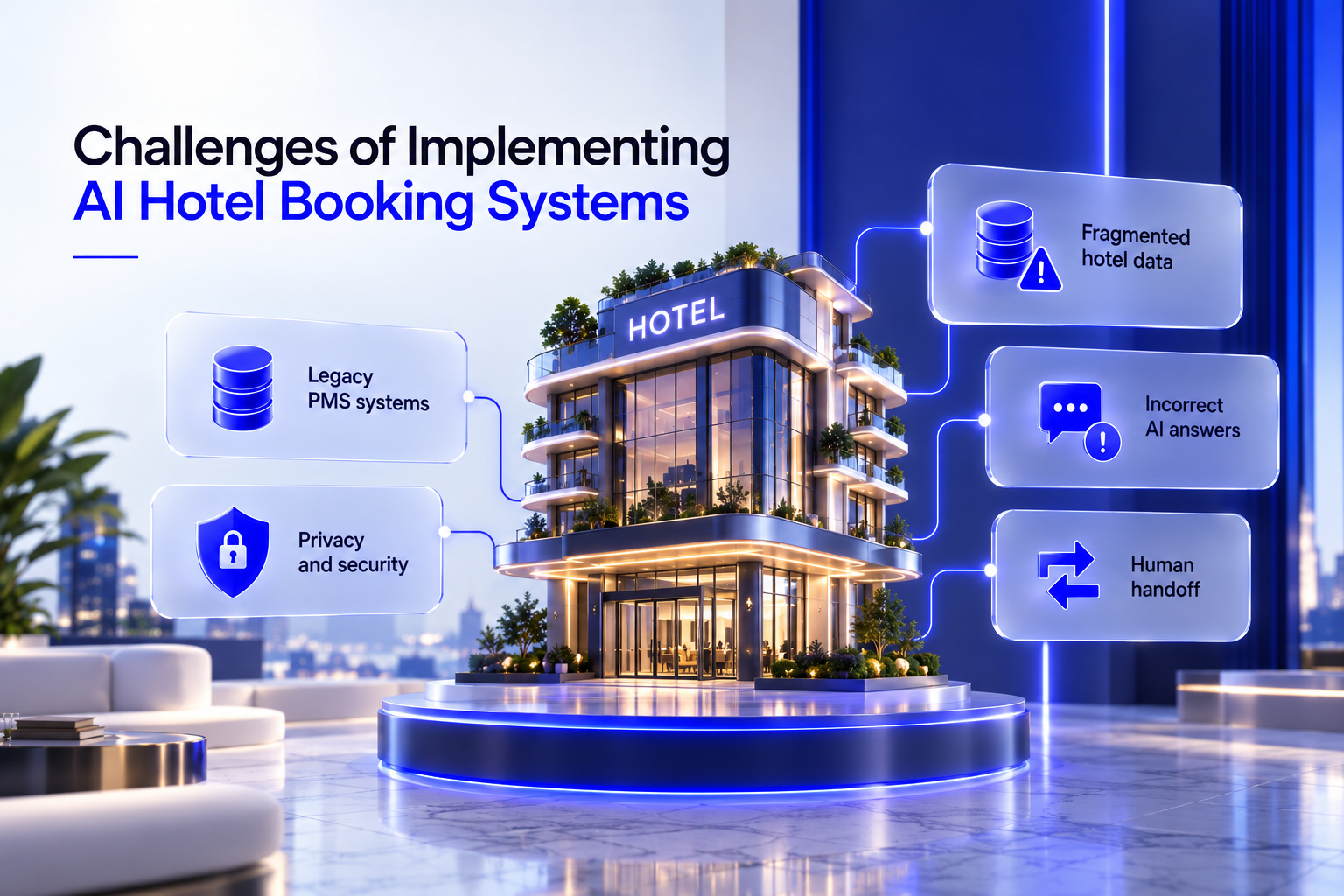
Challenges of Implementing AI Hotel Booking Systems
- Legacy PMS systems: Legacy systems don’t have today’s integrations and, therefore, make real-time access to room data by AI costly and problematic.
- Fragmented hotel data: Dispersed guest, loyalty, and inventory data may hinder AI from providing accurate personal recommendations to guests.
- Incorrect AI answers: With no managed knowledge base, AI will be able to give inaccurate information regarding hotel facilities and services.
- Privacy and security: Privacy and security of guest and payment data are necessary for an AI system globally.
- Human handoff: Complex customers need to be promptly passed to a human who can continue the conversation from where it left off.
How to Choose an AI Hotel Booking System?
Selecting the right software requires evaluating technical capabilities against true business goals. A strong platform must move beyond simple chat and actively drive hotel booking automation. Use this checklist when evaluating vendors to ensure the system delivers real value:
Choosing a system that meets these standards protects the hotel from buying an expensive tool that fails to produce results.
Future of AI in Hotel Booking Systems
The future is moving from thinking to doing. We are entering the time of the hotel that runs itself. Based on the latest hotel AI booking systems case studies, I see five major moves.
- Conversational, Generative, and Agentic AI Tools. Tech will handle nearly every call and text with high-quality voice and text.
- Predictive Fact Use. Hotels will use models to guess guest needs by the minute and adjust prices.
- Face and Voice Check-In. New ways to prove who you are will end desk lines and physical keys.
- Green Tech. Tools will save 28 percent on power by moving lights and air based on live guest counts.
- Hyper Personal Care. Tech will use past stays to set up a room exactly how a guest likes it.
These moves are visible in the most future-minded hotel AI booking systems case studies today. The goal is a way of working where tech and human staff move together.
How Does Thunai Support AI-Powered Hotel Booking?
Thunai handles complex hospitality workflows through its AI-powered platform. The information, policies, and live data from hotels are integrated by the Thunai Brain to form an integrated database for accurate replies to guests.
When engaging in discussions, the agents will communicate with hotel databases to verify room availability and reservation processes.
In cases where help from human beings is needed, the Thunai will seamlessly escalate the conversation with the context intact.
See how Thunai turns guest conversations into bookings. Book a demo!
FAQs About Hotel AI Booking Systems
How does AI increase direct hotel bookings?
AI increases direct bookings by providing instant, 24/7 assistance, reducing research friction and helping guests book directly instead of leaving the site for answers.
Can AI hotel booking systems check live room availability?
Yes, AI platforms integrate with PMS and booking engines to access and provide accurate, real-time room availability and rates.
Can AI booking systems reduce hotel booking abandonment?
Yes. AI helps prevent booking abandonment by answering last-minute questions instantly and sending recovery messages for abandoned bookings.
Can AI booking systems work for small hotels?
Yes, AI booking systems help small hotels automate guest interactions and reduce front-desk workload without adding staff.




.png)
