
Let me be blunt. If your agents still need daily babysitting, you’re not running automation; you're running a day care.
In the past two years, enterprises rushed into frameworks that looked powerful but quietly drained budgets through slow builds, broken data, and endless debugging.
The real challenge isn’t models. It’s orchestration.
This article breaks down the top Lyzr AI alternatives for teams ready to move from fragile pilots to resilient digital workforce platforms built to unify data, reduce hallucinations, and deliver measurable ROI from day one.
Why Teams Consider Lyzr AI Alternatives
Lyzr is a solid framework if you're a Python developer. Outside that world, it starts to strain, which is exactly why so many teams start hunting for Lyzr alternatives.
- The Engineering Bottleneck. Lyzr is SDK-first. Getting one working agent live often takes weeks of custom Python. HR or sales teams can't iterate on their own; they need engineering on call.
- The Credit Bleed Risk. G2 reviewers point to a consumption-based credit system that punishes experimentation. Thin documentation means teams burn through thousands of credits just debugging a basic workflow.
- Unresolved Data Conflicts. Traditional RAG setups often surface contradictions from stale documents. When an old policy fights a new memo, the agent usually guesses and guesses wrong instead of flagging the mismatch.
- Launch Clashing. Some engineering teams report PII masking that behaves differently in the playground than it does in production. For regulated industries, that gap is a compliance problem, not a bug, and it's one of the biggest reasons compliance-heavy teams start looking at Lyzr AI alternatives in the first place.
The Top 10 Lyzr AI Alternatives for 2026
1. Thunai AI: The Centralized Brain for Enterprise
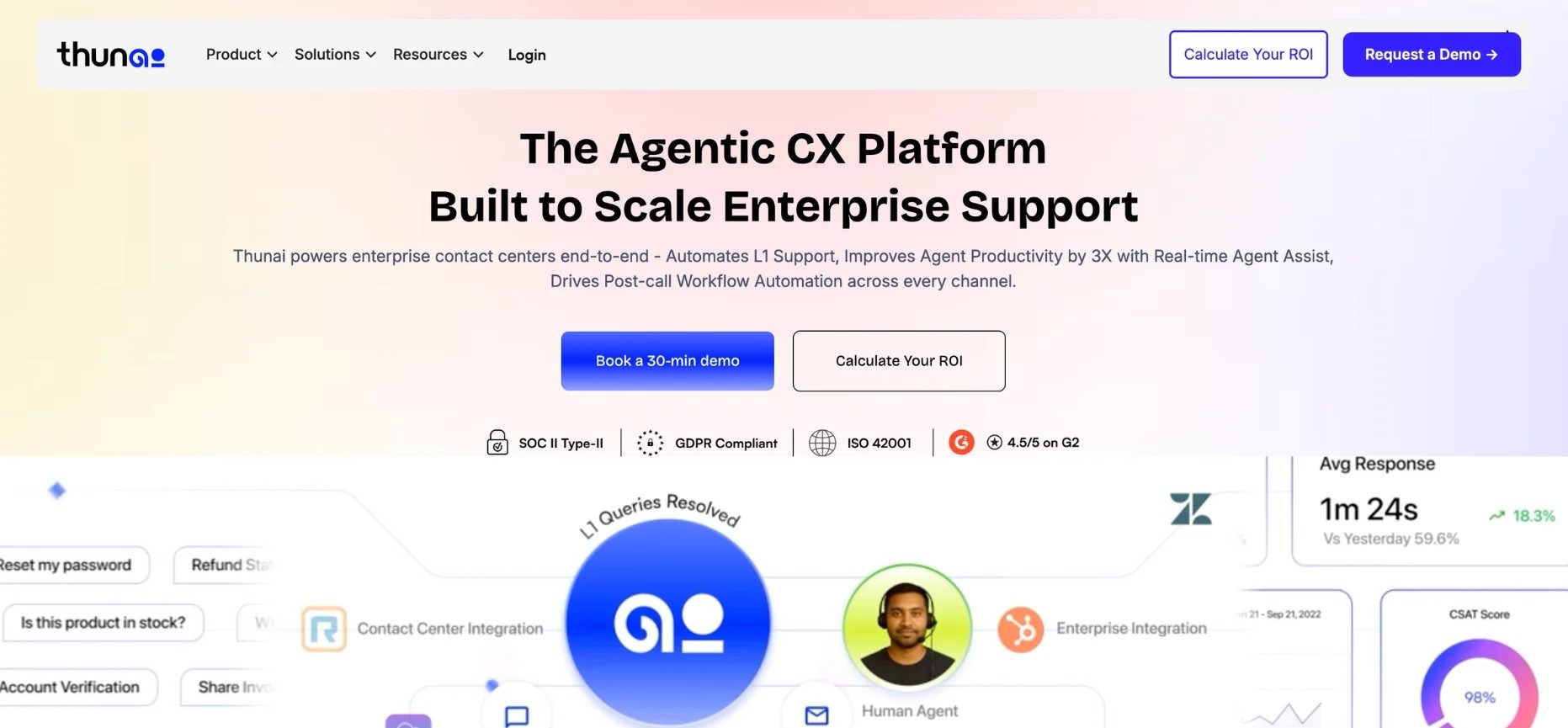
Thunai works like a centralized brain, and it's consistently ranked among the top Lyzr alternatives for business teams. It turns messy, scattered data into digital workers your sales and support teams can actually trust.
It catches data conflicts and fixes them before an agent ever acts on them. That's what keeps answers accurate instead of confidently wrong. And because the platform is no-code, business teams can stand up a working digital worker in days, not months. For a deeper look at how this plays out in a live contact center, see our guide to contact center optimization.
Key Features:
- Thunai Brain: A self-learning knowledge graph that pulls PDFs, videos, and live links into a single source of truth. It finds and resolves data conflicts before an agent ever touches the information- the same "verified truth" approach detailed in our piece on AI and knowledge management.
- Multi-Connect Protocol: A two-way sync layer, so agents don't just read your CRM; they update it in real time. Salesforce and HubSpot records stay accurate without manual entry.
- Thunai Omni: One dashboard for voice, chat, and email, with live call scoring and mood detection. Human managers can watch conversations and step in the moment they're needed; a workflow covers in its retail agents breakdown.
Pros:
- 95% hallucination reduction. Every action is grounded in a verified, self-healing knowledge base.
- Fast time to value. Pre-built agents, Meeting Assistants, and Revenue Finders work on day one, no custom code required.
- No-code builder. Business users can build and ship automations without burning through developer time. See how retail teams use this in practice in Thunai's chatbots for retail guide.
Cons:
- Accuracy scales with how much data you feed it upfront.
- Highly unusual edge cases may still need a little engineering oversight.
2. Google Vertex AI Agent Builder
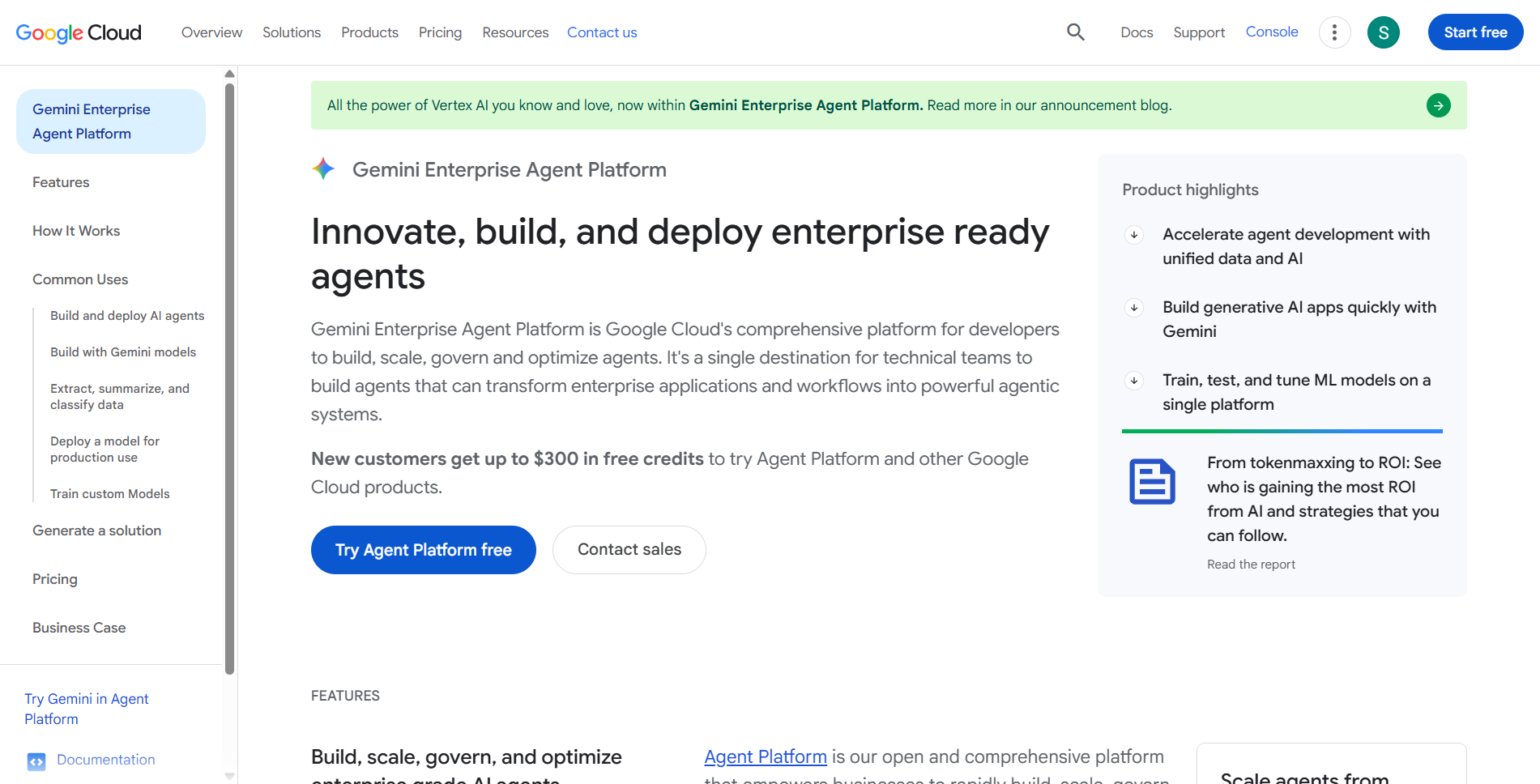
Vertex AI is Google's managed framework for building and scaling autonomous agents, and it's one of the more enterprise-scale Lyzr AI alternatives on this list. It's built for size.
A serverless engine handles orchestration and security behind the scenes, while native BigQuery access keeps agents grounded in your data lake. Vertex supports both no-code prompting and full custom code, which makes it a natural fit if your team already lives in Google Cloud.
Key Features:
- Agent Engine Runtime: A managed environment that scales and recovers from failures automatically; no framework babysitting required.
- Model Armor Security: Runtime-level filtering against prompt attacks, built for agents operating in public-facing roles.
- BigQuery Data Grounding: Direct access to your data warehouse, so agents pull facts from massive datasets with almost no lag.
Pros:
- Built to scale. Backed by Google's global compute and regional resilience.
- Framework-friendly. Plays well with LangChain, CrewAI, and other existing tools.
Cons:
- Cloud lock-in. Moving agents to AWS or Azure later is a real technical lift.
- High complexity. You need expert-level Google Cloud knowledge to set this up and govern it properly.
3. StackAI: The Governance Specialist
StackAI focuses on internal process automation, and it's one of the more compliance-focused Lyzr alternatives available today. A visual builder lets legal and compliance teams create secure workflows without touching code.
Data protections like PII masking keep sensitive information from ever leaving your private environment. Model routing lets you send simple tasks to cheaper models and save GPT-4o for the logic that actually needs it.
Key Features:
- Visual Logic Builder: Create drag-and-drop logic flows for multi-department collaboration, such as contract review and RFP response processes, auditable by non-technical personnel.
- PII Masking and SSO: Data redaction combined with SSO via providers like Okta to keep the information protected while reasoning.
- Multi-Model Routing: Route easy tasks to cheap models, save GPT-4o for complex logic. Costs stay under control without sacrificing output quality.
Pros:
- Built for compliance. A strong fit for legal and finance teams that need SOC 2 or HIPAA-level controls.
- Deployment flexibility. Runs in the cloud, a VPC, or fully air-gapped on-prem.
Cons:
- Higher entry cost than simpler agent wrappers.
- Real learning curve on the advanced features.
4. CrewAI: Role-Led Team Orchestration
CrewAI lets developers build agent teams with defined roles and goals, similar to how a real team is structured. It's a popular pick among open-source Lyzr alternatives.
It leans on business logic first, so agents and researchers can hand work off to each other without manual routing. Because it mirrors familiar team structures, it's become a favorite for fast prototyping.
Key Features:
- Role-Led Definitions: Assign clear jobs Researcher, Editor that mirror real teams and make complex projects easier to manage.
- Agent-based Self-delegation: Agents determine themselves when and where the work should be delegated to another expert in response to any newly emerged data.
- Crew Studio UI: The visual interface that allows non-technical managers to create and control agents' crews.
Pros:
- Intuitive. Easy to model after how your human teams already work.
- Fast prototyping. Often five times quicker than graph-based frameworks for a proof of concept.
Cons:
- Hidden abstractions can make deep control harder for engineers who want full visibility.
- Sequential bias. Strong on linear pipelines, weaker on workflows that need to loop.
5. LangGraph by LangChain
LangGraph extends LangChain for stateful agent flows that need exact, controllable logic. Among Lyzr AI alternatives, it's the one built for engineers who want total precision.
It maps out processes as nodes and edges, so agents can loop back, retry, and recover from failed steps instead of just plowing forward. This is built for AI engineers who need proprietary systems with deep observability.
Key Features:
- Cyclical Workflow Engine: Lets agents loop and manage long-running, multi-turn tasks essential for logic that isn't linear.
- State Machine Logic: Nodes and edges represent every move, giving builders precise control over how an agent recovers from an error.
- LangSmith Tracking: Deep debugging tools that show exactly what happened at every step, so teams can find and fix issues fast.
Pros:
- Total control. Best fit for high-stakes logic where precision matters more than speed.
- Deep ecosystem. Access to LangChain's library of 600-plus integrations.
Cons:
- Steep learning curve. Built for expert AI engineers, not business teams.
- Slower time to market than product-first platforms.
6. Microsoft AutoGen
AutoGen is built for conversational multi-agent systems where agents talk to each other to solve a problem. It's one of the more research-friendly Lyzr alternatives on the market.
It supports code execution inside secure containers, which makes it a strong fit for technical research and IT work. Agents can brainstorm and refine ideas together, closer to a think tank than a rigid pipeline.
Key Features:
- Talk-Led Logic: Models interactions as natural conversations between agents, or between agents and humans, good for brainstorming rigid systems can't do.
- Joined Code Execution: Native support for agents writing and running code inside secure Docker containers, useful for testing and framework work.
- Human-in-the-Loop Triggers: Embedded points at which an agent stops and waits for human approval before continuing to act autonomously.
Pros:
- Flexibility. Excellent for programming bots, assisting researchers, and creative brainstorming.
- Azure-specific. Full integration if you’re already using the Microsoft cloud service.
Cons:
- Orchestration drift. Conversational flows can wander without tight guardrails.
- Latency. Dialogue overhead adds wait time and API cost.
7. Salesforce Agentforce
Agentforce is Salesforce's native AI layer, and it's a natural pick among Lyzr alternatives for teams already living in Salesforce. It lets teams build agents that follow existing CRM rules, right inside the platform they already use.
It automates customer-facing tasks directly in the Salesforce interface, with no outside connectors needed. Admins use the flow builder to extend workflows across support without writing code.
Key Features:
- Security Inherent to CRM: You get all existing security measures from Salesforce, so you don’t have to re-create safeguards for sensitive information.
- Joining Data Access: Get immediate access to customer information; customer service agents can pull account information and update lead stages directly in Salesforce.
- No-Code Flow Builder: The tool uses the interface that your administrators are already familiar with within Salesforce.
Pros:
- Fast to production for sales and support teams already on the platform.
- Enterprise compliance, built on Salesforce's mature security model.
Cons:
- Limited versatility. Reports suggest it performs well in only about a third of real-world tests.
- Cost scales up as conversation volume grows.
8. Glean: The Search Authority

Glean is a smart search layer that uses RAG to answer questions grounded in your internal company data. It's one of the search-first Lyzr AI alternatives worth knowing about.
The content is indexed across a range of applications, including Slack and Jira, while keeping the original file permissions and access rights intact. Imagine it as a colleague who has read all of the documents created by your organization.
Key Features:
- Indexing at Scale: Brings together the power of Slack, Google Drive, and Notion to create an indexed search that is in natural language.
- Permissions Awareness: Never brings up a document that was not already accessible to the person looking at it. Essential for companies with sensitive information requirements.
- Browser-Native Insights: Answers questions in the flow of work, right in the browser, without switching tools.
Pros:
- Immediate value. Cuts down the time employees spend hunting for information.
- High trust. Built around permissions and document accuracy from the ground up.
Cons:
- Limited action. Weaker at multi-step, outside-the-search actions compared to platforms like Thunai.
9. Retool: The UI-First Platform
Retool is a UI-first platform for building custom apps and screens around your AI agents, and it's one of the more unusual Lyzr alternatives in that it starts with the interface, not the agent.
It connects directly to databases and APIs through drag-and-drop components, giving your reasoning engine an actual interface to live in. That speeds up building admin tools and lets teams ship AI software with real checks in place.
Key Features:
- Drag-and-Drop UI Builder: Build full internal apps and dashboards around your agents using pre-made components to turn a chatbot into a real tool.
- Direct DB Connectors: Link agents straight to SQL databases and APIs, no custom middleware required.
- AI App Generation: Use natural language prompts to generate both the interface and the agent logic together.
Pros:
- Operational control. Gives your team a full working tool, not just a chat window.
- Developer speed. Cuts the time to build and ship internal software significantly.
Cons:
- Less orchestration depth than platforms built specifically for agent collaboration.
10. SleekFlow: Omnichannel Engagement
SleekFlow automates customer conversations across social and messaging apps — WhatsApp, Instagram, and beyond. It rounds out our list of Lyzr alternatives with a retail-and-social focus.
It allows agents to unify all information about customers, including their purchase history, and close deals from within the chat session. This solution is ideal for those marketing teams that require an intelligent system that not only answers questions but also makes sales.
Key Features:
- NLP Omnichannel: Merges chats on WhatsApp, SMS, and Facebook into a single interface to support mass retail customers.
- Customer Profile 360: Merges the customer’s contact information and purchase data across all messaging apps for the agent’s knowledge.
- Joining Payment Links: Allows agents to send customers secure payment links right in their chat session.
Pros:
- Strong for social selling and retail marketing teams.
- Built-in automation, drip messages, and smart lead routing included.
Cons:
- Niche fit. Not built for internal work like HR, IT, or procurement.
Technical Performance Comparison Table
Here's how these Lyzr alternatives stack up side by side, at a glance.
Technical Performance Comparison Table
How do these Lyzr AI alternatives differ technically? The table below compares the core capabilities that matter when building and running AI agents in production.
The Economics of Agentic AI: Measuring ROI
When you're weighing a Lyzr AI alternative or comparing several Lyzr alternatives side by side, one metric matters more than the rest: Mean Time to Resolution, or MTTR. A true System of Intelligence should push MTTR down by cutting out manual data hunts and unnecessary human handoffs.
MTTR = Total Resolution Time ÷ Total Number of Incidents
Platforms like Thunai AI have shown a 60% drop in MTTR by resolving data silos and conflicts before an agent ever touches them. That typically works out to a 35% cut in support costs and a 3.5x return on every dollar spent on AI, numbers explored further in the Conversational AI in retail report.
Planned Launch Roadmap for 2026
A recent MIT study found that 95% of AI initiatives failed to deliver meaningful impact, according to researchers from Maynooth University and University College Cork. Here's a path to move beyond the pilot stage, whichever of these Lyzr alternatives you choose.
- Discovery and Alignment (Weeks 1 to 4). Pick two or three high-impact use cases tied to revenue or cost KPIs. Set baseline numbers for MTTR and first response time before you build anything.
- Framework Check (Weeks 5 to 8). Shift from a System of Record to a System of Intelligence. This is where a platform like Thunai AI earns its keep, unifying messy data into one clean, conflict-free base.
- Pilot Prototypes (Weeks 9 to 16). Run time-boxed pilots. Use LangGraph if your logic is complex, or Thunai if you need a fast business launch. Judge results against real conversation data, not demos.
- Scaling and Optimization (Months 4 to 18). Move the pilots that worked into production and start hardening the platform. Focus on deeper connectors and training your team to manage agents day-to-day.
Selecting the Right System of Intelligence
By 2026, picking among Lyzr alternatives isn't really about picking the best model anymore. It's about the depth of the orchestration layer and how consistent your underlying data is.
- Choose Thunai AI if you want fast ROI, a finished business product, and a brain that automatically cleans up your internal data conflicts. It's the most complete all-in-one option for growing companies.
- Choose Google Vertex AI if you need serious cloud-native scale and you're already deep in the Google Cloud ecosystem.
- Choose StackAI if your top priority is secure, internal automation for finance or legal teams.
- Choose LangGraph if you've got a world-class AI engineering team building a proprietary, non-linear system from the ground up.
The companies that win in 2026 won't just be AI adopters. They'll be Adaptive Intelligence firms places where human judgment is sharpened, not replaced, by a verified, autonomous digital workforce.
Ready to move beyond AI pilots? See how Thunai can turn your business workflows into autonomous digital workers. Book a demo today.
FAQs on Lyzr Alternatives
What is Agentic AI, and how is it different from a traditional chatbot?
Agentic AI does more than answer a question. It plans, reasons, and carries out multi-step tasks across your systems. A chatbot waits for a prompt. An agent pursues a goal and coordinates the actions to get there.
Why are enterprises moving away from Lyzr AI in 2026?
Lyzr works well for prototypes. It struggles in production. Heavy developer dependency, rising credit costs, and fragile data pipelines limit real business impact — so more enterprises are choosing Lyzr alternatives built for scale and governance from day one.
What is an agent orchestration platform?
It's the layer that manages how multiple agents reason, share data, and act across your systems. It runs workflows, resolves conflicts, and enforces security, so autonomous agents behave predictably once they're in production, not just in a demo.
How do enterprises measure ROI from Agentic AI?
Most teams track Mean Time to Resolution, or MTTR. Platforms that unify data and cut handoffs typically lower MTTR by 40 to 60%, which shows up as faster service and real, measurable savings on operating costs.
What should leaders look for in a Lyzr AI alternative?
When you're comparing Lyzr alternatives, look at data consistency first, then deployment speed, security controls, and how deep the monitoring goes. The strongest platforms clean up your data before an agent ever reasons over it, support no-code rollouts, and scale without quietly inflating your engineering or inference bill.


.png)