


How Thunai AI Automates RCA for ETL Failures in a Major Retail Chain
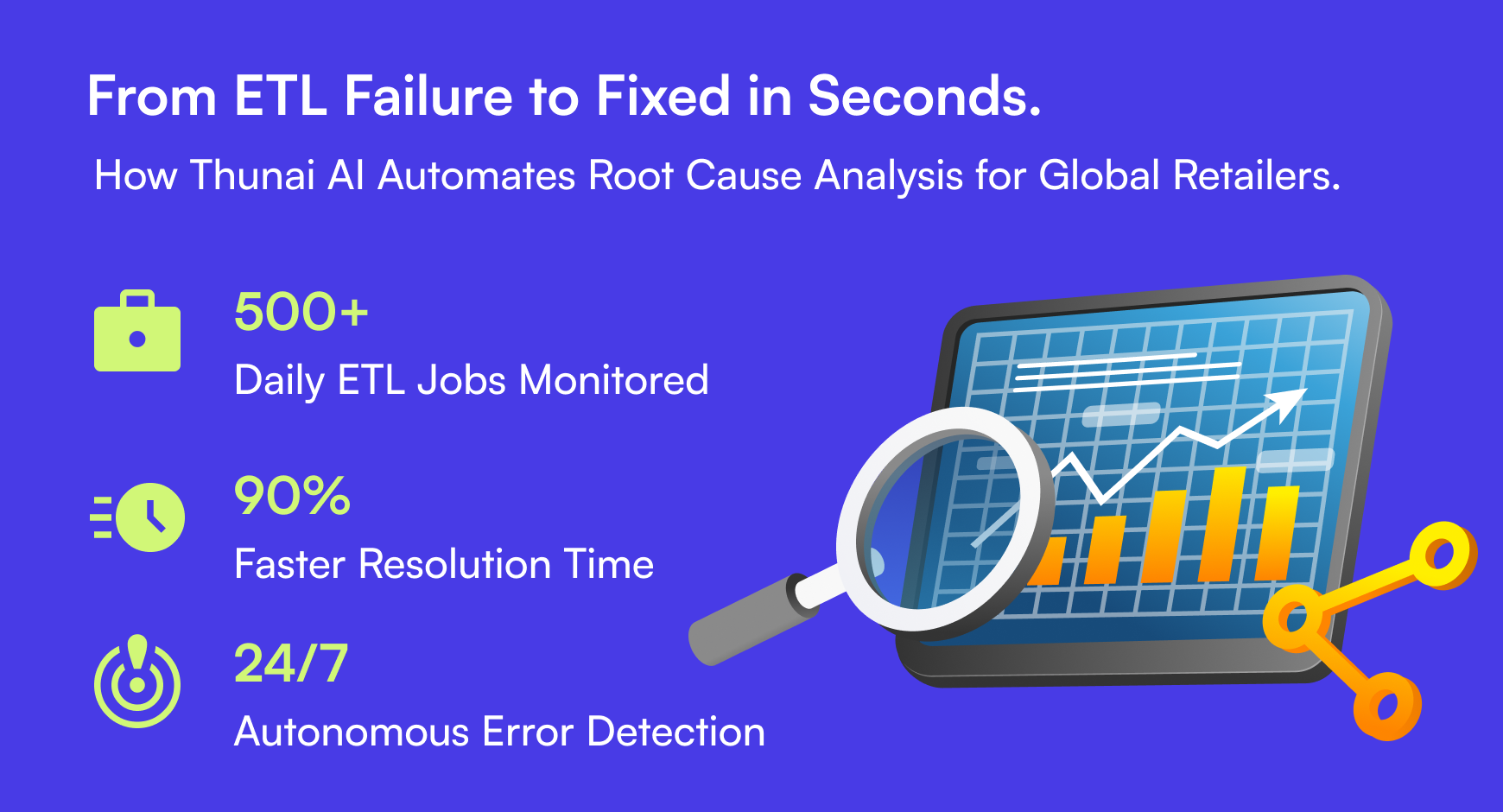
500+
90%
24/7
Client Overview
Our client manages a massive supply chain network. They rely on complex data pipelines to track inventory and sales. Every night, over 500 ETL jobs run to update dashboards for store managers.
Their goal is to ensure data freshness for morning decisions. The business cannot afford delays in stocking shelves or pricing updates.
The Challenges: Data Downtime, Alert Fatigue, Manual Fixes
The data engineering team faced a flood of failures. They had to deal with frequent job crashes in Control-M. These failures were often small but blocked critical reports.
Alerts arrived at all hours. Engineers woke up to check logs manually. They dug through thousands of lines of code to find one error. Most issues were simple schema changes, but finding them took hours.
This friction caused several big problems:
- Costly Data Delays: Reports arrived late. Store managers did not have the right stock numbers. This caused missed sales and overstocking. The business lost trust in the data.
- Alert Fatigue: The on-call phone rang too often. Engineers ignored alerts because so many were false alarms or minor issues. Important failures got buried in the noise.
- Slow Root Cause Analysis (RCA): Finding the error was slow. A job might fail due to a single new column in a CSV. A human had to read the raw log, find the mismatch, and write a fix. This manual loop wasted valuable engineering time.
Our Intelligent Solution
We automated the recovery process. The team integrated Thunai Brain and Common Agent into their Control-M workflow. This system acts as a Tier-1 support engineer.
Thunai acts as the central intelligence for operations. The tool connects directly to Control-M via API and ingests logs instantly. This connection gave the team an autonomous agent that understands their specific data errors.
This setup allowed us to fix up the data pipeline:
- Instant Detection and Ingestion: We set up Control-M to talk to Thunai. When a job fails, Control-M triggers an "On-Do Action." This sends the job log immediately to Thunai Brain. The system ingests the file and starts the analysis before a human even wakes up.
- Intelligent Parsing: Thunai Brain analyzes the failure context. It identifies specific errors, such as a SchemaMismatchException. It cross-references this error against the company's Standard Operating Procedures (SOPs) stored in its knowledge base, in doing so, Thunai understands exactly why the source file broke the pipeline.
- Automated Action: We stopped manual ticket creation. Thunai MCP connects to Jira to take action. The system creates a ticket with the exact line number of the error. It even suggests the specific SQL DDL change required to fix the schema mismatch. This turns a vague alert into a ready-to-solve task.
- Smart Context for Engineers: Engineers stopped digging through raw logs. The Jira ticket contains the full root cause analysis. Developers can see the suggested fix immediately. This clarity allowed the team to resolve schema issues in minutes, not hours.
Conclusion
Thunai changed how the client manages data reliability. The setup turned a chaotic night shift into a smooth operation.
The system brought Control-M and Jira together. Engineers received solutions, not just problems. The tool turned complex log data into clear SQL fixes. The client cut resolution time by 90%. The team now trusts their morning data implicitly.
