
Are you getting value from your AI or just maintaining it?
That's the question a lot of leadership teams are asking in 2026.
Kore.ai pioneered conversational artificial intelligence for many businesses.
Nevertheless, with increased use come to light problems like slow change management, dependency on experts, and inflexibility.
The clients want fast, easy, and humanized interactions. What should be done is not to tune, but to change the whole platform.
This guide breaks down the strongest Kore AI alternatives for real business scale.
Why Companies Are Moving On From Kore.ai

- Slow time to value. Despite "no-code" marketing, deploying Kore.ai's XO platform takes 2 to 6 months. The interface is complex enough that business teams can't tweak conversation flows without pulling in developers.
- Unclear costs. Kore.ai contracts often start at $150,000 to $300,000 a year, and pricing isn't always transparent. Professional services fees stack on top. Newer competitors use usage-based pricing instead, so costs track actual results.
- Voice lag. Kore.ai's architecture was built for text first. That shows in voice interactions, where latency often tops one second, enough to frustrate callers. Voice-first competitors now hit latency under 500 milliseconds, which is becoming table stakes in banking and logistics.

Comprehensive Evaluation of the Top Kore AI Competitor Landscape
1. Thunai AI
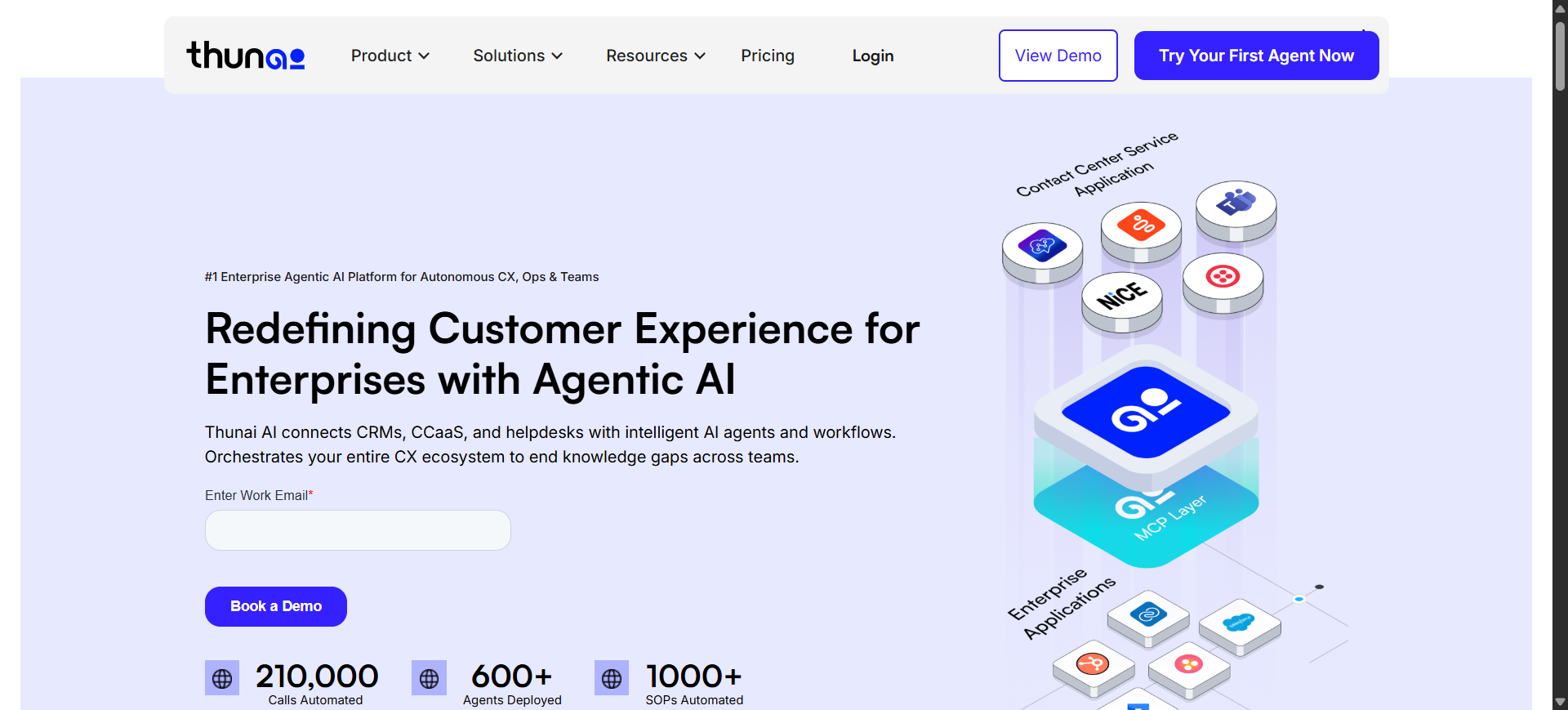
Your company data is likely messy: documents contradict each other, and rules conflict across departments.
While some Kore AI alternatives try to hide this with hard rules, Thunai fixes the knowledge itself. This is the top choice for leaders who need human-like work without the enterprise baggage, acting as a Second Brain for the firm.
Key Features:
- Contradiction-Free Knowledge Graph. Unlike standard databases, the Thunai Brain actively audits your files and live data to find conflicts, such as two different return rules in two different PDF files. By fixing these links before an agent uses the data, it builds a single, verified source of truth that cuts mistakes by up to 95 percent.
- Model Context Protocol (MCP). It enables specialized agents to communicate and exchange data flawlessly. For instance, the voice agent manages the call and feeds all the information to the email agent for further communication without loss of data.
- Chrome Extension Workflow. The Second Brain lives exactly where your staff works by linking into the browser to give help in the moment. This clears out the trouble of switching apps, helping teams find technical answers or handle customer worries while staying in their active window.
- Meeting the Knowledge Loop. Meeting agents join internal calls to write out what is said and turn these talks into searchable knowledge entries. This makes sure internal breakthroughs or rule shifts become support answers right away, closing the gap between plan and service.
Pros:
- Pricing Aggression: Enterprise-level pricing starts from 399 per month, offering a Kore AI alternative to the old-fashioned approach of paying six figures upfront.
- AI Voice Plus Screen Share: Responds to difficult queries from customers by explaining answers through screen sharing rather than providing only text links.
- Speed to Value: Firms can upload their files and have a ready, expert agent live in just minutes or hours instead of months.
Cons:
- Newer Entrant: Since it entered the market in 2025, it has a lesser history in terms of both brand presence and performance.
2. Cognigy
When the central problem you face is that of an isolated contact center operating in a global environment, Cognigy is the expert that you are looking for.
While Kore AI alternatives center on broad cross-department work, Cognigy has an edge in deep telephony linkage and voice support. It is built for high-speed voice environments where 100 percent compliance is required.
Key Features:
- Nexus Engine. This orchestration layer links Large Language Models with a strict rule framework to maintain total control. It confirms that every AI interaction is privacy-aware and follows set rules, which is fundamental for regulated fields that cannot risk model shifts.
- Native Voice Gateway. Cognigy hits lower latency than text-first platforms by linking directly to carrier-grade telephony via SIP trunks. It lets firms keep their current phone base while moving to advanced voice AI.
- Agent Copilot. This feature gives real-time help to staff by giving live agents suggestions and data entry during complex calls. It acts as a link between AI and humans, making sure agents have the information they need for high-value work.
Pros:
- Telephony Leadership: Leading for Voice Centric Activities With Response Times Less Than 500ms and Barge-In.
- Global Reach: With its Build Once, Deploy Anywhere strategy, it is recognized for supporting more than 100 languages through 35 channels.
Cons:
- Steep Learning Curve: Even with visual tools, users say that big changes and advanced behaviors often need code.
3. Yellow.ai
For global brands, language gaps are the biggest bottleneck to growing AI. Yellow.ai is a powerhouse for global engagement, using a multi-model engine to manage over 2 billion talks a quarter.
It is ideal for firms that want to avoid being locked to one vendor and need high precision across many dialects.
Key Features:
- Multi-LLM architecture. The platform is designed for more than 15 types of models that will allow the system to select the most suitable and efficient model for each task. This type of architecture provides a backup option for companies, as it allows switching models even after deployment.
- DynamicNLP Engine. Optimized for intent recognition across 135 plus languages, this engine manages deep queries without localization delays. It features real-time mood analysis, letting the AI adjust its tone and response plan based on the emotions of the user.
- Agentic RAG. This high-performance system pulls grounded, factual answers from scattered knowledge sources like wikis and old support tickets. It moves beyond passive search to resolve queries, using autonomous reasoning to handle multi-step tasks like claim processing.
Pros:
- Fast Launch: Boasts a launch timeline of about three days for standard needs with pre-built templates.
- Staff Experience: Gives strong solutions for internal work, managing tasks like leave requests to cut HR costs.
Cons:
- Pricing Complexity: While they have tiered models, some users say that costs can climb fast as volume grows.
4. Ada

Ada is the platform for the Result Engineer. While many Kore AI alternatives center on ticket deflection, Ada centers on automated resolution and is a best Kore AI alternative.
Their platform is built around shifting your support team from a cost center to a tactical growth engine by giving non-technical staff the power to manage AI logic.
Key Features:
- Ada Reasoning Engine. This serves as the central brain, linking advanced knowledge finders with safety checks to isolate issues. It lets the AI analyze context and carry out multi-step plans on its own, rather than just replying to set prompts.
- No-Code Playbooks. This feature lets CX teams put standard procedures to work in minutes using plain-language prompts without engineering help. It is built to resolve deep questions with human-level precision, providing built-in checks to make sure the AI follows company rules.
- Tactical Optimization Suite. A deep analytics and testing space where managers can simulate real customer scenes in a safe sandbox before launch. It centers specifically on the Resolution Rate rather than just deflection, giving a coach interface for managers to guide AI decisions.
Pros:
- High Return on Investment: Customer ROI in the range of 210% to 357% with a payback period of less than 6 months.
- Quick Implementation: Most agents become live within 2 to 6 weeks, compared to the 3 to 6 months required by traditional solutions.
Cons:
- Transparency of Pricing: They apply a value-based pricing scheme that requires consultation to establish, thus making budgeting difficult from the onset.
5. Retell AI
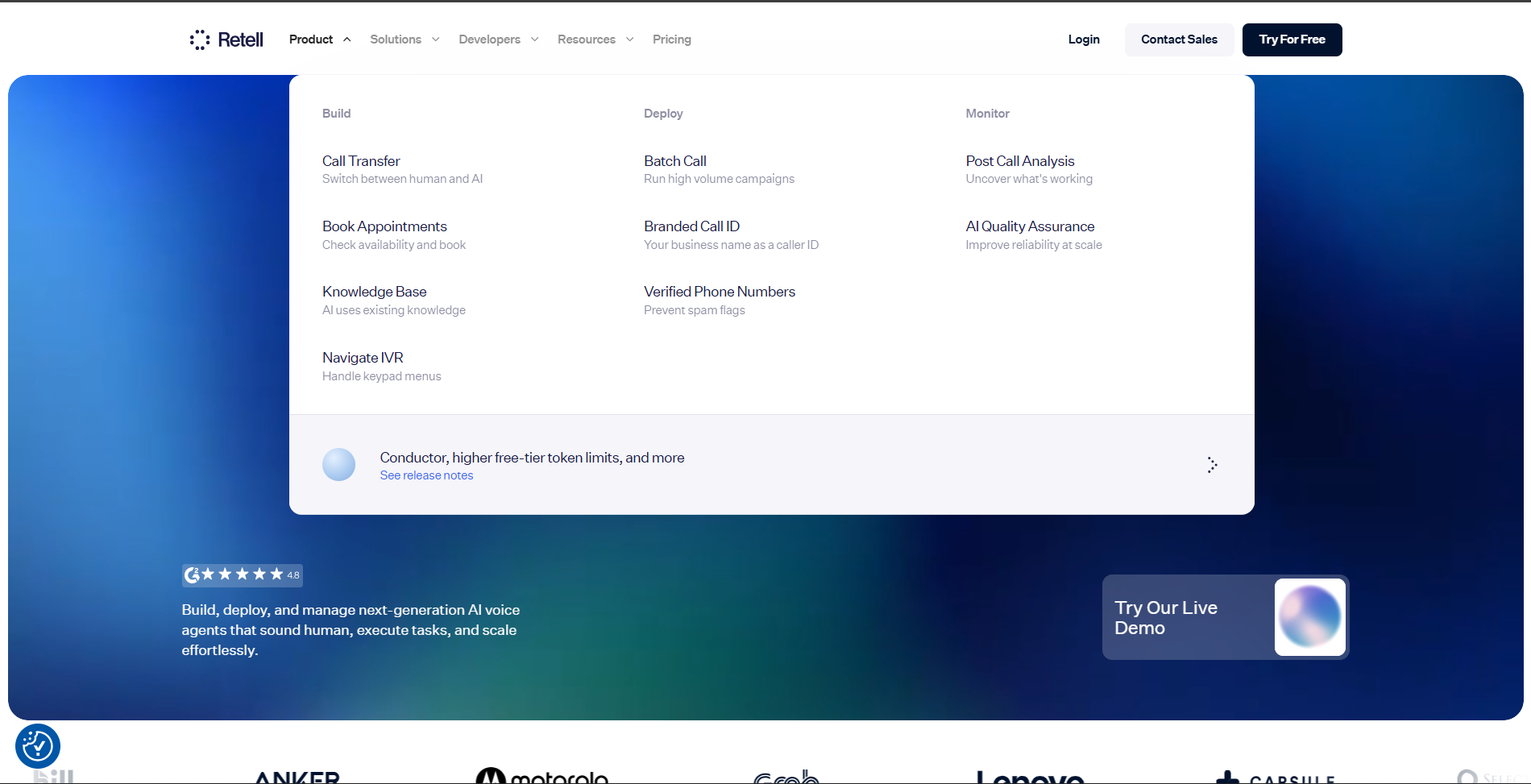
If your business lives and dies by the phone, you cannot tolerate the voice lag common in systems built for chat. Retell AI is the specialist for high-fidelity voice work, built from the ground up to provide a natural talk experience.
It is the go-to choice for healthcare and finance where sub-500ms response times are mandatory.
Key Features:
- Voice-First Foundation. Unlike platforms built for chat, Retell is made for real-time phone work to make talks feel fluid and human. This base removes the awkward pauses found in legacy systems, supporting barge-in so users can interrupt the AI naturally.
- Native Telephony Flexibility. Retell links directly to existing SIP and VoIP systems while letting you use your own carrier. This lets firms keep their current numbers and base while launching both outbound and inbound call needs.
- Rich Call Analytics. Every call is transcribed and studied to give detailed insights into performance, intent accuracy, and agent speed where not all other AI alternatives do. These insights are built-in, meaning you do not need other tools to understand why calls work or where the AI needs help.
Pros:
- Ultra Low Latency: Provides responses faster than 600ms and offers one of the most realistic talk experiences possible.
- Pricing Model: Features a simple pay-as-you-go business model starting at 0.07 per minute.
Cons:
- Niche Center: This is a niche voice center that does not have the all-in-one omnichannel abilities that Kore.ai or Thunai possess.
6. PolyAI

At PolyAI, they make voice assistants that sound so realistic that you could easily mistake them for being humans.
This is one of the best options for brands that prefer the Kore AI alternative and focus on offering a good customer experience while keeping the robot-like scripts at bay.
Key Features:
- Neural Voice Technology. This technology builds human-like speech patterns that include natural accents. The AI can even handle code-switching, moving between languages in a single talk.
- Non-linear Conversation Logic. The Kore AI alternative does not follow a rigid script; it can handle users who skip around or change their minds during the call.
- Pre-trained Industry Models. PolyAI uses models already trained on millions of data points from banking, hospitality, and logistics.It allows for a faster launch because the foundation of the AI's knowledge is already sturdy and tested.
Pros:
- Experience Brand: Ideal for brands wishing to retain a certain tone of voice and a luxurious image.
- Managed Service: They take care of constructing and refining the logic behind your call flow. You will not need any developers or designers within the company.
- Multi-Languages: Offers 24-hour multilingual services featuring highly fluent communication and local accent recognition.
Cons:
- Closed System: Does not offer any self-service logic building; you have to depend on their staff for any update or change.
- High Markup: The minimum entry price is often in the six-figure range, making it a choice only for the largest firms.
7. Haptik
When you are working with customers using messaging services such as WhatsApp and Instagram, the Kore AI competitor for you would be Haptik.
Haptik is a product developed by Reliance Jio and gives you a service that knows how to make use of mobile sales and support. This platform was created specifically for earning money through chat applications.
Key Features:
- WhatsApp Commerce Suite. This suite turns WhatsApp into a full store where customers can find products, get advice, and pay without leaving the chat. The system uses GPT-powered logic to act like a personal shopping assistant for every user.
- AI Booking Agent. The agent is responsible for scheduling for any service provider, like a salon, clinic, or travel desk, connecting with your calendars. This eliminates the necessity for receptionists to answer routine calls and attend to face-to-face customers.
- Lead Qualification Module. The system uses custom forms and natural talk to find out if a prospect is a good fit for your sales team. This makes sure your sales team only spends time on the people most likely to buy your services.
Pros:
- Mobile-First: The ideal selection for those in countries where WhatsApp and SMS are the primary modes of communication for customers who wish to interact with the brand.
- Quick ROI: The earliest adopters claim an 80 percent automation rate on their queries and a 25 percent increase in sales within the first few months.
- Multilingual: Provides support in 22 Indian languages as well as more than 100 world languages.
Cons:
- Limited Customization: While template-driven processes help save time and effort, they might limit your ability to create a complicated process.
- Price Opacity: As most other brands, they too lack public prices, which makes comparison difficult until a conversation with the sales team.
8. IBM Watsonx Assistant
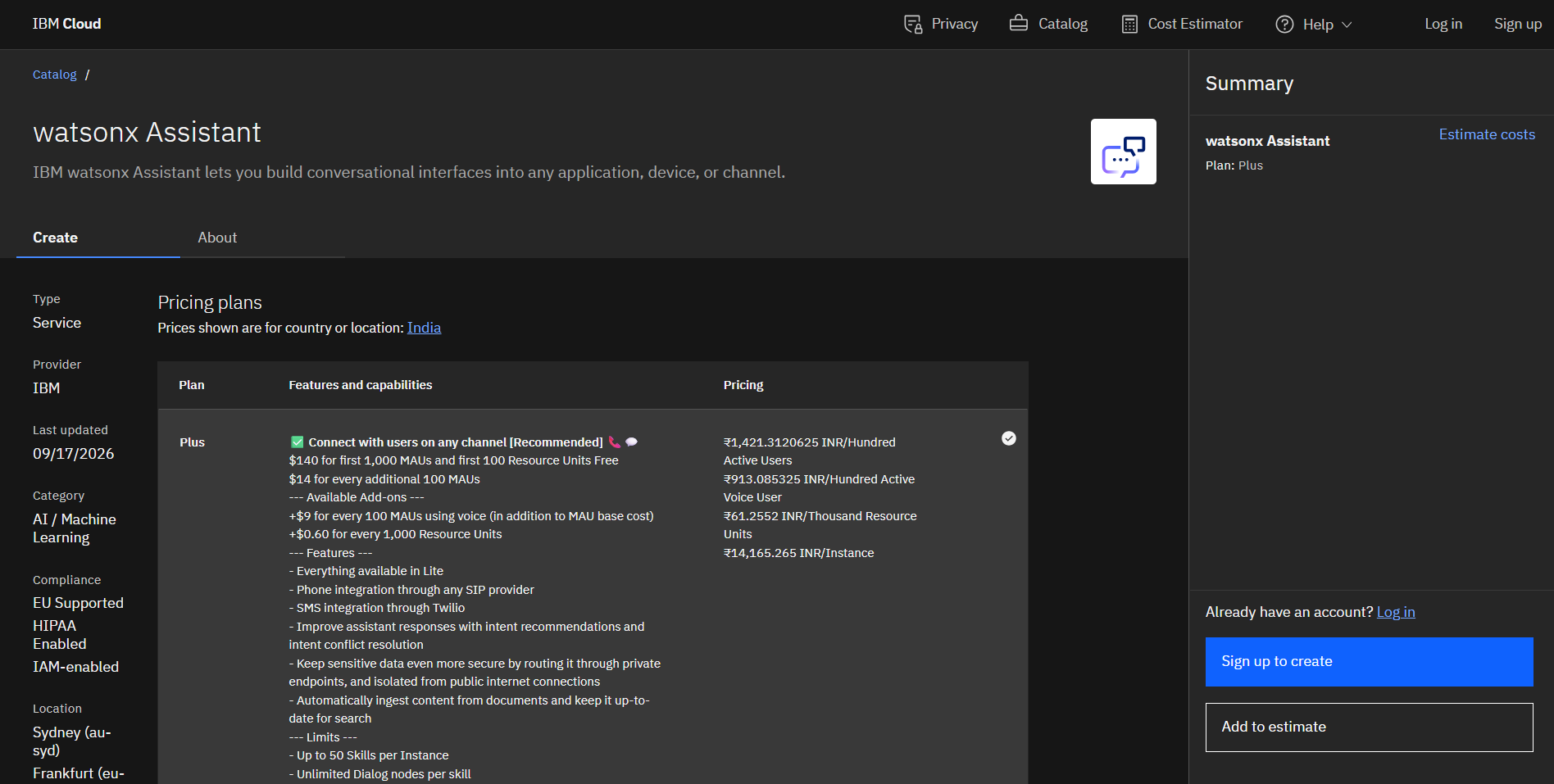
For firms that require a hybrid cloud setup and have deep links to the IBM system, watsonx Assistant is the fundamental choice.
It emphasizes security and responsibility in AI, which makes it an ideal choice for finance, governmental agencies, and healthcare organizations. It is designed to function in any cloud environment and even on your local servers.
Key Features:
- AI Agent for Mainframe Management. This version helps IT teams manage complex systems by using agentic AI to find root causes of issues. It allows operators to stay in one chat window to resolve server problems that used to take hours of manual work.
- RAG with Enterprise Knowledge. The assistant links to your company knowledge base to deliver answers that are always current and based on your data. It makes sure that the AI only gives answers that your legal and compliance teams have already verified as safe.
- Hybrid Deployment Flexibility. The assistant can be hosted on IBM’s cloud, another public cloud or even your own private data center. This allows you to have control over the proximity of your AI to your data, thus minimizing latency and enhancing system security.
Pros:
- Compliance-Focused: Designed with compliance in mind, to cater to some of the most heavily regulated industries on earth.
- Scalable Architecture: Can run hundreds of agents at once without a drop in speed or quality of the responses.
- No-Code Builder: Allows non-technical staff to build and launch agents across web and mobile apps quickly.
Cons:
- Learning Curve: Connecting to deep backend systems or custom data can be hard and may need expert help.
- Ecosystem Lock-in: Works best if you are already using other IBM tools, and can be less flexible for teams outside that world.
9. Aisera
Aisera is the top choice for a Kore AI alternative and teams that want to fix their internal IT and HR support desks.
Unlike Kore.ai, which tries to be everything to everyone, Aisera aims specifically at service desk work to deliver fast wins. It uses pre-trained agents to handle employee requests with almost no manual setup needed.
Key Features:
- AI Service Desk. This platform is designed to take over the repetitive tasks of IT and HR teams, such as resetting passwords. This clears out the backlog of simple tickets, allowing your skilled IT staff to focus on high-level projects.
- Hyperflows for Automation. These flows link your various business apps together to carry out multi-step tasks across different systems. It removes the need for manual data entry between HRIS and IT tools, speeding up the time it takes to get a new staffer ready.
- GenIQ for Secure Model Querying. This feature allows the AI to query your models safely while maintaining data privacy. It gives your team the power of generative AI with the safety of a private, gated environment.
Pros:
- Fast Time-to-Value: Emphasizes quick setup with pre-built links to tools like ServiceNow, Zendesk, and Workday.
- High Resolution: Automates up to 70 percent of internal requests, significantly lowering the cost per ticket.
- Enterprise Ready: Fully compliant with SOC 2 and HIPAA out of the box for immediate use in large firms.
Cons:
- Narrow Scope: Focused mainly on IT and HR, so it might not be the best choice for complex customer-facing sales needs.
- Less Customization: While fast to launch, it offers less freedom to build unique, non-standard workflows than Kore.ai.
10. AgentFlow (Multimodal.dev)
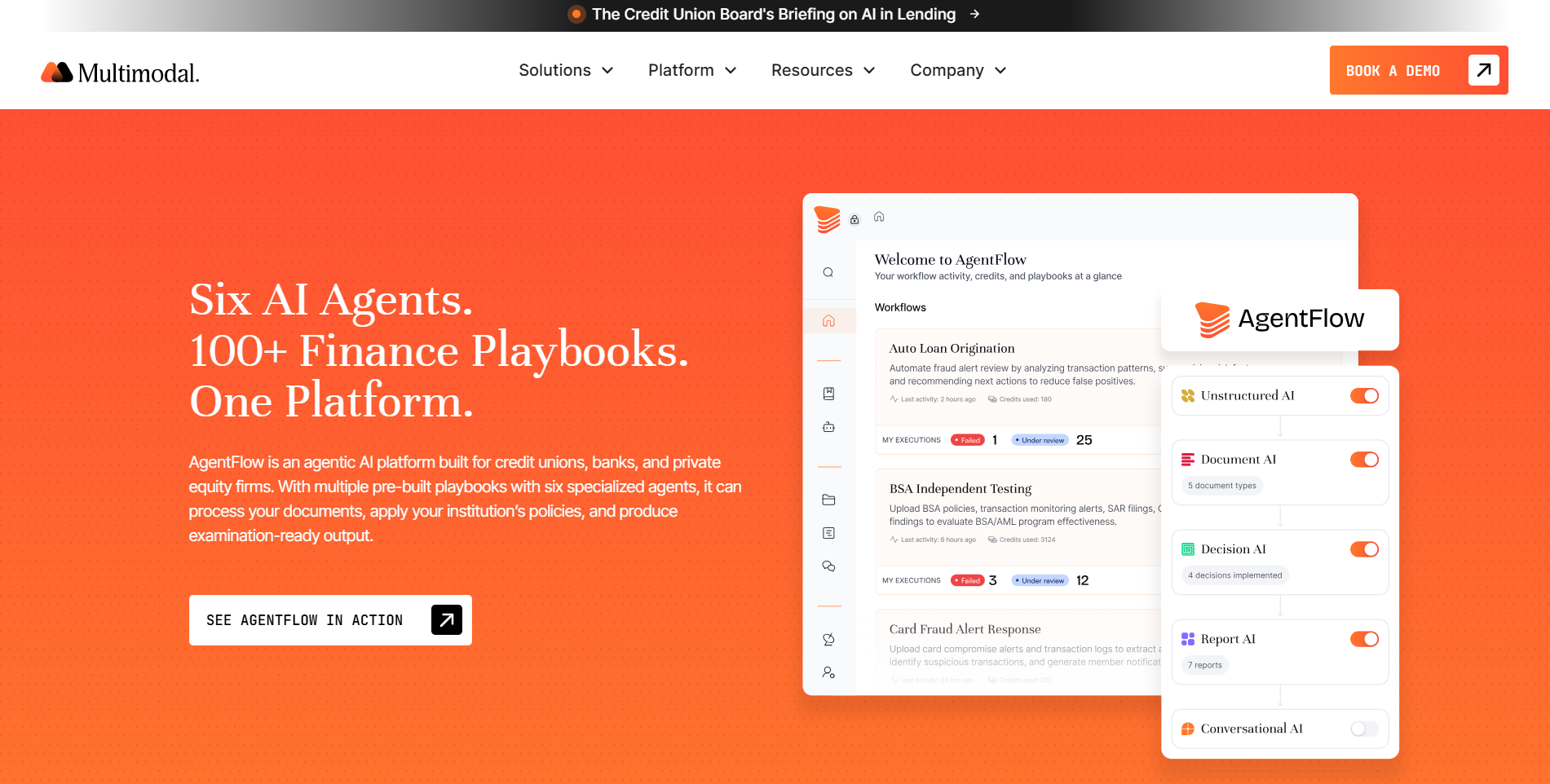
For firms in the insurance and finance sectors where every decision must be audited, AgentFlow is the tactical winner.
It prioritizes governance and explainability over chat interfaces, making it ideal for high-stakes work. It is built to manage the logic of a business process, not just the talk with the user.
Key Features:
- Multi-Agent Governance. This system manages a team of agents that handle different parts of a complex workflow like insurance claims. Every step taken by an agent is recorded and can be audited by a human to find out exactly why a decision was made. It makes sure that the firm stays compliant with the law even when agents are acting autonomously to finish work.
- Confidence-Scored Decisions. Every action the AI takes is given a score to show how sure it is of the result before it moves forward. If the score is low, the system automatically hands the task to a human for review, preventing expensive mistakes. This allows the business to automate the easy cases and only spend human time on the hard ones.
- Private VPC Deployment You can host the entire system within your own virtual private cloud to keep your logic and data away from the public web. This is the top choice for firms that deal with highly sensitive financial data and cannot risk using a public SaaS platform. It gives you the power to use advanced AI agents while sticking to the strictest data rules.
Pros:
- Audit Ready: Built-in trails make it easy to show regulators exactly how the AI is making choices and moving money.
- Domain Specific: Comes with templates built specifically for banking and insurance tasks like underwriting.
- Flexible Logic: Allows business experts to guide the AI's behavior without needing to write a single line of code.
Cons:
- UX Focus: Less optimized for building a flashy chatbot; the main aim is the backend work and the logic.
- Price Point: Custom enterprise quotes are common, and the focus on safety means it can be a high investment.
Thunai: The Best Alternative Option to Kore AI
- After evaluating the landscape, the final tactical verdict is clear: Thunai. While many platforms talk about AI capability, Thunai focuses on execution.
- It moves beyond scripted conversations and fragmented tools, bringing autonomous AI agents that understand context, act across systems, and drive real outcomes.
- For leaders looking to reduce operational drag, improve customer experience, and scale without adding complexity, Thunai delivers where others stall.
- It’s not just a Kore AI alternative; it's a practical step forward for enterprises that want AI to work like a teammate, not a project.
Stop wasting time adding AI to a process you should have redesigned. Pick a Thunai partner that lets you redesign your results for 2026. Book a demo now
FAQs on Top Kore AI Alternatives
How do I choose the right Kore AI alternative?
Start with your biggest gap: voice quality, mobile reach, internal automation, or compliance. Thunai is built to solve your most expensive problem first.
Are these platforms only for large enterprises?
No. Some target global enterprises. Others fit mid-sized teams that want fast deployment and clear ROI.
Do I need an in-house AI team?
Usually not. Many platforms, including Thunai, offer managed services or no-code tools that reduce the need for dedicated AI engineers.
How much does industry specialization matter?
More than most people think. Platforms trained on your industry's data, like Thunai, tend to launch faster and make fewer early mistakes.
Will these platforms work with my existing systems?
Yes. Most, including Thunai, connect with CRMs, service desks, and backend tools, so you don't have to rip out what's already working.