
Are you sure that your AI is aiding the growth of your company or silently losing your customers?
When an AI gives slow responses, fails processes, and lies, it causes harm not just to the support function but to the trust, bottom line, and customer experience as well.
This is why many firms are investigating other AI solutions like Cognigy AI that can interpret their business data, respond instantly, and provide value quicker. Here are 7 Cognigy AI alternatives to go through in this guide.
Why Look for Cognigy Alternatives in 2026?
Cognigy has led the conversational AI space since 2016, and its 2025 merger with NICE — now NICE Cognigy confirmed what the market wants: large-scale, global customer engagement infrastructure. But that scale comes with three recurring pain points teams keep running into:
- Long implementation timelines. Cognigy deployments typically take 4 to 6 months and require specialized teams to design and maintain conversation flows.
- High Total Cost of Ownership. It is priced between $115,000 and $350,000 per annum without voice minutes, integration, and professional services.
- Latency and inflexibility. The hybrid approach (rules and NLP) is under your control, but it may be slow, with latency above 800ms for voice and not able to deal with tasks not defined in advance.
If quick deployment, low cost, and high day-one accuracy are more important to you than enterprise-level scale, the following are some other solutions to consider.

Cognigy vs. Thunai: Choosing the Right AI Backbone
What Is Cognigy?
Cognigy is an AI conversation platform for enterprises only and helps organizations build, implement, and manage AI-powered bots for applications like voice, chat, and internal communications. The hybrid AI technology used by the platform is a combination of deterministic and generative AI and is therefore ideal for industries having strict compliance requirements (banking, insurance, telecom).
Strengths: Integration with CCaaS providers (NICE inContact, Genesys, Five9), strict control of conversation flow, and a scalable architecture.
Weaknesses: Time to value of 4-6 months, design teams for AI and conversation management separately, and latency of voice applications exceeding 800 ms.
What Is Thunai?
Thunai starts from a different premise: knowledge first, flows second. Instead of hand-building conversation trees, it creates a unified "AI Second Brain" that ingests your documents, chat logs, video, and CRM data, then uses that knowledge to power accurate, context-aware agents across every channel.
Strengths: deployment in hours to days, a claimed 95% reduction in hallucinations through conflict resolution in its knowledge layer, sub-500ms target latency on voice, and custom pricing.
Trade-offs: fewer pre-built CCaaS integrations than Cognigy, with niche connectors still being built out.
Head-to-Head: Cognigy vs. Thunai
Verdict: Select Cognigy when you require CCaaS integrations, compliance, and a time frame of several months to deploy. Choose Thunai when quick implementation, cheaper pricing, and accuracy are needed from your raw data sets.
Top 6 Cognigy Alternatives for Enterprises
If you want to look at other names beyond the main fight, here are six strong choices.
1. Thunai
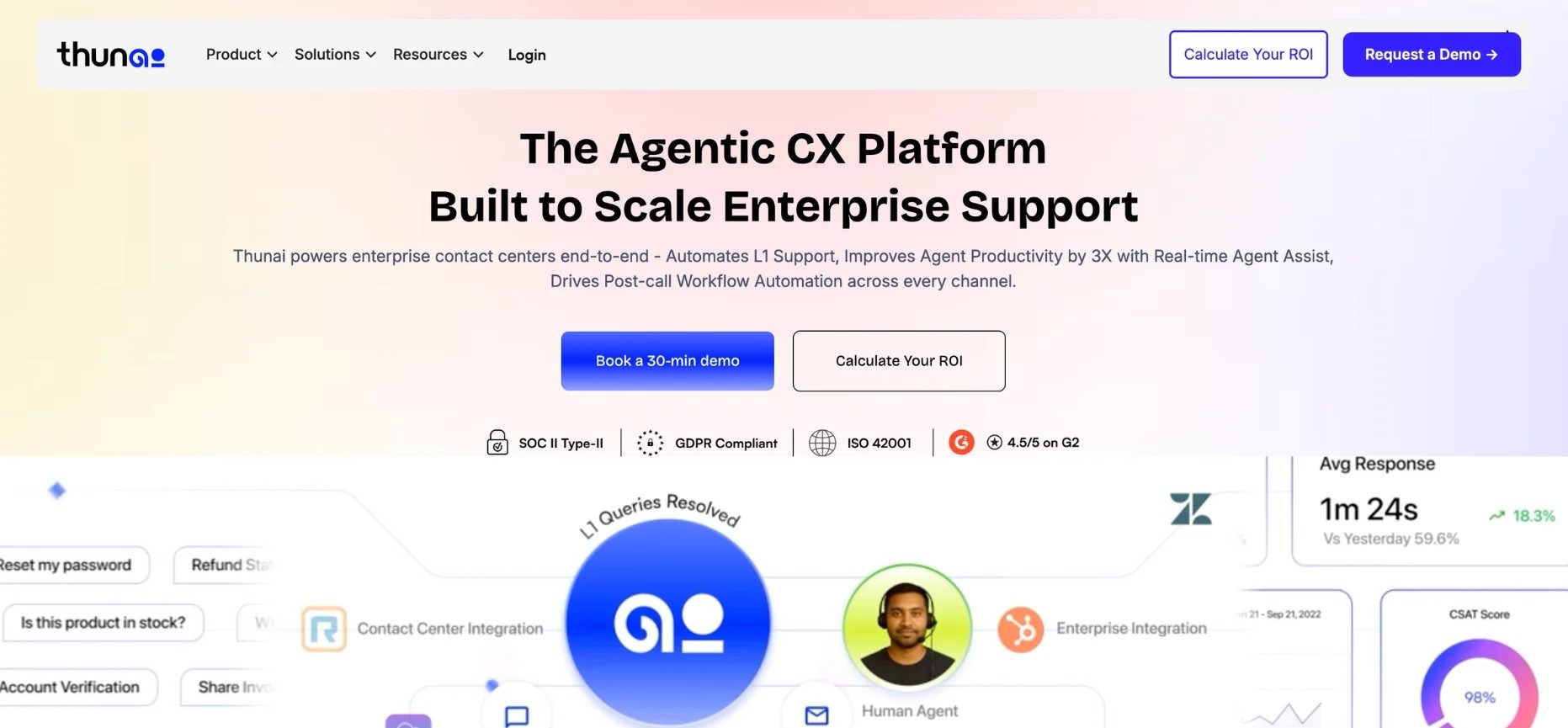
Thunai acts as a second brain by collecting facts from files and chat logs into one place. It resolves conflicting facts that clash to stop the AI from making 95 percent of common errors.
Agents use this single source of truth to answer questions and finish tasks across many channels, automating workflows, customer support, and even CRM and ticket updates.
Features:
- Model Context Protocol: This lets different agents talk to each other without losing any data. A voice bot can pass every call detail to an email bot for a perfect follow-up.
- Live Sentiment Analysis with Barge-In: The system tracks if a user is getting angry in real time. If the score drops, it alerts a manager who can join the call and save the sale.
- AI Suggestions Copilot: While a human talks, the AI shows tips and data on their screen. It pulls these from your internal guides so agents always give the right answer.
- Meeting to Knowledge Loop: A meeting agent joins your internal calls to take notes. It turns these talks into searchable facts so your support team stays updated on new rules.
Pros:
- Very fast setup starts on day one.
- Low-cost tier for growing firms.
- High accuracy with almost no fake answers; the best Cognigy AI alternative.
Cons:
- Still building out some niche app links.
2. Kore.ai

Kore.ai uses a multi-agent style where different bots talk to each other to solve a task. This Cognigy AI alternative platform allows users to pick the AI model that works best for their specific needs.
Kore.ai, as a cognigy alternative tool, along with Kore AI alternative tools, is made for banks and hospitals where rules for safety are very strict.
Features:
- Multi-Agent Orchestration: This lets you manage a whole team of bots that work as one. You can coordinate tasks across HR, IT, and sales departments with high precision.
- Knowledge Graph Maturity: This goes beyond simple search to map how different facts link together. It helps the AI reason through complex problems that have many steps.
- Enterprise RAG Search: The system breaks down hard questions into smaller subtasks. It then finds the best data for each step to give a very accurate final answer.
Pros:
- Very flexible for work across every part of a firm.
- Strong focus on safety and rules.
- Full end-to-end work automation.
Cons:
- It's very hard to learn. You need a team of experts.
- Delay can be high for real-time voice calls.
- High price with no public rates.
3. Yellow.ai
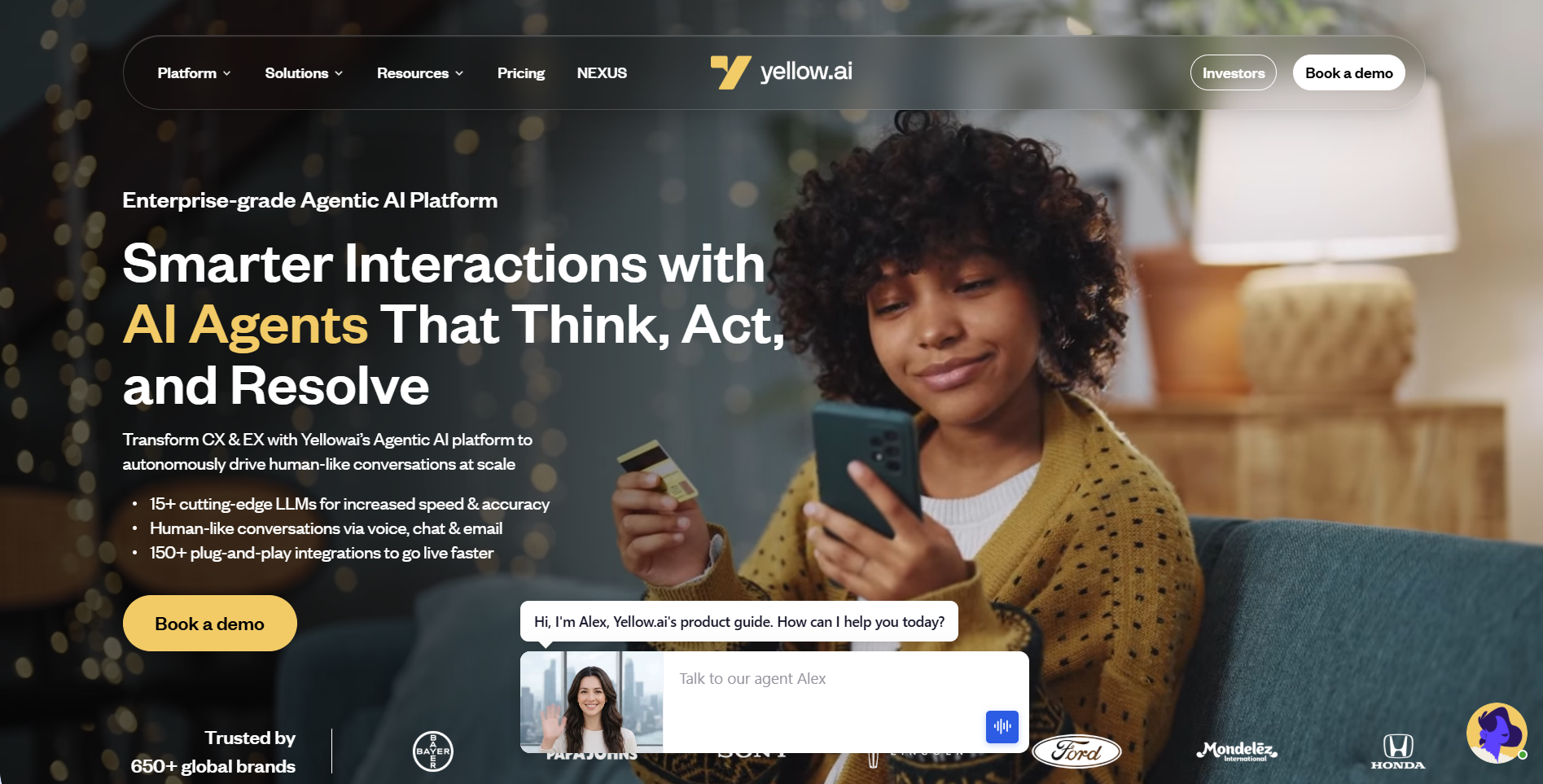
Yellow.ai uses a multi-model engine called DynamicNLP to handle billions of talks. The system excels at talking like a person in over 135 different languages. This Cognigy AI alternative uses pre-built templates for stores and online sales to launch quickly.
Features:
- DynamicNLP Multi-LLM Engine: It enables the bot to identify the user’s intentions in 135 languages. It processes billions of conversations annually and gains experience from them to improve itself.
- Unified Experience in Omnichannel Communication: There are 35 channels available to communicate using various applications like WhatsApp or SMS. If the user changes channels midway during the conversation, the bot retains the context of the discussion.
- Komodo 7B Model: This is a special AI model made for regional languages. It helps the bot talk naturally in local dialects that other big models might miss.
Pros:
- Leader for firms that need many languages.
- Fast to launch compared to old platforms.
- Can handle massive amounts of traffic.
Cons:
- Some risk in how it links to old systems.
- Hard to customize for very complex legal steps.
- Costs can go up fast if you have a lot of traffic.
4. Voiceflow

Voiceflow is a layer that works with any AI tech to build chat and phone agents.
This Cognigy AI alternative uses a visual canvas so teams can build and test agents without writing any code. The tool prioritizes teamwork and clear design for the user experience.
Features:
- Collaborative Visual Canvas: This works like a shared doc where teams build bots together. Designers and coders can see changes in real time and leave notes for each other.
- LLM and NLU Agnosticism: You can choose to use GPT, Claude, or any other AI model. This stops you from being locked into one vendor as new tech comes out.
- High Fidelity Prototyping: You can test how your voice bot sounds on a real phone or smart speaker. This helps you fix weird pauses or bad tones before you go live.
Pros:
- Speeds up the time to see value. You can launch in days.
- Clear pricing based on the number of users.
- Great for teams that care about how the bot feels to use.
Cons:
- No built-in phone system. You must link to other tools like Twilio.
- Prices go up fast for large teams.
- You still need tech help to link the final agent to your data.
5. Rasa
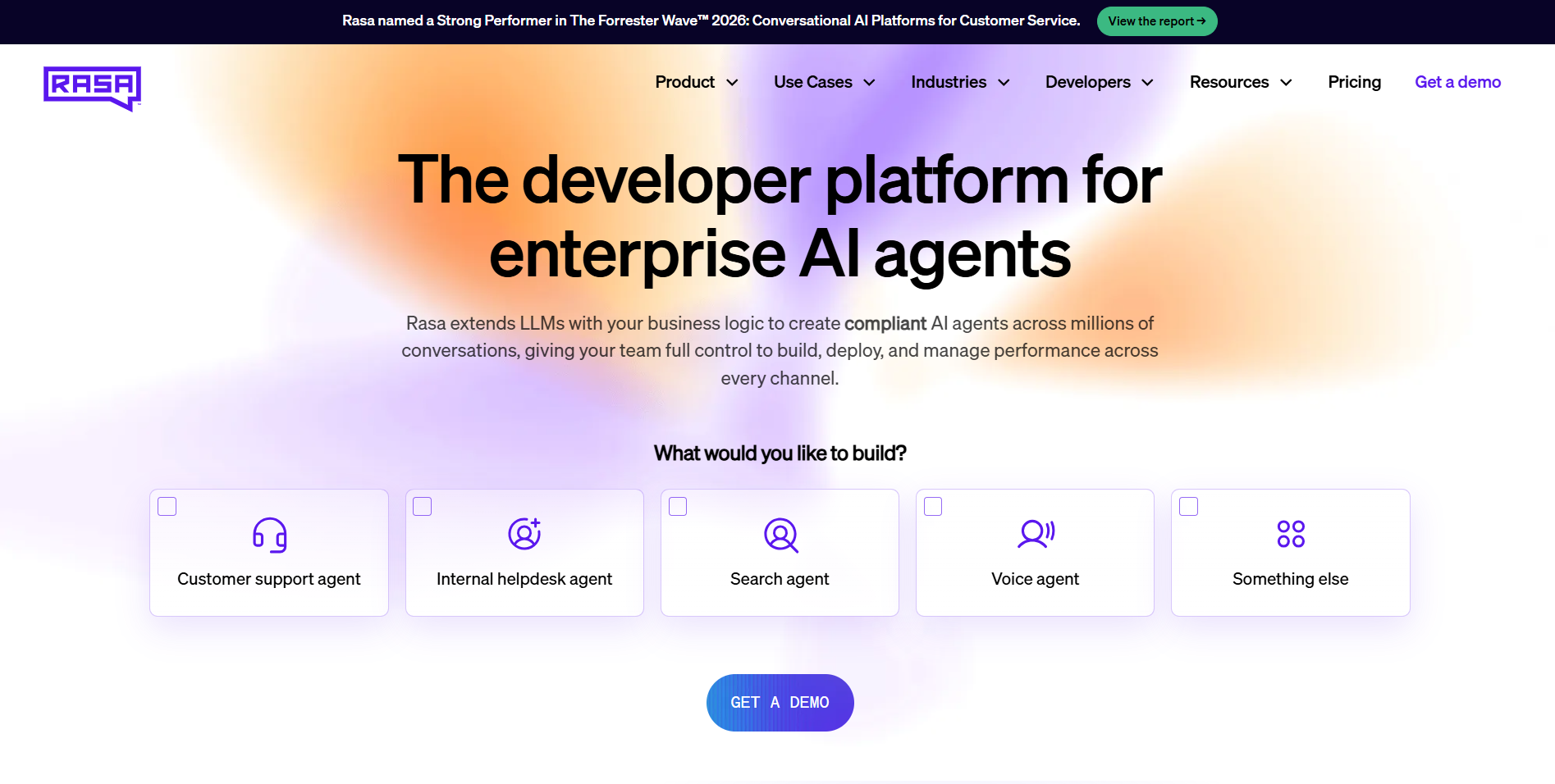
Rasa is an open-source system built for developers who want total control over data. This Cognigy AI alternative has tech that fixes conversations when a user changes the topic during a chat. The architecture lets firms choose and change their AI models as the tech grows.
Features:
- Conversation Repair Technology: This helps the bot handle it when a user changes their mind. If a user jumps from one topic to another, the bot keeps up without breaking.
- Open Source Framework: You can see and change every part of the code for your bot. This is perfect for firms that need to build very custom or secret functions.
- Rasa Studio No-Code UI: This gives non-tech staff a way to help build the bot. They can design the talk flows while the tech team handles the deep coding.
Pros:
- Total ownership of your data and models.
- Allows for new ideas without being stuck with one vendor.
- The basic version is free for teams starting out.
Cons:
- Needs a lot of people to build and keep it running.
- Slow to launch compared to ready-made tools.
- Hard setup. Not for teams that want simple tools.
6. OneReach.ai
OneReach.ai provides a low-code platform that focuses on user experience and trust. This Cognigy AI alternative uses a reasoning engine to handle long, multi-step tasks across many channels. The system prioritizes human-like conversations that build trust with the customer.
Features:
- Omnichannel Hub: You can build one bot that works on the phone, web, and social media. It tracks the user across all of them so they never have to repeat themselves.
- Low Code Logic Builder: You can create very complex tasks using a simple visual tool. It lets you add steps for checking data or sending alerts without heavy coding.
- Personalized CX Journey: The bot uses your CRM data to treat every user as an individual. It remembers their past purchases and likes to give them better help every time.
Pros:
- Rated high for service and ease of use.
- Good balance for both business and tech teams.
- Faster growth than heavy enterprise tools.
Cons:
- No public pricing. You must talk to a sales rep.
- Less depth for phone calls than voice-first tools.
- Hooking up to old data can take extra work.
Cognigy Alternatives Compared by Pricing and Usage
Selecting the right Cognigy AI alternative base is about matching your company's needs to the style of the tech. This chart looks at the facts for leadership.
The Final Verdict: Choosing the AI Backbone That Defines Your Future
- Select Thunai when the quickest route to accurate and knowledge-based AI at affordable rates is required.
- If you’re from a Global 2000 organization requiring CCaaS deep integration and compliance, then Cognigy is your choice with time to deploy over several months.
- Kore.ai is for automation across departments in a regulated industry.
- Yellow.ai is best suited for multilingual, high-volume, and B2C use cases.
- For fast prototyping and a design-led approach, choose Voiceflow.
- Select Rasa when full data ownership and model control is required.
- If you require a low-code omnichannel CX solution that returns ROI fast, then select OneReach.ai.
- For a developer-focused voice automation platform with transparent usage rates, go for Retell AI.
Ready to move beyond traditional AI workflows? Book a Thunai demo today and see how AI agents can turn your business knowledge into real actions.
FAQs on Cognigy AI alternative
What are the major risks of moving to AI that CEOs often miss?
The biggest risk is not the tech failing. It is people trusting the AI too much without checking the work. This is called automation bias. Also, if your data is a mess, the AI will just make mistakes fast. This is why the Thunai Brain is useful. It acts as one source of truth and cleans data before the AI ever uses it.
How does the price of a platform change the long-term return?
Old platforms like Cognigy or Kore.ai use hidden, sales-led contracts. These can lock you into high fixed costs between 100,000 and 350,000 dollars a year. Modern tools like Thunai or Retell AI use monthly rates or pay per minute. This lets you test and only pay more when the system works.
Is Agentic AI really different from the bots we used before?
Yes. Old bots are like a train. They follow a track or a flow. If a user asks something odd, the bot breaks. Agentic AI is different. It has a goal. You tell it to help a user return an item. It figures out the best way to do that on its own. It can handle interruptions and changes in the talk naturally.
When will I see a return on the money I spent?
Firms that use fast AI see value 2.5 times faster. While a big Cognigy setup might take six months to save money in a huge center, a fast platform like Thunai can show results in days. It stops common queries right away once it links to your data.
Does using an AI backbone mean I have to replace my whole helpdesk?
Not at all. Modern platforms like Thunai AI sit on top of what you have. They link to Zendesk or Salesforce with one click. They give your humans new powers instead of making you start from zero. This lets you modernize without the pain of a total move.