What occurs when insurance bots go beyond answering questions?
They can verify policies, endorse, file claims, and update core systems.
However, there are consequences to the level of automation too; it is the risk that comes with regulatory compliance, data security, and licensing.
This is a guide to all things related to the use of chatbots in insurance through artificial intelligence.
What Is an Insurance AI Chatbot?
An insurance AI chatbot is a digital assistant built to automate customer conversations across the policy life cycle. Unlike general assistants, AI chatbots for insurance work under strict state rules.
They also plug into complex enterprise data networks. They turn chat text, emails, and voice transcripts into structured database actions.
The best tools integrate with agency management systems (AMS) and policy administration systems (PAS). These systems include Guidewire, Applied Epic, Duck Creek, and AMS360.
Such integration enables AI chatbots for insurance to validate policyholders, search for terms, charge premiums, bind policies, and file claims. Decisions about insurance are contractual. So these bots need firm guardrails that stop false statements and protect private records.

Scripted chatbot vs. conversational AI vs. agentic AI that can transact
Insurance messaging tools fall into three groups.
- Scripted Decision-Tree Chatbots: These use fixed rules, buttons, and keyword matching. Odd phrasing or a multi-part question breaks them. They cannot write changes back to core databases. Containment stays at 20% to 30%.
- Conversational AI Systems: These use natural language understanding (NLU) and large language models (LLMs). They grasp context and pull answers from policy manuals. Still, they mostly read and do not write. To update a vehicle schedule or a deductible, they hand off to a licensed human.
- Agentic AI That Can Transact: This is the top level of maturity for AI chatbots for insurance. Agentic systems plan steps and run verified actions in real time. They use integration layers like the Model Context Protocol (MCP). This bot will check the underwriting rules, access data from Applied Epic or Guidewire, endorse the policy, and issue the documents in just a few seconds.
AI Chatbot Use Cases Across the Insurance Lifecycle
Modern bots automate sales, servicing, claims intake, and underwriting work. To find the best AI tools for insurance agents, ask how well each one removes friction at every stage.
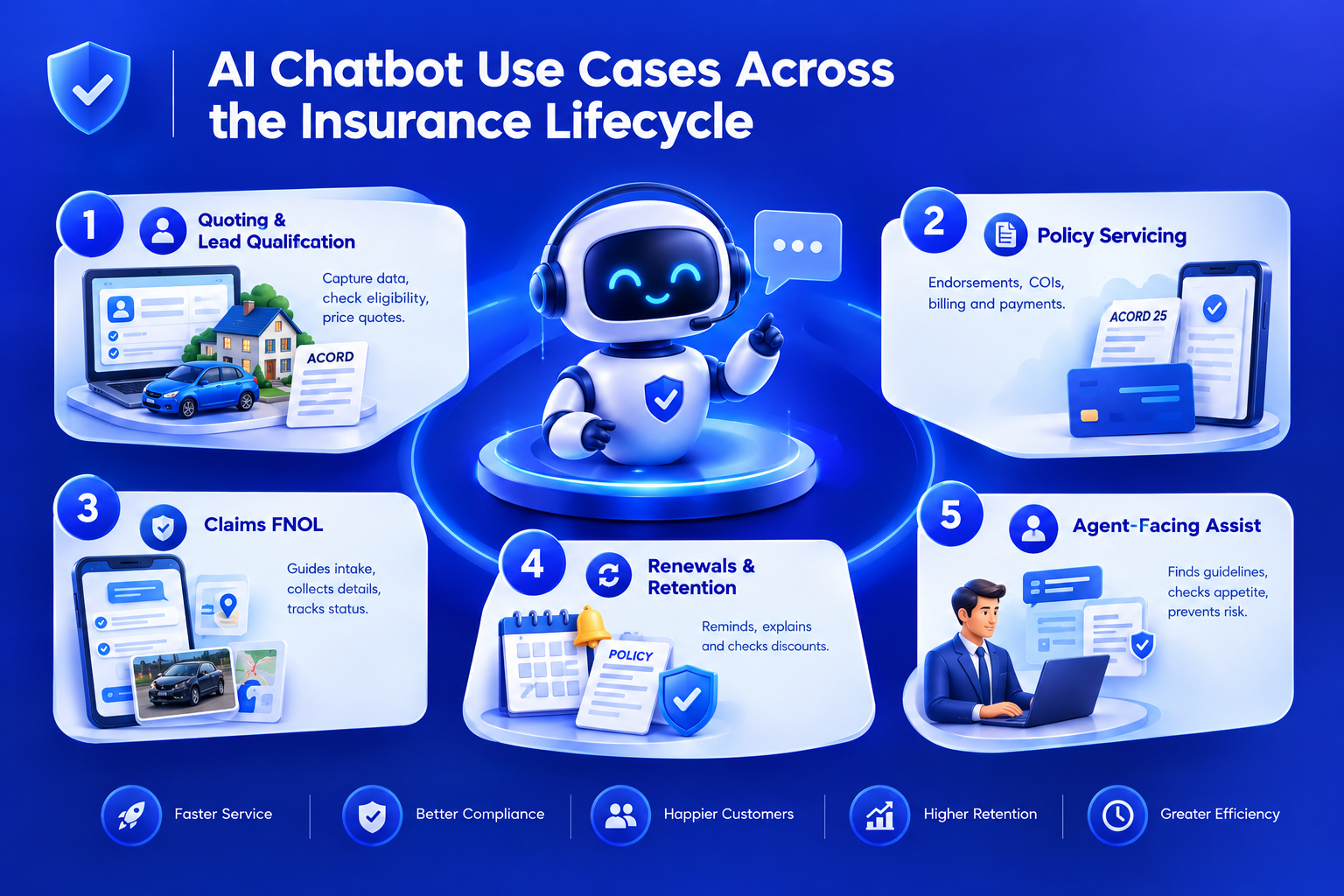
Quoting and lead qualification
- Lead workflows capture consumer data, check eligibility, and price a preliminary premium.
- Chatbots collect rating data such as property addresses, vehicle identification numbers (VIN), commercial payroll, and loss histories.
- By linking to rating software and public databases, AI chatbots for insurance check facts on the fly.
- The bot confirms square footage, checks municipal records, and prepares standard ACORD applications.
- Leads outside guidelines get a polite decline. High-value prospects go to licensed producers with a summary of coverage needs.
Policy servicing: endorsements, COIs, billing
Routine servicing makes up most incoming calls and emails at modern agencies. Strong AI chatbots for insurance resolve these requests on their own:
- Endorsements Mid-Term: The system uses 2-factor authentication to verify the identity. The system collects the payment, calculates the pro-rata premium, logs the agreement, and updates the policy database.
- Certificates of Insurance (COI): The bot verifies the policy status, verifies the additional insured status, generates the ACORD 25 certificate, and sends it to the policyholder.
- Billings & Payments Inquiries: The bot answers questions regarding the billing schedule, premium adjustments, and accepts credit card or ACH payments.
Claims FNOL and status tracking
- First Notice of Loss (FNOL) is a key moment. Retention is won or lost here.
- Dedicated AI-powered tools for insurance claims processing cut intake from twenty minutes by phone to under three minutes in chat.
- During reporting, AI chatbots for insurance guide claimants through set questions.
- They collect accident dates, GPS coordinates, a short narrative, and police report details. Computer vision reviews photos of damage and checks file metadata.
- The claim automation platform opens the claim in your tool, routes it to an adjuster, books a rental car, and issues a tracking ID. Claims teams then focus on inspections and settlements.
Renewals and retention outreach
- Surprise premium hikes drive churn. Automated outreach tracks renewal dates thirty to sixty days before expiry.
- It reaches policyholders by web chat, email, and messaging with clear renewal outlines.
- When rates rise due to state filings, the bot explains why.
- It also checks for unused discounts, such as bundling, low mileage, or protective devices.
Agent-facing assist: carrier appetite, underwriting guidelines lookup
- Producers lose hours searching carrier appetite guides and binding manuals.
- Specialized insurance knowledge management tools turn scattered manuals into one source of truth.
- Internal AI chatbots for insurance act as assistants during client talks.
- An agent can ask: "Can we place an electrical contractor with three ladder claims operating on commercial sites over four stories?" The assistant scans guidelines, checks binding authority, notes exclusions, and lists fitting markets in seconds.
- This shortens onboarding and stops teams from binding unapproved risks.
By Insurance Line: What Changes
Goals, rules, and containment figures vary by vertical. Personal Property and Casualty (P&C) leans on automated resolution. Health and Medicare lines need strict safeguards.
In health and senior markets, bots must support voice as well as text. Firms that compare the top AI voice agents for insurance companies find that seniors switch between phone and chat. Enterprise AI chatbots for insurance keep context across channels, so customers never repeat themselves.
Compliance and Security for Insurance Chatbots
Compliance is the main divide between sandbox bots and dependable enterprise software. Insurance is among the most audited industries. Failures in automated messages bring civil liability, license penalties, and churn. Enterprise-grade AI chatbots for insurance need built-in guardrails that enforce set statutory standards.
1. PII and PHI Safeguards Under HIPAA
- Bots that provide health insurance, bodily injury claims, or workers’ compensation deal with protected health information (PHI) and personally identifiable information (PII).
- A Business Associate Agreement (BAA) needs to be signed by the provider.
- The design must guarantee zero data retention with base model providers, so private records never enter public training sets.
- The transcripts should be encrypted using AES-256 and TLS 1.3, respectively.
- The certificates to look out for include SOC 2 Type II, ISO 27001, and ISO 42001.
2. State Department of Insurance (DOI) Rules and the NAIC Model Bulletin
State commissioners review AI use under market conduct rules. Many states have adopted or built in the NAIC Model Bulletin on the Use of Artificial Intelligence Systems by Insurers. New York did so through DFS Circular Letter No. 7. Colorado did so via SB 21-169. Carriers that deploy AI chatbots for insurance must keep an Artificial Intelligence Systems (AIS) program. It requires:
- An audited inventory of all AI models that touch policyholder decisions.
- Testing to prevent bias or unfair proxy discrimination.
- Written governance showing that outsourcing to vendors does not remove carrier accountability.
3. Centers for Medicare & Medicaid Services (CMS) Recording Rules
Agencies and marketing organizations that act as TPMOs face tough federal rules. CMS recording is mandatory under 42 CFR §§ 422.2274 and 423.2274. TPMOs must record and keep every interaction in the chain of enrollment, in chat and by phone. Any of the AI chatbots for insurance that touch Medicare must follow these rules:
- Keep every chat log and call recording in secure, searchable storage for at least 10 years.
- Show the standard TPMO disclaimer in the first 60 seconds.
- Record consent and log Scope of Appointment forms before reviewing plans.
Missing logs can bring license sanctions, lost carrier contracts, and fines.
4. Licensed-Advice Boundaries
- Every state code draws a line between administrative help and licensed advice.
- Unlicensed reps and bots may not recommend coverage limits, advise clients to drop policies, or judge whether risk is adequate.
- Enterprise AI chatbots for insurance must enforce this line.
- Say an insured asks, "Should I lower my umbrella coverage to $1 million?" The bot must say it is automated, decline personal advice, and transfer the chat to a licensed agent.
5. Audit Trails and Errors & Omissions (E&O) Exposure
- Courts hold firms accountable for what their bots say and quote.
- Suppose a bot wrongly tells an insured that a commercial property policy covers flood loss.
- The agency then faces E&O liability.
- Insurers need auditable logs of the user input, the knowledge base text used, the model's confidence rating, and the exact reply.
What an Insurance Chatbot Costs
Pricing for AI chatbots for insurance depends on architecture, customization, and integration depth.
Buyers must also count total cost of ownership. That includes upkeep for older AS400 links, LLM token charges during severe weather surges, and yearly compliance checks. Flat monthly pricing removes the surprise of usage-based fees.
Insurance Chatbot Platforms Compared
The market for AI chatbots for insurance includes CX suites, contact center vendors, and vertical AI platforms.
Reviews often praise Thunai's quick setup. Clients launch working agents in under 48 hours. Its Thunai Brain engine resolves knowledge conflicts across policy manuals and helps prevent hallucinations.
Large deployments at Bazooka Candy and Neuberg Diagnostics show a 70% drop in handle times and an 80% deflection rate, with 95% customer satisfaction.
How to Measure Insurance Chatbot ROI
To calculate return on AI chatbots for insurance, track service efficiency, savings, and retention.
Containment rate, quote completion rate, FNOL cycle time, cost per policy serviced
1. Containment Rate.
- This is the share of interactions resolved with no human.
- Basic info bots contain under 30%. Modern AI chatbots for insurance reach 75% to 80% on routine tasks such as payments, ID card delivery, and coverage checks.
2. Quote Completion Rate.
- Long forms make buyers leave.
- Conversational AI lifts completion by 25% to 40% over static forms.
- It clarifies questions and checks entries live.
3. FNOL Cycle Time.
- Manual intake often delays assignment by one or two business days.
- Agentic bots capture details, review photos, check coverage, and post files in seconds.
- That lowers claims costs by 30% to 40%.
4. Cost per policy serviced.
- Live calls cost an agency between $4.50 and $7.50.
- Automated chats with an AI Chatbot for insurance cost between $0.20 and $0.45.
- These run around the clock.
Where Insurance Chatbots Fail
Poor design sinks results. AI chatbots for insurance fail for four root causes.
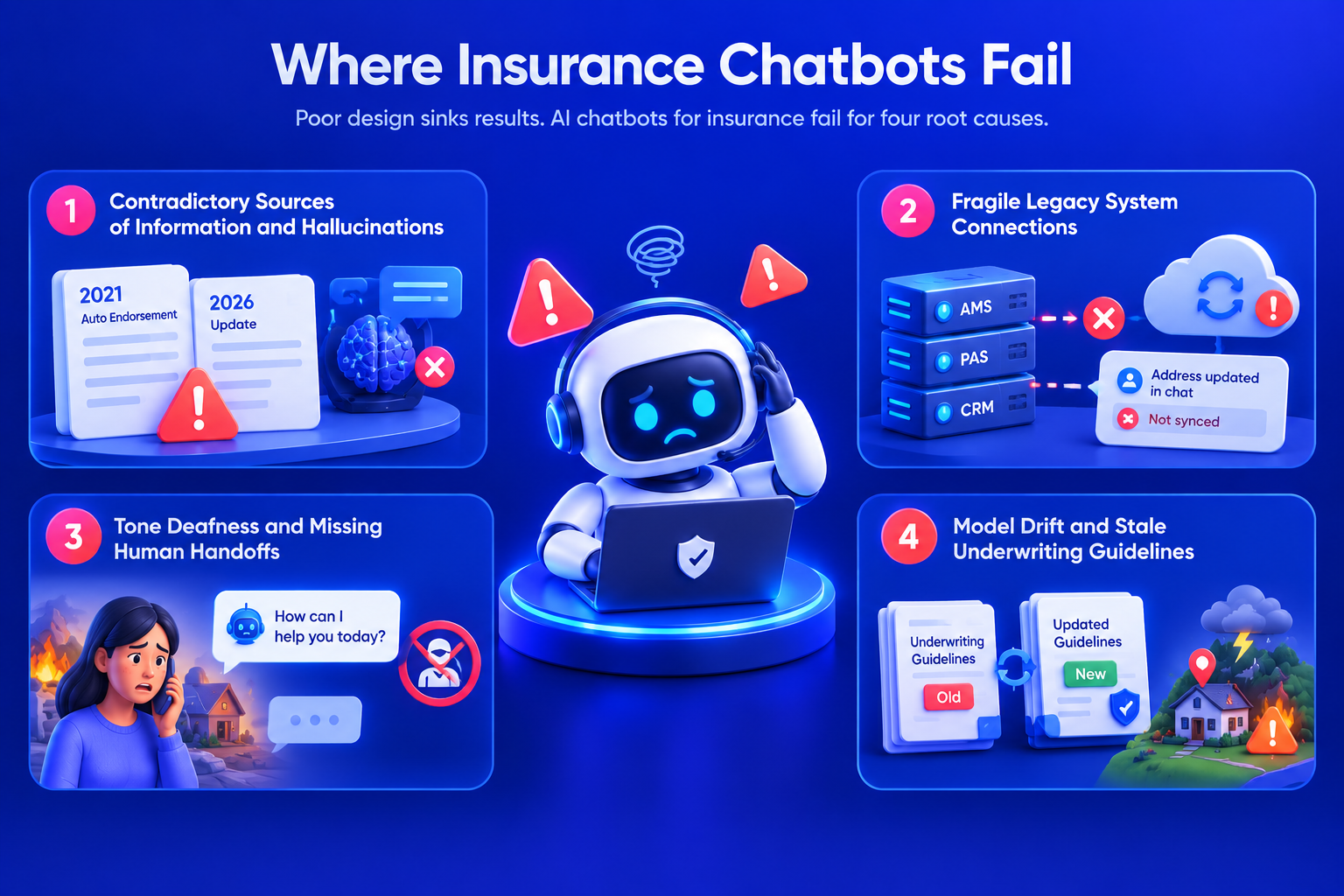
- Contradictory Sources of Information and Hallucinations: The AI writes based on probabilities, not truths. A 2021 auto endorsement in contrast with a 2026 update, results in errors. An error in the deductible amount carries risk.
- Fragile Legacy System Connections: Unstable scrapers or delayed batch updates drop data between systems. A client may change an address in chat, but it never syncs. Then come missed cancellation notices and billing failures.
- Tone Deafness and Missing Human Handoffs: Claimants call during fires, crashes, and losses. Bots with no sentiment detection irritate them. No fast handoff to an adjuster leads to cancellations and state complaints.
- Model Drift and Stale Underwriting Guidelines: Appetite shifts with weather and inflation. A bot that keeps quoting high-risk brush areas after a binding freeze creates unauthorized policy exposure.
FAQs
Can AI chatbots for insurance bind coverage autonomously?
Modern AI chatbots for insurance can finish intake, rating, and payment steps. Binding authority is still heavily regulated. A program cannot use discretionary underwriting judgment without a licensed producer. In practice, bots gather data, calculate prices, and hold policies for one-click agent approval. Automated binding fits only pre-authorized personal lines with clear rating rules.
How do AI chatbots for insurance comply with HIPAA regulations?
The vendor must sign a Business Associate Agreement (BAA). The bot must redact personal health identifiers, encrypt data at rest and in transit, and use role-based access. User records must never train public language models.
What is the difference between conversational AI and agentic AI in insurance?
Conversational AI understands questions and pulls answers from manuals, but it stays mostly read-only. Agentic AI adds planning, multi-step action, and tool use. It connects to APIs, pulls account data, and writes records into policy software.
How do AI chatbots for insurance integrate with legacy systems like Applied Epic and Guidewire?
Integration runs through APIs, software kits, and protocols such as MCP. Modern cloud installs use RESTful web services. Older on-premises setups use secure middleware that turns chat input into database commands and keeps records in sync.
What are the CMS call recording requirements for Medicare chatbots?
Under 42 CFR §§ 422.2274 and 423.2274, TPMOs must record and store all communications in the enrollment chain. This covers calls, video meetings, and online chats. Firms must keep logs in secure systems for at least 10 years and show the TPMO disclosure within the first minute.
How do AI chatbots for insurance handle complex or emotional claims?
Enterprise platforms use sentiment analysis to spot stress and urgency. If a claimant reports a house fire or major crash, the bot skips non-essential forms, gives approved emergency guidance, and moves the chat to an adjuster. The human gets the full history and a summary.
What is an acceptable containment rate for an insurance chatbot?
For high-volume personal P&C work, such as billing dates, ID cards, or payments, well-tuned bots reach 75% to 85%. In complex lines like commercial or life underwriting, rates usually run 45% to 60%. Specialists handle the rest.
How do state Departments of Insurance regulate AI chatbots for insurance?
Regulators use market conduct exams, trade practices enforcement, and the NAIC Model Bulletin. Carriers must show their algorithms avoid unfair proxy discrimination, document how decisions are made, run model risk programs, and keep human escalation paths.
Can AI chatbots for insurance reduce Errors and Omissions (E&O) risk?
Well-built bots lower E&O exposure by keeping every interaction consistent. Humans sometimes forget disclaimers or misquote terms. Bots read from verified documents, state legal notices every time, and keep timestamped audit logs. Platforms like Thunai Brain cross-check documents to remove conflicting statements.
How quickly can an agency deploy AI chatbots for insurance?
Custom builds usually take six to twelve months. Vertical SaaS platforms like Thunai ship with pre-built workflows and no-code connectors. Agencies can load their knowledge base and launch live AI chatbots for insurance in under 48 hours.



.png)