


Fortune 100 MRO Retailer Automates Case Summaries in Salesforce
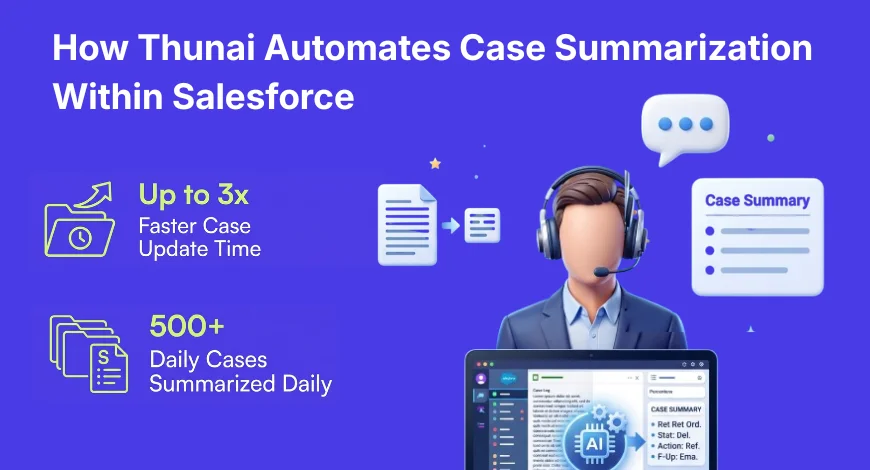
Up to 3x
500+
Up to 70%
Client Overview
Our client is a Fortune 100 MRO retailer that sells to facility managers, property management professionals, and maintenance purchasing departments within the United States.
Salesforce forms the main part of their support system, and as such, they require a means of maintaining accurate case tickets automatically.
This would be instead of having agents spend all their time entering information about their calls, emails, or chats.
On the whole, the client’s service desk handles hundreds of incoming case tickets per day on the phone and through chats involving everything from ordering problems to product warranty claims
The Challenges: Incomplete Cases, Manual Logging, No Sentiment Visibility
Support agents were carrying two jobs at once, resolving customer issues and documenting them. The documentation side was falling behind, and three problems kept showing up across every shift:
- Manual Case Updates After Every Call: After each voice interaction, agents were expected to write up a full case summary in Salesforce from memory. With high daily call volumes, entries were rushed, inconsistent, and frequently incomplete, leaving team leads with case records that did not reflect what actually happened on the call.
- No Idea of Prior Customer Interactions: Agents had limited visibility into previous customer interactions or conversations. Managers and agents lacked a concise view of previous customer conversations, making it difficult to understand case history quickly.
- Fragmented Interaction History: Customer interactions played out across voice and chat, but the case record in Salesforce rarely captured the full picture. Agents picking up a case mid-way had no reliable summary to work from. Meaning, customers needed to repeat themselves twice.
Our Intelligent Solution
We placed Thunai directly inside the client's Salesforce environment as native LWC components. Agents did not take on a new tool. Thunai became part of the interface they already worked on.
- Automated Post-Call Case Summarization: After every voice interaction, Thunai automatically generates a structured case summary capturing interaction details, discussion points, and resolution context for agent review and storage in Salesforce. In doing this, the documentation burden is fully lifted from the agent the moment a call wraps up.
- Issue Recording and Detection via Thunai Omni: When an issue on Thunai is detected mid-conversation, Thunai identifies key issues, escalation triggers, and discussion topics during conversations and highlights them within Salesforce for future reference.
- Channel-Aware Case Updates via Thunai MCP: Whether an interaction plays out over a voice call, email, or a chat session, Thunai identifies the source channel and updates the Salesforce case record accordingly. Every case carries the full, accurate history of how and where the conversation took place, pulling together all touchpoints into one clean record automatically.
- Consistent Case Records Across Every Agent: Because Thunai handles the documentation, case summaries no longer depend on who took the call. Records are structured, complete, and drawn from the actual interaction rather than from an agent's recollection at the end of a long shift. With this, team leads can always count on the case history being accurate regardless of who handled it.
Conclusion
By automating case summarization directly within Salesforce, Thunai reduced administrative effort, improved documentation consistency, and gave agents and supervisors immediate access to accurate interaction histories across every customer touchpoint.
Better yet, Thunai gathered information during actual interaction, which provides the team with an understanding of trends rather than focusing on single escalation incidents.
The hours previously spent on post-call admin are now going directly toward working through the next case in the queue. And in general, the support team spends less time writing up cases and more time closing them.
