
As a CEO, I have seen similar problems raised by teams in the boardroom and product meeting sessions.
The teams would like to find out if they need to make investments in either AI assistants or AI agents and the effects of such a choice on their clients, data, and operations.
In this article, we discuss the difference between AI Assistants vs AI Agents in simple terms, comprehend the working of the latter, understand the various kinds of AI agents and finally give some examples.
What is an AI assistant?
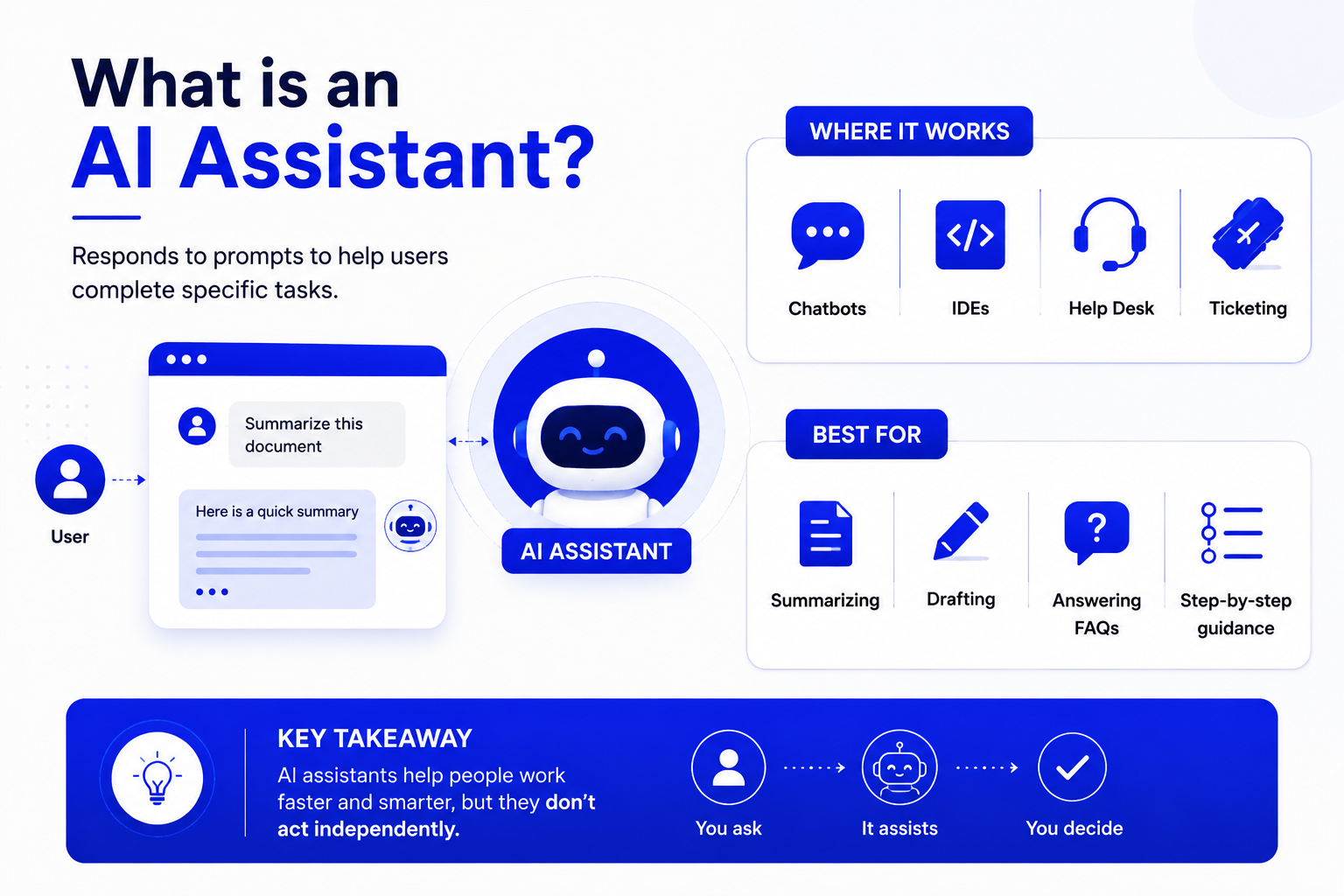
The AI assistant is the computer software that assists the user in performing a specific task or conversation. Such software is known to be task-specific and reactive since it acts in response to the inquiry, command, or task assigned by the user.
Think about your coding helpers available in your IDEs, your customer support chatbots on your site, or your writing assistants creating outlines for you.
From a business standpoint:
- An assistant is embedded within your processes in your chat box, your editor, and your ticket management platform.
- It is great when it comes to jobs such as summarizing information, writing first drafts, answering frequently asked questions, and giving step-by-step instructions.
- The assistant does not communicate with anything else outside unless there is intervention by you.
In short, assistants are perfect for ensuring that your staff becomes more efficient and supportive of customers but does require your input all the same.
What is an AI agent?

AI agents are not like this; they are programmed for accountability in relation to a goal, not merely an answer. An agentic AI system is a system which has the ability to sense, think, plan, act, and learn.
Instead of answering this question, we tell an AI agent, “qualify new leads from this source and schedule demo’s,” or “monitor our support backlog and auto-close low-risk requests.” The agent then figures out what to do next, step by step.
An AI agent typically:
- Watch signals and events from your tools and data sources.
- Decides when work needs to be done, not just when a person asks.
- Uses APIs, workflows, and business rules to complete entire processes.
While comparing AI assistants vs AI agents, Agentic AI is useful if you want your systems to be able to perform actual work for you rather than just thinking and writing faster.

AI assistant vs AI agent: the core differences
Here is a simple way to compare AI assistants vs AI agents across key dimensions.
Narrative view
- If your goal is to help a human achieve more in a single moment, you deploy an assistant. It will give suggestions and draft responses but won’t move money, send critical emails, or change your systems on its own.
- For situations where you want to automate all processes throughout a particular journey, you build an agent. The trade-off is that it makes decisions on when to schedule follow-up emails, update records, or even do human reviews.
- Most stacks nowadays incorporate both of these approaches. While an agent works in the background to facilitate process flows, assistants are there to help the operators check and adjust the results.
How AI agents work (perceive → reason → plan → act → learn loop)
Between AI Assistants vs AI Agents, It is useful to see how an AI agent operates through the process within the AI agent cycle of operation:
- Perceive
The AI agent obtains input from the following sources: events from CRM and support systems, logs, user input, etc. - Reason
It interprets what those signals mean against your goals and rules. Here, language models, rules engines, and retrieval systems work together. - Plan
The agent breaks down a goal into ordered steps. For example: find leads → score them → send intro email → follow up → update CRM. - Act
It executes those steps through APIs, workflows, or direct integrations. This is where real work happens: sending an email, creating a ticket, updating a record. - Learn
After taking any action, the agent observes its impact and modifies its behavior based on the impact. The feedback could either be explicit (input given by the users) or implicit.
A production ready agent needs more than a clever loop, though. You also need:
- A memory store for state and context over time.
- Observability so your team can inspect every action and decision.
- A safety layer with policies, approval flows, and rate limits.
- Clear metrics that define success and trigger alerts when behavior drifts.
Thunai’s engineering approach focuses precisely on these layers, so teams don’t have to build them from scratch for every new agent.
Types of AI agents
Leadership and construction professionals should have an idea of the kinds of AI agents since every kind fits different situations. Whenever one searches for “AI assistants vs AI agents” or “kinds of AI agents,” they are always trying to match the kinds to their specific application.
Here are widely discussed core types, explained simply:
- Simple reflex agents
Rule based systems that react to current inputs with fixed actions. They are fast and predictable but don’t use memory or future planning. - Model based reflex agents
Similar to reflex agents, but they keep an internal model of the environment. This helps them adapt when everything is not directly visible. - Goal based agents
Focused on reaching defined outcomes. They plan and evaluate different paths to achieve those goals, which is useful in complex workflows. - Utility based agents
Not only reach a goal but also optimize for value: cost, time, satisfaction, or risk. They are ideal for trade-off decisions. - Learning agents
Refine their policies based on experience and feedback. They may be initially very basic and become smarter through learning. - Multi-agent systems
Networks of agents that cooperate or coordinate with each other. These are powerful in logistics, large-scale operations, and complex environments.
When you discuss AI assistants vs AI agents and different types of AI agents in your firm, you really select the degree of their autonomy, memory, and learning capabilities.
Real-world examples (assistants: support bots, coding agents: autonomous sales agents, workflow orchestration)
It seems people are looking for AI assistants vs AI agents because they need something that can serve as an example, not just theory. Let’s consider real-life AI assistants vs AI agents examples.
Assistant examples
- A chatbot that helps answer frequently asked questions and fetch the order status, handing complicated queries to a human.
- A programming copilot that will recommend functions to you, explain error codes, and help newbies prevent common mistakes.
- A sales copywriting assistant who drafts emails and value propositions based on the information you have in your CRM system.
These AI assistants stay close to the human. They act like smart colleagues who never get tired, but they still wait for you to decide what is sent or shipped.
Agent examples
- A chatbot that helps answer frequently asked questions and fetch the order status, handing complicated queries to a human.
- A programming copilot that will recommend functions to you, explain error codes, and help newbies prevent common mistakes.
- A sales copywriting assistant who drafts emails and value propositions based on the information you have in your CRM system.
The examples above of AI assistants vs AI agents provide instances where agents operate from tool to tool and even across time periods. This results in realizable leverage, namely, more touchpoints, less manual labor, and better metrics on what the system has accomplished.
Agentic AI vs generative AI
The two types of artificial intelligence are easily confused since they commonly employ the use of large language models.
- Generative AI is all about the creation of something or anything. The user gives a prompt, and it generates something.
- On the other hand, Agentic AI concerns itself with the completion of tasks and accomplishment of goals. It can employ the use of generative models in planning and writing prompts.
In reality, most of today’s agents incorporate Generative AI into logical reasoning and communications and execute using logic and integrations.
When should your business use an assistant vs an agent?
Leaders often ask, “Do we need AI assistants vs AI agents right now, and where should we start?” Here is a simple decision framework you can use in your next strategy session.
Choose an assistant when:
- You want fast productivity wins for teams: drafting, summarizing, answering questions.
- Don't underestimate the importance of human judgment, particularly in areas like law, finance, and regulation.
- Your business processes are intricate or too new to automate.
Choose an agent when:
- You have clearly defined, repetitive workflows that follow rules and are easy to measure.
- The cost of manual operations is high and automation can deliver ROI quickly.
- You are now ready to make investments into the guardrails and change management of autonomous systems.
Practical steps
- Map your workflows. Identify where humans spend time on structured, repeatable tasks.
- Assess risk. Ask, “What is the worst thing that could happen if this is automated?”
- Start with a hybrid. Deploy an assistant-in-the-loop approach, where an agent proposes actions and humans approve them.
- Scale autonomy over time. As you gather data and confidence, allow the agent to act alone for low-risk scenarios.
In AI assistants vs AI agents, this path lets you introduce agentic AI without forcing the organization into a sudden shift.
Building agents in production — where teams get stuck
Most teams underestimate the engineering and operational work required to take agents from prototype to production. The hard problems aren’t only in prompts; they are in systems.
Common sticking points:
- State and memory
Agents need structured memory: what they did, what worked, what failed, and what the current context is. Without this, they behave like assistants stuck in short-term conversations. - Observability and debugging
If you cannot replay why an agent made a decision, you cannot trust it. Teams need logs, traces, and dashboards that expose the full perceive → reason → plan → act → learn loop. - Safety and governance
Agents that talk to CRMs, payment systems, or customer channels must follow policies. That means hard limits, approval workflows, and auditable changes.
What can thunai do?
- Thunai offers the ability to host both AI assistants and AI agents within one platform.
- It integrates with your existing systems such that the agents will be able to act rather than just respond.
- It ensures that each of your agents has access to shared memory and constraints.
- It brings visibility to the activities of your agents.
Thunai simplifies AI assistants vs AI agents with a unified platform. Thunai’s engineering approach is built to address exactly these gaps in AI assistants vs AI agents. Our customers have highlighted three strengths in particular:
- “We finally have a clear window into what our agents are doing across systems.”
- “Thunai made it easy to start with human approvals and gradually let agents act on their own.”
- “The platform gave us the confidence to run agents on live customer workflows, not just in the lab.”
Ready to turn AI into real business outcomes? Build autonomous AI agents with Thunai today. Book a demo now…
FAQs on AI assistants vs AI agents
What is agentic AI?
Agentic AI can be described as an artificial intelligence system that operates autonomously, plans multi-step tasks, and interfaces directly with databases and APIs in order to accomplish a certain high-level goal.
How do AI agents work?
AI agents work on the basis of constant cycles of perception, reasoning, planning, actions, and self-improvement. The core reasoning component is represented by large language models, which are integrated into the external database and software.
Can agents act autonomously?
Absolutely. Autonomous AI agents are meant to perform full workflows with little human intervention. But in production-worthy systems, they must always work within some bounds, employing deterministic verification layers and humans in the loop for significant decisions.
Where does Thunai fit in this picture?
Thunai makes it easier to create and manage agents in the real world. It offers you the memory, observability, and safety layers needed to let your product and engineering teams focus on the core logic and user experience