
Have you ever waited for two hours on the phone due to a canceled flight? Tourism is an extremely difficult industry to cater to. This is because the prices keep changing within minutes, the policies depend on the destination, and whenever there is bad weather, thousands of people require assistance at the same time.
The tourism chatbot AI is what you need. This is a computer program that allows tourists to manage their bookings via voice or chat messaging. The chatbot connects with hotel and flight management systems, and in no time books your flight.
After years of building conversational AI, I can say this with confidence: chatbots in the travel industry are fast becoming basic infrastructure. In this article, we will cover what travel chatbots are, why they matter now, their key benefits, real use cases, and examples, and how to get started.
What Are Chatbots in Travel?
Travel chatbots replace rigid forms and menus with natural conversation. Travelers type or speak, and the bot acts.
Early chatbots in travel were simple decision trees. If a passenger asked about a delay in an unexpected way, the bot got lost and handed them to a human.
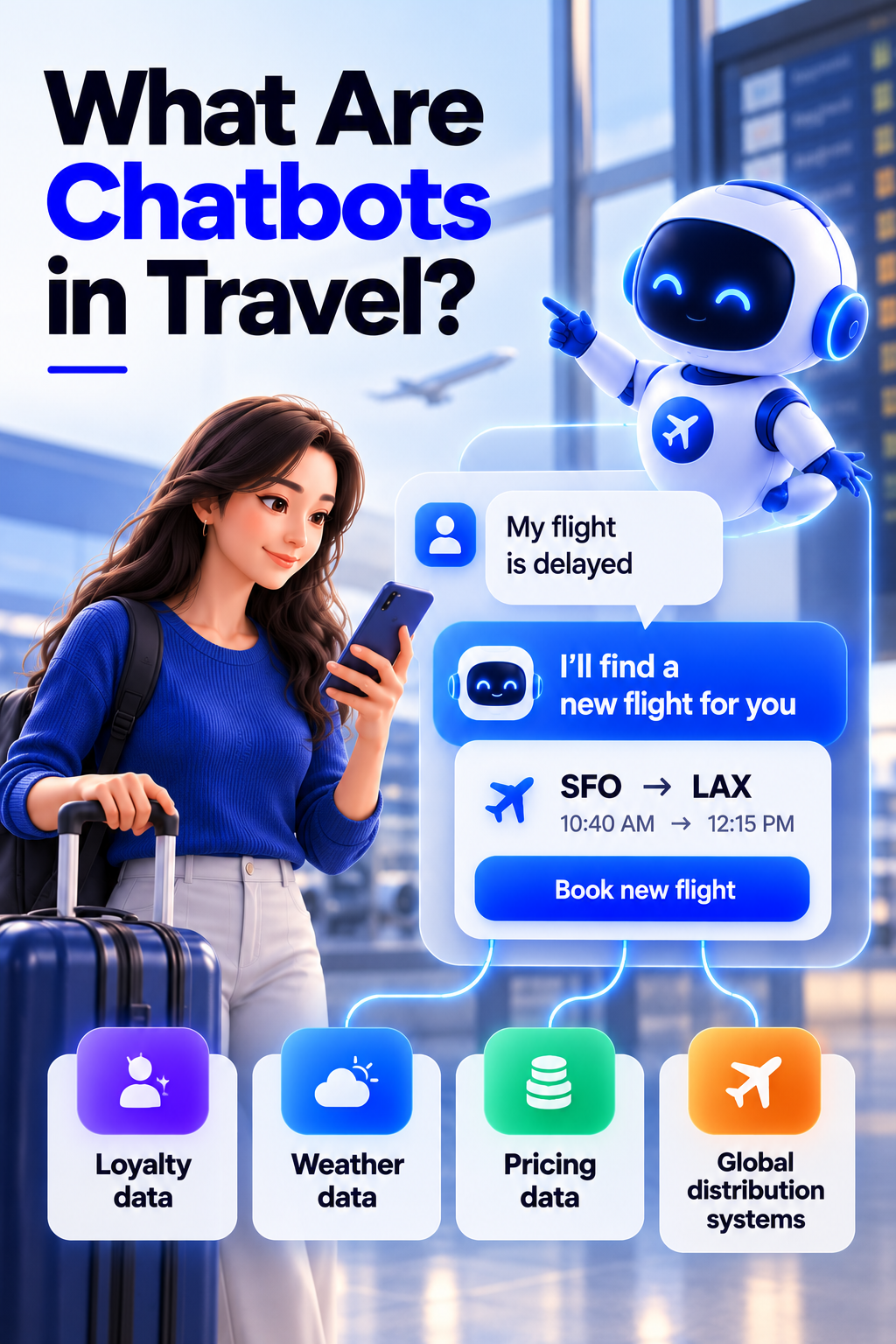
Whereas today’s travel chatbot is an AI agent. It works using LLMs for intent recognition and links with Global Distribution Systems such as Amadeus and Sabre for booking flights. In case of a flight delay, it considers loyalty information, weather data, pricing, and issues a new ticket through the chat itself.
This capability to execute is what makes modern bots different from traditional ones. Here is how they compare:
Why Travel Needs Chatbots Now
Travel never remains static. Airlines, hotels, and online travel agents need to address sharp spikes in customer service requests, which human staff cannot cope with.
The reasons for this are easy to trace in flight delays and cancellations. In 2025, US airlines had to cancel more than 118,000 flights, while a single winter storm can leave hundreds of aircraft grounded.
In such cases, thousands of customers simultaneously try to get through to customer service representatives, resulting in long waits and frustration among customers and damaging the brand’s image.
Customers want quick assistance, too. The calls are unnatural once a delay passes the one-second mark, and most people believe that their call was disconnected and hang up. Thus, a travel company needs to have a solution that understands natural language and accesses the GDS data in no time.

Benefits of Chatbots in Travel Industry
A well-built travel AI chatbot improves the numbers that matter most to a travel business. I see four main gains.
Lower cost per contact and less agent overload
Every single conversation that AI handles is a conversation not handled by an employee. Chatbots are found to be handling tier-1 conversations effectively, and in the travel and retail industries, ticket deflection ratios go up to 78%. This drives down the cost per contact.
By letting AI address the small questions like luggage capacity and terminal, your staff would have the luxury of focusing on the harder questions. In the instances where your employees do answer the call, a real-time AI agent assist system listens into the call and provides the appropriate information needed based on the policy, making sure no details are left out.
24/7 support and shorter wait times
As a matter of fact, travel transcends all time zones, and thus an individual traveling from New York to Tokyo may require assistance at 3 AM EST. It is not easy to staff for the night shift, but the chatbot can be on duty all the time.
This is clearly reflected in the statistics. The AI assistants have helped reduce the booking process by 35% and have reduced the resolution time from 2 hours to less than 25 minutes. Customers get responses instantly, and the CSAT score goes up.
Proactive disruption communication
Customer service is often reactive: the passenger finds out the flight has been cancelled, gets panicked and calls for assistance. This process is turned upside down by AI.
The bot is always tracking the current situation and alerts the passengers who get affected by the cancellation using any of the three modes of communication - WhatsApp, SMS, or e-mail. The agent will have completed all their searches on the GDS system, looked for fare rules and even reserved a seat by now, and the only thing the passenger needs to do is click the 'Accept' button.
Multilingual reach
Travel companies cater to travelers from many linguistic backgrounds, but no company can have agents fluent in all of these languages. In addition, human translators can cause delays of about 15 minutes during a single phone call.
The voice/text agent identifies the language used by the customer and answers in that language as well. Through the With Thunai AI voice translation, live calls are translated in real time without delay in over 150 languages, allowing a single English-speaking team to support customers in Asia, Europe, and South America.

Use Cases of Chatbots in Travel
Chatbots in Travel do far more than answer simple questions. They support the entire passenger journey, from the first search to the trip home.
Booking and itinerary changes
This is when the AI agent earns money. The passenger can, for instance, request a nonstop trip from Chicago to Rome within some budget limit; the AI bot will then extract the information of the source location, destination, and budget limit and feed it to the booking engine and make the choices available.
Payments are made via PCI-DSS compliant tokenization without any credit card details ever being seen by the language model. Should there be a need for changes to the travel date, the AI bot will then update the Passenger Name Record (PNR) through fare rules. The reason this can be done is workflow automation of the chatbot.
Trip planning and recommendations
A plethora of choices could exhaust the traveler, and the chatbot could be an ideal personal concierge to them. Around 44 percent of Chinese travelers, in addition to many others around the world, have started using AI chat to plan their trips.
The AI chatbot reviews past purchases, loyalty level, and preferences to make customized plans. If a guest always chooses small boutique hotels, the chatbot will not show the big resort hotels.
Hotel and guest requests
Hotels use chatbots during the stay itself. Guests message the hotel’s AI on WhatsApp or an in-room tablet to order room service, ask for extra towels, or book a spa visit.
The agent sends each request to the right team. The towel request is sent to the housekeeping dashboard while the dinner reservation is processed in the restaurant POS system. There is no more bottlenecking at the front desk as there is less telephone time and more hospitality time.
FAQ and policy answers
The rules for travel are complex. Baggage allowances are based on route and fare; visa requirements are based on nationality; cancellation rules depend on the time of booking.
It takes a valuable few minutes for a human agent to go through the entire policy document while an AI finds the solution right away.
To keep those answers correct, strong systems rely on AI knowledge management. These tools read manuals, spot conflicts in the text, and tie every answer to verified policy. When the AI is not confident, it hands the case to a person.
Examples of Chatbots in Travel
Several large brands already run AI agents at scale, and their results make useful travel chatbot examples to learn from.
Lufthansa built a chatbot named Elisa to help during disruptions. When bad weather hits, Elisa plugs into the airline’s rebooking and refund flows, so passengers can get a new flight or an eligible refund without being passed between departments.
KLM Royal Dutch Airlines uses BlueBot, also known as BB. The company placed the bot on Facebook Messenger and Google Assistant so that users could make reservations through conversations that were similar to messaging friends.
To see how this works in practice, look at how Thunai automates travel inquiries and bookings. Through connections to GDS systems and payment gateways, the AI agent of an enterprise can conduct the entire transaction by itself.
How to Get Started
For instance, deploying a chatbots in travel should be done in a systematic way since speed is always likely to bring problems.
1. Perform an audit of your tickets: Determine what the most frequent repeated inquiries are that take up agents’ time. The ideal candidates for starting with would be flight status inquiries, baggage policies, and date changes.
2. Select the platform where your data is safe: The platform should comply with GDPR when it comes to handling passenger data and with PCI-DSS for payments, and should utilize tokenization so that the AI model would never see a whole card number.
3. Set up a latency budget: Voice AI taking more than a second drops satisfaction levels. Consider how much time each step in the pipeline will take you.
The ranges could be roughly like that:
- Speech-to-text: 100 to 500 ms
- LLM inference: 200 to 1,200 ms
- Text-to-speech: 100 to 400 ms
- Network transport: 40 to 200 ms
4. Train only on approved data: Connect the agent to live GDS APIs and your own knowledge base. This prevents made-up answers and keeps every quoted fare accurate.
5. Run a controlled pilot: Divert around 20% of the traffic that comes into the organization to the new chatbot. Measure the ticket deflection ratio and the customer satisfaction level. Scale the pilot program after its success.
How Thunai Helps Travel Brands
Thunai is an Agentic CX and enterprise AI platform built for high-pressure industries like travel. It sits as an intelligence layer on top of your current CCaaS and CRM tools, so you don’t need to replace anything you already use.
The platform rests on two pillars.
The first is Thunai Brain, a context engine that reads airline policies, hotel manuals, and technical files. It finds and fixes conflicts in the text before the AI ever speaks, so your travel bot does not misquote a fare rule or a cancellation term.
The second is Thunai Omni, which connects to Zendesk, Salesforce, and Amazon Connect through the Model Context Protocol. It translates voice calls instantly in over 150 languages. For your human team, it also shows live answers on screen during the call and updates your CRM afterward.
The result is shorter handle times, fewer language barriers, and disruptions that resolve on their own.
Ready to see what an AI agent can do for your travel brand? Book a demo
FAQs About Chatbots in Travel
Can chatbots in travel make payments safely?
Yes. The travel chatbots run under a software system that is PCI-DSS compliant. The chatbots pay using secure links or tokenization. This means that at no point is your full credit card number disclosed to the chatbot or the human agent.
What are the capabilities of AI agents in handling flight delays and cancellations?
They watch flight status in real time, and when a disruption happens, the AI messages the passenger first. It checks the GDS, such as Amadeus or Sabre, for other flights, applies the airline’s fare rules, and rebooks the passenger right in the chat.
What is the acceptable time limit for the voice agent powered by AI technology?
The response time of an AI-powered voice agent should be in the range of 500 to 1,000 milliseconds. Anything beyond that, and your callers assume that the line is dead, causing abandonment and poor NPS.