Can you handle the demands of your customers without any extra expenses and trust losses?
The bank should have the ability to offer immediate service, avoid fraud, and be compliant with all regulations even after office hours.
Regular chatbots do not work in cases of complicated requests and the need to conduct real transactions.
With the help of AI chatbots for banks, all of these problems can be solved.
Here are the main use cases, real examples, implementation steps, costs, and other information which will help bankers to make the right choice.
What Are Chatbots in Banking?
Banking chat tools have changed a lot. The first ones ran on fixed scripts. They matched customer text to a set list of intents. If a customer typed something unexpected, the bot failed. Customers got frustrated.
AI chatbots used in banks today operate quite differently. They have been developed using technologies based on semantic reasoning, transformers, and RAG, which is retrieval-augmented generation. The chatbots link to the core ledger system, the CRMs, and card systems via secure APIs.
What makes such chatbots unique is that they are not limited to just directing clients to some FAQ page. Chatbots are able to follow a dialogue throughout a number of exchanges, know client needs, and perform validated ledger actions. In reality, AI chatbots in the banking industry can be considered a digital agent, checking credit inputs, detecting fraudulent activity, etc.

Where Do Banks Use AI Chatbots? 7 High-Impact Use Cases
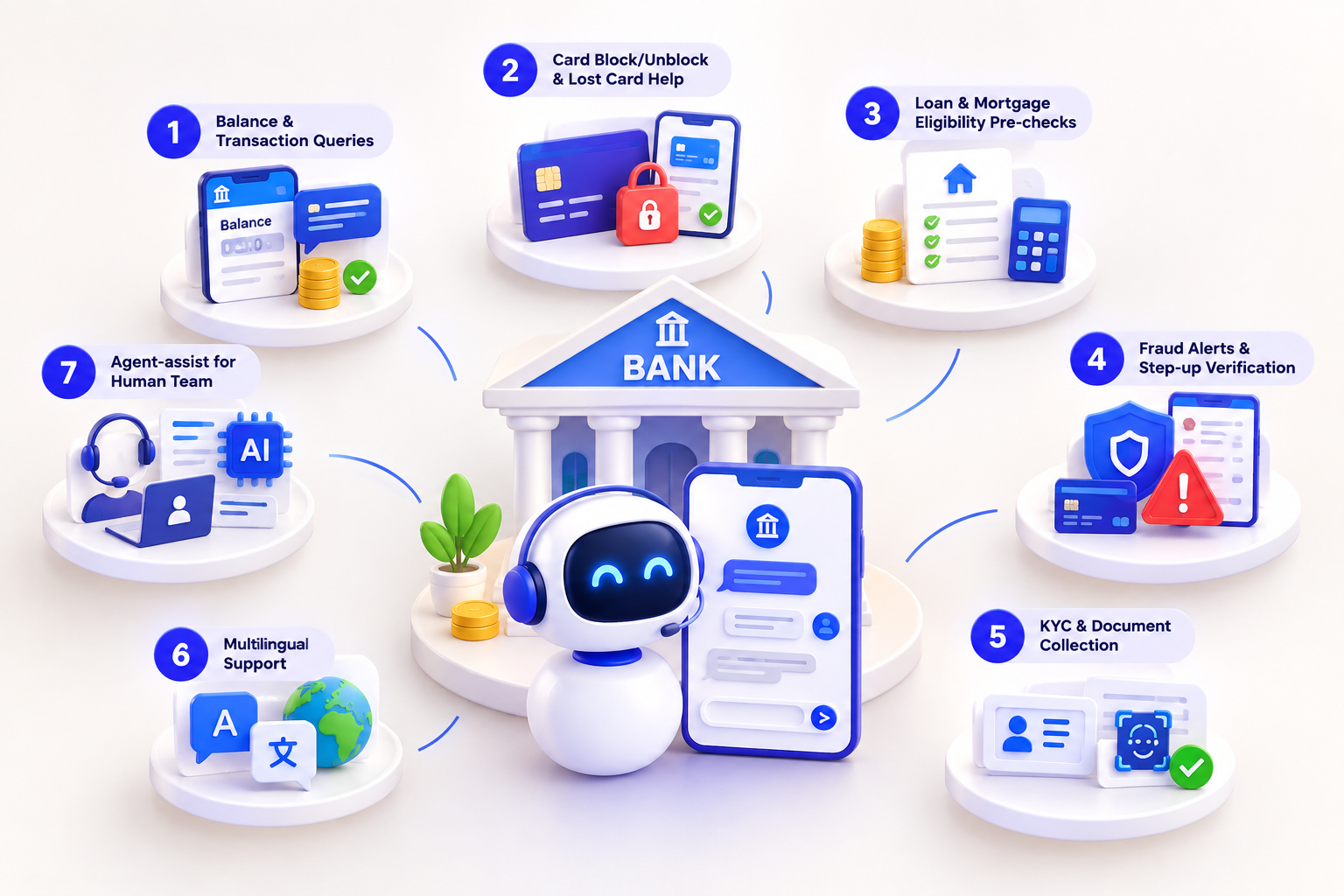
Banks deploy AI chatbots in the banking industry in both front-end and back-end operations. The idea is to automate recurring processes and ensure smooth operation.
1. Balance, transaction, and statement queries
- In banking, account queries represent the highest application for AI-based chatbots.
- Customers may want to check their balances, get details on their cleared checks, track down a merchant’s charges, or even ask for their statement of account.
- The bot validates the conversation, fetches the information from the company’s ledger via an API, and responds within a few seconds.
2. Card block/unblock and lost-card help after hours
- When banks are closed, AI chatbots help keep bank cards safe by shutting down their payment capability after a long day.
- After a customer loses their bank card, the chatbot immediately freezes it, checks the recent transactions on it, and asks the customer to get another one.
- It also provides a token for the mobile wallet.
3. Loan and mortgage eligibility pre-checks
- A lending team employs an AI chatbot during banking to verify a person's eligibility to take out a loan.
- This means that it will inquire about one's income level, work history, debts, and the amount of money that one requires.
- It will compare the information with credit scores within its database, and if eligible, schedule a meeting.
4. Fraud alerts and step-up verification
- Chatbots in the banking sector allow the fraud department to alert immediately when suspicious transactions occur.
- There is no delay for a manual operator.
- The customer gets a prompt by secure message or mobile alert.
- They confirm or reject the charge inside the chat.
- If it is fraud, the bot locks the card and opens a case.
5. KYC and document collection
- Identity verification is required in the onboarding process.
- In the banking industry, AI chatbots help with uploading documents.
- The chatbots accept ID card scans, selfies, and address proofs.
- Workflow automation uses OCR technology to read the document details.
- It performs real-time sanctions screening and anti-money laundering registry testing.
6. Multilingual support
- Global banks have customers in many different languages.
- The call centers have trouble staffing themselves with native speakers who can handle many languages at any one time.
- With AI voice translation, the AI chatbots in banking can understand and respond in hundreds of languages and dialects.
7. Agent-assist for the human team
- During a live call, real-time assistance from an AI agent acts like a researcher.
- They do transcription, sentiment analysis, look for policies, and come up with a solution.
- Time is reduced, along with errors.
- Many banking organizations using AI chatbots go ahead and incorporate AI agent assistance.
Real-World Examples: Erica, Eno, HSBC and OCBC
Real cases show the return on AI chatbots in banking at scale.
Bank of America built Erica with Graph Retrieval-Augmented Generation (GraphRAG) and domain-specific small language models. This design ties answers to structured financial ontologies. So the system can tell available funds from total ledger balance with high precision.
Capital One focused Eno on protection. It warns customers about subscription price hikes and repeat merchant charges. HSBC built Amy to handle multi-dialect queries in retail and commercial banking. That shows these tools can serve complex corporate accounts.
OCBC built Emma for property financing only. It links straight to debt servicing calculators. Emma qualifies customers before handing them to mortgage specialists. This proved that AI chatbots in banking can drive balance sheet growth.
How to Implement a Chatbot for Customer Service in Banking
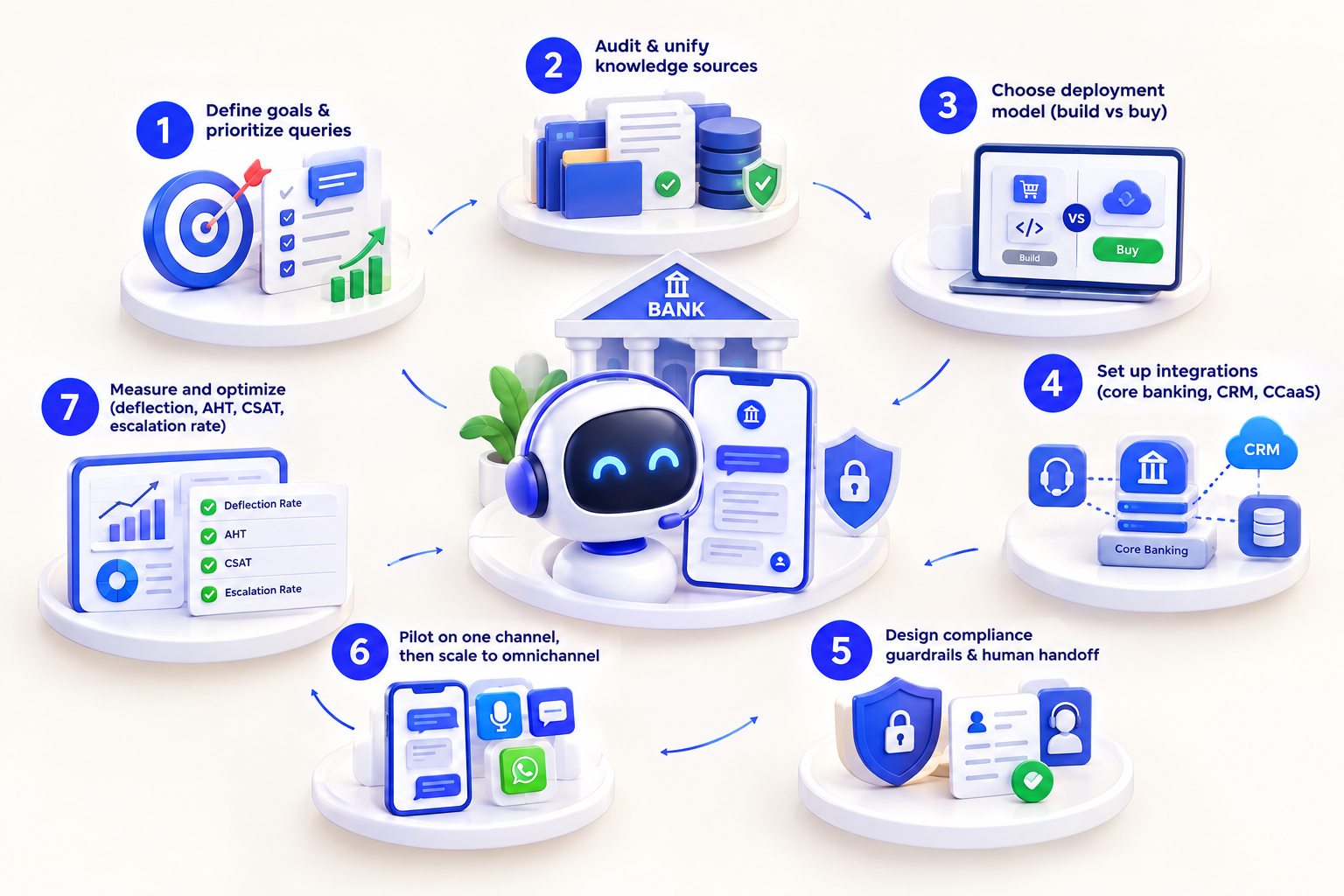
The implementation of AI chatbots within the banking industry needs to be done in stages, with technical factors needing to take into account security issues.
Define goals and the queries to automate first
- Start with your contact logs.
- Find high-volume, low-complexity questions that eat up staff time.
- Good first picks are balance checks, recent transactions, and card activation.
- Set clear targets, such as a 75% resolution rate or 40% shorter phone handle times.
- These numbers show whether the pilot works.
Audit and unify knowledge sources
- When records conflict, AI chatbots in banking give mixed answers.
- That creates compliance risk.
- Gather scattered procedures, credit rules, product manuals, and fee schedules into one knowledge base.
- Run automated contradiction detection across the files.
- The bot then uses only verified, current policy.
Choose the deployment model (build vs buy)
- Banks must weigh custom builds against bought software.
- An in-house platform can take up to two years.
- It needs a dedicated engineering team and large capital.
- A proven enterprise vendor can launch in days.
- It brings ready-made financial workflows and modern security at lower total cost.
- Many teams find that buying AI chatbots in banking is the faster path.
Set up integrations (core banking, CRM, CCaaS)
- For the bot to perform any transactions, it has to be linked with core systems.
- Core systems include the ledgers of the bank, identification systems, telephone systems, and CRM.
- Connectors that come ready out of the box, like artificial intelligence agents for Salesforce, help the system automatically track cases and document account records.
Design compliance guardrails and human handoff
- These autonomous agents will require proper limitations.
- These will have to hide all account numbers through redaction of data.
- There will also be a need for multi-factor authentication before transferring any money.
- Whenever there is any request below the model confidence level, it will be referred to human experts.
- The referral package should have the authenticated identity, all the history, and previous requests.
- Consumers do not repeat themselves.
- Proper guardrails are required to create trustworthiness among AI Chatbots in banking.
Pilot on one channel, then scale to omnichannel
- First launch in one controlled environment, for example, chat within the mobile app with authentication.
- A pilot will help the teams to validate accuracy and refine intents on actual inputs.
- Once success is proven and achieved, extend into voice IVR, SMS, and messaging apps.
- Scale AI chatbots in banks only after the pilot is proven successful.
Measure and optimize (deflection, AHT, CSAT, escalation rate)
- Monitoring the results process starts post-launch.
- The dashboard must display deflection rate, average handle time, escalation rate, and customer satisfaction.
- The use of AI call scoring allows for QA and compliance to audit all interactions to make sure that disclosure is being done and new barriers are identified.
Compliance, Security and Hallucination Risk: What to Ask Before You Buy
AI chatbots in the banking sector have very high compliance standards. Advice and transactions are highly regulated, and mistakes are very expensive. Making up a single fee structure or messing up a single data transfer could result in penalties and damage to your reputation.
There are several regulatory requirements that banks must comply with. According to PCI DSS 4.0, systems should never store credit card numbers or verification codes in any unencrypted chat logs. Regulations under PSD2 and open banking demand proper customer authentication to facilitate payment instructions through chatbots in Europe.
Hallucination occurs when generative models generate an answer that does not have any verified information from the data sources. To reduce such errors, grounded AI knowledge management systems are used by banks.
When you review vendors of AI chatbots in banking, ask these questions:
- Does the architecture prevent customer financial records from training public third-party models?
- Can the platform run within private clouds or on-premises infrastructure to satisfy jurisdictional data residency mandates?
- How does the process handle conflicting information among internal documents in order to remove any wrong answers?
- Is there an unalterable audit trail for each transaction and human transition?
What Does an AI Banking Chatbot Cost?
The total cost of AI chatbots in banking depends on scope, integration depth, and approach.
Large global banks often fund their own frameworks. Mid-sized and regional banks usually earn more return from purpose-built enterprise platforms. These lower upfront costs, cut launch time, and reduce engineering overhead.
How Thunai Supports Banks and Financial Institutions
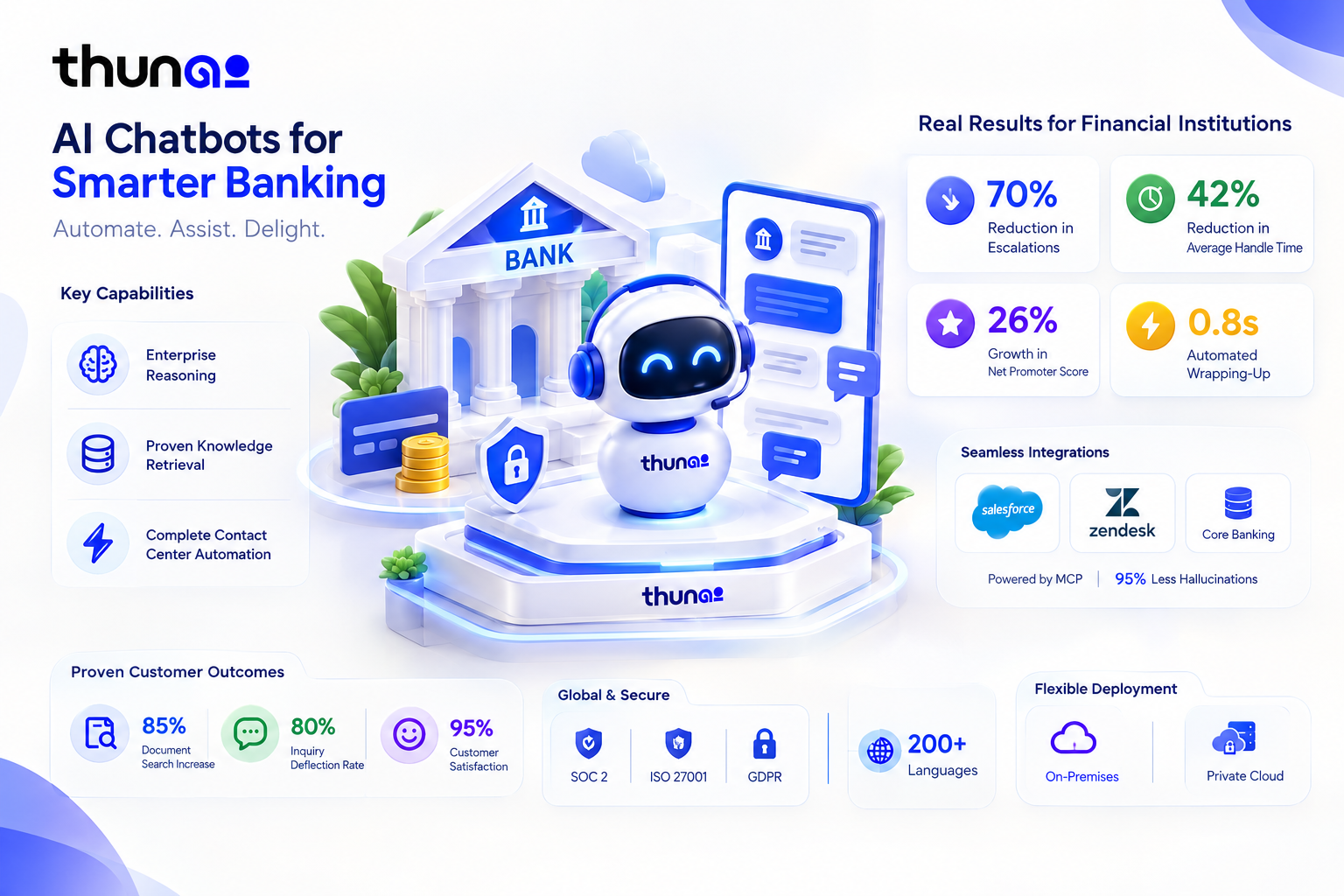
Thunai drives the next-generation AI chatbots in banking through enterprise-level reasoning, proven knowledge retrieval, and complete contact center automation. This solution was designed specifically to eliminate bottlenecks in financial organizations. It helps answer questions, assist humans on phone calls, and automate the processes after the calls.
It delivers documented gains in demanding enterprise settings:
- 70% Reduction in Escalations: Autonomous agents solve complex Tier 1 queries. Only sensitive issues need to be escalated.
- 42% Reduction in Average Handle Time: Agent Assist Solution provides customer information and shows compliant processes on the go.
- 26% Growth in Net Promoter Score: Instant resolution and right answers ensure that no queue is left behind and increase customer satisfaction.
- 0.8 Seconds Automated Wrapping-Up: Post-call process creates notes, fills CRM forms, and tickets up.
Thunai Brain links to corporate databases via MCP integrations, which results in a synchronized network in Salesforce, Zendesk, and core banking databases. Its automated contradiction detection engine reduces 95% of AI hallucinations by auditing company repositories for conflicting guidance.
Financial companies appreciate Thunai for quick deployment and high reliability. Deployment by customers reveals an increase of 85 percent in terms of document search, an 80 percent inquiry deflection rate, and a consistent 95 percent customer satisfaction.
Thunai supports more than 200 languages and conforms to SOC 2, ISO 27001, and GDPR. Thunai provides on-premises as well as private cloud deployment options for complete data sovereignty.
For institutions looking to digitize services, they should take a look at AI agents for banking and finance.
Enterprise leaders can book a demo to see Thunai’s automated banking workflows in a live environment.
FAQs
Why are retail institutions adopting AI chatbots in banking so rapidly?
Retail banks face heavy call volumes, strict service-level agreements, and rising demand for 24/7 digital access. Chatbots automate routine balance and transaction requests. They solve customer issues with no wait. They also keep costs steady as customer volume grows.
What distinguishes a rule-based banking bot from an agentic AI chatbot?
Rule-based bots follow rigid decision trees. They break when customer input strays from scripted keywords. Agentic AI chatbots use natural language understanding to read context. They query back-end financial systems through APIs, reason through multi-step requests, and run complex workflows on their own.
How do banking chatbots maintain regulatory data privacy standards?
Conversational banking platforms use end-to-end encryption, strict role-based access, and automated tokenization to mask card numbers and personal data. Leading systems comply with SOC 2, ISO 27001, PCI DSS 4.0, and GDPR. They also offer secure private-cloud or on-premises hosting.
Can conversational AI platforms initiate financial payments securely?
Yes. When linked to core banking engines through authenticated APIs, these platforms can process bill payments and start account transfers. Secure designs require step-up multi-factor authentication or biometric checks before any transaction runs.
How do financial institutions prevent conversational models from hallucinating false figures?
Banks use deterministic API calls to read figures straight from core accounting systems. They never let a language model generate financial numbers. For policy and product guidance, platforms ground answers in verified knowledge bases. These remove contradictory information and limit outputs to documented facts.