
Is it the case that your support crew spends most of their time trying to find answers than solving the issues at hand? I know it sounds like a vicious circle. But here’s the reality, AI virtual assistants change everything for you. They identify your problem, use reasoning on your data based on Thunai Brain, and execute actions throughout your CRM, ERP, and other solutions through MCP, accomplishing all the actions end to end.
Here you will get to know about AI virtual assistants, different types, examples in banking, healthcare, and insurance industries, and how to select and deploy the best one.
What Is an AI Virtual Agent?
Business software has changed fast. Not so long ago, AI was purely experimental; now the actual point lies in its practical implementation.
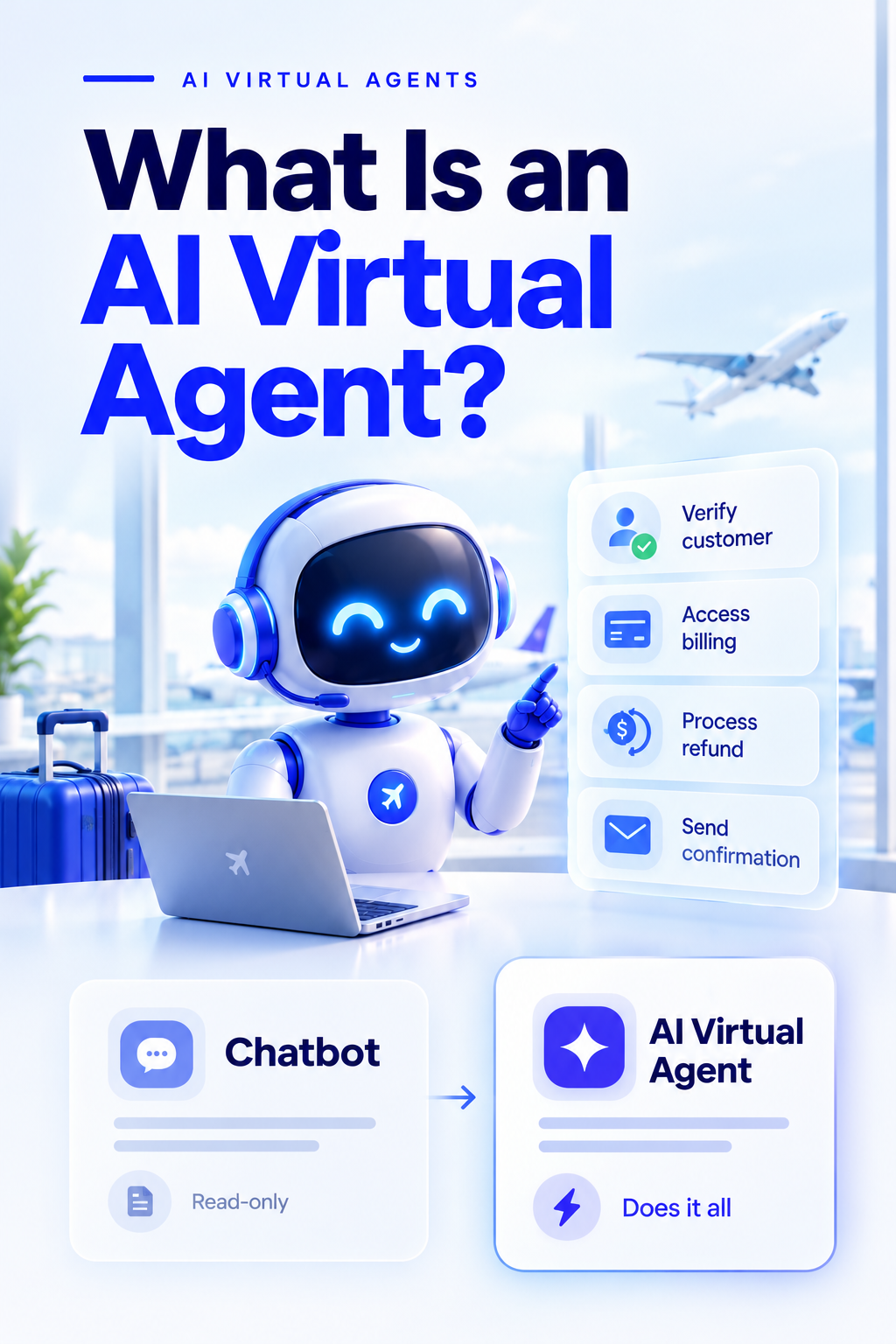
Chatbots are read-only tools giving out standardized answers or help page references, letting customers finish the job on their own.
AI-powered virtual agents take it to a whole new level of being able to verify a customer, gain access to the billing platform, suspend payments, compute the refund, and send confirmations without returning the job to the customer.
That gap shows up in the budget too, through smaller support backlogs and better team efficiency.
How Does an AI Virtual Agent Work?
Before you entrust an agent with your business processes, it would be better to understand what goes on inside. This process is made up of three layers:
- Understanding
- Reasoning
- Action
Understanding:
Through calls, emails, and chats, the agent makes use of NLP technology to determine the intention of the customer and gather pertinent information such as account numbers or symptoms.
Reasoning:
On some occasions, AI algorithms may generate incorrect responses referred to as hallucinations. These can be reduced via Thunai Brain, which acts as the shared memory of your process, previous tickets, and policies.
Action:
The best software applies the Model Context Protocol (MCP) technology which is a kind of universal adapter. Integrating AI into your CRM was a painful and fragile experience before MCP. Now, the agent makes a plan, calls the right tool through an MCP server, gets the information and syncs the other system.

Types of AI Virtual Agents
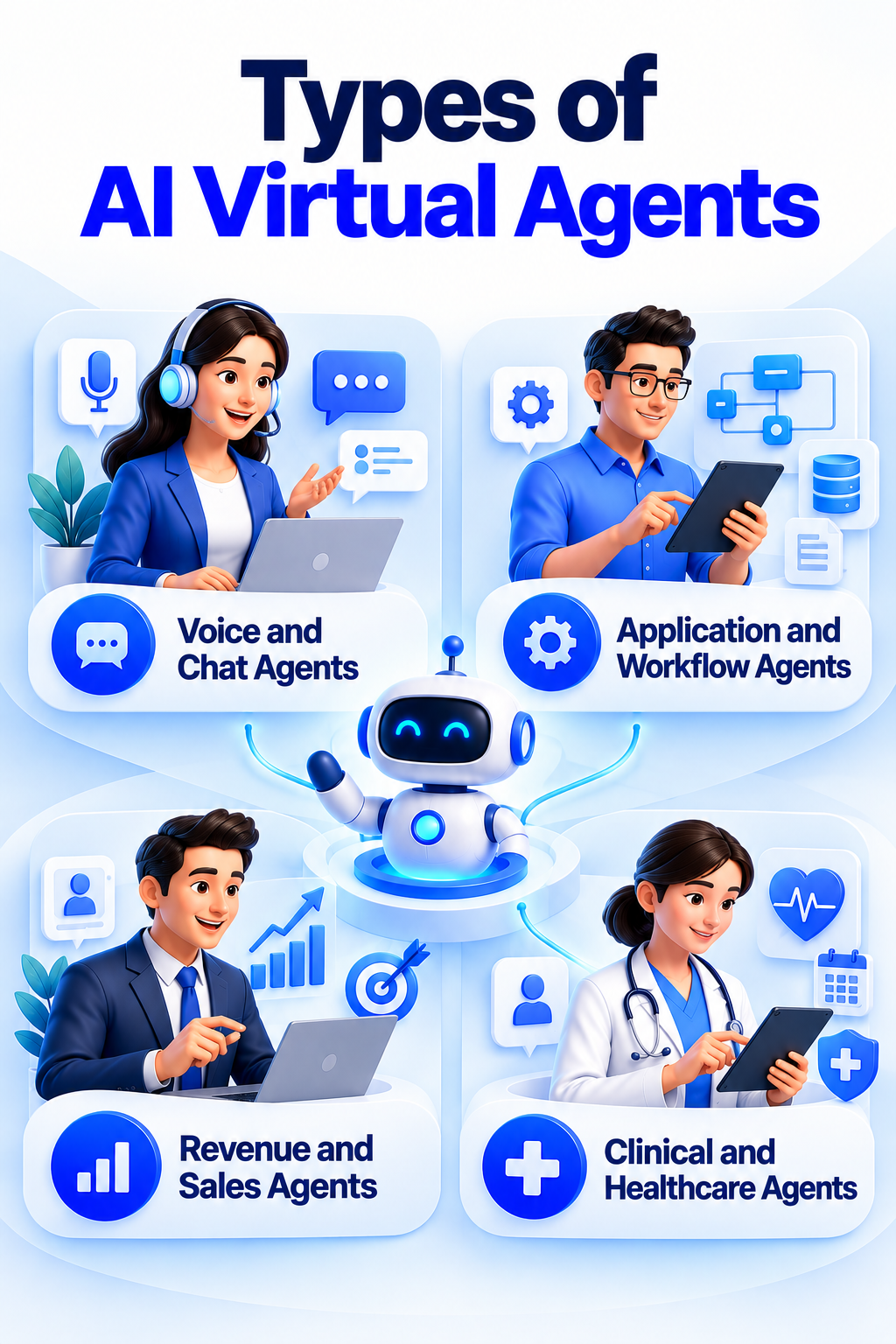
Different bottlenecks call for different agents. And here are the four different types along with their specialties.
Voice and Chat Agents
The voice and chat agents work as the first point of customer service and help in making phone calls in 200+ languages and doing things like resetting passwords, tracking orders, and making appointments. They are available 24/7 and make sure that there is no delay in providing services.
Application and Workflow Agents
They operate in the background, classifying intricate emails, scanning for customers’ histories within the CRM, writing customized responses, and updating the tickets. The end product is visible to your team members, saving you from passing things around.
Revenue and Sales Agents
The sales agents attend to the calls, write transcripts of the discussion, and detect signs of the buyers' sincerity. Then, they add those opportunities into the CRM automatically. You spend less time typing and more time closing sales.
Clinical and Healthcare Agents
In healthcare, these agents act as ambient scribes. They hear the conversation between the doctor and the patient, strip out any chitchat, and write clinical notes that are organized into the EHR. The doctor reviews and signs instead of typing for hours after clinic.
Benefits of AI Virtual Agents
Shifting from manual assistance to AI virtual assistants allows for incremental gains that work together. Here are the top ones.
Availability around the clock and quicker responses
Customers require answers around the clock, and an unanswered call can result in lost sales. AI virtual assistants don’t have off-the-clock time.
They also handle unexpected spikes in activity from the introduction of products, seasonal surges, and system disruptions that would overwhelm a human staff.
Lower costs and easier scaling
Scaling a traditional contact center takes serious capital, and turnover in support is high. AI agents break the link between growing volume and growing headcount. The median payback period for an AI customer service agent is 4.1 months.
Higher agent productivity
If the routine questions are handled by the AI agent, humans can focus on handling complicated issues. In real-time agent assistance, the agent can have a co-pilot in each conversation who will present the history of the caller, the policy, and actions to be taken.
Consistent, accurate answers
Inconsistency can arise if the agents refer to various manuals. The AI agent uses a single knowledge base to maintain consistency and log all activities.
Cleaner CRM data
An AI agent embedded within a system such as Salesforce will record calls in real time, identify purchasing cues, and update the appropriate CRM fields. See how Thunai handles CRM updates with AI agents for Salesforce.
AI Virtual Agent Examples
The value is easiest to see in real industries. Each one has its own pain points, and each agent is built to fix them.
Banking
- Banks require speed and security; therefore, the agent connects with core financial applications using secure API keys.
- In the case where a consumer disputes a card transaction, the agent will authenticate their identity, check their transaction history, verify their fraud policy, and open the case within minutes as opposed to waiting for thirty minutes on hold. For more information about the application in finance, see AI agents for banking and finance.
Healthcare
- The clinical practitioner listens to the patient during the encounter and does not waste time on small talk but rather makes the SOAP notes in the EHR system like Epic or eClinicalWorks.
- The healthcare agents also take care of contacting patients and scheduling their appointments on a 24/7 basis, freeing up the front-desk employees. Find out more about this process through an AI healthcare assistant.
Insurance
- Claims increase significantly during natural disasters as well as at the time of enrollment. In case there is any claim registered through the application as well as by telephone, then the FNOL is handled by the agent, wherein all information is collected.
- The FNOL guarantees that the policies are validated because outdated policy information cannot be raised. In case sentiment analysis suggests that the person is frustrated, the agent directs him to an adjuster with all the required data. Learn more about claims management at Thunai and AI agents for insurance.
How to Choose an AI Virtual Agent Platform
There are many software tools claiming to be AI agents; however, what matters most is the platform's architecture.
Choosing poorly may result in failed integration, vulnerabilities, and poor adoption rates. Focus on these three criteria.
Action Architecture and MCP Integration
Look for products developed on MCP that will mesh well with your existing tech infrastructure - whether it is an in-house ERP or Salesforce or Microsoft Teams - within weeks, rather than months of writing code.
The system must be able to take in data, analyze it, and implement changes without human involvement.
Enterprise Security and Compliance
The AI agents are dealing with sensitive customer data, while the consumer solutions are not equipped to do so. Be sure to request compliance certification from each vendor.
The platform must also operate on the principle of least privilege in that the agent can only access data that is necessary for the purpose at hand.
Human-in-the-loop controls
Although autonomy is excellent, there must be some form of control for the dangerous processes. Select a policy engine that has HITL controls. Simple things like password resets must be performed instantly.
Processes that involve high risk, such as large refunds, a modification of a key banking record, or a definitive diagnosis, must be held off until approved by a human manager. This keeps the company secure without causing delays.
How Thunai Deploys AI Virtual Agents
Enterprise-level projects tend to fail owing to their excessive time consumption and engineering requirements. Thunai's methodology was based on quickness, efficiency, and no coding. The deployment process is less than 48 hours long and includes 3 phases.
Step 1: Unify the knowledge base
- First comes the Thunai Brain where you can upload all the loose data that exists in the form of support tickets, PDF manuals, CRM entries, and standard operating procedures.
- The system then sorts this information into a knowledge graph, pointing out inconsistencies that require human evaluation.
Step 2: Connect your systems
- In the next step, the Thunai MCP makes sure that the platform is connected to the existing software solutions.
- Popular apps like Salesforce, Zendesk, Amazon Connect, and Microsoft Teams are already integrated into pre-integration packages.
Step 3: Launch specialized agents
- With knowledge unified and systems connected, you switch on the agents. Thunai offers a library of pre-trained agents for different industries.
- A retail brand can launch order tracking right away, and a healthcare clinic can turn on ambient scribes. The agents begin answering calls, drafting notes, and resolving first-level tickets almost immediately.
FAQs about AI Virtual Agent
What distinguishes chatbot from AI Virtual Agent?
The Chatbot uses matching of the keyword to answer pre-written answers. The AI Virtual Agent is oriented towards goals and reasons through a problem; it makes proper decisions about the needed tools, actions in a multi-step manner to solve problems on their own without any human assistance.
What is the Model Context Protocol (MCP) and why is it important?
The MCP is a free open standard acting as a universal interface between the AI model and external sources of data. Instead of creating brittle custom integrations for each separate tool, the IT department enables agents to access data and make reads and writes in a variety of applications.
How do AI virtual agents impact human support teams?
They help rather than replace them. Taking care of repetitive questions at the first level and manual CRM updates means less administration fatigue for your staff. This way, they will have more time to deal with complicated issues and customers, leading to improved employee job satisfaction and lower turnover.
Is my company's information safe in those systems?
Top platforms are designed with security in mind. The high-quality platforms offer you certifications for SOC 2 Type II, ISO 27001, and GDPR compliance. With the help of Role Based Access Control and Knowledge Graph, segregation of sensitive data will be done and AI will do the job based on the permission levels.
What will be the time frame for this implementation?
Modern platforms with no-code approach and ready-to-use integration can be implemented much quicker than traditional software solutions. In less than 48 hours you will be able to upload your documents and integrate your CRM with your active agents.
What if the AI cannot resolve the problem?
Effective platforms offer clever mechanisms for escalating. With the help of sentiment analysis and intent detection, the AI recognizes when the client is unhappy or the problem exceeds the limitations of the AI. This way, the conversation is transferred to a human expert along with the history and summary.