
By 2026, AI is no longer a cool app to show off in your board meetings.
Everyone has one. The real question now is simple: is your AI actually helping, or just sitting there looking smart?
Kore.ai keeps coming up whenever serious teams talk about scaling automation, and for good reason it’s powerful and built for big things. But power alone doesn’t guarantee progress.
In this piece, I’m sharing an honest look at Kore.ai: what works, what slows you down, and where faster, sharper platforms are changing the game.
The 2026 Context: Why Buy-over-Build is the CEO’s Only Path
- Before we look at the features, we have to look at the math. In 2026, 72% of organizations have abandoned "DIY AI" in favor of purchasing and customizing existing platforms.
- We don't have time to hire 50 NLP engineers to build a foundational model when we need to show ROI this quarter.
- Kore.ai has secured its position as a Leader in the 2026 Gartner® Magic Quadrant™ for the third year running. They have successfully transitioned from a "bot builder" to a "Generative AI Engineering" powerhouse.
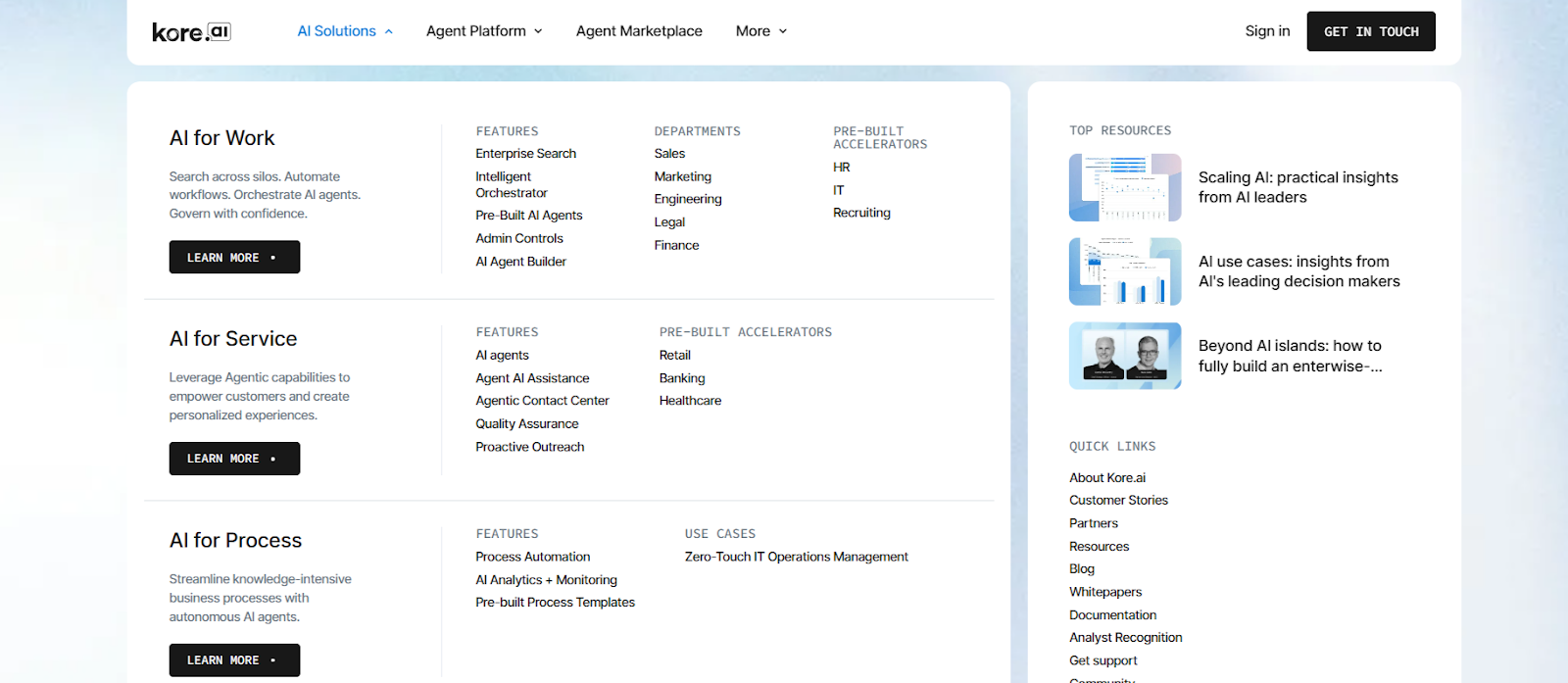
The Three Features of the Kore.ai Ecosystem
- AI for Work: This is your internal productivity engine. It connects to your Slack, SharePoint, and Wikis to automate employee support and activate Agentic RAG search.
- AI for Service: This reimagines the contact center, providing real-time support for human reps and allowing autonomous agents to handle 24/7 customer inquiries.
- AI for Process: This is the most critical for the bottom line. It streamlines complex business operations like procurement or billing by orchestrating agents that can plan and execute multi-step actions across your software stack.

Top Features: What Actually Drives ROI in 2026?
Multi-Agent Orchestration: The End of Silos
In the early days of AI, we had "single-bot silos", one bot for HR, one for IT, none of them talking to each other. In 2026, the game is Multi-Agent Orchestration.
Kore.ai allows specialized agents to collaborate, share context, and hand off tasks. Imagine a customer refund request:
- Agent A identifies the intent and sentiment.
- Agent B checks the return policy in the knowledge base.
- Agent C calls the payment API to process the money.
- Agent D drafts a confirmation email.
This happens within defined "boundaries of authority," ensuring the AI doesn't go rogue while maintaining a seamless user experience.
Technical Breakthrough: Parallel Agent Processing
Latency is the "silent killer" of enterprise AI. In 2025, waiting 30 seconds for an AI to think was common. In 2026, it’s a deal-breaker.
Kore.ai’s Parallel Agent Processing architecture solves this by decomposing a task into sub-tasks that execute simultaneously. Instead of a linear chain of reasoning, a central "Orchestrator" distributes work to specialized sub-agents.
- Traditional Sequential Execution: 30+ seconds.
- Parallel Execution Phase: 6 seconds.
Agentic RAG and Knowledge AI
Kore.ai doesn't just search for text; it provides a "ChatGPT for the enterprise" experience. It handles structured and unstructured data from 250+ pre-built connectors (Salesforce, SAP, ServiceNow).
Crucially, it preserves original security permissions if an employee isn't allowed to see a salary spreadsheet in SharePoint, the AI won't show it to them either.
The Aircraft Carrier Problem: Limitations & Drawbacks
I’ve seen too many mid-market companies sink because they bought a tool they couldn't operate. Here is the unfiltered reality of Kore.ai in 2026:
The Learning Curve and Talent Gap
Kore.ai is dense. It is not a log in and master it in an afternoon tool. Most organizations end up needing to hire specialized Conversation Designers and Solution Architects to maintain the flows.
If you don't have a dedicated IT R&D department, you’ll be paying for expensive professional services or outside consultants indefinitely.
Voice Latency: The One-Second Barrier
Despite the parallel processing improvements, user reviews frequently highlight a "one-second barrier" in voice responses. In a high-stakes service call like a bank fraud report that one-second robotic delay can kill trust and lead to abandoned calls.
The Price Tag
Kore.ai is an enterprise-cost solution. While there are "Essential" plans around $500-$1,500 per month, they are heavily restricted.
- Standard Enterprise Contracts: Typically range from $50,000$ to $300,000+ annually.
- Implementation: Factor in another +50% of the license cost for setup and integration.
The Strategic Pivot: Why I’m Watching "Thunai"
For many of you, the "Aircraft Carrier" (Kore.ai) is overkill. If you’re a mid-market leader or an agile enterprise, you need something that fixes the foundation rather than just the surface.
This is where Thunai is disrupting space in 2026. While Kore.ai builds complex orchestration layers, Thunai focuses on being your organization's "Second Brain".
Fixing the Dirty Data Problem
- The biggest reason AI fails is conflicting data. Your PDF handbook says a 30 day return policy, but your Slack says 45. Any standard AI will hallucinate a mix of the two.
- Thunai’s Contradiction-Free Knowledge Graph actively audits your files and live data to find these conflicts and self-heals those links before an agent ever speaks.
Why Thunai is Beating Legacy Rivals for Mid-Market:
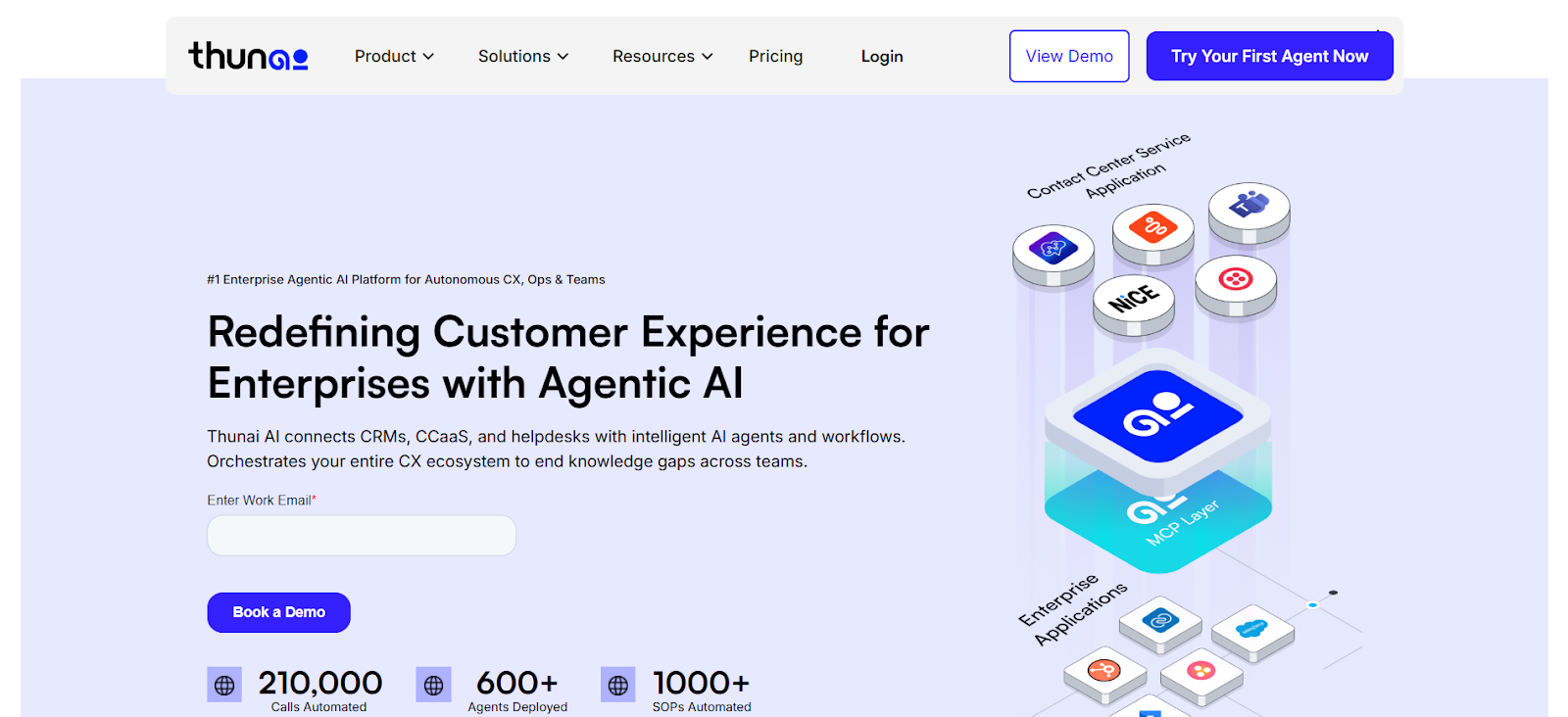
- Human Like Interaction: Thunai offers less than 50ms voice latency, making conversations feel genuinely human, not like an IVR with a skin.
- Model Context Protocol (MCP): This technology lets specialized agents talk and share data perfectly. For example, a Voice Agent handles a call and passes every detail to an Email Agent for follow-up without losing an ounce of context.
- Speed to Value: You can go live in days, not the 4-6 months Kore.ai requires.
- Aggressive Pricing: Enterprise plans start at $399 per month, a fraction of the six-figure upfront bills from legacy rivals.
2026 Comparison: Kore.ai vs Thunai
Procurement Trends: The CEO Playbook for 2026
By 2026, over half of governments worldwide mandate responsible AI through strict regulations. This means that compliance is no longer a choice; it is a license to operate.
As a CEO, your procurement strategy should shift from "finding a tool" to "building a value chain".
- From AI Experiments to Accountability: Stop funding demos. In 2026, we only fund systems that we can explain, control, and prove.
- The Agent Architect Role: Tactical, repetitive roles are disappearing. Your next critical hire is the Agent Architect, someone who understands both business logic and AI model behavior.
- Human in the Loop is a Strategy, Not a Limitation: Even with "Parallel Processing," high-risk domains require oversight. Autonomy should expand naturally as trust matures, not be forced on day one.
Final Verdict: Should You Buy Kore.ai in 2026?
Choose Kore.ai if:
- You are a company with a $1000k+ budget for AI transformation.
- You are in a highly regulated industry (Banking, Healthcare) where compliance documentation is as important as speed.
- You need to automate internal IT, HR, and Ops tickets across 5,000+ employees.
Look at Thunai if:
- You are a mid-market leader and Fortune 2000 who needs ROI this quarter, not next year.
- You have conflicting data and need a "Second Brain" to fix your knowledge gaps before you launch an agent.
- Your primary goal is Human-like Voice AI for sales or support without the robotic lag.
In 2026, the winner isn't the company with the most expensive AI platform. It’s the one with the clearest execution which thunai does.
The Smarter Path Forward using Thunai
Kore.ai remains a formidable platform for enterprises ready to invest in scale, structure, and patience. But in 2026, success isn’t defined by how big your AI is, it's defined by how fast it creates clarity and value.
That’s where platforms like Thunai change the conversation.
By fixing knowledge gaps, eliminating data conflicts, and delivering human-like interactions at startup speed, Thunai proves that AI doesn’t need to be heavy to be powerful.
The future belongs to AI that thinks clearly, speaks naturally, and delivers results now, not someday.
Experience the platform firsthand with your hand Thunai…
FAQs on Kore AI
Is Kore.ai good for mid-sized companies in 2026?
Kore.ai is powerful and it is mainly built for large enterprises with complex needs.Mid-sized companies often find it heavy in cost and setup.That’s why many look for faster, lighter platforms before scaling big.
What makes Kore.ai different from normal chatbots?
Kore.ai is not just a chatbot builder; it’s a full AI orchestration platform.It manages multiple agents, workflows, and enterprise systems together.This makes it closer to an AI operating layer than a simple bot tool.
Why do some companies struggle after buying Kore.ai?
Most issues come from complexity, not capability.It needs skilled teams, time, and clear processes to succeed.Without that, even the best platform can stall at the pilot stage.
How is Thunai different from Kore.ai?
Thunai focuses first on fixing and connecting company knowledge clearly.It avoids data conflicts before AI responses are generated.This helps businesses move faster with fewer surprises.
Which AI platform gives faster ROI in 2026?
Platforms with quicker setup and cleaner data usually win on ROI.Heavy systems pay off long term, but not always in the first quarter. That’s why agile “Second Brain” tools are gaining attention.