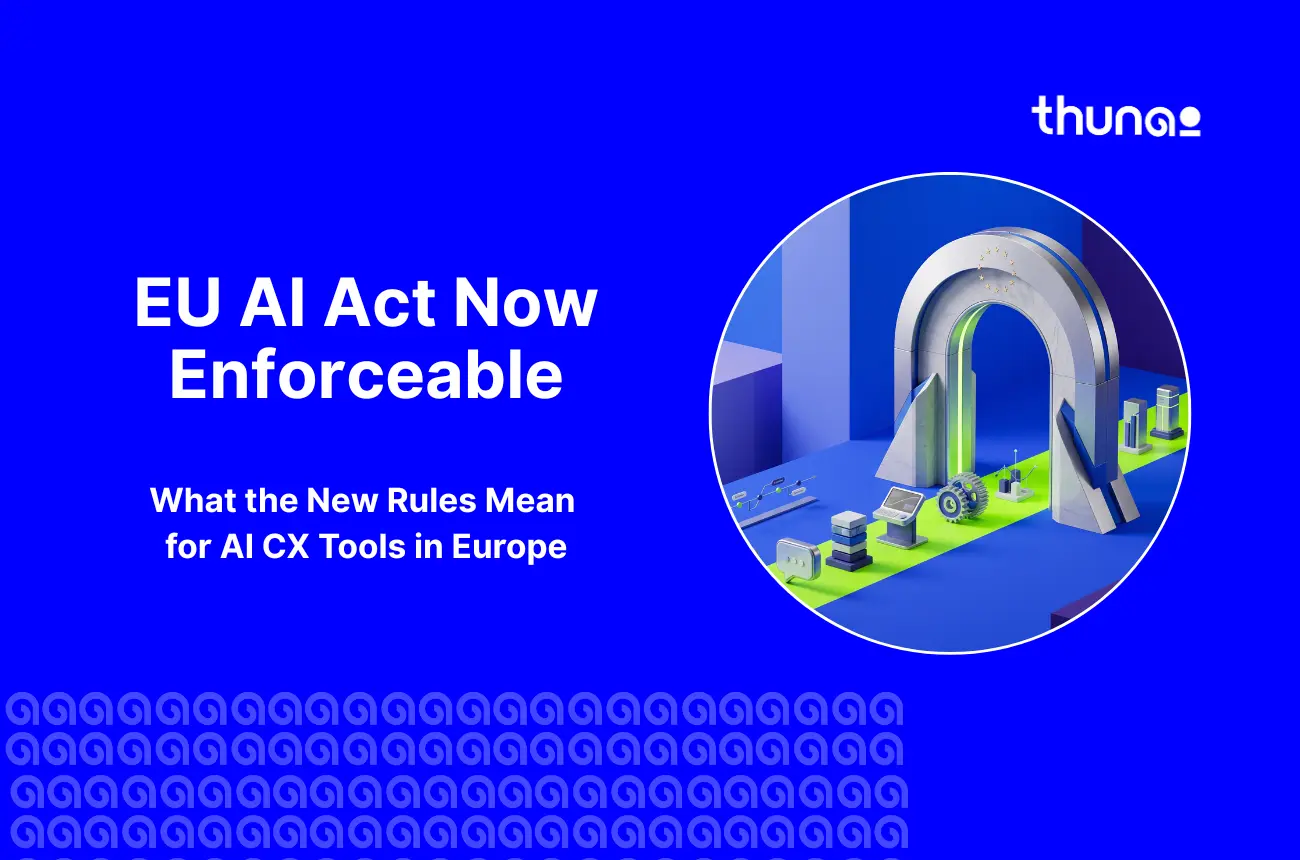

The implementation period of the EU AI Act’s obligations for transparency (Regulation (EU) 2024/1689) ended on August 2, 2026, in the European Economic Area. In accordance with Article 50, it is necessary for all chatbots, voicebots, and AI assistants communicating with customers to be identified as such.
The rule isn't limited to companies based in Europe. Any support team whose AI-generated responses reach a customer in the EU is in scope, including US and Asia-based SaaS companies, e-commerce retailers, and contact centers running third-party chatbot vendors.
For customer support and CX leaders, this is no longer a legal department problem. It's an operational one, and it starts on the very first line of every AI conversation.
An Overview and Timeline of the EU AI Act
The EU AI Act has had an uneven rollout ever since the proposal for it was made by the European Commission back in April 2021. There was political agreement on the act in May 2024, which then came into effect the following month.
February 2025 outlawed unacceptable risk practices such as social scoring and workplace emotion recognition systems.
August 2025 activated rules for general-purpose AI models, including the large language models powering many support chatbots.
First, Article 50's requirements for transparency have come into full force as of August 2, 2026, with machine-readable marking to follow in December 2026 and the full high-risk regime to kick off in August 2027.

What Is Article 50 of the EU AI Act?
Article 50 governs limited-risk AI systems, the exact category most customer support tools fall into.
Per the European Commission's final guidelines on Article 50, responsibility splits between the Provider, who builds the AI, and the Deployer, who uses it to talk to customers.
If you integrate a third-party chatbot on your website, you are the Deployer, and the disclosure requirement falls to you, not to your vendor.
That translates to the need to disclose to the customer that they are communicating with AI, apply watermarks to AI-generated text and audio content, disclose before-hand any sentiment or emotion analysis performed by the system, and label AI avatars and clones of voice.
What Your AI Customer Support Platform Should Have for EU AI Act Compliance
Meeting the requirements of the EU AI Act begins with the platform, not the document. Here's what support leaders need to see in their AI tools:
- Automatic AI transparency in the first line of every chat, phone, and email interaction – not in a disclaimer or somewhere in the footer.
- Single click-based escalation to an individual who has access to the whole conversation, fulfilling the condition for human supervision.
- The RAG model, which means that each answer is traceable to the document itself as opposed to the unregulated training data set.
- Tamper-proof logging of the prompt, answers, and escalations for at least six months.
- Watermarking of all the products of AI-generated audio, images, and texts.
What Would Happen If Your AI Tools Fail to Meet the Standards Required in the EU AI Act?
Article 50 of the EU AI Act will result in penalties equivalent to €15 million or 3% of the total global turnover, whichever is greater.
A single undisclosed chatbot in one European market can trigger a penalty sized to a company's entire global business.
The legal exposure isn't only regulatory. In Moffatt v. Air Canada, a tribunal held the airline fully liable for its chatbot's hallucinated refund policy, rejecting the argument that a bot is a "separate legal entity." Courts are increasingly treating AI outputs the same as a human agent's promises, which puts customer support teams on the front line of this risk.
EU AI Act Compliance Checklist for Customer Support Teams
Getting ahead of the enforcement of the EU AI Act doesn't require a full legal overhaul. The reality is that it honestly just needs a clear, sequenced plan:
- Audit every AI touchpoint, which includes AI chatbots, AI voice agents, email assistants, sentiment tools, and classify each under the Act's risk tiers.
- Confirm your role as Provider or Deployer with every vendor, and get contractual proof of their compliance obligations.
- Turn on disclosure and escalation features at the interface level, before the AI processes a customer's first message.
- Train frontline and QA staff on AI literacy as required under Article 4, and keep signed training records.
- Build an incident response plan, with reporting to regulators within the mandated 15-day window.
But this is not anything entirely new (AI tools like Thunai AI are built with these requirements in mind).
Feel free to reach out for a demo on what this looks like for your AI customer support system.
Frequently Asked Questions
Does the EU AI Act cover AI chatbots?
Yes. By definition (Article 50(1)), AI chatbots are "Interactive AI Systems," and the deploying business is supposed to disclose their artificial nature at the beginning of each interaction – not in the Terms of Service. The responsibility lies with whoever uses the chatbot to interact with its users, even if the chatbot was developed by the vendor.
Are AI customer support tools classified as high-risk?
Not usually. Standard chatbots, FAQs, sentiment routing tools, etc., are classified as Limited Risk and are subject only to Article 50 transparency. Tools become high-risk when they affect credit scoring, insurance decisions, essential public services, job screening – in this case, additional compliance measures apply.
What features should EU AI Act-compliant AI voice agents have?
AI voice agents should notify callers at the very beginning that they are dealing with an automated agent. Generated audio files should be marked by machine-readable watermarking; in case of using voice cloning, the caller should hear an audible disclaimer; and also the callers should be able to speak to a human easily.
What features should be present in a compliant EU AI Act chatbot?
Verify if AI disclosure is done before using the chatbot, "speak to a human" feature along with complete transfer of context, answers from RAG, security and retention of prompts and outputs for a minimum of six months, and native watermarking for text/image output.
What changes should companies do before launching AI chatbots?
Risk categorization, negotiations with vendors about compliance responsibilities, training of support teams on AI, preparing an incident response plan, and auditing knowledge bases of AI.