



What if you could get Sierra-level AI agents without Sierra-level price tags or timelines?
Sierra AI has proven that industrial‑grade agents can transform customer service into smarter automation, safer policies, and happier customers.
The good news is you don’t have to lock into six-figure contracts to reach that level anymore.
A new wave of Sierra AI alternatives in 2026 comes with similar features, faster deployment, and more flexible pricing.
In this guide, you’ll explore 12 Sierra AI competitors that help you launch reliable, brand‑safe agents quickly.

Top Sierra AI Alternatives and Competitors in 2026 (12 Best Options)
What Is Sierra AI?
Sierra AI represents an Agent Operating System for customer service within the business environment. The tool allows large organizations to create their own AI agents that would be capable of functioning via chat, voice, e-mail, SMS, and messaging, and integrate with other tools such as CRMs and ERPs.
Founded by Bret Taylor and Clay Bavor, Sierra is designed for always on, policy safe automation at scale which is why many teams search for “Sierra AI alternatives” when they need similar power with more flexible pricing and faster deployment.
Features of Sierra AI
Sierra AI presents a curated set of Features designed for safety and execution. The conversational AI tool moves beyond simple FAQ responses into complex workflow automation.
- Hybrid Reasoning Engine. Sierra does not rely only on LLMs. The platform uses a supervisor model to check the work of the generative AI. This system confirms that the business logic follows strict rules.
- Agent Studio. This is a low-code environment for CX teams. Instead of writing scripts, users define goals declaratively. You tell the agent to process a return, and the AI calculates the steps. The tool prioritizes configuration over coding.
- Deep Enterprise Connection. Sierra agents take action. They link deeply with CRMs and ERPs to update records, process payments, and schedule appointments autonomously. These agents do the work instead of linking to help articles.
- Trust Guardrails. The main value of the platform is brand safety. This system includes strict testing environments and policy layers to guarantee the agent never promises something it cannot deliver. The framework is built to lower liability.
Limitations of Sierra AI
Sierra AI adds significant resistance and cost to your company. These limitations often force agile teams to look elsewhere. You must understand the extra costs you pay.
- Extremely High Cost. The entry point acts as a gatekeeper. Annual contracts often start around $150,000, with setup fees adding another $50,000 to $200,000. This pricing rules out mid-market companies.
- Outcome-Based Billing Complexity. Sierra charges based on successful resolutions. This model creates problems in practice. Defining a resolution becomes a contract dispute. Meaning, predictable budgeting becomes impossible for purchasing teams.
- Slow White-Glove Deployment. You cannot sign up and build. The setup process is heavy and often requires 1-2 months of engineering work. Sierra is not a self-serve tool for fast updates.
- Closed System Architecture. Users report a lack of control. You depend on Sierra engineers for complex changes. You cannot easily change the underlying prompts or swap models, leaving you locked into their ecosystem.
- Unclear Trust Claims. Some technical teams question the depth of the Agent OS defense. Doubt exists regarding whether the platform is truly revolutionary or simply a polished connection layer with a high price tag.
12 Best Sierra AI Alternatives and Competitors in 2026
1. Thunai AI
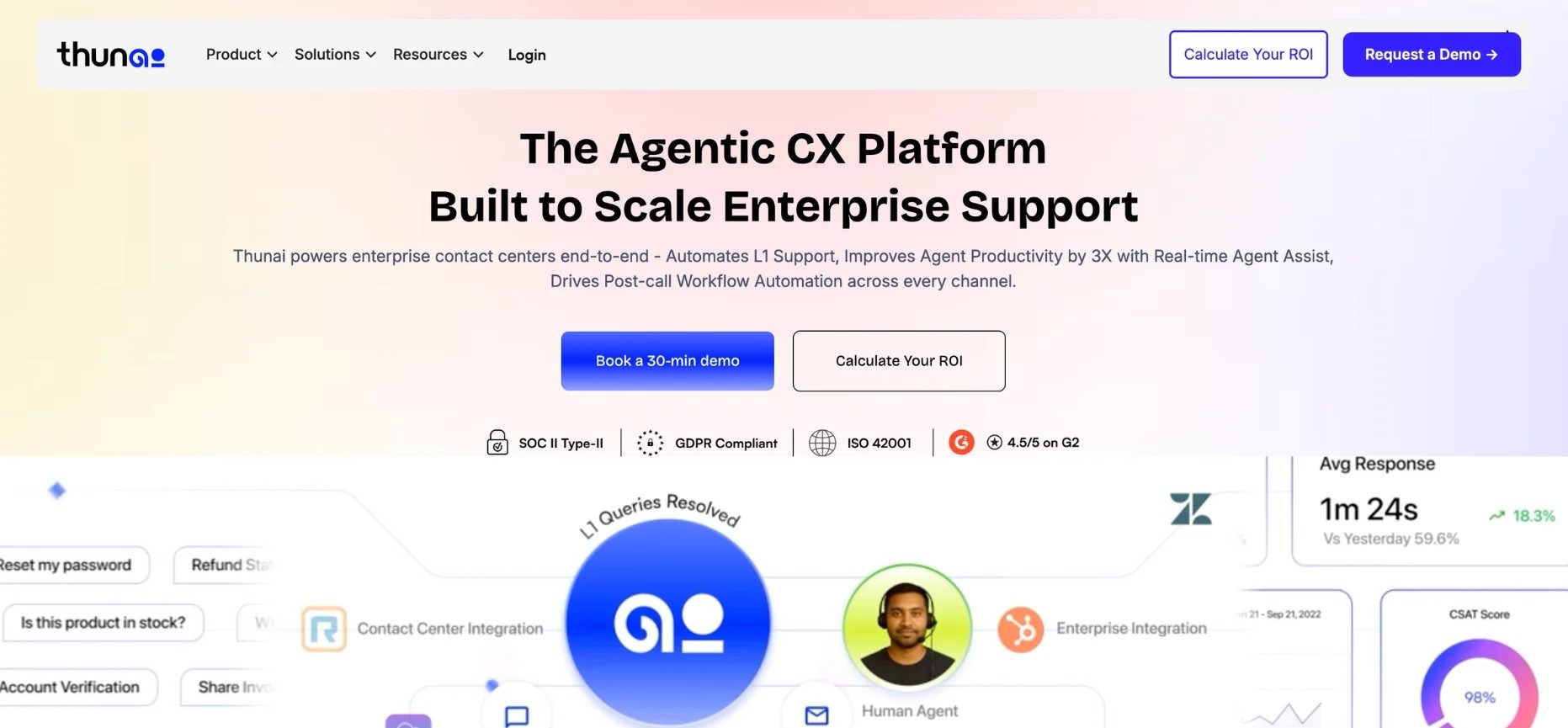
Your company data is messy. Documents contradict each other. Policies conflict. Sierra AI solves this by restricting the AI with hard-coded rules. Thunai AI takes a different path: this Sierra AI alternative fixes the knowledge itself.
This is the top Sierra AI alternative for companies needing AI automation and orchestration and human-like AI agents that interact with customers.
Thunai positions itself as the Second Brain for the company. Instead of just trust, this Sierra AI alternative prioritizes Knowledge Orchestration. Its proprietary Thunai Brain ingests your SOPs and logs to create a contradiction-free knowledge graph.
This process lowers hallucinations by 95% without the $150k price tag. For companies that want agentic strength without the high markup, Thunai is the disruptive choice.
Key Features:
- Contradiction-Free Knowledge Graph. Thunai does not just read your documents; the brain audits them. This system actively flags conflicts (like two different return policies) so the AI never gets confused. Thunai solves the root cause of hallucinations: bad data.
- Model Context Protocol (MCP). Thunai uses the Model Context Protocol to enable advanced AI agent orchestration, a key advantage highlighted in our Thunai vs Sierra comparison. This proprietary technology allows different agents to talk to each other. A Voice Agent can handle a call and pass the data perfectly to an Email Agent for the follow-up. Context is never lost between channels.
- Chrome Extension Workflow. The Second Brain lives where your employees work. The extension connects directly into the browser to help staff in real-time without forcing them to switch apps.
- Meeting to Knowledge Loop. Meeting agents transcribe internal calls and instantly turn them into knowledge base entries. Your internal discussions become external support answers automatically.
Pros:
- Aggressive Pricing: Plans start at $7/month, with Enterprise at $399/month. This price is much cheaper than Sierra.
- AI voice with screensharing: Thunai can function as an AI voice agent with screen sharing to help customers in real-time without forcing them to switch apps.
- Speed to Value: Upload docs and have a working agent in minutes.
- Transparent Control: You own the knowledge graph and the logic.
Cons:
- Newer entrant (2025) with less brand history than legacy players.
2. NICE Cognigy

Cognigy was a leader in low-code conversational AI before its massive $955M acquisition by NICE in 2025. Now, as NICE Cognigy, this competitor to Sierra AI is the top choice for consolidated contact centers.
This Sierra AI alternative presents a vertically joined stack where the telephony, workforce management, and AI agents live in one ecosystem.
This is one of the best Sierra AI alternatives for global contact centers needing unified telephony and AI.
This is the safe choice for companies that want a single vendor. Not to mention, it’s also a solution that combines the sophisticated Voice Gateway of Cognigy with the global reach of NICE CXone.
Key Features:
- Native Voice Gateway. Cognigy controls the phone line. This tool handles SIP connections, voice activity detection, and barge-in natively. The gateway manages the audio stream instead of just generating text.
- AI Ops Center. A dedicated dashboard for observability. The center gives IT teams real-time insights into latency, error rates, and agent performance to fix the black box issue of AI.
- Agent Copilot. The AI listens to live human calls and suggests answers in real-time. This function lowers training time for human agents by giving instant guidance.
Pros:
- Unified Stack: Single contract for phone lines, recording, and AI.
- Strong Visual Builder: Praised by designers for handling complex logic.
Cons:
- Complex Pricing: Bundled with CCaaS contracts, making it expensive for standalone needs.
- Excessive: Too complex for simple marketing or FAQ bots.
3. Kore.ai

Kore.ai is the platform for everything. While Sierra is new, Kore.ai has built its Experience Optimization (XO) platform for over a decade.
The company serves over 400 Fortune 2000 companies and is a staple in the Gartner Magic Quadrant.
This is the top Sierra AI alternative for Fortune 2000 banks and healthcare groups needing strict compliance.
If your industry is heavily regulated (like banking or healthcare), Kore.ai presents the granular governance you need. This conversational AI platform prioritizes depth and security over novelty.
Key Features:
- Multi-Engine NLP. Kore.ai uses a triad system. The engine combines Fundamental Meaning, Machine Learning, and Knowledge Graph engines to confirm intent recognition is strong. The system does not rely on just one LLM.
- Specialized Assist Solutions. Pre-trained bots for specific industries. BankAssist, HealthAssist, and HR Assist come with the domain knowledge already built-in.
- Granular Governance. Define strict roles, permissions, and audit logs. You can control exactly who sees what data. This control is a primary requirement for compliance-heavy sectors.
Pros:
- Flexible Pricing: Session-based or seat-based options make it grow easily.
- Extreme Depth: Can replace traditional IVR systems entirely.
Cons:
- Steep Learning Curve: The platform is massive and can be confusing.
- Complex Configuration: Not for teams wanting a quick fix.
4. PolyAI

If your priority is a voice that sounds human, PolyAI has no equal. Spun out of Cambridge University, they center entirely on high-quality voice experiences.
Unlike generalist platforms, they built a proprietary speech stack designed to handle the messiness of real phone calls.
This is the one of the best Sierra AI alternatives for high-volume hospitality and logistics voice support.
PolyAI is a managed service. You pay them, and their engineers build the bot. This conversational AI is the solution for high-volume environments like logistics and hospitality where voice quality impacts the bottom line.
Key Features:
- Voice-First Architecture. Fine-tuned for accents, background noise, and interruptions. The stack handles pauses naturally.
- Code-Switching. The agents can switch languages mid-sentence. This capability is a major advantage for global support lines.
- Managed Deployment. PolyAI handles the build and tuning. This offering is a full-service option for companies that want to outsource the complexity.
Pros:
- Best-in-Class Voice: Consistently rated as the most human-sounding on the market.
- High Autonomy: Resolves complex calls without human help.
Cons:
- Price: Custom pricing from $150,000/year.
- Closed system: The logic of Sierra AI cannot be changed by you.
5. Replicant

Replicant centers on one metric: Resolution. They market their agents as Thinking Machines designed to automate Tier-1 issues fully.
Founded by Gadi Shamia, Replicant engineered its stack to remove the awkward pauses that affect other voice bots. This is one of the better Sierra AI alternatives for Tier-1 issue resolution with speed priority.
Replicant is a strong competitor for enterprise CX leaders who want to stop deflecting calls and start resolving them. The platform gives deep visibility into why customers are calling.
Key Features:
- Sub-Second Latency. The structure is optimized for speed. This architecture prevents the lag that makes customers hang up, creating a fluid conversation.
- Conversation Intelligence. The engine transcribes and analyzes 100% of calls. This process gives a rich data loop to help you fix upstream business problems.
- Visual Builder. Unlike PolyAI managed black box, Replicant presents a builder tool that gives customers some control over the flow.
Pros:
- High Resolution Rates: Built to finish tasks, not just route calls.
- Strong CSAT: Users praise the improvement in customer satisfaction scores.
Cons:
- Connection Friction: Some users report challenges connecting to legacy systems.
- Custom Pricing: Lacks clear pricing for mid-market buyers.
6. Moveworks

Moveworks is the specialist for internal Employee Experience (EX). If your problem is IT tickets and HR questions, this is the solution.
Recently acquired by ServiceNow for $3 billion, Moveworks is the Copilot for the workforce. This is an option among Sierra AI alternatives for internal IT and HR employee experiences.
The bot lives inside Microsoft Teams and Slack. This tool intercepts issues before they ever reach a helpdesk.
The system uses a specialized reasoning engine trained on millions of IT tickets to understand enterprise terms immediately.
Key Features:
- IT/HR Reasoning Engine. Pre-trained to understand technical requests or wifi issues. The engine works out-of-the-box for internal support.
- Invisible Interface. Employees do not download a new app. They just chat in Slack or Teams, and Moveworks fixes the issue in the background.
- Deep System Action. This conversational AI connects to Okta, Jira, and Workday to reset passwords, create tickets, and look up policy answers autonomously.
Pros:
- High Deflection: Resolves 50%+ of IT tickets automatically.
- ServiceNow Native: The acquisition promises even deeper connection.
Cons:
- Internal Only: Not suitable for customer-facing support.
- High Per-User Cost: Can be expensive for smaller headcounts.
7. Synthflow

For those priced out of the six-figure enterprise contracts, Synthflow is the democratizer. Launched in 2023, this platform brings voice AI to the SMB mass market.
The tool is a no-code builder that uses ElevenLabs for high-quality voice synthesis. This is the best Sierra AI alternative for SMB and mid-market outbound sales.
Synthflow is perfect for outbound sales, appointment setting, and simple inbound queries for businesses that need speed and affordability.
Key Features:
- Drag-and-Drop Builder. Zero coding required. You can build a voice agent visually in minutes.
- Transparent Pricing. Plans start at just $29/month. Voice costs are around $0.08/minute, a fraction of legacy provider rates.
- ElevenLabs Connection. Access to the best synthetic voices in the market instantly.
Pros:
- Extremely Affordable: Accessible to startups and small businesses.
- Fast Setup: No engineering team needed.
Cons:
- Limited Logic: Lacks the deep complex Features required for Fortune 500 banking workflows.
- Glitchy: Users report occasional stability issues compared to enterprise tools.
8. Talkie.ai

Talkie.ai proves the value of specialization. This competitor to Sierra AI concentrates strictly on the healthcare market.
Generalist bots struggle with patient data and scheduling details; Talkie.ai is built for it. The platform presents deep links with EHRs like Athenahealth and ModMed.
This is the best Sierra AI alternative for healthcare practices needing patient access automation.
For medical practices, this is the superior alternative to a generic Sierra setup. This conversational AI understands patient intake, prescription refills, and appointment scheduling out of the box.
Key Features:
- EHR Connection. Native links to Electronic Health Records. The system can read and write patient data securely.
- Medical Context. Pre-trained to handle sensitive patient conversations and medical terms.
- Automated Triage. Handles scheduling and refills. This automation frees up front-desk staff for in-person care.
Pros:
- Vertical Expertise: Solves the generic bot problem for doctors.
- Mid-Market Pricing: ~$1,000-$1,500/month per practice is manageable.
Cons:
- Niche: Only useful for healthcare providers.
9. Voiceflow

Voiceflow started as a prototyping tool but has evolved into the industry standard for designing conversational AI.
This tool is favored by developers and designers for its flexible canvas. This is the best Sierra AI alternative for developers and designers needing design flexibility.
Voiceflow is a builder, not a managed service. You use it to design the logic and then connect it to any LLM (OpenAI, Anthropic) or channel you want. Voiceflow presents ultimate flexibility.
Key Features:
- LLM Agnostic. You are not locked into one model. Swap between GPT-4, Claude, or local models as needed.
- Collaborative Canvas. Teams can design conversation flows together visually. Massive library of community templates to speed up work.
- Developer API. Export your designs or run them directly via API. Perfect for teams building custom products.
Pros:
- Total Control: You own the design and the stack.
- Transparent Pricing: Free tier available; Pro is $50/editor/month.
Cons:
- You Build It: Requires effort. It is not a done-for-you solution.
- Telephony Complexity: Requires separate connection (e.g., Twilio) for voice.
10. Ada

Ada sits between the DIY builders and the heavy enterprise giants. This platform is the Automated Brand Agent for digital-native companies like Meta and Square.
Ada pioneered the shift from scripted chatbots to reasoning agents. This is the best Sierra AI alternative for digital-native brands requiring CX automation.
Ada is designed for high-growth digital brands that need to automate customer support across web and mobile. The agent is smarter than a script but faster to setup than a legacy system.
Key Features:
- Reasoning Engine. Moves beyond decision trees to understand intent and context dynamically.
- No-Code Builder. Marketing and CX teams can manage the bot without engineering help.
- Partner Model. Ada positions itself as a partner in your CX plan, not just a tool provider.
Pros:
- Digital Native Center: Perfect for e-commerce and SaaS brands.
- Strong Support: High user ratings for customer success.
Cons:
- High Cost: Deals often range from $60k to $300k annually.
- Unclear Pricing: No transparent price list; tailored for enterprise.
11. Intercom Fin

Intercom Fin is an AI agent embedded inside the broader Intercom platform. It’s built to resolve support issues using your help center, past conversations, and product data.
This is a practical Sierra AI alternative for SaaS and subscription businesses already using Intercom.
Key features:
- AI agents that can auto‑resolve common questions and draft replies for human agents.
- Native integration with Intercom inbox, help center, and customer profiles.
- Detailed analytics on deflection, resolution, and support volume.
Pros:
- Simple to deploy if Intercom is already your main CX tool.
- Unified stack for chat, product tours, and AI agents.
- Good fit for product‑led growth motions.
Cons:
- Less attractive if you don’t plan to adopt Intercom more broadly.
- Limited for complex telephony or regulated voice workflows.
12. Zendesk AI

Zendesk AI is the AI layer on top of Zendesk Support, built to route tickets, suggest responses, and deflect customers to self-service when appropriate.
For companies that live inside Zendesk, this is a natural Sierra AI alternative.
Key features:
- AI‑powered ticket routing and intent detection based on historical data.
- Suggested replies and macro recommendations within the agent workspace.
- Deflection through help center search, widgets, and AI answers.
Pros:
- Minimal change management; teams keep Zendesk as their core.
- Solid reporting on deflection and agent assistance.
- Works across email, web, and chat.
Cons:
- More AI assistance than a full Agent OS.
- Less suited to deep telephony and complex IVR out of the box.
How to Choose the Right Sierra AI Alternative
- The Trust vs. Cost Trade-off. Sierra sells insurance against brand risk. If your primary fear is a hallucination appearing on the news, Sierra or Kore.ai present the heaviest guardrails. If you need ROI and speed, Thunai AI presents a better balance.
- Voice vs. Chat. If your volume is primarily phone calls, PolyAI and NICE Cognigy are the specialists. Sierra and others are often chat-first with voice added on.
- Build vs. Buy. Do you want a black box that just works (Sierra, PolyAI)? Or do you want to own the logic and iterate fast (Voiceflow, Thunai)? The black box saves time initially but costs control long-term.
- Vertical Specificity. Do not buy a generic tool for a specific problem. Healthcare groups should use Talkie.ai. Internal IT teams should use Moveworks. Sierra is a generalist; specialists often outperform generalists in their niche.
- Budget Reality. Can you afford a $150k starting price? If not, Sierra is off the table. Thunai and Synthflow present entry points under $100/month, allowing you to prove value before increasing spend.
How Thunai Stands Out as the Top Sierra AI Alternative
Thunai fundamentally reframes the problem. Sierra believes the solution to AI risk is more rules and more supervisors.
Thunai on the other hand, is one of the ai assistants and customer support tools that believes the solution is better knowledge and smarter automation processes.
Key Differentiators:
- Knowledge vs. Guardrails. Sierra prevents errors by blocking the AI. Thunai prevents errors by fixing the data the AI reads. The Thunai Brain creates a contradiction-free foundation, so the agent is smart, not just restricted.
- Agent Collaboration (MCP). Thunai uses the Model Context Protocol to prepare you for the future where agents talk to agents. The protocol is built for a multi-agent world, not just a chatbot world.
- Price-to-Performance. For $399/month (Enterprise), you get features that rival the $150,000 offering from Sierra. Thunai is the practical choice for the CFO and the CIO alike.
Ready to see this in your own stack? Book a free Thunai demo and watch a contradiction free Second Brain and live AI agent go live in minutes not months.
FAQs on Sierra AI Alternatives
What is the main disadvantage of Sierra AI?
Sierra AI is very expensive for many. With annual contracts starting around $150,000 and high setup fees, the tool is a luxury good. Additionally, its closed system approach limits your control over the underlying models and prompts.
Is there a free alternative to Sierra AI?
Yes. Thunai AI presents a Free Forever plan with 100 AI credits. Voiceflow also presents a strong free tier for designers. These tools allow you to build and test agents without any upfront cost, unlike Sierra.
Who are the founders of Sierra AI?
Sierra AI was founded by Bret Taylor (former Co-CEO of Salesforce and OpenAI Board Chairman) and Clay Bavor (former VP of Google Labs). Their history is a major driver of the company's trust positioning and high valuation.
What is agentic AI?
Agentic AI refers to systems that can reason, plan, and perform tasks autonomously. Unlike old chatbots that followed a script, agentic AI (like Sierra and Thunai) that understands goals (e.g., process a return) and figures out the necessary steps and API calls to achieve them based on earlier guidelines set



.png)
