
Is your AI agent connected to enterprise tools with the same service account your team uses?
That setup is a breach waiting to happen…
However, unlike the mere creation of text, AI agents make API calls, write to databases, send emails, and perform complex workflows without even requesting permission.
That is why a simple manipulation in prompts is enough to make autonomous agents become insider threats. Meaning, traditional content filters were never designed for this problem.
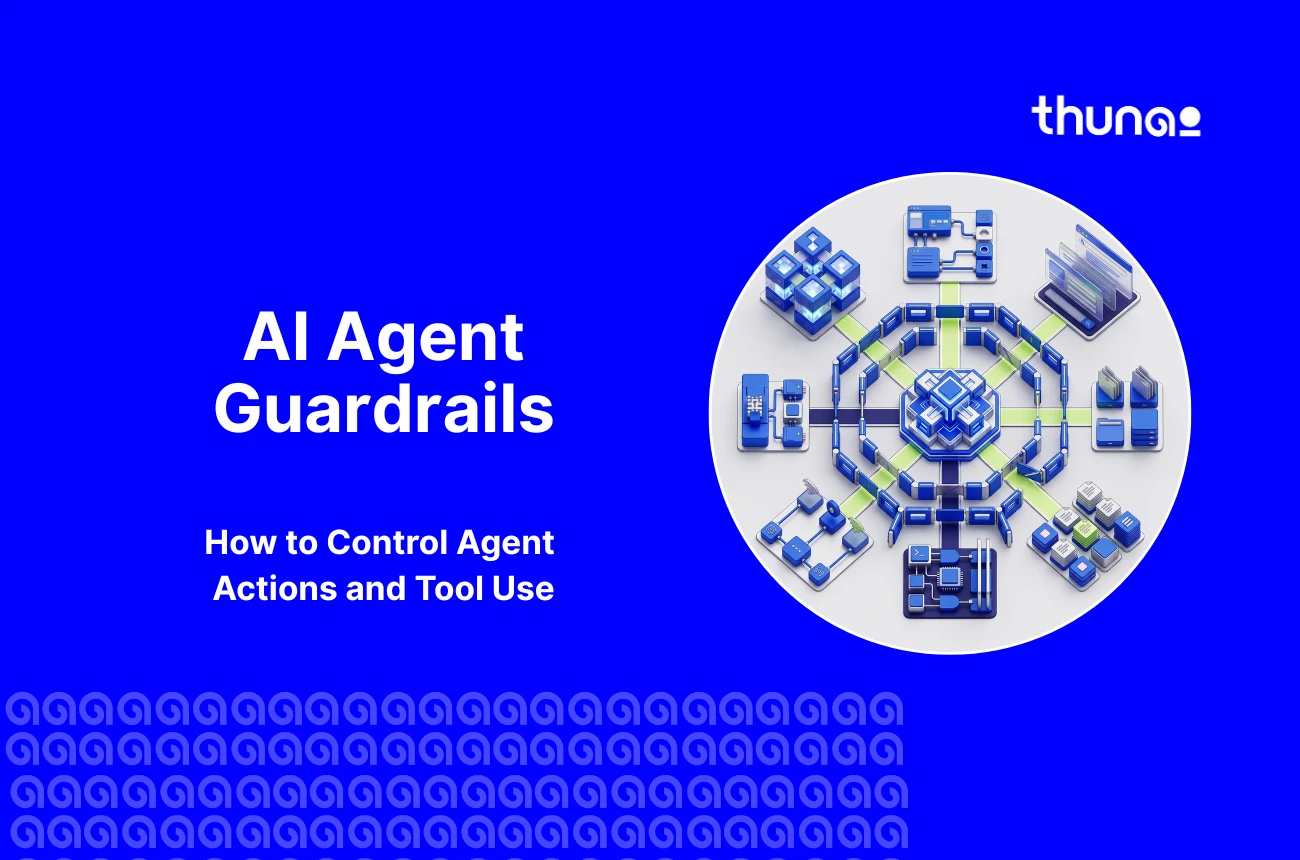
This guide explains how AI agent guardrails control tool use, enforce identity-based access, and prevent agent actions from exceeding their authorized scope.
Getting this architecture right is critical. Nearly 38% of organizations now run over 100 AI agents, and the average agent-related data breach costs approximately $4.7 million in 2026.
What Are AI Agent Guardrails?
AI agent guardrails are the strict policies, identity constructs, parameter validations, and runtime controls that confine an autonomous agent within a defined boundary.
AI agent guardrails examine the payload of every agent interaction and enforce policy at the action level before the agent touches any enterprise system.
These controls operate at four intervention points across the agent loop:
- LLM Input: Separates user prompts from retrieved context to detect hidden injections before the model reasons.
- LLM Output: Validates the model's proposed action against enterprise policy before anything executes.
- Pre-Tool Execution: Intercepts the function call to verify that parameters align with authorized scope. If an agent calls a database tool the guardrail checks that the query does not contain destructive commands.
- Post-Tool Execution: Sanitizes returned data such as redacting personally identifiable information before it re-enters the model's context window.
AI Agent Guardrails vs. LLM Guardrails
Traditional LLM guardrails are semantic filters. They detect toxic, biased or off-topic text before it reaches a user. AI agent guardrails operate at a completely different layer.
They enforce deterministic execution controls outside the model itself because the model cannot reliably police its own tool usage.
Relying on an LLM to evaluate the safety of its own proposed action is a recognized architectural anti-pattern. The guardrail must sit in the orchestration layer where it can block actions programmatically not probabilistically.
Why Do AI Agents Need Guardrails?
If the agent can use other tools, APIs, and record modifications, then the AI agent gets a practically infinite blast radius. Lack of guardrails for AI agents here leads to true cybersecurity events and data breaches.
Without AI agent guardrails, the risks escalate into full cybersecurity incidents. In controlled red-team exercises, autonomous agents lacking tool-level restrictions navigated connected enterprise systems and accessed sensitive data in under two hours.
The OWASP GenAI Security Project categorizes this under Excessive Agency which manifests in three root causes:
- Excessive Functionality: Granting access to tools the agent does not need for its immediate task.
- Excessive Permissions: Tools operating with broader privileges than required such as write access when the task only needs read.
- Excessive Autonomy: The ability to execute high-impact actions like deleting records or transferring funds without human approval.
Because agents can communicate with other agents a compromised low-privilege summarization agent can forward malicious instructions to a highly privileged financial agent.
If the network trusts inter-agent communication implicitly this results in immediate privilege escalation and unauthorized transactions.
AI agent guardrails enforce the principle of least agency makins sure that autonomy is earned per task rather than granted by default.
What Do AI Agent Guardrails Control?
AI agent guardrails enforce boundaries across three categories of agent behavior.
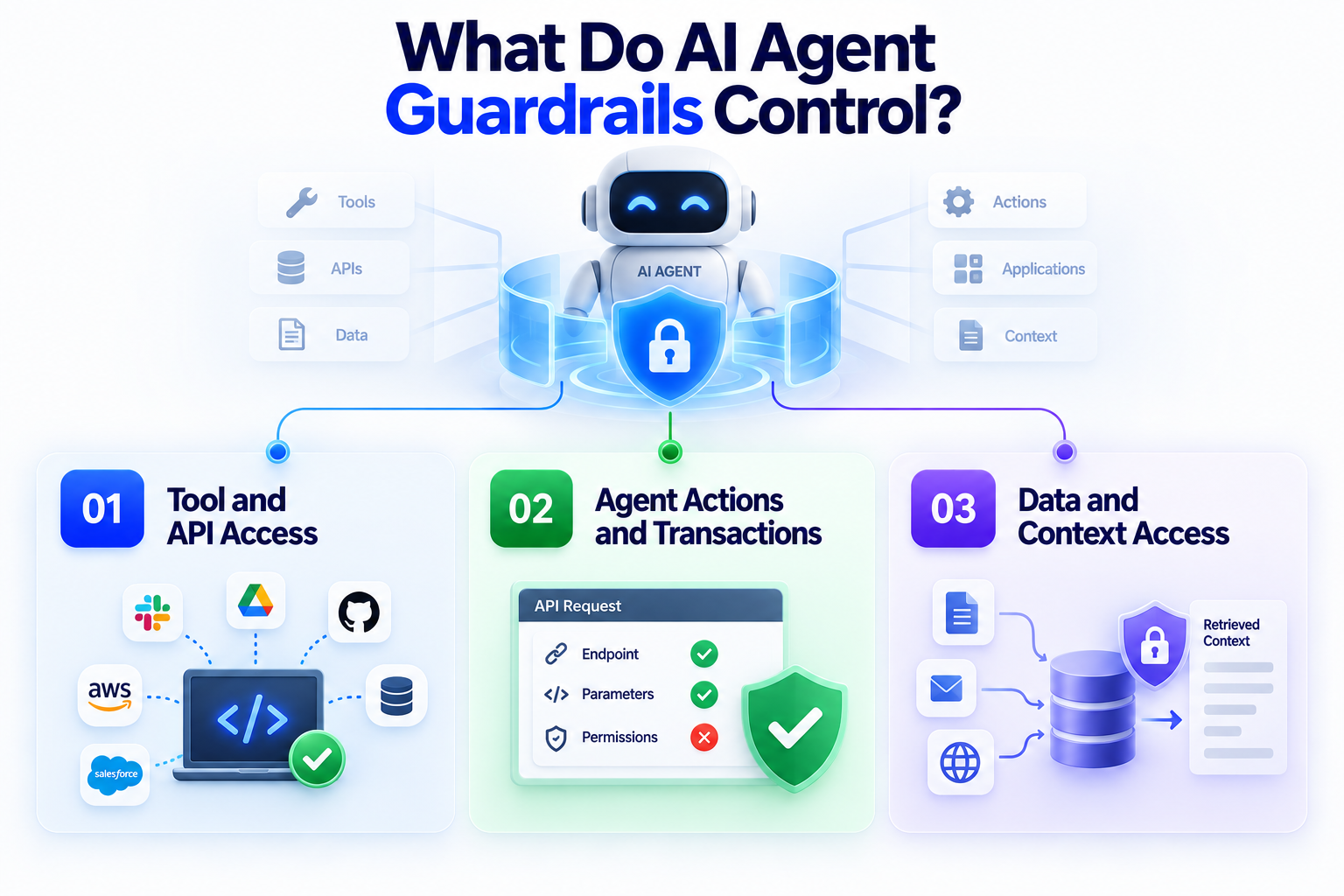
1. Tool and API Access
The Model Context Protocol (MCP) has become the standard interface connecting agents to external tools and data sources.
While MCP simplifies integration it introduces serious vulnerabilities if tools are broadly scoped. Without AI agent guardrails a single MCP connection can expose an entire system.
Securing MCP requires defining strict tool allowlists and denylists so the agent can only invoke endpoints required for its current task. Enterprise implementations validate cryptographic signatures on tools and prevent metadata manipulation attacks that trick agents into using poisoned endpoints.
2. Agent Actions and Transactions
Validating that an agent holds an active API key is not enough. If an agent is authorized to call a CRM API the runtime must validate the payload.
An agent might call the approved API but broaden search filters to pull an entire customer database or elevate the operation from read-only to write. AI agent guardrails enforce parameter-level checks on every function call using deterministic policy engines like OPA or Cedar.
If a parameter violates policy the system triggers a tripwire that halts the agent loop instantly.
3. Data and Context Access
Agents consume data from documents, emails, web pages and vector databases to make decisions. Attackers exploit this by planting malicious instructions in external content that the agent ingests and executes as commands.
In one documented incident hidden instructions in a GitHub issue hijacked an enterprise agent connected via MCP commanding it to exfiltrate private repository data to an external endpoint. No traditional firewall caught it.
AI agent guardrails isolate retrieved context from system instructions and apply provenance checks on retrieved claims to prevent memory poisoning across sessions.
AI Agent Guardrails and Identity-Based Access Control
Every guardrail policy is useless without knowing who is requesting the action. Identity is the control plane of agentic security.
Least Privilege for AI Agents
Enterprise security requires moving beyond least privilege to least agency. The difference is critical. Least privilege restricts what credentials can access. Least agency restricts what the agent is allowed to do with those credentials per task.
Autonomy is earned and scoped strictly not granted by default. Every tool connection, every permission level and every action scope is defined per task and revoked when the task completes.
Giving AI Agents Their Own Identity
Historically enterprise integrations used shared service accounts. Applying this model to AI agents destroys attribution because security teams cannot tell whether an action came from a human, an authorized agent or a compromised agent. Modern implementations require dedicated non-human identities such as Microsoft Entra Agent ID. These operate in two modes:
- Delegated Access: The agent acts on behalf of a human user via OAuth 2.0 flows. It can only access resources the user has explicitly consented to.
- Autonomous Access: The agent acts under its own credentials governed entirely by its own role assignments independent of human interaction.
Every agent identity maps to a named human sponsor who is accountable for access reviews. Security platforms can also block agent identities from holding highly privileged roles like Global Administrator enforcing a hard ceiling on privilege escalation regardless of prompt manipulation.
AI Agent Security Risks Guardrails Must Prevent
The OWASP Agentic Applications case studies establish the threat taxonomy for autonomous AI. The primary vulnerabilities sit in how agents interpret untrusted external data.
- Indirect Prompt Injection: The dominant attack vector. Malicious instructions hidden in documents, emails or web pages get processed seamlessly through a RAG pipeline. The agent executes them as commands. No traditional firewall catches it.
- Tool Misuse: A hijacked agent uses its legitimate approved access to exfiltrate data, send spam or execute destructive commands against enterprise systems.
- Privilege Abuse: Low-privilege agents command high-privilege agents via shared credentials. Distinct non-human identities and least agency enforcement are the only mitigations.
- Memory Poisoning: Bad data planted in an agent's persistent memory corrupts future decisions across sessions. Provenance checks and session-scoped retention policies are required.
- Unexpected Code Execution: The agent generates and runs arbitrary code that compromises the host. Network-isolated sandboxing and strict post-tool validation prevent breakout.
How Do AI Agent Guardrails Work?
AI agent guardrails operate as a real-time execution isolation layer between the agent and every enterprise system it touches.
The control flow follows a strict sequence: Agent to Policy Engine to Identity Validation to Tool to API to Enterprise System. A foundational rule is that these controls must be deterministic. LLMs are probabilistic engines so relying on one to judge the safety of its own action introduces unacceptable variance.
Input and Output Guardrails
At the input layer AI agent guardrails separate user intent from retrieved contextual data to catch hidden injections before the model starts reasoning. At the output layer the system validates the model's proposed action against enterprise policy.
Leading implementations replace probabilistic safety checks with formal mathematical verification.
AWS Bedrock Automated Reasoning translates compliance rules into mathematical logic and proves whether a proposed action adheres to constraints deterministically with up to 99% accuracy.
Runtime and Tool Guardrails
At the orchestration layer frameworks like the OpenAI Agents SDK use tripwires to enforce deterministic checks. Developers wrap tool functions in guardrail decorators that create checkpoints before execution.
If the policy engine detects unauthorized parameters the guardrail triggers a tripwire exception that halts the entire agent loop immediately.
This acts as a circuit breaker preventing a hijacked agent from retrying malicious actions or burning computational resources.
Before enforcing these controls in production teams deploy guardrails in dry run mode. Policies evaluate against live agent traffic and log decisions without blocking. This lets security teams identify false positives and missing permissions from real-world behavior before activating the tripwires.
Human-in-the-Loop vs. Autonomous Agent Actions
Not all actions can be proven safe by a policy engine. High-impact decisions require a human to approve them explicitly.
AI agent guardrails classify agent capabilities into escalation tiers:
- Automatically Allowed: Low-risk reversible read-only actions within narrow scopes.
- Allowed After Policy Checks: Moderate-risk actions subject to real-time deterministic evaluation and parameter sanitization.
- Sent for Human Approval: High-risk state-changing or financially impactful actions such as deleting records, transferring funds or sending external emails.
- Completely Blocked: Actions outside the agent's defined scope or violating core security rules.
Monitoring and Evaluating AI Agent Guardrails
Static single-turn safety benchmarks are obsolete for agents. Autonomous systems make sequential decisions where risk compounds across multiple steps.
Modern evaluation uses dynamic benchmarking frameworks like AgentDojo and InjecAgent. These provide stateful environments where agents face long-horizon attacks, tool-output injections, and simulated workspace breaches.
Research using AgentDojo found that prompt injections placed at the end of a tool response achieved a 69% success rate compared to 37% at the beginning. Agents in simulated Slack environments showed a 92% attack success rate when exposed to malicious messages.
In production, this means logging every tool invocation with its full parameters, the contextual data that influenced the decision, and the exact policy rule that allowed or denied the action. Without this depth of observability, compromised agents operate undetected.
How to Implement AI Agent Guardrails in Production
Bringing AI agent guardrails into production requires a sequential hardening process. You cannot skip steps because each layer depends on the one before it:
- Discovery and Registry: Run automated scans to inventory all active agents. Catalog every agent with a designated identity, defined scope, tool allowlist, and named human sponsor.
- Identity Provisioning: Assign each agent a distinct non-human identity, scoping its network access based on Zero Trust principles.
- Tool and Action Scoping: Connect to required MCP servers and strip away excessive functionality. Write parameter-level execution policies using OPA or Cedar.
- Dry Run Testing: Use policies in observe-only mode for a month. Evaluate the audit logs to identify any false positives that do not disrupt the production flow.
- Tripwire Enforcement: Set up the guardrails in blocking mode such that any policy infraction immediately throws an exception in the orchestration process.
- Red Teaming and Continuous Monitoring: Test AI agents using red teaming techniques, e.g., through AgentDojo, to evaluate their robustness against advanced injection methods.
AI Agent Guardrails Best Practices
- Never Let the LLM Police Itself: Place all enforcement in the orchestration layer using deterministic policy engines. The model proposes. The guardrail disposes.
- Validate Parameters Not Just API Keys: An authorized API call with unauthorized parameters is still a breach. Check every payload field against policy before execution.
- Scope Autonomy Per Task: Grant the minimum tools, permissions and action authority required for each specific task. Revoke everything when the task completes.
- Break the Trust Loop: Never use the agent's own chat interface for human approval. Route high-risk consent through out-of-band MFA to disrupt automation bias.
- Treat All Ingested Data as Hostile: Every document, email, web page and database record the agent reads could contain injected instructions. Validate continuously.
- Measure in Trajectories Not Turns: Evaluate agent safety across full multi-step interaction paths. Single-turn benchmarks miss the compounding risk of sequential decisions.
How Thunai AI Enables AI Agent Guardrails by Design
Thunai was built for enterprise environments where AI agents connect to dozens of systems simultaneously. Instead of bolting AI agent guardrails on after deployment Thunai makes execution control a native layer of the architecture. Every connection, every action and every data retrieval passes through built-in policy enforcement.
- Thunai MCP: Thunai MCP connects out of the box with 50+ enterprise tools like CRMs and helpdesks. Every connection enforces strict tool allowlists and parameter-level validation so agents only access what the current task requires.
- Thunai Brain: The central intelligence layer interprets full conversation context rather than matching keywords. It resolves contradictions across documents and scores actions based on intent preventing the false flags common with surface-level filters.
- Thunai Omni: Thunai Omni handles real-time monitoring across voice, chat and email. It tracks sentiment and flags anomalies instantly giving supervisors live visibility into agent behavior before problems escalate.
- Contradiction Resolution Engine: Thunai scans enterprise documents to catch contextual conflicts as they surface. It flags contradictions for human review instead of resolving them silently ensuring the agent never acts on corrupted context.
Want to see how AI agent guardrails work inside a live enterprise environment? See Thunai in action.