



Are you receiving 200+ calls on your help desk daily while your software spending is rising?
It is a very common problem!
A lot of companies experience trouble with pricing structures that get more costly as they hire more people.
In this blog post, we will review the concept of component based pricing, its expected expenses, and the advantages of predictable pricing.
The Hidden Cost of Running QA the Way You've Always Run It
- Traditional contact center management has lived with a massive operational compromise for decades. Standard operating procedures dictate that your quality assurance team manually sample only 1% to 3% of total call volume.
- This leaves 97% to 99% of customer interactions unmonitored. This structural blind spot is highly expensive. U.S. companies lose roughly $62 billion annually due to poor customer experiences.
- When studying AI call auditing vs manual QA, manual auditing is slow and expensive. The cost of manually processing an inbound call stands between $6 and $8. Under manual setups, the standard manual QA cost per call averages ₹40 in regional outsourcing hubs.
- At the same time, call centers face high annual agent turnover of 30% to 45%. Replacing a single agent costs over $30,000. When grading scorecards on a tiny random sample, agents feel graded unfairly, damaging morale.
- Studying AI call auditing vs manual QA shows that human scaling is a losing battle. Transitioning to an AI QA automation contact center platform plugs these leaks immediately.
What AI Call Auditing Actually Does - and What It Doesn't
- To choose between AI call auditing vs manual QA, we must examine what automation actually does. Rather than rigid keyword matching, systems like Thunai.AI call auditing use a central knowledge engine called the Thunai Brain.
- It gathers chat transcripts, recordings, and customer history to maintain a single source of truth. It connects to CCaaS platforms via the Thunai Multi-Connect Protocol (MCP) in under two days.
- Using Thunai Omni, the system transcribes voice, checks SOP compliance, and tracks sentiment with the help of the knowledge base engine.
- In the Product Hunt review section, Business Architect Ram Prasad Rengan stated that the knowledge base feature is a game changer, delivering context rich snippets.
- However, studying AI call auditing vs manual QA reveals that automation has boundaries. AI cannot manage complex human emotions on its own or replace the human touch required for escalations. Instead, it automates transcription, grading and CRM updates allowing supervisors to transition into active coaches.
The Side by Side Breakdown: AI Auditing vs Manual QA Across 5 Critical Dimensions
Comparing AI call auditing vs manual QA side by side which reveals how legacy systems limit customer experience teams.
To build a highly profitable support operation, you must compare these two methods across five key operational pillars. This direct comparison of AI call auditing vs manual QA isolates where manual programs fail.
FTE Cost Breakdown - What Manual QA Costs at 200, 500, and 1,000 Calls/Day
When you map out the labor requirements, the primary financial difference between AI call auditing vs manual QA becomes undeniable.
Let us run a standard cost model based on 22 business days, assuming a single analyst reviews 10 calls daily. We compare an international salary of $50,000 per year with an Indian regional salary of ₹350,000 per year.
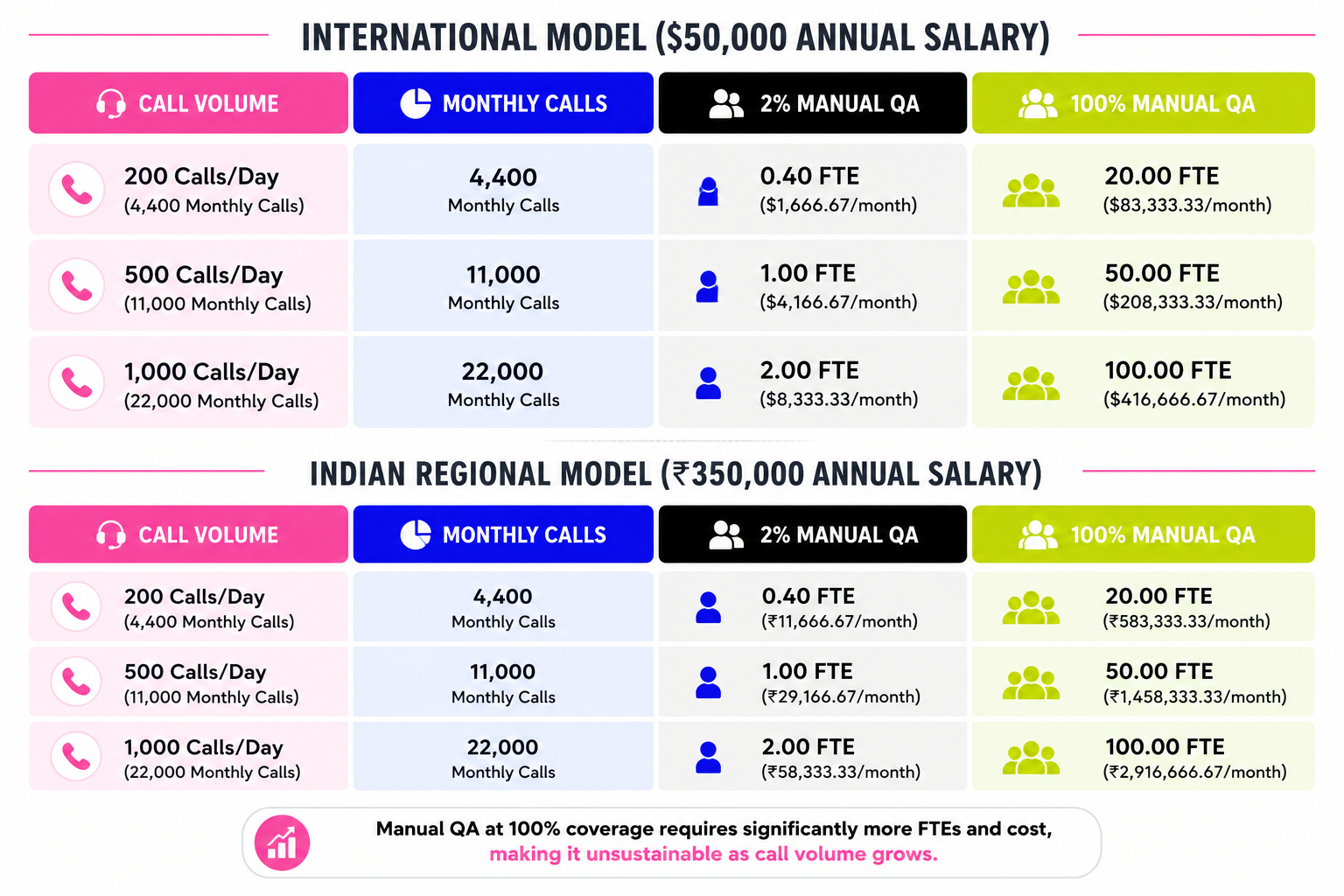
This headcount model highlights why studying AI call auditing vs manual QA is a major financial choice. Attempting 100% coverage manually requires 50 analysts at 500 calls daily, costing $2,500,000 annually, which is unsustainable.
Coverage Percentage - Why Auditing More Calls Isn't Just a QA Win
The true business level differentiator in the AI call auditing vs manual QA is call visibility. A low call audit coverage percentage leaves your business vulnerable. Manually sampling only 2% of your volume relies on isolated anecdotes rather than statistically valid patterns.
See how a global SaaS company achieved 100% call audit coverage and 3× faster compliance detection with AI-powered SOP monitoring in our guide on AI SOP Compliance and Call Auditing for SaaS Platforms.
In regulated sectors, this broad view serves as a safety net. Automated auditing flags missing mandatory scripts like the Mini-Miranda disclosure instantly.
In healthcare, it masks Protected Health Information (PHI) to avoid HIPAA violations. Applications such as Thunai Revenue AI analyze conversations to detect purchase intents, resulting in an average increase of 32% in revenue.
Error Rates and Scoring Consistency - The Bias Problem in Manual Audits
The major operational issue with AI call auditing vs manual QA comes down to consistency. Human evaluators naturally bring individual biases to the grading process.
Two people analyzing the same call may rate them 10 to 20 percentage points differently. However, you will only achieve an 85 to 90% agreement by conducting continual calibration sessions.
Human reviewers also face fatigue, and manual reviews can introduce accent bias. An AI QA automation contact center platform fixes this issue.
By using automated grading, you apply a single, objective standard to every interaction. The system standardizes grading globally, making sure agents are scored on actual performance.
AHT Impact - What Your QA Method Is Doing to Handle Time (Whether You Know It or Not)
- Tracking the AHT impact QA reveals another silent cost when analyzing AI call auditing vs manual QA performance.
- Legacy QA programs force agents to spend too much time on manual note taking. This after call work can consume up to 40% of an agent's standard shift.
- Transitioning to automated auditing directly addresses the AHT impact QA. By using automated workflows, Thunai generates instant call summaries and updates CRM databases automatically, cutting after call work by 2 to 4 minutes per interaction.
- Additionally, real-time agent assist systems give live guidance mid call, reducing dead air. Monday.com dropped its average ticket handling time from 24 minutes to 16.9 minutes by scaling quality reviews.
Thunai.AI's Component Wise Pricing Model - What 200+ Calls/Day Teams Actually Pay
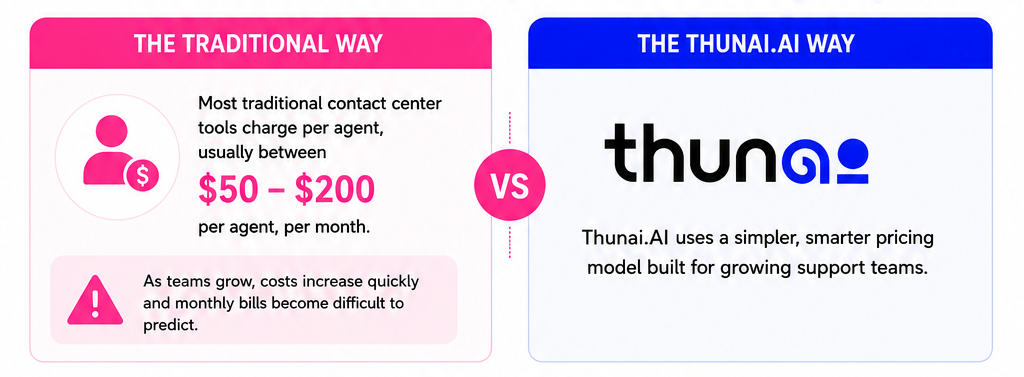
Most traditional contact center tools charge per agent, usually between $50 and $200 per month for each user. As teams grow, costs increase quickly and monthly bills become difficult to predict.
Thunai.AI uses a simpler pricing model:
- Free Plan: $0/month (Free Forever)
- Professional Plan: From $7 per month (Yearly Billing)
- Growth Plan: From $79 per month (Yearly Billing)
- Enterprise Plan: Custom Pricing tailored to your business needs
- AI Credits: Range from 100 to 2,000+ credits depending on the plan
- Agent Support: Includes Chat, Voice, Email, and Meeting Agents, with unlimited agents in the Enterprise plan
- Thunai Brain Storage: Scales from 512MB to flexible enterprise grade data ingestion
The platform's pricing is built around three core components:
- Thunai Brain: AI knowledge and intelligence engine
- Thunai MCP Connection Layer: Integrates with your existing tools and systems
- Agent Studio: Lets you build and customize AI workflows and automations
Why This Matters for Teams Handling 200+ Calls a Day
- Rather than having to pay for each agent individually, teams may increase their user numbers without fear of increased license fees. This results in predictability and cost efficiency not possible under the old seat based system.
- In simple terms, Thunai.AI lets growing support teams scale their operations without their software costs increasing with every new agent.
Still relying on random call reviews? See what 100% conversation coverage can do for quality, compliance, and customer experience with Thunai AI. Book your demo today.
How to Build the Business Case for AI Call Auditing - A Framework for Ops Leads
Ops leads who must justify an automation project can use this structured comparison of AI call auditing vs manual QA to secure executive buy-in.
Securing board approval requires presenting a rigorous, calculated return on investment. The central financial logic uses a clear formula:
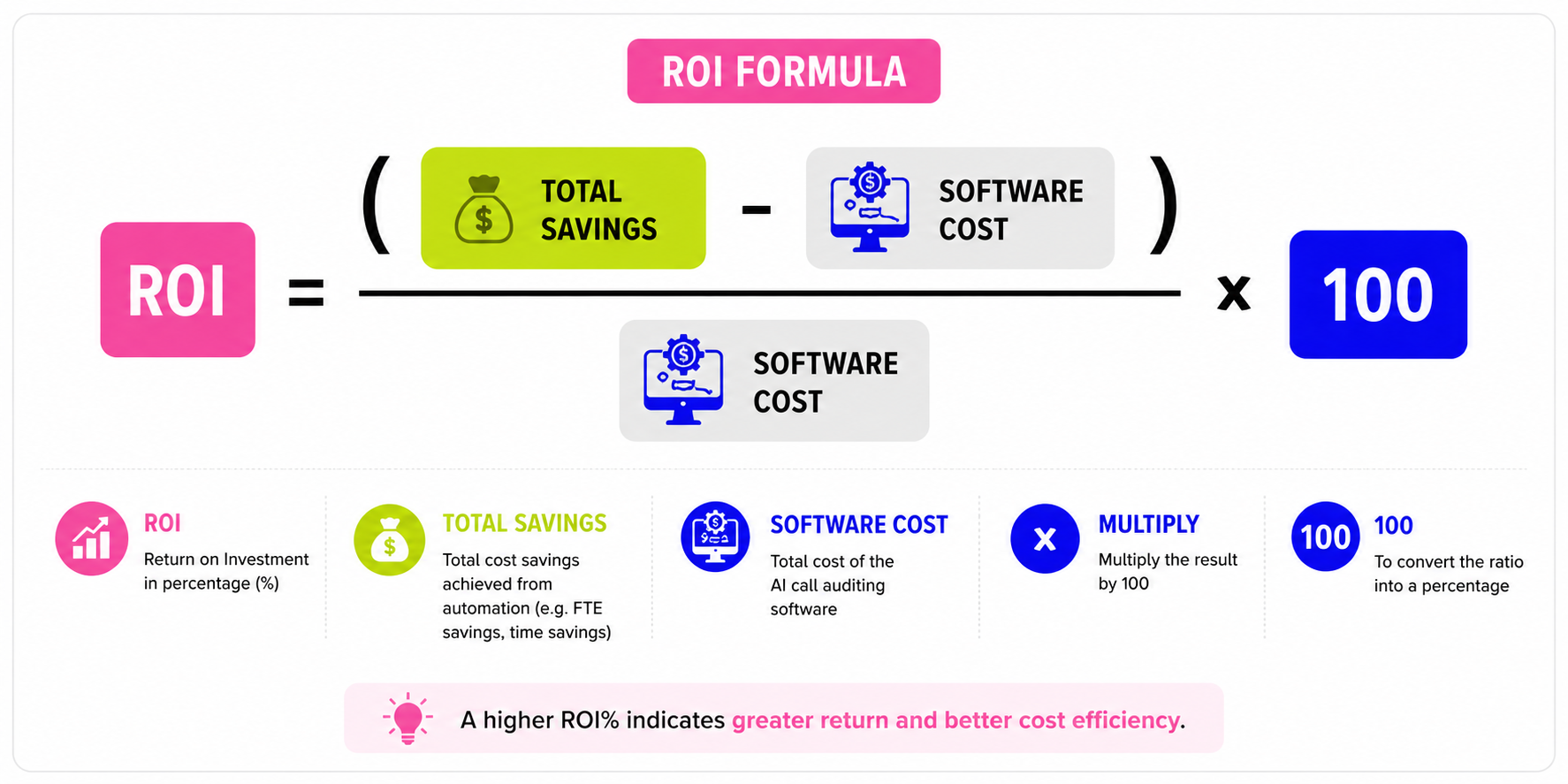
Deploying an AI QA automation contact center platform yields broad risk and quality visibility.
The financial impact is clearly illustrated by a case study from a production deployment in a regulated NBFC handling 1,500 daily calls.
Want to see your potential savings? Calculate your ROI with Thunai
3 Situations Where Manual QA Still Has a Role Alongside AI Auditing
Comparing AI call auditing vs manual QA does not mean removing your managers. Human oversight remains an essential part of a complete quality strategy. Operations leads should use human in the loop QA in three specific areas:
- Calibration & Training: Groups that employ automatic evaluation continue to conduct regular calibration meetings to compare AI scores against human consensus scores and improve the grading rubric.
- Complex Escalations: Complex escalations require human assessment to determine the emotional nuances in the conflicts.
- Emotional Coaching Sessions: The human supervisor is required for coaching sessions, where emotional intelligence is key to success.
FAQ
How should an enterprise transition from legacy quality tracking to AI call auditing vs manual QA automation?
The transition is straightforward. You deploy Thunai.AI call auditing as a secure layer on top of your existing software. Using the MCP connection layer, you link the platform to major CCaaS tools in under two days with zero downtime. This lets you scale your call audit coverage percentage to 100% instantly. By choosing AI call auditing vs manual QA, you gain full oversight of your support queues without operational delay.
What is the average manual QA cost per call in traditional contact centers?
Globally, processing support calls manually costs between $6 and $8 per call. In regional outsourcing hubs, the standard manual QA cost per call averages ₹40 per call. When specialized analysts review 10 to 25 calls daily, the human effort equates to roughly $18.94 per audited call. Comparing AI call auditing vs manual QA budgets shows that manual tracking is unsustainable as call volumes grow.
How does the Thunai Brain handle customer data security and compliance?
The platform features compliance shields that redact sensitive information, such as credit card details, automatically. The platform is built to satisfy strict GDPR and SOC 2 security standards. It gives enterprises full control over data residency through secure regional hosting and self hosting options.


