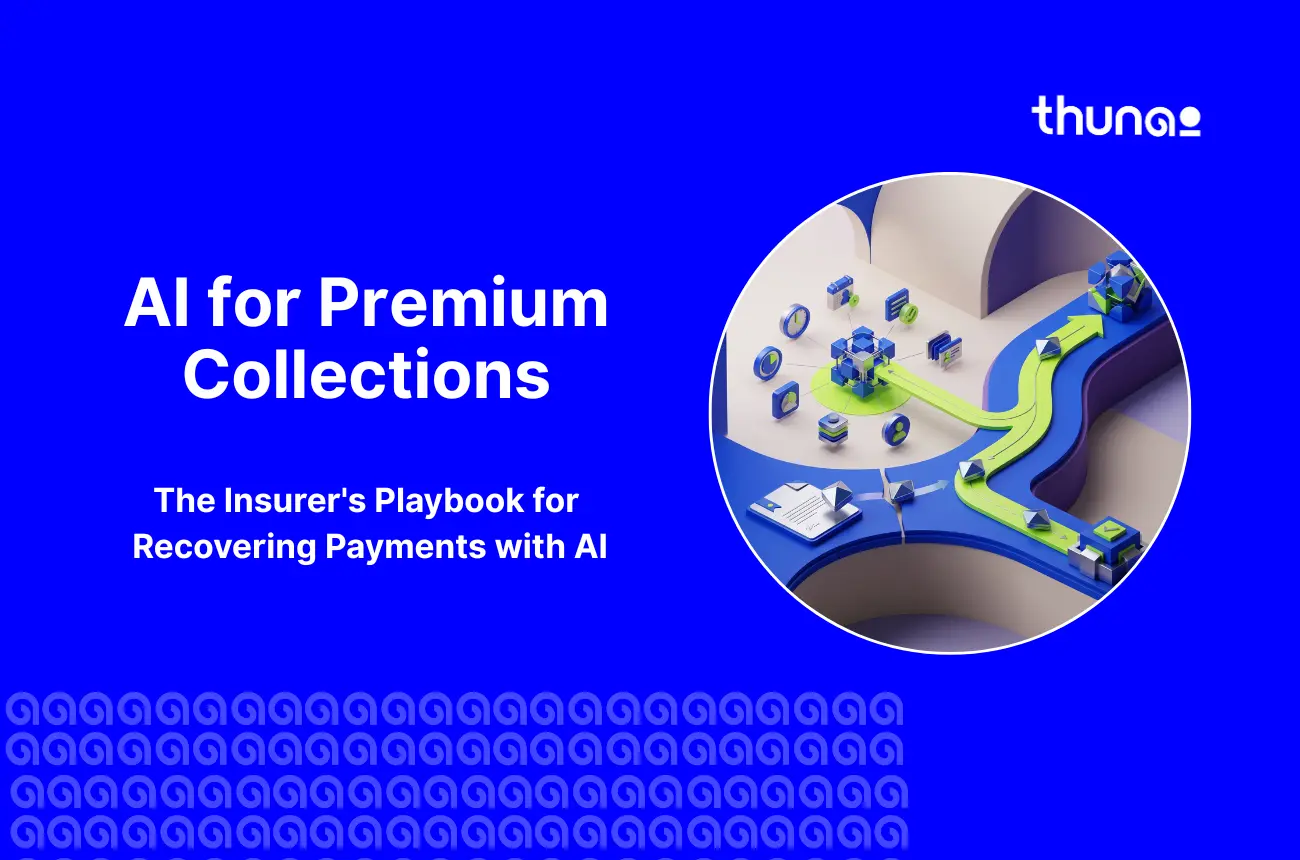

How many losses do insurance companies suffer just because payment has not been made on time?
A payment reminder service goes beyond sending reminders about payment.
Insurance companies must be able to determine customers who are at risk, deal effectively with failed payments, and make payment easy before the policy expires.
AI for premium collections service can help achieve all this and many other things.
In this guide, we’ll explore how insurers can use AI to recover payments before lapse.
The premium collections problem, in numbers
The premium collection impacts income, retention, and customer service. If a payment is not received, the insurance company has to issue reminders, handle the grace period, and handle billing issues.
A manual process makes each step slower. It also creates more work for billing and contact center teams.
Billing and payment sit in the top three reasons policyholders call
Policyholders often call to:
- Ask why a payment failed.
- Update a card or bank account.
- Confirm the amount due.
- Request a payment date change.
- Understand a grace period notice.
- Check whether the policy has lapsed.
Most of these questions are simple. Still, each call takes agent time. A voice agent can answer common questions, share a secure payment link, and transfer complex cases to a human representative.
The 1st to 15th volume spike and what it does to AHT and queue times
Billing activity often increases between the 1st and 15th of the month. Many customers receive their salaries during this period. They may also manage rent, loan payments, subscriptions, and insurance bills at the same time.
This can create a sharp rise in billing calls. Average handle time can increase. Queues can become longer. Some customers may abandon their calls before reaching an agent.
AI for premium collections helps insurers manage this pressure. It can send reminders before the due date, detect failed payments, and answer routine billing questions without a live agent.
Involuntary lapse vs. voluntary churn — why the fix is different
Voluntary turnover occurs when a customer opts to depart. Involuntary turnover occurs if an insurance policy lapses because a payment is not made on time.
The two problems need different solutions:
- Voluntary churn may need a retention conversation.
- Involuntary lapse may only need a payment link or card update.
- Hardship cases need patience and human support.
- Billing errors need quick investigation.
A good AI for premium collections program separates these cases. It does not send the same message to every customer.
Where traditional collections breaks down
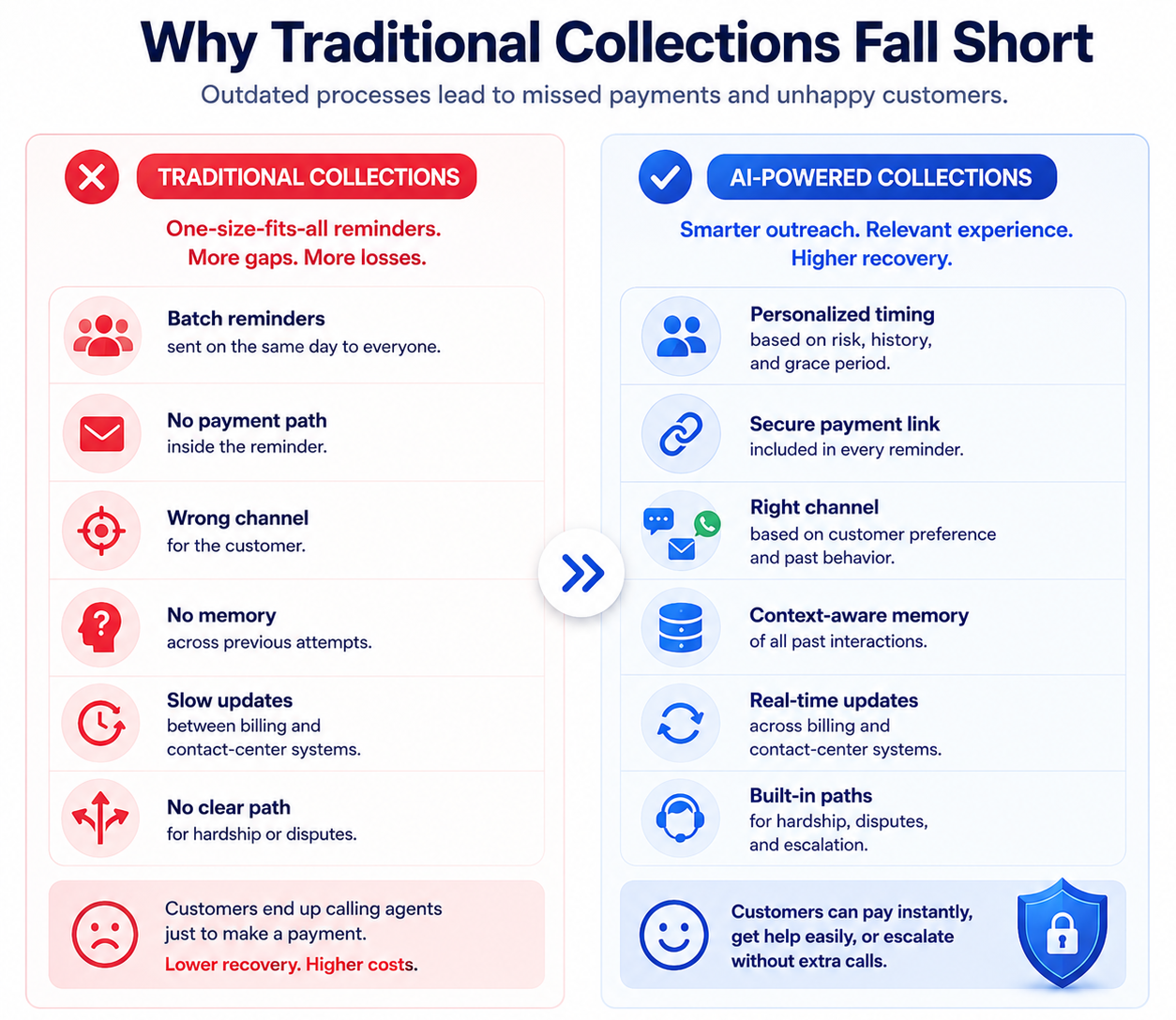
Many insurers still use fixed reminder schedules. A message goes to every policyholder on the same day. The message may not consider payment history, customer preference, or the remaining grace period.
Common problems include:
- Batch reminders sent on the same day to everyone.
- No payment path inside the reminder.
- Wrong channel for the customer.
- No memory across previous attempts.
- Slow updates between billing and contact center systems.
- No clear path for hardship or disputes.
The usefulness of a reminder becomes low if the customer has to contact the agent to make the payment. AI for premium collections has a secure link for payments, a callback link, or a transfer to a billing specialist.
What AI changes in the collections stack
AI adds intelligence to the collections process. It can help decide who to contact, when to contact them, and which channel to use.
It does not replace billing controls, compliance reviews, or human judgment.
Propensity to lapse scoring — prioritising who to contact and how hard
A propensity to lapse model estimates which policies may lapse after a failed or missed payment.
The model may consider:
- Previous payment failures.
- Payment method.
- Policy tenure.
- Grace period history.
- Contact preferences.
- Recent account changes.
- Previous promises to pay.
The score should guide outreach. It should not make decisions that cannot be reviewed.
For instance, a low-risk client will get a friendly SMS. But a high-risk customer would be reached by voice call, SMS, and email. In AI for premium collections, the team gets more time for customers who require a personal approach.
Channel orchestration (voice, SMS, WhatsApp, email, IVR)
Customers respond to different channels. Some prefer email. Others act faster after receiving an SMS or voice reminder.
Channel orchestration helps insurers choose the next best channel. It should consider consent, urgency, customer preference, and past response behavior.
A simple sequence may look like this:
- Email reminder before the due date.
- SMS with a secure payment link on the due date.
- Voice agent call after a failed payment.
- WhatsApp message where permitted.
- IVR support for inbound billing questions.
- Human escalation for hardship or disputes.
AI for premium collections is not about contacting customers on every channel at once. It is about using the fewest contacts needed to solve the problem.
Conversational payment capture — completing collection without a live agent
Voice AI can provide an explanation of the balance, confirm the policy, answer basic questions, and direct the customer to a secure checkout process.
The voice bot shouldn’t request the client’s credit card details during regular interaction. Instead, it can direct the customer to a secure IVR or hosted payment page. It can minimize PCI-DSS risk.
Once the payment is processed, the system can confirm its outcome and make changes to the billing software.
Self-healing payment method updates (expired card, failed ACH, changed bank)
Payment failures don’t necessarily imply that customers are unwilling to pay. Payment methods can expire. A bank might refuse an ACH payment. Customers change their accounts.
AI for premium collections will be able to detect the cause of the problem and even prompt the customer to make necessary adjustments and attempt another transaction.
This process can prevent repeat failures. It can also reduce unnecessary calls to the billing team.
Deflecting inbound billing calls with a voice agent
An inbound voice agent can handle questions such as:
- “When is my next payment due?”
- “Why did my payment fail?”
- “How much do I owe?”
- “Can you send me a payment link?”
- “Has my policy lapsed?”
The agent should authenticate the caller before showing policy or payment information. It should also record the outcome of the conversation.
If the customer mentions financial hardship, a complaint, or a coverage dispute, the call should go to a trained human representative.
A reference collections cadence
The right schedule depends on the policy type, billing rules, grace period, state, and customer consent.
The following table is just a beginning. It needs to be assessed by the legal and compliance departments before deployment.
In most cases, automated insurance collections usually incorporate pre-due notifications, non-payment reminders, and cancellation notifications.
AI for premium collections can adjust this cadence. A customer who settles the bill post the first SMS requires a different approach than one who ignores multiple SMS messages.
Compliance and tone guardrails (the real differentiator)
Collections automation must protect the policyholder and the insurer. Before launch, compliance, legal, billing, and customer service teams should review the workflow.
Gartner highlights that insurers have to consider risks involved with the use of AI and improve their governance because AI is becoming increasingly integrated into insurance businesses.
Important safeguards include:
- Contact frequency/time restrictions: Adhere to relevant regulations, consent policies, and internal guidelines.
- Disclosure of AI use in outbound collection calls: Provide information on the insurance company and AI agent usage where necessary.
- Handling of hardship situations and transfer to a live agent: Make referrals where there is any evidence of financial distress, illness, bereavement, or unemployment.
- Record keeping, consent, and audit trail: Maintain records of consent and call outcomes where applicable.
- State-level grace period variation: Use policy and state data to calculate the correct warning and lapse dates.
- Secure payment handling: Use tokenization, secure IVR, or a hosted payment page whenever possible.
AI for premium collections should sound calm and respectful. It should never threaten, pressure, or confuse the customer.
Metrics that prove using AI works
Tracking key performance metrics proves the value of AI for premium collections:
- Recovery rate by stage: Tracks payment success across pre-due and grace period stages.
- Involuntary lapse rate: Measures reductions in policy cancellations.
- Cost per recovered dollar: Compares collection expenses against recovered revenue.
- Billing call deflection percentage: Shows the share of billing calls handled automatically, reaching up to 80% deflection.
- Days sales outstanding (DSO) on premium: Measures the average time to collect past-due payments.
- CSAT on collections contacts: Measures customer satisfaction, keeping CSAT scores at 95%.
Leaders can estimate cost savings and efficiency gains using the CX ROI Calculator.
Implementation — 30/60/90
A clear 30-60-90 day deployment plan uses workflow automation for smooth adoption:
- Days 1 to 30 (System Integration & Inbound Deflection): Integrate conversational AI technology into billing systems and CRMs. Deploy inbound voice agents to deflect billing calls.
- Days 31 to 60 (Outbound Cadence): Implement outbound automated messages via various means for pre-due and post-due reminders. Make use of propensity modeling to detect at-risk accounts.
- Days 61 to 90 (Advanced Workflows and Optimization): Offer the option for dynamic payment plans, card update, and call grading functionality. Optimize the conversation models using call data.
How Thunai supports premium collections
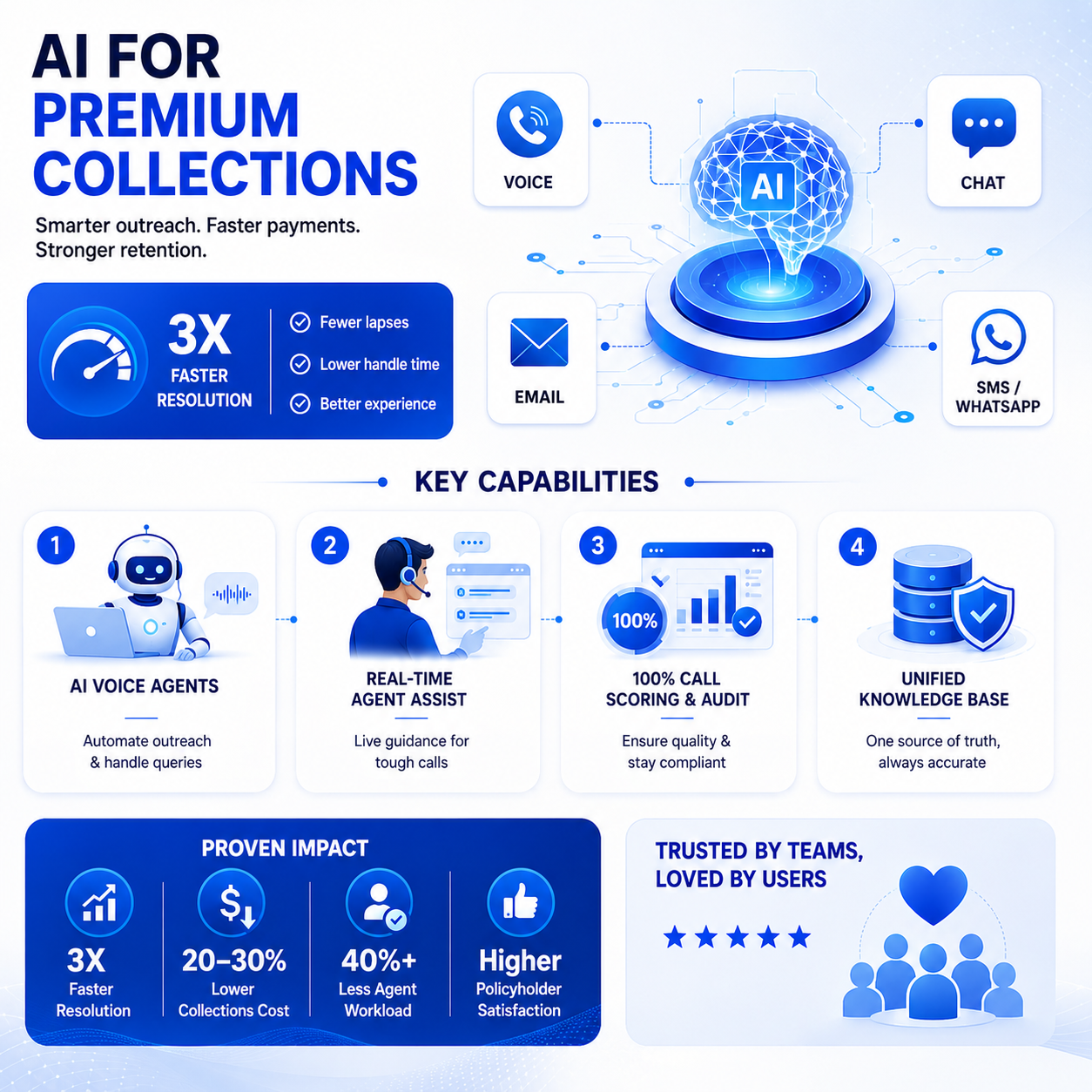
Thunai helps insurance and financial enterprises scale operations with AI for premium collections. Thunai delivers autonomous voice, chat, and email agents that speed up ticket resolution three times faster. It links directly with core billing tools and CRM platforms for live data updates. Carriers also gain from features proven across AI agents for banking and finance to maintain high security.
Key Thunai capabilities include:
- Omni-Channel Outbound & Inbound Voice Agents: Agents process dunning sequences and handle billing queries.
- Agent Guidance in Real-Time: Human agents are provided with live guidance on difficult calls.
- Instant Call Scoring & Audit: Quality tools grade 100% of collection calls against compliance rules.
- Unified Knowledge Base: Single sources of truth prevent conflicting policy advice.
Users consistently praise Thunai's positive performance. Reviewers call Thunai an ultimate companion and a second brain for support and customer operations teams.
They emphasize its capability of managing calls, emails, and chats without any issues and improving efficiency at work. Businesses that use Thunai deflect queries by 80%, reduce handle time by 70%, attain a 95% CSAT score, and go live within two days.
Recover missed premiums, prevent avoidable lapses, and automate collections with AI - Book a demo with Thunai today.
FAQs on AI for Premium Collections
Can AI take a premium payment over the phone securely?
Yes, if the workflow uses secure payment controls. The AI can authenticate the policyholder and transfer the payment step to a secure IVR or hosted payment page. Tokenization can help limit exposure to sensitive payment information.
How does AI decide who to contact first?
AI for premium collections can use payment history, failed transactions, policy tenure, customer preferences, past responses, and time left in the grace period. The model should help prioritise accounts while keeping decisions reviewable.
What happens if the policyholder says they can't pay?
The AI for premium collections should detect hardship language and stop the normal collections script. It should explain the next step and transfer the customer to a trained representative. The representative can discuss an approved payment plan, assistance option, or reinstatement path.
Does this integrate with our billing platform?
Integration depends on the insurer’s billing, policy, CRM, payment, and identity systems. A connected workflow can read payment status, send approved reminders, and write outcomes back to the correct system.