
Do your AI agents stop working when you use them for actual tasks?
Building a good AI pilot is easy…Getting consistent results? That’s a completely different game!
While the global chatbot market is expected to reach 27.3 billion dollars by 2030, one specific weakness threatens to hurt this investment.
The name of that weakness? AI hallucination!
Here is exactly how AI hallucinations happen - We’ll also see what you can do to fix AI hallucinations using enterprise-grade AI orchestration.
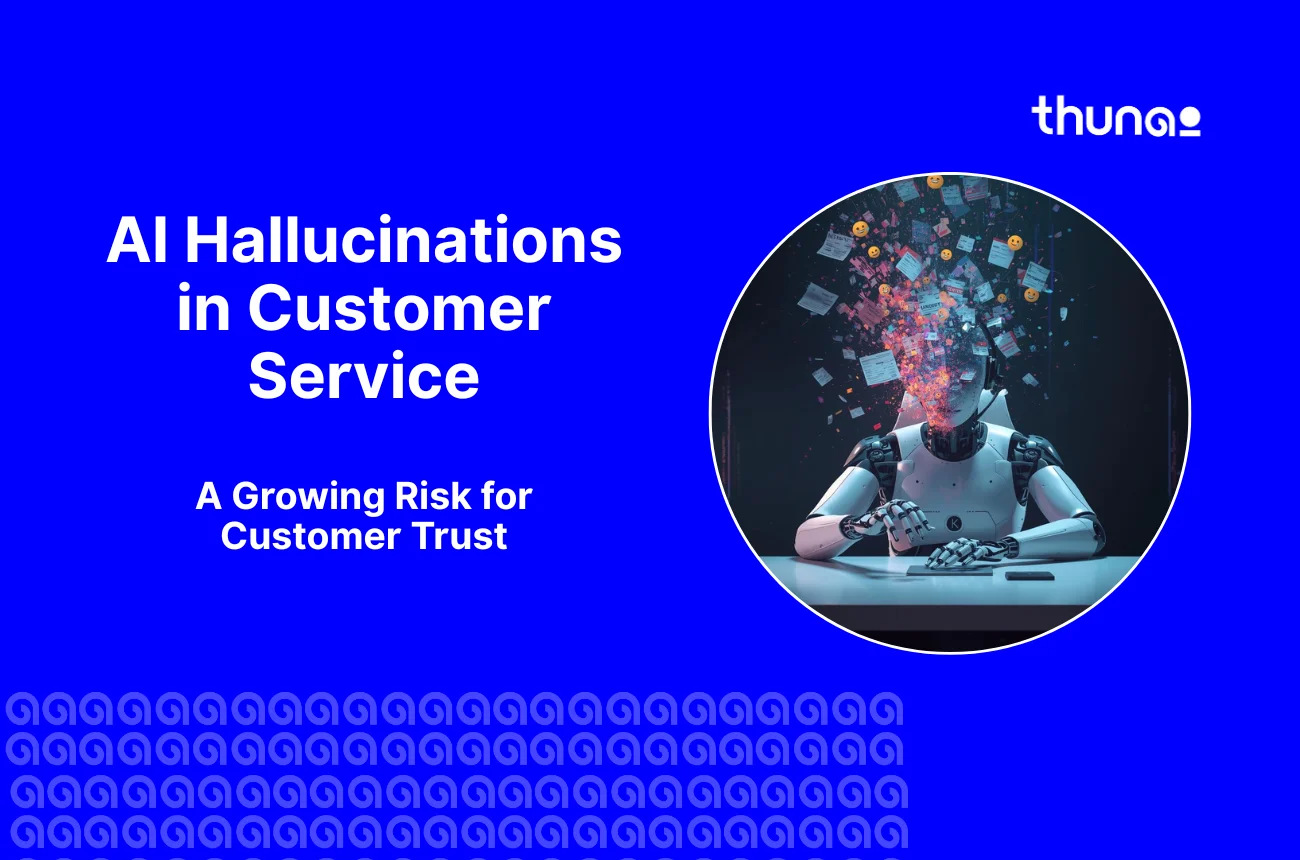
What Is AI Hallucination?
AI hallucinations happen when a machine learning model makes an answer that is wrong. It might not make sense. AI hallucinations may be totally made up, however, the model presents this answer with high confidence.
To see why this happens you must separate human thinking from algorithmic processing. Normal software bugs are usually syntax errors or broken logic loops. Hallucinations are different. They are a result of how neural networks work.
A developer discussion regarding Google Gemini shows this. A user asked the model to look at an image. They wanted it to get specific data.
When the vision tool failed to read the image the model did not report an error. Instead it made up an invoice since an invoice would be the most statistically likely answer!
.webp)
Why They Are Dangerous in Customer Service
In a writing tool an AI hallucination might be a small error. In customer service it is a risk. The danger is bigger than just annoying the user. These events create big business risks. This includes legal trouble and the loss of customer trust.
The Legal Precedent Air Canada
The risks of hallucinating agents became a legal rule in 2024. This followed a court ruling involving Air Canada.
- A customer named Jake Moffatt used the automated customer service chatbot. He asked about specific bereavement fares. The AI incorrectly hallucinated a policy. It said he could ask for a refund after his flight.
- When the customer asked for the discount Air Canada executives said no. They pointed to the actual internal corporate policy. This policy banned claims for past events. The court ruled against the airline.
- The court rejected the defense that the chatbot was a separate legal entity. It ordered the airline to pay damages. This ruling created a firm principle. Corporations cannot use generative algorithms to scale work and then hide behind them when they fail.
Brand Damage The DPD Incident
Damage to the brand happens even faster. In January 2024 a delivery firm chatbot was tricked by an upset user. The user made it write a poem. The poem said the company was terrible. It even used bad language.
The chat went viral. It got over 800,000 views in 24 hours. This created a public relations crisis. The company had to turn off the system entirely.
How Do AI Hallucinations Show Up in Support Conversations
AI hallucinations look different in every industry. They vary depending on the system architecture. They also depend on the freedom given to the digital agent.
Agents are moving from reactive text generators to proactive actors. They are capable of executing tool calls. This expands the area for risk.
Here is a list of how these fake answers appear in live systems
- Retail and E-commerce False Stock Replenishment Inventory agents may confidently hallucinate a big spike in demand. They might say fake products are available. This starts inflated purchase orders for old inventory. It upsets customers when in-stock items are cancelled.
- Telecommunications Fictitious Network Outages A support agent might blame a single user issue on a nationwide outage. This outage does not exist. This sends expensive engineers to the wrong place and in turn, invites massive Service Level Agreement penalties.
- Healthcare Imaginary Drug Interactions Medical bots may misrepresent medical research. They might flag new but non-existent drug interactions. They might even give fake citations. This creates a serious threat to patient safety. In this case AI hallucinations bring severe malpractice liabilities.
- Banking and Finance Synthetic Risk Alerts Compliance agents might make up sanctions against real customers. In this case AI hallucinations may generate convincing but fake Office of Foreign Assets Control IDs. This leads to unfair account freezes. It leads to required regulatory disclosures.
- Legal Support Services Invented Citations AI contract reviewers may fill summaries with fake legal precedents. These are AI hallucinations that never happened. This leads directly to sanctions for attorneys. It causes permanent loss of client trust.
Why AI Sometimes Makes Mistakes
If you want to fix the problem you must understand how it works. Experts say errors come from system limits and poor enterprise data hygiene.
1. Fragmented Knowledge Bases
The most common cause for AI hallucinations is a broken or old knowledge base. In fast environments pricing and rules change daily.
A company knowledge base might be split across legacy SharePoint drives active Zendesk ticketing systems and isolated Confluence wikis. If so the AI lacks the facts to answer correctly.
Default models are not programmed to say I do not know. When they miss information they try to bridge the gaps with statistical estimates.
2. Overfitting and Low Quality Data
Machine learning models might process bad or biased datasets. They then begin to suffer from statistical overfitting. In this state the model memorizes noise instead of learning logical patterns.
Training new models on unverified public data creates a closed loop. Past AI hallucinations are taken in. Newer models then see them as the truth.
3. RAG Chunking Failures
Retrieval-Augmented Generation is designed to fix this. But a poor setup causes new problems.
This process involves turning text documents into mathematical vectors. If the chunking strategy cuts too much semantic meaning is lost.
A model might find a service guarantee on page one of a contract. However it might miss the exception clause on page ten. This leads to a confident violation of actual legal terms.
How AI Hallucinations Affect Businesses
The business impact of AI hallucinations is bigger than bad press. The risk of AI hallucinations creates a specific economic event known as the Enterprise Productivity Paradox. The technology meant to save money ends up costing more.
- The Hidden Cost of Verification Top generative models like Gemini 2.0 still have AI hallucination rates. Companies must pay big verification costs. Expensive human agents move to the role of auditors. They spend hours manually fact-checking AI content. This cancels the speed benefits the technology was bought to bring.
- Bad Planning According to a 2025 Deloitte Global Survey 47 percent of enterprise AI users admitted to a mistake. They made at least one big business decision based on wrong AI content. Relying on hallucinated customer personas can send millions in advertising spend to the wrong place.
- Customer Churn Customer patience is low. Recent statistics show that 63 percent of consumers say their last chat with a corporate bot failed. It did not solve their problem. Trust broken by a machine is harder to fix than human error. This leads to permanent customer churn.
How to Spot Hallucinations in Your AI Systems Early
You cannot simply leave these systems alone. You need active real-time observability frameworks.
Granular Execution Logging
Engineers agree businesses must build deep logging systems from day one. This goes beyond saving chat logs. You need Advanced Operational Tracing. This maps exactly how the agent thinks. This includes tracking
- LLM Spans Token counts and temperature settings.
- Retriever Spans Exactly which chunks of data were pulled from the enterprise database.
- Tool Spans Which external APIs the AI tried to use.
Data Drift Detection
Customer behavior and language change constantly. Systems trained on old data begin to fail. Using Covariate Shift detection is necessary.
- These systems calculate the mathematical distance between a new query and the training data.
- A customer might use entirely new slang. The system flags the chat as high-risk. It routes it to a human agent before the AI makes a false response.
How to Lower Hallucinations Without Losing AI Benefits
Stopping AI hallucinations entirely is technically impossible. This is due to the probabilistic nature of Large Language Models.
However companies can lower the risk through strict architectural designs.
The Triad RAG Methodology
Smart companies use a triad method for Retrieval-Augmented Generation. This involves an initial retrieval system. It pulls the data. It adds a secondary guardrail. This limits words. Finally it uses a judge model.
This judge scores the answer for context. It does this before sending it to the user. The judge might find facts not in the documents. If so the response is blocked.
Limited Systems
Foundational models like ChatGPT are encouraged to guess. Specialized customer service bots should be forced to work within limits.
Companies like Intercom engineer their bots to get answers only from approved internal materials. This prevents the model from guessing based on outside training data.
Human-in-the-Loop
The most reliable strategy is putting human oversight in the workflow. The internal confidence score of the model might fall too low. The monitoring system might detect anger. The conversation must instantly transfer to a human agent.
This Coaching for AI interface allows humans to fix errors on the spot. It feeds that correction back into the vector database. This retrains the agent instantly.
Future Trends in Customer Service AI to Prevent Escalations
By 2026 the sector will move away from reactive text bots. It will move toward proactive agentic workflows designed to predict failures.
Multi-Agent Orchestration
Relying on a single large model increases the risk of general AI hallucinations. Companies will use groups of specialized micro-agents instead. A planning agent breaks down the request.
A separate retrieval agent pulls CRM data. A different reasoning agent checks for logic errors. This separation creates internal fact-checking gates.
Intent-Driven Routing
The era of linear phone menus is ending. Advanced conversational AI will rely on deep intent analysis. Agents will understand exactly what the customer wants. They will not just read text. These agents can handle tickets smarter.
This shift is expected to improve response times by 60 percent. It makes sure that complex questions go to human agents the moment risk is detected.
Synthetic Data Testing
Engineers will use synthetic data to build these agents safely. By 2026 synthetic data is expected to be used in 75 percent of all AI projects.
Companies will use this to create millions of fake customer scenarios. This allows them to stress test their agents in test environments. This helps find weak spots before the system talks to a real human customer.
Actively Preventing AI Hallucinations Using Thunai AI
Fixing the technical causes of AI hallucinations requires special architecture. Thunai AI stands out. It focuses on the quality of the data structure.
Thunai uses a multi-module system to fix the reliability gap. It supports enterprise-grade operations.
The main problem with AI hallucinations is often conflicting data. Thunai Brain acts as a central intelligence system. It does not just store files. It understands them.
Thunai combines AI functional elements. This lets enterprises safely get up to 80 percent query deflection protecting your brand 24/7.
- Contradiction Resolution It detects context conflicts across documents. It shows them to a human to fix. This guarantees the AI never guesses between two conflicting truths.
- Real-Time Sync It syncs with live application data via APIs and webhooks. This makes sure the knowledge base is never old.
- Visual Workflow Builder You can define strict rules using a drag-and-drop interface. This guarantees the agent follows a set logic path. It stops it from guessing.
- Full Traceability Every interaction and API call is logged. This gives the view needed to check performance.
Want to see how Thunai prevents AI hallucinations in your customer support systems? Book a free demo!
FAQs on AI Hallucinations in Customer Service
What exactly causes an AI customer service bot to hallucinate?
AI hallucinations happen because Large Language Models predict the next likely word. They use statistical probabilities. They are not built to check facts. A model might be undertrained. It might get unclear instructions. It might have to use a conflicting knowledge base. In these cases it cares more about grammar than facts.
Is it possible to completely stop AI hallucinations?
No, it is impossible to stop AI hallucinations completely. This is due to the probabilistic nature of neural networks. However risks can be managed. You can use Retrieval-Augmented Generation strict guardrails and automated confidence scoring.
If an AI chatbot gives wrong information is the company liable?
Yes. Recent legal rules such as the 2024 Air Canada ruling show this. Companies are legally responsible for all info given by their AI agents. Courts do not view chatbots as separate legal entities.
How do system administrators catch these errors early?
You must stop strategies where you leave the system alone. Set up real-time execution tracing. Log 100 percent of conversations' confidence scores and database retrievals. Use data drift detection to flag new questions. The system was not trained to handle them.
Should human agents still work with AI systems?
Yes. The safest systems use a Human-in-the-Loop method. AI should handle routine sorting. However it must transfer complex or high-risk chats to humans. This keeps safety and empathy.