
Do your customer support teams stop working well when they face hard or non-linear problems?
Making a large library of help documents, SOPs and help desk articles is one thing…
However, getting agents to find and use that information in seconds during a live call is another.
This retrieval gap is a big problem!
That is why real-time agent assist is the method for building high-performance support teams and here’s how it works…
What Is Real-Time Agent Assist in Customer Support?
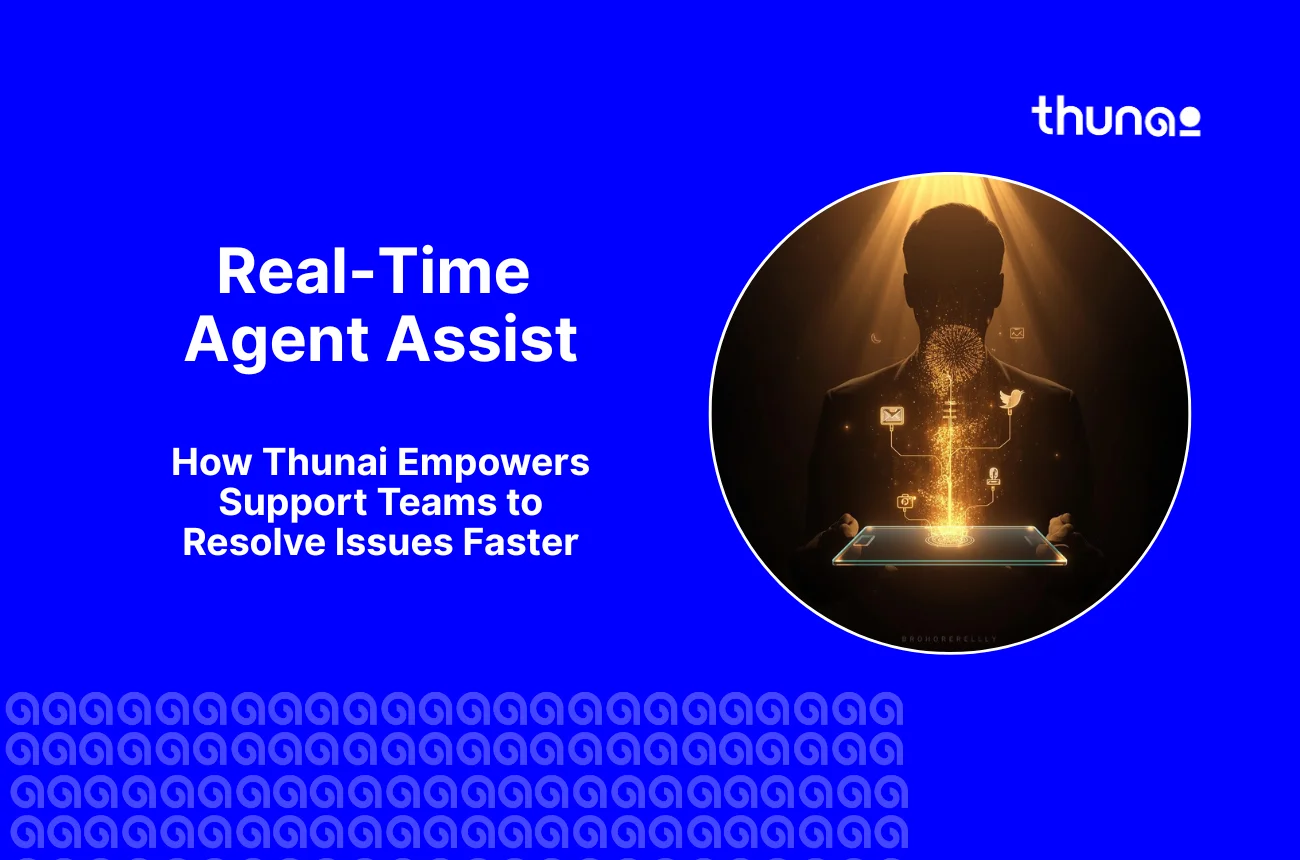
Real-Time Agent Assist is an advanced application of artificial intelligence. This AI feature acts as a smart guide for human customer service representatives. These systems work inside the active window of the agent to give live help.
Instead of trying to force customers into frustrating and autonomous chatbot loops, this technology monitors live human-to-human interactions. real-time agent assist listens via voice telephony, video conferencing, or text-based chat.
This distinction is important. Traditional AI operates on fixed parameters and set responses.
Virtual agents only route requests without human interaction. In contrast, real-time agent assist systems engage dynamically. They use natural language processing to understand the specific context of a live call.
Why is Real-Time Agent Assist Important?
Real-Time Agent Assist is important. This AI feature is a necessary part of changing support from a reactive cost center into a proactive revenue driver.
Current research shows that the modern consumer has reached a breaking point regarding traditional support channels.
- Consumers hate repeating themselves. About 34% of consumers would choose an AI agent over a human representative to avoid the frustration of repeating their issue to multiple agents.
- Traditional knowledge bases fail agents. Agents act as slow search engines. They manually cross-reference old articles while the customer waits on hold. This drives up Average Handle Time and hurts customer trust.
- Complex queries cause standard AI to fail. Leading models achieve a 58% success rate in single-turn scenarios. Their performance drops to about 35% in multi-turn settings where the AI must handle multiple variables.
What are the Main Functions of Real Time Agent Assist?
A proven and trustworthy Real-Time Agent Assist layer is designed to fix these pain points by supplying three main functions:
- Contextual Guidance: Real-time agent assist reads the transcript to extract the main directive of the customer. It removes conversational filler to identify specific items, such as account numbers or product names.
- Live Compliance: A strict rules engine scans the transcript at the same time to make sure that required legal disclosures are stated by the agent. It marks potential violations instantly.
- Automated Workflows: It is not enough to simply show an agent a policy. The system must help in executing the resolution. Real-time agent assist automatically fills the required CRM fields and drafts authorization memos.
With so much at stake, how can a team get started?
4 Steps in Real-Time Agent Assist
Setting up an assisted agent system is a structured process. The system moves from raw audio ingestion to intelligence delivery. This process can be broken down into a multi-phase lifecycle.
Phase 1: Ingestion and Hearing (The Ear)
The process starts at the point of ingestion. During a live interaction, the platform captures dual-channel audio streams directly from the telephony system.
- Isolating the Signal: This dual-channel method separates the sound of the customer from the agent. This makes sure that artificial intelligence can accurately map context.
- Streaming the Data: Traditional batch processing is useless for live assistance. Real-time systems use constant WebSocket connections. Audio is sent to the processing servers in tiny data chunks or 4096-byte packets.
- Creating the Transcript: These packets enter a streaming Automatic Speech Recognition engine. The engine constructs mathematical representations known as Turn objects to deliver fixed transcripts before the speaker finishes their sentence.
Phase 2: Understanding and Thinking (The Brain)
Once the text is generated, your AI system is routed through a group of specialized artificial intelligence models. Natural Language Processing models parse the transcript to extract the main directive of the customer.
At the same time, Sentiment and Emotion Analysis models operate as an emotional gauge. This model looks at linguistic patterns and acoustic tone to output probability scores, such as 60% frustrated or 30% neutral.
Phase 3: Grounding and Verifying (The Memory)
The synthesized intelligence is fed into a central Decision Engine. This engine relies heavily on a framework known as Retrieval-Augmented Generation.
Generative AI alone often makes up facts because it relies on static training weights. Retrieval-Augmented Generation solves this problem by taking the intent and using it to query the secure and private databases of the company.
Phase 4: Acting and Coaching (The Voice)
The final stage is the delivery of intelligence. Modern systems avoid overwhelming the representative with dense blocks of text.
Instead, the interface uses dynamic pop-up cards and subtle visual indicators. If negative sentiment spikes, the interface hides sales scripts and shows de-escalation tactics.
8 Different Aspects of Agent Assist
To design a working agentic system, a technical leader must understand Real-Time Agent Assist at two distinct levels.
These are the high-level Architectural Components (the system structure) and the low-level Operational Functions (the system abilities).
Foundational Architectural Components
These components describe the high-level structure of data processing and control.
- Streaming ASR Engine: This is the main component. It processes audio in tiny data chunks rather than waiting for full sentences. This advanced architecture allows the decision engines to analyze intent with an end-to-end latency of about 300 milliseconds.
- Dual-Channel Ingestion: In this model, the system captures audio streams directly from the company telephony or video conferencing system. It separates the sound of the customer from the agent to make sure statements are attributed to the correct speaker.
- Retrieval-Augmented Generation (RAG): This type of system is a verification method. It connects the reasoning of the AI to the verified and private data sources of the company. This stops the AI from guessing answers based on broad and unverified internet training weights.
- Multimodal Knowledge Graph: This model is specifically designed for ingesting unstructured data. It takes in data across all types, including PDF documents, slide decks, and training videos. It builds a multidimensional graph to map semantic relationships.
Common Operational Functions
These functions describe the specific flow of work and help given to the agent.
- Sentiment and Emotion Analysis: This type of function operates as an emotional gauge. It looks at linguistic patterns and acoustic tone. It uses Multiclass Classification to output probability scores to measure frustration or satisfaction.
- Real-Time Compliance Monitoring: This function involves a strict rules engine scanning the transcript. It makes sure that required legal disclosures are stated by the agent. It marks potential violations instantly to stop regulatory fines.
- Zero After-Call Work (ACW): This type of function is an automation pattern. The moment a call ends, the AI generates a structured and complete summary. It automatically fills the corresponding fields within connected platforms like Salesforce or HubSpot.
- Live Supervisor Command: This type of function is for management visibility. Supervisors get an all-seeing live dashboard that monitors the sentiment of the entire production floor. It allows managers to actively step in or whisper-coach agents during at-risk escalations.
Comparing Real-Time Agent Assist With Other Systems
A common source of confusion for companies is telling Real-Time Agent Assist apart from other kinds of technology. But how is this different from what we already use?
- vs. Chatbots: Chatbots have the most basic difference. They try to force customers into autonomous loops to deflect calls. Agent Assist monitors live human-to-human interactions to help the human solve the problem.
- vs. Traditional Knowledge Bases: Traditional wikis require the agent to manually search for information. Agent Assist is proactive. It pushes the exact information to the screen of the agent the moment it is needed, without a search query.
- vs. Standard LLMs: Standard LLMs like ChatGPT rely on static training weights and often make up facts. Agent Assist uses RAG to query secure company databases. This makes sure the information is factually flawless and verified.
- vs. Post-Call Analytics: Post-call tools analyze the conversation after it is finished. This is too late to save a customer. Agent Assist operates in real time. It triggers alerts during the call so a supervisor can intervene before the customer hangs up.
Real-Time Agent Assist Benefits
The benefits of Real-Time Agent Assist are big. They move beyond simple gains to reveal the true bottom-line value of artificial intelligence.
- Drastic AHT Compression: Delivers a consistent 20% to 30% lowering of Average Handle Time.
- Massive Capacity Expansion: Boosts agent hourly handling capacity by 13.8%.
- FCR Optimization: Drives a 15% to 25% increase in First Contact Resolution.
- Surge in CSAT: Companies report a massive 31.5% surge in Customer Satisfaction scores.
- Retention Increase: Leads to a 24.8% increase in customer retention.
- Admin Work Drop: Saves agents up to two hours of administrative labor every single day.
- Employee Retention: Drives a 20% to 40% improvement in employee retention.
- Accelerated Onboarding: Cuts new hire onboarding times by 30% to 50%.
- Lowers Hallucinations: Lowers AI hallucinations by a huge 95%.
- Retrieval Accuracy: Improves document retrieval accuracy by 85%.
Real-Time Agent Assist With Thunai Omni
Thunai takes in the scattered knowledge of a company like documents, videos, CRM data, chat transcripts, and email and brings together this knowledge into a single and contradiction-free Thunai knowledge base.
This type of verified and centralized knowledge hub then serves as the basis for a group of autonomous AI agents.
For example, in an omnichannel contact center, Thunai agents are added into an existing system like NICE CXone or Genesys. The platform supplies truly conversational AI agents.
These agents can handle complex inquiries. They can automate post-call summaries. They can also give real-time assistance to human agents.
Thunai reports several key performance metrics achieved through its coordination platform:
- Lowers AI hallucinations by 95% by grounding agents in the verified Thunai knowledge base.
- Resolves 80% of technical issues without human escalation via Voice Agent.
- Lowers agent workload in contact centers by up to 70%.
- Analyzes and scores 100% of all customer interactions for Quality Assurance.
Want to see Thunai AI in action? Book a free demo!
FAQs on Real-Time Agent Assist
How does real-time agent assist maintain data privacy?
The main requirement is absolute security of PII. Thunai is heavily audited and maintains strict compliance with SOC2 Type II, ISO27001, and GDPR standards. For maximum security, fully localized and on-premises deployment options are available.
How does the Thunai prevent hallucinations?
Business tools use Retrieval-Augmented Generation (RAG) to tether AI reasoning to verified private data. Thunai further lowers hallucination rates by 95% by algorithmically fixing contradictions within the uploaded data before it is surfaced.
Do I need to replace my current contact center software?
No. Adding this is complementary. Thunai acts as a flexible intelligence layer that wraps around existing CCaaS providers like Amazon Connect or Genesys. This allows you to modernize without abandoning historical equipment investments.
What happens when the AI cannot resolve an issue?
The system is designed as human-in-the-loop. If a scenario is new, the AI compiles all known context and presents it to the human agent for judgment. The AI then observes this resolution to learn how to handle similar edge cases in the future.