.webp)

Firms fail to receive about 40 percent of their incoming calls, while 85 percent of clients won’t make a call again after receiving bad service. At the same time, the cost of manually processing inbound calls stands at anywhere between $6 to $8, while employee attrition keeps increasing business costs.
Therefore, the main question that arises is, how can companies offer immediate, round the clock customer service through the phone without hiring more staff?
In this guide, we will take a look at automated calling systems, how they function, and which solution you need for optimum ROI.
The Real Cost of Running Phones Manually in 2026
- As a CEO, I look at our balance sheet daily. I see where we waste money, and I see where we thrive. If your business still answers every phone call manually, you are burning capital.
- Relying on a modern automated call system protects our bottom line and ensures we remain competitive in a tight market.
- Research shows that 76% of customers still want to use the telephone for support with humans to handle every basic inquiry is a massive drain. The average cost of a manual inbound call is $7.16.Live agent costs in the US contact center industry are priced at a cost per hour of between $29 and $42.
- Turnover rates in the call center industry range between 30 percent and 45 percent per year. The need for an automated system is evident through this data.
- You also lose money on missed calls. Companies without an answering strategy miss about 40% of their calls.
- For example, missing 35% of calls costs a contractor $12,250 monthly. Implementing an automated calling system prevents these leaks. Choosing the right automated call system protects our budget and frees our teams to focus on high value clients.
What an Automated Call System Actually Is (And Isn't)
To define an automated call system correctly, we must look past basic voicemail. A bad phone setup frustrates customers and hurts your brand. It makes your callers hang up and call your competition instead.
An automated call system is not just an old school answering machine, It is a complete intelligent software setup.
An automated phone call system coordinates customer inquiries, updates database records, and connects communication channels.
A professional automated call system is an integrated communications infrastructure which links your lines directly to your CRM, every touchpoint managed by an automated call system should feel structured, responsive, and seamless.
It takes direct action to resolve customer issues quickly.

Legacy Automated Telephone Calling Systems vs. AI-Powered Systems
- A legacy automated telephone calling system is built on rigid menus. These are old DTMF platforms.
- They force callers to press buttons on keypads. They cannot understand spoken words or natural language context. This rigid approach causes immediate menu fatigue and high call drop rates.
- Comparing legacy setups against an automated call system powered by modern artificial intelligence reveals a massive capability gap.
- AI-powered systems use conversational artificial intelligence and natural language processing where callers can speak naturally, and the system understands them.
- The response latency is under 800 milliseconds, which matches natural human speech. Our modern automated call system does not force customers to wait through long menus.
- The automated call system learns the new rules immediately, ensuring your messaging remains consistent on every single call.
Inbound Automated Call Answering Systems vs. Outbound Calling Systems
- An inbound automated call answering system is built to manage incoming traffic.
- Its main job is to answer calls instantly, resolve FAQs, and route callers without frustrating barriers which helps minimize client hold times.
- An outbound automated calling system does the opposite. It dials numbers automatically to execute outbound sales or notifications.
- An outbound automated call systems setup must follow strict pacing rules to stay compliant under local laws.
- Algorithms filter out voicemails, routing only live prospects to agents.
Types of Automated Call Systems — and Which One Fits Your Use Case
Choosing which specific type of automated call system fits your operations requires matching your business model with the proper telecom architecture. Telephony platforms are not one size fits all.
Automated Call Distribution Systems (ACD) for High Volume Teams
- For busy offices, automated call distribution systems are essential.
- An ACD acts as a smart router for your incoming lines. It sends the call directly to the most qualified agent based on caller intent or CRM history.
- The system matches technical calls to engineers and billing queries to accountants. This skills based routing is vital for automated call distribution systems handling high volume teams.
- A high quality automated call system makes your team look professional and organized.
Automated Membership Phone Systems for Communities and Associations
- Instead of using a general call router, you should deploy an automated membership phone system. This specialized software connects directly to your membership platform to streamline operations.
- A tailored automated call system ensures that the software automatically verifies dues status, processes credit card payments, and logs interactions.
- Platforms like Member365, Enumerate, and PayHOA automate tedious administrative tasks. This updates your member database on the spot.
- If you manage a volunteer board or a local HOA, an automated membership phone system removes hours of manual follow up.
Predictive, Progressive, and Power Dialers: What's the Difference
Dialer logic is critical for outbound campaigns. Your choice impacts connection rates and compliance.
- Predictive Dialers: They use algorithms to forecast agent availability and make simultaneous calls through many numbers and allows maximum talking time but has 3% abandonment probability.
- Progressive Dialers: These dial exactly one number per agent when the agent is ready. This eliminates dropped calls, making it perfect for regulated industries.
- Power Dialers: These dial a set, pre configured number of lines per free agent to keep outbound momentum high.
- Preview Dialers: These display customer details to the agent before making the call, allowing for deep B2B personalization.
By setting up your automated call system using the correct dialer, you are able to get a good blend between the two.
How to Automate Phone Calls Without Rebuilding Your Entire Stack
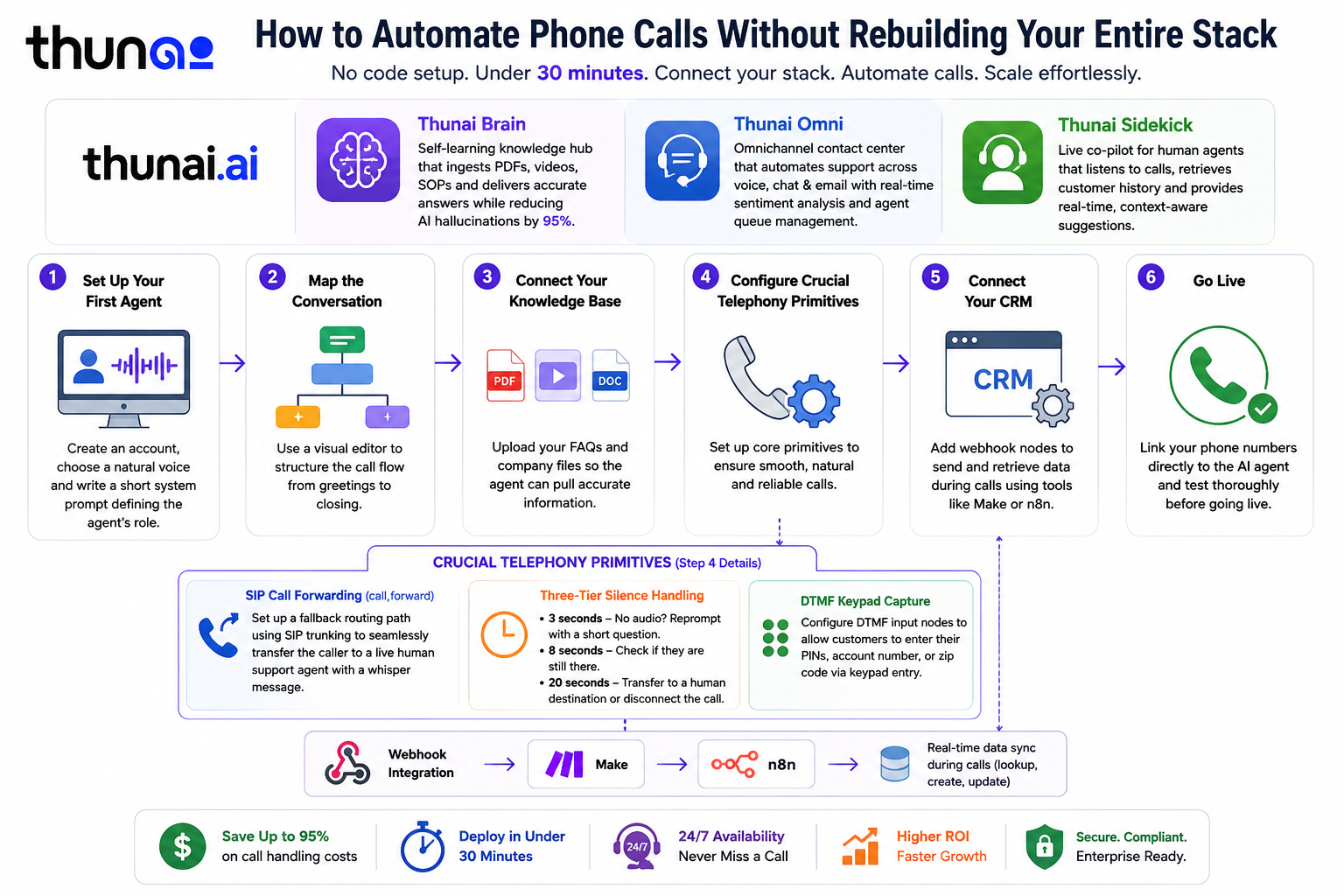
Many worry about setup complexity. Let me show you how to automate phone calls without breaking your existing systems. You do not need a team of developers to build an automated call system from scratch.
Instead, you can connect modern API first voice platforms to your CRM using visual integration builders.
The easiest option is Thunai.ai, built on Kafka and Flink. It allows no code setup in under thirty minutes. Thunai simplifies business automation through three key modules:
- Thunai Brain: This centralized, self learning knowledge hub ingests your company's PDFs, videos, and SOPs, converting raw documentation into precise customer answers while reducing AI hallucinations by 95%.
- Thunai Omni: This is an omnichannel contact center engine that automates support across voice, chat, and email with built-in real-time sentiment analysis and agent queue management.
- Thunai Sidekick: A live co-pilot for human agents that listens to active calls, retrieves customer history, and provides real-time, context-aware suggestions.
Let's break down how to automate phone calls step by step :
- Set Up Your First Agent: Create an account, choose a natural voice, and write a short system prompt defining the agent's role.
- Map the Conversation: Use a visual editor to structure the call flow from greetings to closing.
- Connect Your Knowledge Base: Upload your FAQs and company files so the agent can pull accurate information.
- Configure Crucial Telephony Primitives:To ensure your automated call system does not drop calls or feel broken, configure these three core primitives :
- SIP Call Forwarding (call_forward): Set up a fallback routing path that uses SIP trunking to seamlessly transfer the caller to a live human support agent with a whisper message.
- Three Tier Silence Handling: Set explicit timeouts on all capture nodes. If no audio is detected after 3 seconds, reprompt with a short question. At 8 seconds of silence, check if they are still there. The call should be transferred to a human destination or disconnected after 20 seconds.
- Capture of DTMF Keypad Input: Configure your call flow with DTMF input nodes to allow customers to enter their PINs, account number, or Zip Code via keypad entry.
- Connect Your CRM: Add webhook nodes to send and retrieve data during the call using visual platforms like Make or n8n.
- Go Live: Link your phone numbers directly to the AI agent and test thoroughly.
User reviews:
- On G2, Saran K. noted: "The agents automate my email follow-ups and handle lead qualification, which has saved me hours every day, all without the need for scripting. The knowledge-based linking also ensures that responses are context-aware."
- On Product Hunt, Zagita wrote: "Thunai actually feels human while handling real work! Love the self-learning brain and how it turns chaos into actionable agents. That 99.9% voice accuracy? Game-changer." .
These quotes show that Thunai excels in actual operations. You can build an automated call system that works with your existing stack without complex code.
Where Automated Calling Systems Deliver the Fastest ROI
Every business decision must show a clear financial return. Shifting to automated call systems delivers rapid payback. Let us look at the exact areas where every automated call system we deploy saves us immediate cash.
Customer Support and Call Answering at Scale
- The fastest payback comes from a hybrid customer support model. Under this framework, you automate Level 1 support queries like simple FAQs.
- AI answers these basic calls instantly for just $0.40 each but the human team only handles the remaining 20% of complex, high value conversations.
- The company will gain an annual saving of around $919,400 using such a strategy, making sure that the payback period is within 18 days after implementing it.
Outbound Campaigns, Reminders, and Lead Follow-Up
- Outbound automation also delivers rapid returns. In sales, speed is matter’s.
- When a lead fills out an online form, webhooks trigger an automated call instantly. The voice agent calls the lead in seconds, qualifies their intent, and books a demo.
- This rapid follow up increases conversion rates by 3 to 5 times. It also reduces customer churn by up to 40%.
- Every automated call system we deploy saves us immediate cash by securing hot leads.
Is There a Free Automated Phone Answering System Worth Using?
For saving money many small businesses look for free automated phone answering systems. However, a free trial is only good for initial testing but cannot run a commercial business on it.
A free automated phone answering system always has strict minute limits. You will face robotic voices and zero database integrations.
Instead, a flat monthly rate like NextPhone's $199 unlimited plan is best. It prevents surprise billing rounding fees and most per minute providers round call durations upward to the next full minute, inflating your expenses.
4 Mistakes Teams Make When Setting Up Automated Answering Systems
Even great technology fails if configured poorly. Make sure that your teams do not make the following four common errors in using automated answering systems:
- Creating an overly complicated menu: Only have a total of 3 to 5 choices in the menu to prevent confusion.
- Internal Department Names: Do not organize menus by internal hierarchy. Build menus around common customer intents like returns or scheduling.
- Hiding Humans: Forcing callers into endless loops is a critical error. A direct and easy way to connect with a human must be available at all times.
- Audio Quality Issues: Utilizing subpar audio clips or using outdated scripts harms your reputation. Only use high-quality audio prompts with professional voices.
Stop missing calls and start converting every customer conversation into revenue with Thunai's AI-powered automated call system. Book your demo today.
FAQs
How can contemporary organizations comply with TCPA and GDPR?
Current organizations wishing to remain compliant with TCPA should solve problems associated with abandoned calls. Companies that adhere to regulation will use progressive dialers, which help agents prepare for receiving calls.
What are the benefits of the hybrid model?
Hybrid models achieve an 87% resolution rate with higher customer satisfaction. They use AI to resolve Level 1 queries instantly while routing complex cases to humans.
How does voice latency impact call quality?
Delays of 2 to 3 seconds cause callers to interrupt the system. Platforms like Thunai resolve this by delivering latency under 800 milliseconds.
Can these systems handle global callers?
Yes. Enterprise platforms like Thunai use advanced speech systems to translate calls across 150+ languages natively.
Are there any hidden costs when scaling?
Many per-minute plans round call times upward to pad bills. Using flat monthly pricing plans ensures predictable costs and shields against seasonal spikes.