
Are you losing patients and money because of missed calls?
AI receptionist for a medical practice makes calls round the clock, schedules appointments, and answers basic questions.
In this article, we are going to discuss what an AI receptionist is, its benefits, the characteristics to consider, and the way to select the most suitable one for your clinic.
What Is an AI Receptionist?
An AI receptionist software deals with the calls made and even answers questions posed online. It applies voice AI technology and natural language processing. It also performs clinical workflows independently.
Traditional IVR systems make callers navigate their keypad-based menu, and patients usually become frustrated and hang up the call. An AI receptionist software for the medical practice converses like a normal human would.
The software hears, understands, validates your rules, and works within a medical context instantly. It can take several lines simultaneously. There is no waiting on hold.
Here is what it does each day:
- It books, moves, and cancels visits in your calendar. It follows each doctor’s rules.
- This system gathers data on contact, insurance, and patient details prior to making the call.
- This system helps clear any questions regarding scheduling, venue, parking, and preparation.
- This system can help identify acute symptoms and medication renewals.
- It routes them to appropriate personnel or emergency departments.
- It then files a report after each call.

Teams that use an AI receptionist for medical practice get this full workflow without extra hires.
How an AI Receptionist Works in Medical Practice
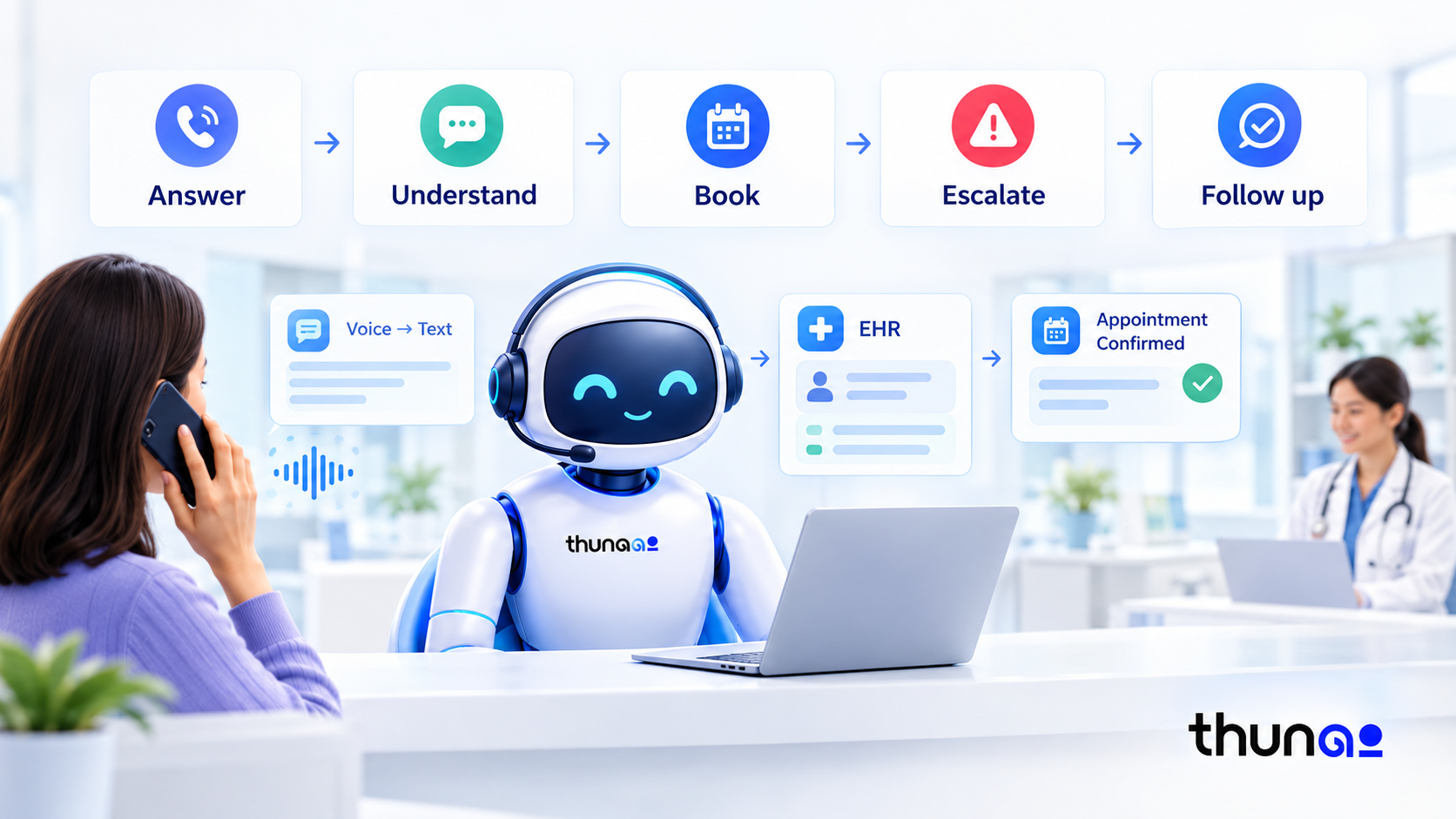
- A good AI receptionist for medical practice works like an experienced medical secretary. It answers on the first ring. There is no queue.
- It turns speech into text and reads the caller’s intent. It notes tone, dialect, and urgency. Clinical safety rules apply the whole time. For common questions, it answers from your own documents. Examples include driving directions or blood-work prep.
- For appointment booking, it is helpful in all of these cases and interfaces with your EHR system and practice management systems. It analyzes the schedule of the provider in order to pick the right time slot based on the nature of the visit.
- However, when the caller reports chest pain, difficulty breathing, or profuse bleeding, the agent stops the appointment scheduling process. Directs the caller to the triage nurse or tells the caller to seek urgent help. The caller is then referred for medical attention.
- After the call, it saves notes in your database. It texts a confirmation with a calendar link and intake forms.
Reviews of Thunai on Product Hunt and G2 cite a 5.0 rating and 99.9% voice accuracy. They also note less manual paperwork. That is why an AI receptionist for medical practice becomes a steady partner in busy clinics.
AI Receptionist vs. Live Staff vs. Basic Chatbot (Comparison Table)
It is a good compromise among cost, availability, accuracy, and empathy towards patients. This is how an AI receptionist for a medical practice is different from human staff and chatbots.
The receptionists welcome patients with their warm demeanor. Patients make many phone calls to the office, and these sometimes get the better of the receptionists. Basic chatbots answer website questions. They cannot take calls, handle nuance, or write bookings into medical databases.
Many clinics fill this gap by using Thunai Omni. This software integrates all communication channels into one process. It sends an entire transcript of the call to its employees in case human interaction becomes necessary. It gives you an instant voice translation in over 30 languages. You don’t require any interpreters, and your patients do not experience any delays. An AI receptionist for a clinic improves every patient interaction.
What It Actually Saves You
Benefits from the use of an AI receptionist for medical practices include three areas: recovered calls, low cost to replace employees, and reduced no-shows.
- Practices lose revenue in four ways.
- They miss calls at peak hours. They miss calls after hours. Patients skip visits.
- Staff run overtime. Primary care clinics miss up to 35% of calls during the morning rush.
- About 42% of inquiries come when the office is closed. And 65% of patients who hit voicemail call a rival instead.
- The losses add up to hundreds of thousands of dollars a year.
The table shows typical savings for a mid-sized clinic that adds an AI receptionist for medical practice.
Voice and Text Reminders help in lowering no shows by 20% up to 36%. Consider a practice where there are 30 patients per day. Saving five no-shows each week will amount to many thousands of dollars.
Increased Efficiency. The front desk workers cut down call duration by 150 to 190 hours a month. The medical assistants can now room the patients and take their copays and referral arrangements. Telephones don't distract them anymore. Attrition becomes lower, thus cutting down expenses for hiring and training. An AI receptionist for a medical office can pay off quickly.
Key Capabilities to Look For
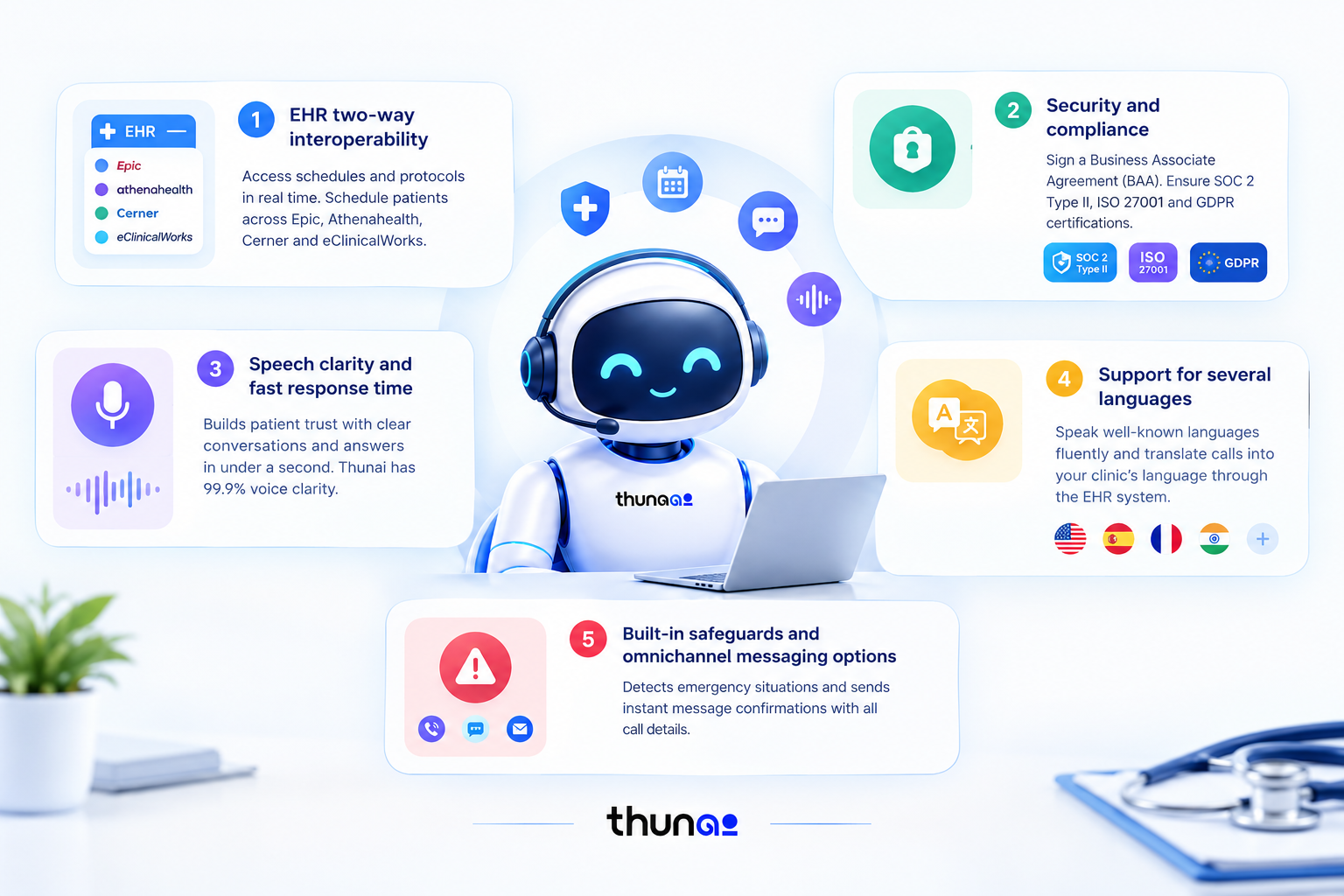
An AI receptionist for a practice should have certain qualities that need to be evaluated. Below are some of them.
- EHR two-way interoperability is critical. The provider should have access to schedules and protocols in real time. The ability to schedule patients in other EHR platforms like Epic, Athenahealth, Cerner, and eClinicalWorks is required. This process of sending emails and completing forms will take additional time, potentially resulting in double booking.
- Security and compliance become mandatory in the case of AI receptionists working at practices. It is mandatory that the provider signs the Business Associate Agreement or BAA. The most crucial thing here is that the provider should have SOC 2 Type II, ISO 27001, and GDPR certifications.
- Speech clarity and fast response time. Trust from patients requires both. Delaying answers for more than a second leads to confusion among elderly people or those who are nervous. Thunai has 99.9% voice clarity, so there will be no mistakes in writing down the names of medicines and clinicians.
- Support for several languages. Diversity calls for multilingual solutions. The system needs to speak well-known languages fluently. At the same time, it should translate the content of calls into the clinic’s language through the EHR system.
- Built-in safeguards and omnichannel messaging options. The system must detect emergency situations. In addition, instant message confirmation containing all information about the call should be sent. Any AI receptionist for a medical practice has to provide all five features.
How to Choose the Right AI Receptionist for Your Medical Practice
Picking an AI receptionist for medical practice calls for a clear process. Follow these five steps.
- Phone Traffic Audit. Analyze your phone call data for daily call volumes, morning spikes, hold times, and evening calls. The numbers will establish your ROI and baseline metrics.
- Compliance and Security. Request a Business Associate Agreement. Ensure that there is SOC 2 Type II and ISO27001 certification. What about the PHI? Is the data scrubbed on their system?
- Scheduling scenarios. Make sample calls to test how the AI medical office receptionist performs when handling scheduling tasks. Test first-time visits, rescheduling for providers who cancel appointments, and custom visit durations by doctors.
- Ensure that the reliability of the triage in the emergency setting is established, as the patient may be having chest pain, numbness, and problems breathing. Booking of the appointment should not continue. Transfer the phone call to a triage nurse or emergency services.
- Evaluate onboarding and support. A complicated implementation process can interfere with the delivery of care. According to Thunai, their agents are deployed within two days after being trained in the domain.
Want to stop missed calls, ease burnout, and protect revenue? Book a demo with Thunai. See an AI receptionist for a practice handle live clinical calls.
FAQs
What will tell you that the AI receptionist will be able to handle emergency situations safely?
The AI receptionist will function under the safety guidelines in addition to keywords at all times. If the patient describes having symptoms of chest pain, allergy, and difficulty breathing, then the system will not.
How does an AI receptionist integrate with health records?
It connects through APIs. It reads doctor availability in real time and applies the right visit lengths. It writes confirmed bookings to the calendar. It also adds call summaries to the patient record. An AI receptionist for a practice does this with no re-entry by staff.
Is an AI receptionist for a practice fully HIPAA compliant?
Yes, of course. This is particularly the case when you receive the information from an enterprise-level healthcare provider since they have their BAA. All voice audio and transcripts are encrypted. In addition, they have SOC 2 Type II, ISO 27001, and GDPR compliance certifications.
Will patients become frustrated with interacting with the voice of the AI?
Not likely, if conversational voice AI technology is used, not keypad menu technology. Thunai has smooth pacing, latency of less than a second, and 99.9% voice accuracy. Patients receive their results instantly without waiting on hold.
Does the AI receptionist substitute front office staff?
No, because it handles requests such as scheduling appointments, giving directions, and giving hours of operation. Hence, 60% to 80% of the phone calls are removed from the workload of the employees. These consist of meeting with patients, resolving payment issues, and delivering care. Not all clinics fire their staff. Just get an AI receptionist.