
Contact center leaders keep asking the same question: is there a better fit than Decagon?
Decagon's autonomous agents, built on what it calls Agent Operating Procedures (AOPs), do real work. But the price tag, the setup time, and the way it bills can send buyers looking elsewhere.
This guide breaks down the pricing mechanics, the deployment models, and the channel coverage across voice, chat, and email - so you can compare Decagon against the field without guessing.
Why CX teams go looking for alternatives
Teams walk away from Decagon (or skip it entirely) for a handful of recurring reasons.
There's no public rate card, and sales-led pricing hurts
- Decagon doesn't publish pricing. Every deal goes through sales.
- Procurement benchmarks put the baseline platform fee around $50,000 a year, before any usage charges kick in.
- Full contracts typically land between $95,000 and $590,000+, with most falling somewhere in the $386,000–$433,000 range.
- That's a steep floor, and it's exactly why teams start hunting for decagon alternatives with clearer pricing.
"Per-conversation" and "per-resolution" don't mean what you'd assume
- Decagon bills one of two ways. Per-conversation, at roughly $0.99 a touch, charges you for every interaction the AI handles - even the ones it fumbles and hands off to a human.
- Per-resolution charges more per unit, but only for interactions the AI actually closes.
- This is where things start getting complicated: vendors do not always agree with their customers on what constitutes a resolution.
- Cases involving abandoned chats and doubtful deflections are the source of many billing disputes.
Rip and replace vs. layering on top
- Decagon is an independent layer, and usually this involves redirecting the call and chat traffic outside of the solutions that you have.
- When you've constructed your entire system using Genesys Cloud, Amazon Connect, NICE CXOne, and RingCentral, you certainly don't want to give up the routing capability, workforce management, and the compliance suite to another solution.
- This drives the architect towards building things on top of what's already in place rather than taking something out.
The engineering lift is real
- Standing up Decagon takes work.
- You're building custom AOPs, wiring integrations, and tuning logic - usually with dedicated engineers or paid professional services.
- Onboarding typically runs 6 to 16 weeks. That's a long runway if you need results now.
Explainability and QA coverage fall short
- Governance teams want to see how decisions get made.
- Decagon ships monitoring tools like Watchtower, but tracing multi-turn reasoning end-to-end is still hard.
- And as per sqm group research, most contact centers only manually review 1 to 2% of interactions unless the platform scores 100% of them automatically - which Decagon doesn't do natively.
Voice came later, and it shows
- Decagon started as a chat and email platform.
- Voice arrived afterward. Voice 2.0 brought sub-second latency and outbound calling, which is genuine progress - but voice-first operations tend to want native SIP integration and proven stability under call spikes from day one, not bolted on later.
Smaller teams simply can't buy in
- Decagon sets a minimum annual commitment that shuts out anyone under roughly 10,000 monthly interactions.
- If you're mid-market, you need options that don't demand a six-figure floor just to get started.
Who should actually stay with Decagon?
- Not everyone should leave. If you've got a large enterprise budget, heavy chat and email volume, and an engineering team ready to build custom AOPs, Decagon's structured approach pays off.
- It handles ticketing and transactional actions reliably, has serious VC backing, and Zendesk users report strong satisfaction.
- If that's your profile, you may not need a Decagon alternative at all.
How we evaluated the alternatives
We scored every vendor on five things:
- Deployment model - SaaS you migrate to, self-hosted infrastructure you control, or middleware that layers over what you already run.
- Channel depth - how well each platform handles multi-turn, low-latency conversations across text, digital messaging, and phone.
- Pricing transparency - whether pricing is public, what's fixed, and how predictable costs stay when volume spikes.
- QA and analytics after handoff - visibility into both AI resolutions and human escalations, ideally with full call and chat scoring.
- Time to first value - days with pre-built templates, or months of manual prompt tuning.
Decagon alternatives at a glance
The 12 best Decagon alternatives in 2026
1. Thunai — best for adding agentic AI without replacing your CCaaS
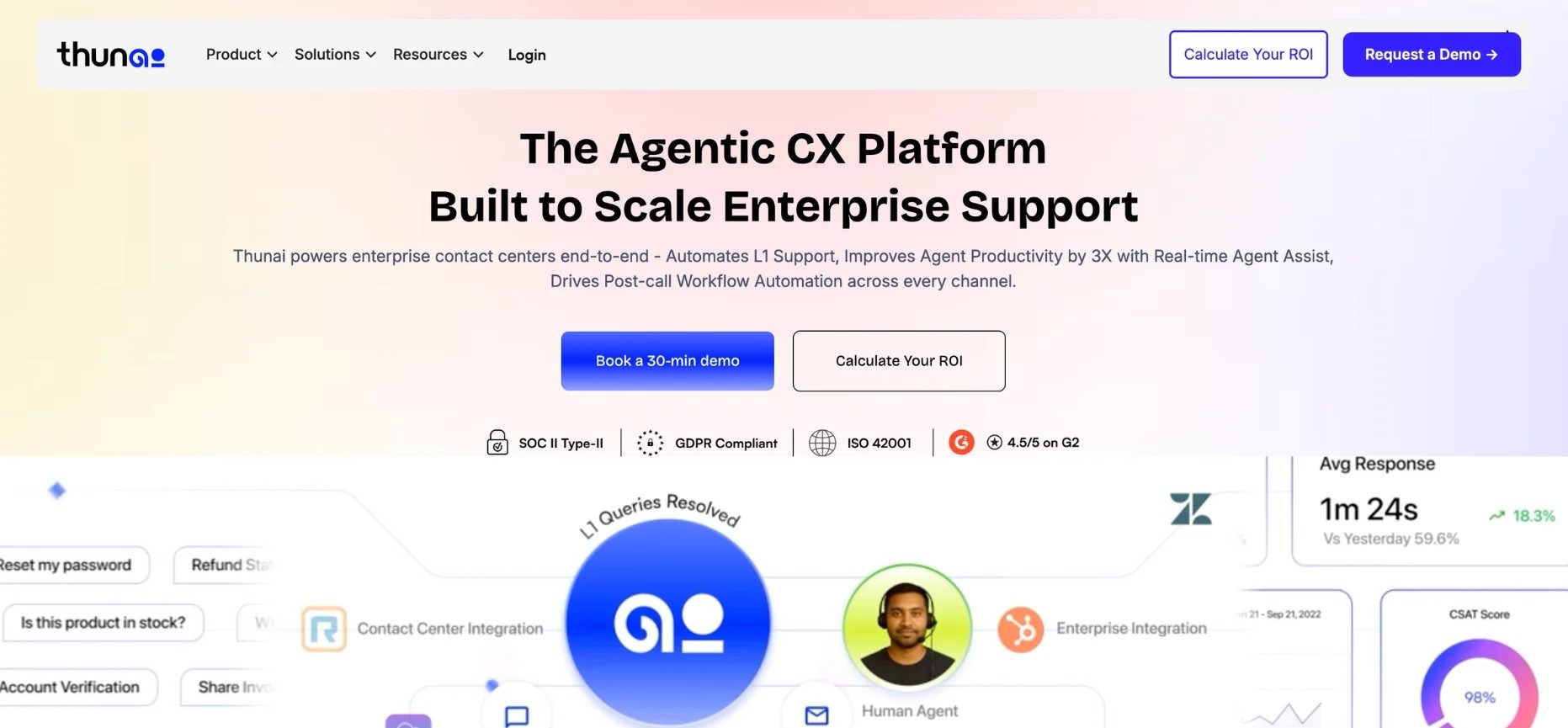
Thunai overlays itself right above Amazon Connect, Genesys Cloud, NICE CXone, and RingCentral. Rather than ripping out your telephony and CRM infrastructure, it overlays itself above and handles all the repetitive Level 1 tickets from voice, chat, and email channels.
Features
- Auto-resolves 80%+ of L1 inquiries using pre-trained domain workflows
- Real-time Agent Assist gives live suggestions and transcription during calls, cutting handle time by roughly 30%
- 100% automated call and chat scoring, no sampling, no gaps
- Automated post-call wrap-up writes CRM notes and follow-ups on its own
Pros:
- Real ROI: Bazooka Candy realized a 60% reduction in triage, and there was even one deployment that delivered 78% deflection in a call volume of 210,000+ with 4.8+ CSAT.
- It comes in as an overlay, so nothing in your existing stack gets pulled out.
Cons: It is made for mid-market and enterprise-level contact centers, not for solo helpdesks.
2. Sierra — best for outcome-priced autonomous deflection
Sierra is one of the decagon alternative builds branded conversational agents for large consumer brands, with a heavy focus on reasoning and staying on-brand across web chat and inbound voice.
Features
- Modular reasoning architecture for fluid, multi-topic conversations
- Brand personality controls that keep messaging and safety consistent
- Deep API integration for updating transactional records directly
Pros:
- Pricing is outcome-based, around $1.50 per successful resolution instead of flat seats.
- Conversational quality is genuinely strong for consumer brands.
Cons: Entry contracts usually start at $150,000–$250,000+ a year.
3. Ada — best for enterprise managed automation

The focus of Ada (Decagon alternative) is digital containment and a no-code environment for support teams who seek automated solutions without engineering effort.
Features
- Visual, no-code workflow builder across web, mobile, and social
- Bundled translation capabilities for language-based support across borders
- Pre-built integrations for Zendesk, Salesforce, Freshdesk, and other applications.
Pros:
- A mature platform with a long track record at scale.
- Median contracts near $73,500 make it more approachable than seven-figure custom builds.
Cons: Voice automation trails behind its chat capabilities.
4. Fin by Intercom — best for teams already inside Intercom
Fin, one of the Decagon alternatives, is Intercom's native AI agent, and it's one of the fastest, most transparently priced options on this list.
Features
- Instant knowledge ingestion: it crawls your help center and internal articles within minutes
- Handoff logic that passes full conversation history and metadata to human agents
- Works standalone with Zendesk and Salesforce Service Cloud too
Pros:
- There are no annual fees, and the price list is open and clear ($0.99 per resolution).
- 14-day free trial means you can use it without any sales calls.
Cons: You will be charged for messages customers leave unanswered.
5. Forethought — best for Zendesk-native triage
This is one of the decagon alternative; Forethought's SupportGPT engine focuses on triage: routing tickets, detecting intent, and cutting down manual categorization work.
Features
- Automated ticket classification with urgency and priority tags
- AI-drafted macro suggestions for human agents
- Workflow automation that deflects common L1 questions
Pros: Tightly integrated with Zendesk, and it noticeably reduces manual triage work.
Cons: Not built with real-time voice telephony in mind.
6. Cresta — best for real-time agent assist alongside AI agents
Cresta, a Decagon alternative, doesn't try to replace your agents; it makes them faster. It analyzes live conversations and coaches in real time.
Features
- Live speech and text analysis that surfaces answers mid-call
- Automated post-call summaries and CRM entry
- Supervisor dashboards tracking compliance, objections, and sentiment
Pros:
- Improves agent effectiveness and reduces onboarding time.
- Works well with most leading CCaaS systems.
Cons: It's a copilot for humans, not an autonomous deflection engine.
7. Cognigy — best for regulated, flow-controlled deployments

Cognigy blends agentic LLM reasoning with deterministic rule-based flows, a good fit for teams that need governance and structure. This is also a good Decagon alternative.
Features
- Low-code studio combining LLM reasoning with strict logic trees
- Native Voice Gateway with direct SIP trunking
- Detailed compliance reporting exportable to BI tools
Pros:
- Deploys on-premise, private cloud, or hybrid.
- Strong security posture for finance and healthcare.
Cons: Configuring complex hybrid flows takes real technical skill.
8. Kore.ai — best for on-premise and industry-template builds

Kore.ai, one of the Decagon alternatives, ships with pre-built templates for banking, healthcare, retail, and ITSM a shortcut for vertical-specific rollouts.
Features
- Functional blueprints tailored to complex verticals
- Multi-LLM orchestration so you're not locked to one model
- Role-based access control and audit logging
Pros:
- Deep template library speeds up vertical deployments.
- Handles on-premise and isolated private cloud hosting well.
Cons: The interface has a learning curve that slows down quick, iterative changes.
9. Salesforce Agentforce — best for Service Cloud-centric stacks
This is one of the Decagon alternatives; Agentforce lives inside Salesforce, grounding its responses in your actual CRM data.
Features
- Direct integration with Service Cloud objects and Omni-Channel routing
- Grounds answers in purchase history and case records
- Executes CRM actions like closing cases or updating fields
Pros:
- A natural fit if you're already standardized on Salesforce.
- Pricing is public at $2.00 per conversation.
Cons: You need the underlying Salesforce licenses too, which raises total cost.
10. Parloa — best for voice-first contact centers
Parloa is one of the Decagon alternatives and is built around telephony first, aimed at replacing outdated IVR systems at scale.
Features
- Sub-second latency tuned for accents, interruptions, and noise
- A simulation sandbox to test scenarios before going live
- Native SIP trunking with Genesys Cloud and NICE CXone connectors
Pros:
- Holds up under heavy call volume and peak spikes.
- Simulation tools catch problems before launch.
Cons: Entry pricing typically starts around $300,000+ a year.
11. Rasa — best for self-hosted, developer-owned agents
Rasa, one of the Decagon alternatives, is the pick for teams that want full control of the models, the data, and the code.
Features
- Rasa’s dialogue management and natural language understanding
- Deployed on in-house Kubernetes clusters or self-managed servers
- Custom Python actions for deep legacy backend integration
Pros: Complete control over data residency and model weights, with no vendor lock-in.
Cons: Needs ongoing maintenance from dedicated engineers.
12. Zendesk AI Agents — best for lean teams already on Zendesk
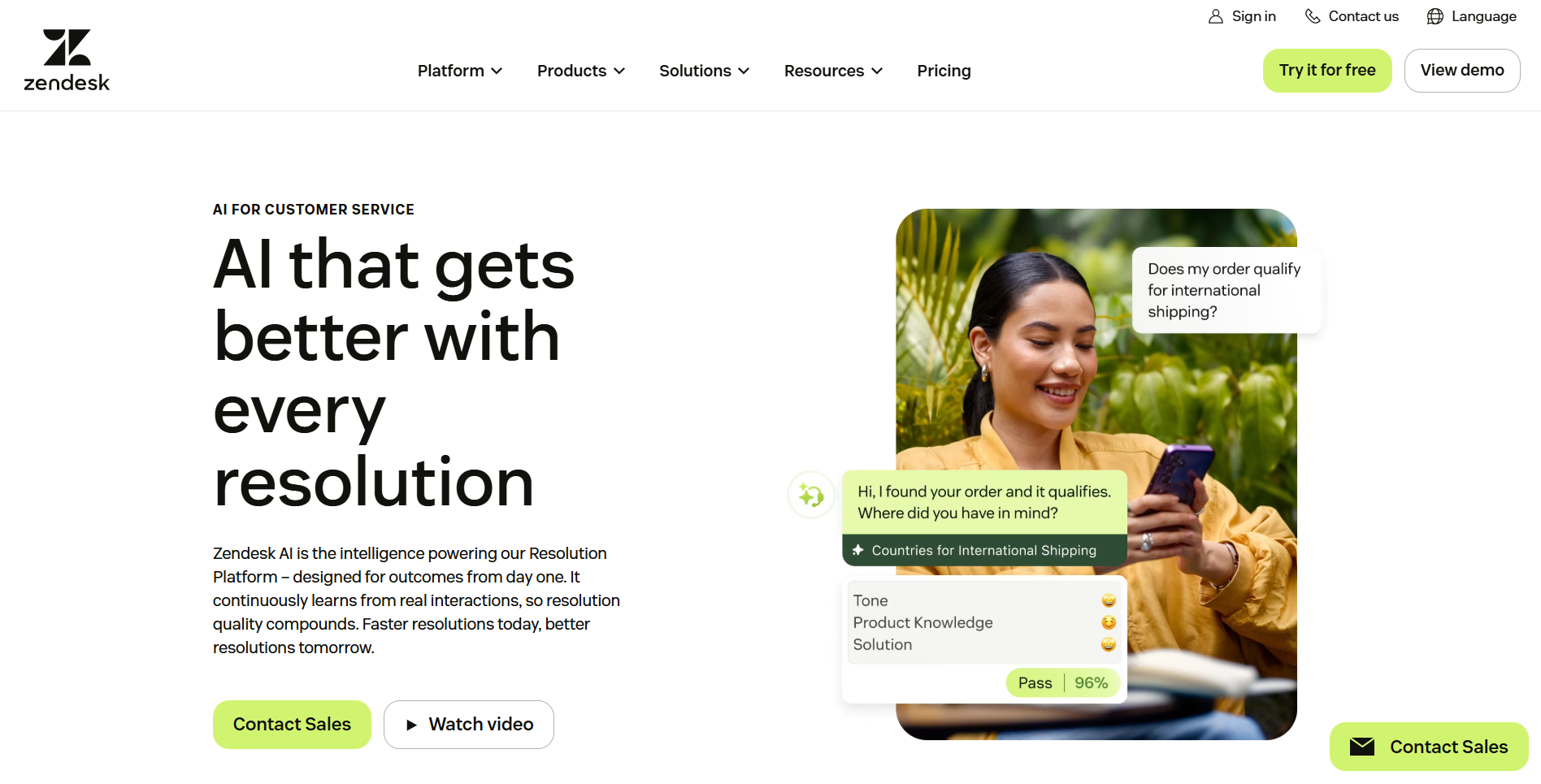
If you already run Zendesk, this is the path of least resistance. This is also the best Decagon alternative.
Features
- Instant setup by indexing your Help Center and macro history
- Automated intent detection and canned response suggestions
- Native handoff to Zendesk Agent Workspace, no third-party webhooks needed
Pros:
- Zero integration overhead if you're already a Zendesk shop.
- Simple self-service setup through the admin center.
Cons: Overages run $1.50–$2.00 per resolution once you're past the base tier.
Pricing models compared: what you're actually paying for
Vendors in this space monetize four different ways:
- Platform fee + usage - a fixed base (often ~$50,000/year) plus metered rates on top.
- Per-resolution - you pay only when the AI actually solves the problem (Fin at $0.99, Sierra around $1.50).
- Per-conversation - billed on every interaction opened, whether it resolves or escalates (Agentforce at $2.00).
- Per-seat / middleware tiers - flat subscriptions scoped to capacity and features.
What to model before you sign
Work out your baseline volume, expected seasonal spikes (Q4 retail, for instance), and whatever you're already paying for helpdesk licensing.
Per-conversation pricing gets expensive fast if your containment rate slips during a volume surge.
Where each model breaks down
Per-resolution pricing gets costly when a flood of simple FAQ questions rack up resolution counts.
Per-conversation pricing punishes you the other way, complex cases that need human escalation still count as billable, even without a resolution.
Replace or augment: picking the right architecture
When standalone makes sense: early-stage companies with minimal legacy tooling, light voice volume, and simple routing needs.
When middleware wins: established telephony contracts, workforce management systems, and complex L2/L3 queues. Middleware adds L1 automation and real-time assist without downtime or a system rebuild.
The cost of migrating away from an existing CCaaS platform is easy to underestimate; lost telephony configs, agent retraining, and systems-integration consulting all add up fast.
Running the evaluation: an RFP checklist
Ask every vendor these questions before you sign anything:
On resolution and billing:
- How is a resolved interaction technically validated in the event logs?
- Do abandoned or dropped sessions get billed as completed resolutions?
- What's the audit process for crediting false deflections or immediate human re-dials?
On security and flexibility:
- SOC 2 Type II status, HIPAA readiness, GDPR compliance
- Zero data-retention options for LLM prompts
- Multi-model flexibility, so you're not locked into one provider
What to test in a 30-day proof of concept:
- Accuracy against your top 20 repetitive L1 intents
- Latency and interruption handling on live voice calls
- Clean human escalation with full context carried over
- End-to-end post-call summaries logging correctly into your CRM
Where Thunai fits
Thunai is built for teams that want to scale AI in the contact center without tearing out what already works.
It integrates directly into Amazon Connect, Genesys Cloud, NICE CXone, and RingCentral, automates 80%+ of L1 requests, cuts handle time by 30% with real-time agent guidance, and scores 100% of interactions for ongoing quality compliance.
For teams weighing Decagon alternatives, it's a strong balance of capability and architectural fit.
Looking for a smarter Decagon alternative? See how Thunai adds agentic AI to your existing contact center - without replacing your stack. Book your demo now
FAQs on Decagon Alternatives
Who are Decagon's biggest competitors?
Thunai for CCaaS middleware automation, Sierra for branded outcome deflection, Ada for digital containment, and Parloa for voice-centric contact centers.
How much does Decagon cost per year?
Around $50,000 as a base platform fee, with most enterprise contracts landing between $386,000 and $433,000 depending on volume.
Is there a self-serve or transparently priced alternative to Decagon?
Yes, Fin by Intercom publishes pricing at $0.99 per resolution with no platform fee. Thunai also offers predictable, ROI-based tiered pricing.
Can I keep Genesys, NICE, or Amazon Connect and still add AI agents?
Yes. Thunai runs as middleware on top of Amazon Connect, Genesys Cloud, NICE CXone, and RingCentral, so you get AI agents without replacing your existing routing or telephony.
Which Decagon alternative is best for voice support?
Parloa and Thunai both offer deep telephony integration, fast response times, and full call scoring, making them the strongest picks for voice-heavy operations.