
What if you could provide instantaneous response to your customers at any time without adding even one more employee to your team? This is what Agentic AI can already do.
Unlike old chatbots that used to repeat scripts, the proposed solution takes measures in advance, integrates into your business systems and handles all the requests in one run. Also, the system is capable of analyzing all the interactions so that the manager can get access to all the relevant information instantly.
Human agents now have the freedom to address complicated and valuable cases, whereas regular activities run automatically. Conventional solutions scale on headcount, but automation scales on-demand with no increase in cost and no loss of quality.
In this article, we’ll talk about the principles of contact center automation, when it gives the most benefits and what challenges managers need to consider.
What Is Contact Center Automation?
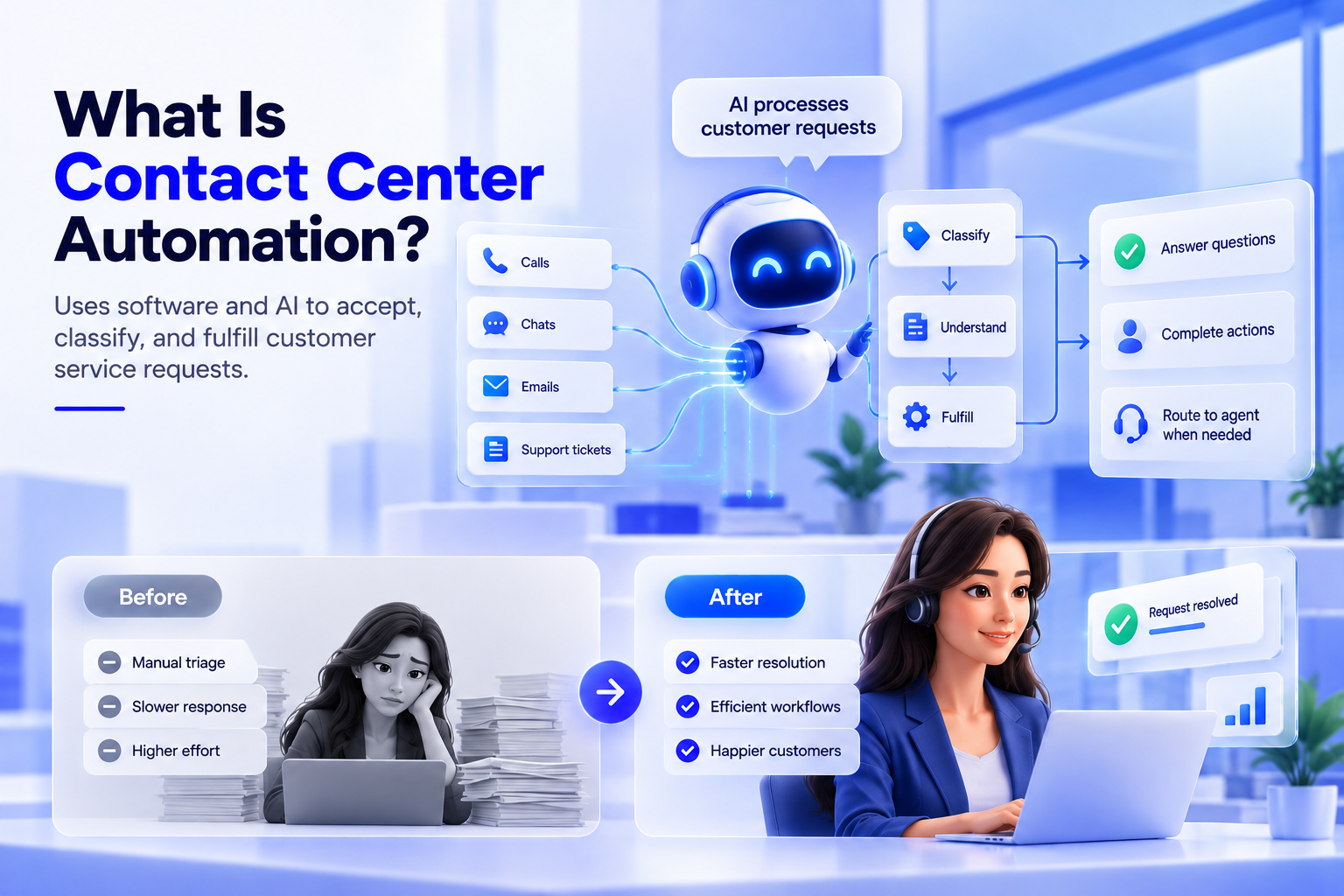
Contact center automation refers to the use of software and AI technologies to accept, classify, and fulfill customer service requests. Its purpose is to transform a lengthy, manual process into a quick and efficient digital one.
There are two kinds of AI technology present here, and the distinction between them is quite important.
Generative AI acts as an assistant. It reads your company policy, restates the appropriate part to the customer, and then waits until the human employee does the actual job.
Agent-based AI does the work on its own. For example, if you need to send back a defective item, an agent checks the order details, makes sure the return period hasn’t expired, and approves the refund claim in your billing system. The refund and the shipping label are sent out together in one interaction.
Good automation should cover the whole customer journey. In terms of front-line operations, it should be responsible for operating the voice and chat channels. In terms of back-office operations, it should tag tickets, update records, and reduce the administrative backlog. For a deeper look at how agentic AI differs from generative AI, read our guide on Agentic AI vs. Generative AI.

How Contact Center Automation Works
Modern machines do not depend on any static menus or scripts. What happens is that each message that comes in kicks off a cycle of sensing, thinking, and doing.
Step 1: Intake and sorting
The message is taken in and the AI gets the true meaning behind the customer's message, comprehending the meaning of the message, the tone and how urgent the customer's request is.
Step 2: Routing and validation
AI works out its level of confidence in the requests because at times some things need human input, like filling an application form for life insurance. At times like these, the AI immediately routes the case to a specialist.
Step 3: Knowledge base look up
For the approved tasks, the AI pulls out relevant information from your business data through a process of Retrieval-Augmented Generation (RAG). It searches the vector database for the proper policy. Well-designed systems take care of the context window, so that the model receives only the text needed.
Step 4: Task execution
The AI makes plans and communicates with other programs via APIs. It verifies the result of each move and moves on to the next action. Finally, it makes changes in your CRM.
Key Benefits of Contact Center Automation

- Instant answers
Nobody likes waiting, and automation gets rid of the queue completely. Artificial intelligence reacts at all times and across all platforms, and the percentage of customers who would rather receive an instant response from AI than a slow response from a human representative is rising.
- Lower turnover
Working in a contact center takes its toll on people. With automation handling all the mundane queries, employees will have more time for those conversations that need human involvement.
- Scale without hiring
Teams of humans increase proportionally, meaning that with twice the volume of calls, the payroll will be doubled. Not AI, however. One automated system will handle thousands of chat windows simultaneously at a product launch or on holidays.
- Full visibility
One cannot monitor every call, therefore the quality of interaction is estimated based on a sample. AI will review 100% of calls and pinpoint exactly where your process needs improvement.
Contact Center Automation Use Cases
Automation delivers value in three main areas. It supports live agents during conversations, runs workflows in the background, and scores every call for quality.
Real-time agent assist
In highly automated systems, human agents deal with sensitive situations which need empathy and experience on part of the agents. Agent assist acts like a live co-pilot while agents have such conversations.
Speech-to-text technology records the conversation while AI determines the needs of the customers instantly.
The information regarding policies, customer’s record, and the next course of action is provided on the screen without putting the caller on hold. Know more about Agent Assist in real time.
Workflow automation
Each contact made by the customer entails the creation of an admin task. It needs to be marked, and a description needs to be recorded. This is done using workflow automation, which removes all manual data entry processes.
It is compatible with various software systems such as Salesforce, ServiceNow, and HubSpot. Following the call, a short note is created and inserted into the appropriate CRM record.
It also ensures that tasks are routed in a very efficient manner, such that if the churn rate is high, it automatically alerts the retention expert via Slack or Microsoft Teams. Explore Thunai for smarter workflow automation.
Call scoring automation
The regular QA process only inspects 2% of the calls; the remaining 98% are not evaluated at all. Compliance problems and unhappy clients hide in these unseen 98%.
AI will evaluate each call according to your criteria for quality. This includes analyzing the degree of empathy, tone, accuracy, and adherence to the process.
If an agent violates any rule, the system will automatically pass on the record to the supervisor together with the needed data and coaching materials. Learn more about automated quality monitoring with Thunai Call Scoring Audit.
Contact Center Automation Trends to Watch
Agentic AI goes mainstream
The move towards active chatbots is gathering momentum. An agentic AI approach applies connected apps to tackle an issue from start to finish.
Voice biometrics instead of passwords
Deep fakes have become a significant security concern, and the answer to deep fakes lies in voice biometrics. The voiceprint takes less than a millisecond to authenticate the speaker, and there is no password that a thief could steal from him.
Real-time translation
Language was a barrier for global organizations, forcing them to set up multiple centers all over the world. Real-time speech-to-speech translation is available in over 150 languages.
Proactive contact
Traditionally, centers used to wait for the telephone to ring, but not anymore. When flights are delayed, or when deliveries are delayed, the artificial intelligence calls the client and provides options of rebooking or reimbursement. The inbound call does not even occur.
KPIs to Measure Automation Success
Many automation projects fail because leaders track the wrong numbers. Deflection rate alone is a dangerous trap, since an AI that hangs up on every caller would achieve 100% deflection while the business continues to lose customers.
A balanced set of metrics gives a far more accurate picture.
One warning deserves attention here. Your human performance metrics will shift once automation is running.
Since the easy tasks are being done by the AI, the human representatives will get only the difficult tasks to deal with, and hence the average handle time will go up.
The Technical Architecture Behind Contact Center Automation
The main reasons why the AI system is failing in many AI projects in enterprises are not because of AI technology itself but are related to technical architecture. The most frequent technical issue is context gaps, where the AI system will be able to recognize what information it needs, but is unable to figure out whether it is up-to-date and valid.
Latency becomes yet another key concern, particularly in case of voice communication. Slow response times and delays can be frustrating for the user and will demand low latency from the system.
Finally, human takeovers must provide context continuity. At the point of handover from the AI to a human agent, the API must quickly pass on the transcript, intent, customer details, and summary of the interaction.
Thunai’s Approach to Contact Center Automation
We developed an agentic AI system to address the growing needs of support teams that are looking for scalability. This system performs Level 1 support functions autonomously, boosts the productivity of the agents, and executes post-call operations automatically.
The core of our platform is Thunai Brain, which is a self-learning knowledge repository. This tool aggregates all data of the company, ranging from PDF documents to chat conversations, and consolidates it all into one source of truth without any discrepancies.
Thanks to real-time streaming context provided by IBM Confluent, Thunai Brain always works with the latest available data.
Above Thunai Brain, we use agents for voice, chat, and email called Multilingual Voice Translation. Our Voice Agent operates in 150 languages and converses in a natural way.
Thunai makes a call, verifies policy, performs requests, and updates your CRM system. When the customer faces some visual trouble, AI can initiate screen sharing and walk him through the process.
FAQs About Contact Center Automation
Why do most of the AI applications in contact centers fail?
They usually fail because of two factors which are the poor quality of data and the wrong alignment of goals. The thing is that when AI uses the unstructured data from CRM systems, it cannot determine company's policies.
What is a context gap?
A context gap can be considered a difference between the availability of data and proper usage of those data. It is possible that AI finds the required information, but it does not understand that it should not be used because of the approval policy.
Is automation enough to replace manual quality assurance?
Of course, it is. Manual QA analyzes only 2% of calls, while artificial intelligence can transcribe and analyze all of them using your criteria. In other words, it covers all gaps and makes compliance complete.
What is the advantage of real-time assistance for an agent on a call?
Live help can be considered like a personal mentor which assists agents in dealing with calls. This tool listens to the client, understands his problem and gives the best solution to the agent.
What if AI cannot solve the problem?
Good AI has reliable guardrails. If it lacks confidence or the problem is complicated, it does not make decisions and switches the client to a specialist. All conversations, including the past ones, are passed without repetitions.