
Is your self-service portal actually solving problems? Or just delaying the inevitable ticket by not helping your customers?
Research shows 73% of customers try self-service first. Yet only 14% of those journeys reach a real resolution.
Which is why deflection rate - the industry's favorite metric - is dangerously misleading.
Meaning the success showing up on your dashboard might just be a customer giving up.
This guide explains how the self-service resolution rate replaces vanity metrics with real answers.
What Is Self-Service Resolution Rate?
The Self-Service Resolution Rate (SSRR) calculates the percentage of service requests that have been totally and completely solved using automation like chatbots, KBs, FAQs, and portals, without escalating them to a real human agent at all.
The formula is pretty easy to understand.
To get this number, you need to divide the number of self-service contacts that have not led to a ticket being opened.
After that, you can get this by dividing it by the total number of contacts via self-service and then multiplying it by 100.
For example, if you receive 10,000 visitors to your portal in a month, and out of them 8,500 do not contact your support team within the next two weeks, then your self-service effectiveness would be 85%.
But SSRR gets confused with two other metrics constantly:
- Containment Rate: measures conversations that stay inside the bot without a human handoff - easy to inflate through abandonment.
- Deflection Rate: measures the share of total support volume diverted away from agents entirely - a cost metric, not a satisfaction metric.
Why Self-Service Resolution Rate Matters More Than Deflection Rate
For years, deflection rate ruled the boardroom. The math was seductive: a live agent interaction costs between $8.00 and $13.50, while a self-service interaction costs as little as $0.10 to $1.84.
But deflection is fundamentally a negative metric. It only measures what didn't happen - a ticket wasn't created. It says nothing about whether the customer's actual problem got solved, or whether they simply gave up.
The real cost shows up downstream, not on the dashboard. 38% of Gen Z and Millennial customers won't escalate a failed self-service attempt at all. They don't complain. They simply abandon the brand.

What Drags Self-Service Resolution Rate Down
Despite the hype around AI, 86% of self-service attempts still fail to actually fully fix customer complaints. Three failure patterns explain most of it.
1. Difficult to Locate and Fragmented Knowledge
43% of failed journeys happen simply because the customer couldn't find content relevant to their issue.
Marketing owns the website, product owns the in-app tooltips, IT owns the internal desk - and none of it talks to the others.
- Disconnected Systems: A chatbot and a help center can give two completely different answers to the exact same question.
- The Real Cost: When the correct answer only lives in an internal PDF, customers escalate to a human or abandon the task entirely.
2. Outdated Search and Broken Journeys
45% of failed attempts to solve issues occur because the system simply DOES NOT understand what the customer was trying to do.
Legacy keyword search fails is very limited. And can easily fail the moment a customer types "database" when the article says "table" (meaning no results will show up at all!)
- Keyword Blindness: Exact-match search punishes customers for not knowing your internal terminology.
- Decision-Tree Traps: Any edge case that strays even slightly from the pre-built path breaks the entire journey.
3. Tone-Deaf, Fake Empathy
AI agents that say "I know how frustrating this must be," with no authority or even emotions to actually fix anything or understand, are widely resented by customers who see straight through it.
To deal with this, teams need to make sure their AI chatbot or voice agents act as just L1 support.
The reality is that actual dast, clear, and precise solutions in terms of AI beat manufactured warmth every time.
How AI Improves Self-Service Resolution Rate
To deal with a 14% global average, leading CX teams are using AI to do more than deflect. There are three trends and use cases that support teams are doubling down on using AI.
1. Contextual Intelligence and Memory
81% of customers want automated agents to continue a conversation without hacing to repeat themselves, and 74% get annoyed when this happens.
Memory-rich AI remembers all the context, offering solutions even before the customer completes the question.
2. AI Agents That Can Take Action or Initiate Processes
The earlier versions just delivered the link. The current agentic version validates the customer, verifies an order status, provides a return shipping label, and updates the CRM system.
Even more, it does this process automatically in just one thread of the conversation.
This is precisely why the experts believe that AI will handle 70% to 95% of customer engagement in the coming decade.
3. Omnichannel and Flexible Support
76 percent of customers favor a mix of text, images, and video in one thread.
A photo of a blinking router light now gets diagnosed instantly, instead of turning into a three-day ticket.
93 percent of AI agents working at established companies have already mastered at least one non-text communication medium.
4. The Use of AI to Monitor Support Systems
The cold truth is that AI does not take away the need for human agents, however, it does change their role.
The automation of those predictable questions will allow your top agents to focus on the questions that cannot be answered by bots.
More often than not, top-notch agents handle the outputs generated by the bot, deal with the toughest escalations of the bot, and help the failures of the bot go back into the knowledge base.
What to Look for in a Generative Search Tool for Customer Self-Service
Choosing the wrong platform locks in a low resolution rate for years. Evaluate any vendor against these criteria:
- Transparent Reasoning: 95% of consumers expect AI to explain its decisions - look for a logged reasoning trail, not a black box.
- Strict Knowledge Grounding: Answers should be restricted to verified documentation, with visible source citations customers can check for themselves.
- Unified Reporting: One schema across chat, email, and search - not three competing definitions of "resolved."
- Escalation Taxonomy: Failed interactions should be tagged by reason - policy gap, unsupported intent - so your team knows exactly what to fix next.
- Enterprise-Level Security: SOC 2, ISO 27001, and GDPR Compliance, along with real-time removal of any PII before the data is fed to an LLM.
The 2026 vendor landscape reflects these priorities in different ways:
- Fini: Reasoning First Architecture Designed for Audit Trail Capabilities with 98% Accuracy and No Hallucinations Guarantee.
- CustomGPT.ai: Strict knowledge grounding for documentation-heavy teams; one case study reported an 86% resolution rate.
- Zendesk AI: Omnichannel ticketing plus acquired agentic AI, built for teams that need native case management.
- Ada: Multilingual intent clustering, benchmarked at a 70% Automated Resolution Rate.
- Salesforce Agentforce: CRM-native execution inside Data Cloud, with a reported $100M in internal savings.
How to Measure and Benchmark Your Own Self-Service Resolution Rate
Benchmarks vary wildly by industry and audience, so don't compare an IT password-reset portal against a regulated healthcare billing line and expect matching numbers. Instead, build your own clean baseline first, then hold it against the market.
I. Set Your Baseline and Track These Consistently Across Every Channel:
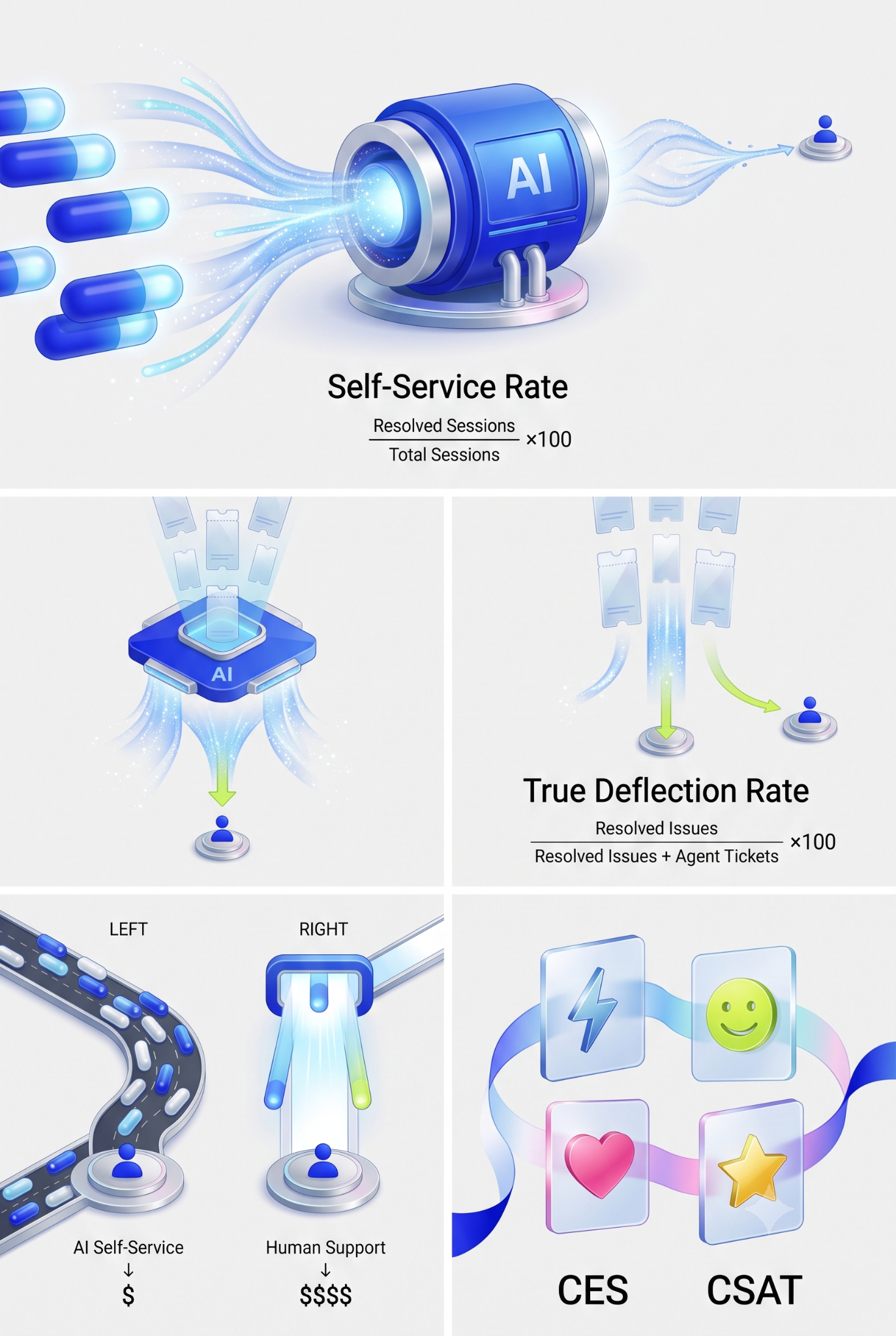
- Self-Service Resolution Rate: Resolved Sessions ÷ Total Sessions x 100
- True Deflection Rate: Resolved Issues ÷ (Resolved Issues + Agent Tickets)
- Cost Per Contact: fully-loaded self-service cost versus fully-loaded agent cost
- CES and CSAT, isolated specifically for fully-automated journeys
II. Compare Against 2026 Benchmarks

- Global average resolution: 14% baseline, 40-60% for top-quartile teams
- AI containment rate: 43-50% baseline, 70-85%+ for high-maturity platforms
- Cost per self-service interaction: $1.84 baseline, as low as $0.10 for leaders
- B2B/SaaS resolution: 70-75% baseline, 85%+ for top performers
- Healthcare patient resolution: 15% baseline, 30%+ for leaders
III. Run the Audit
- Mine failed searches for the exact terminology customers actually use
- Review your top 20 articles monthly for knowledge decay
- Find the exact step where users rage-click or demand a human
- Make the human escape hatch highly visible - it counterintuitively improves self-service uptake
The gap between your baseline and the benchmark is simply a map of exactly where to invest next.
Want to know how Thunai helps with this? Book a free demo with our CX specialists to find out!
FAQs on Self-Service Rate
Does a high self-service resolution rate lower CSAT?
No - not when the metric reflects true resolution. Real customers like to use self-service, since it is immediate. The only way to reduce CSAT is to force the customer through rigid loops that do not solve the problem and block access to a human.
How can we combine AI and humans in the customer service process?
AI can handle the repetitive questions such as password recovery, status of an order, basic troubleshooting. Meanwhile, humans can be engaged when the query requires more in-depth knowledge or the query is emotionally sensitive - eventually taking the position of the AI supervisor, contributing to the development of the knowledge base.
What's the worst thing in launching a self-service portal?
Not having an escalation path. A customer who has failed at self-service and needs to start explaining the problem again will have a worse experience than without any portal at all.
Can AI completely replace the knowledge base?
No. Generative AI is an intelligence layer, not a replacement. It's only as accurate as the documentation behind it - connect it to an outdated knowledge base and you get fast, confident, damaging hallucinations instead of resolutions. The knowledge base stays your single source of truth; AI simply makes it conversational.