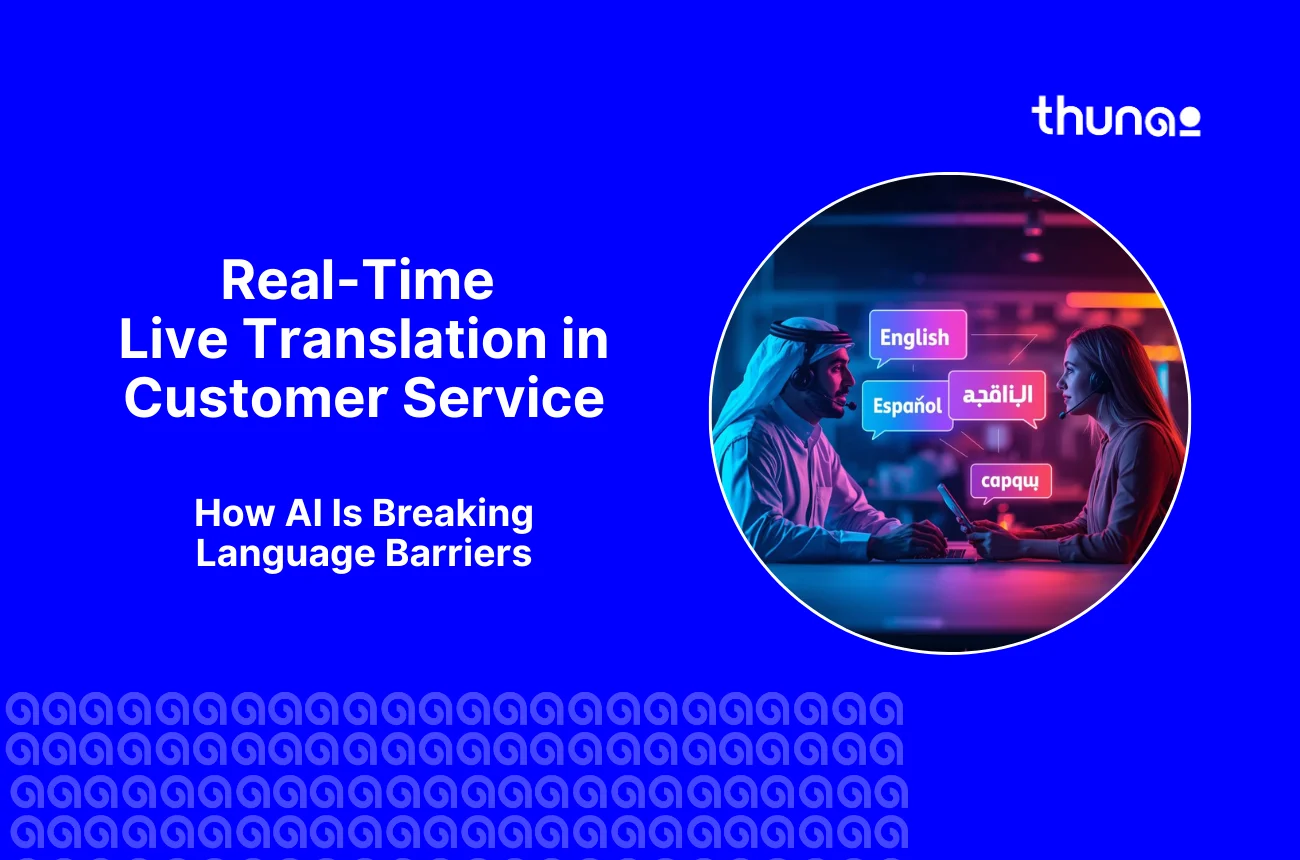

A customer contacts your support team with an urgent issue. Yet, communication ends before the issue is even resolved!
This is not because the solution to the problem does not exist, but because of the language itself.
That does not only cost you business but also - trust, time, and several millions of dollars worth of income worldwide.
Given expansion of business activities on the international scale, hiring more people alone will not be sufficient to overcome the language issue.
The answer lies in real-time translation through the power of AI. It is going to help businesses operate on a global scale.
What Is Real-Time Live Translation?
Real-Time translation in Customer Service is the process by which speech or text is translated into another language instantly during a live conversation.
Unlike the approach of translating once the whole sentence has been uttered, the translation process is conducted on each word uttered by the speaker or typed by the user.
It guarantees a smooth interaction without any breaks.
The 3 Step Process: STT to Translation to TTS
The process by which modern live translation operates is based on a rapid process:
- Speech to Text (STT): The speech of the user gets recorded using WebSockets and converted into text data at lightning speeds.
- Translation: Rapid engine with the help of Large Language Models alters text while maintaining its original intent and brand tone.
- Text to Speech (TTS): Altered text gets converted back into speech in the same manner as the original speaker.
Speed Benchmarks: What Counts as Real-Time?
In the world of real-time live translation in customer service, milliseconds are the difference between a good talk and a bad one.
Deloitte’s report saysAI use in contact centers increased by 15% from 2023 to 2025, whereas there was an average 0.5-point decrease in CX and EX scores during the same period.
An optimal score for real-time would be when the lag is below 300 milliseconds.
Any lag longer than 500 milliseconds is considered abnormal by humans and triggers a negative response in the brain.
To get a true flow, you need a system that can process, change, and reply faster than a person can blink.
How AI Real-Time Translation Works: The Technology Explained
The growth of real-time live translation in customer service has been a move from stiff rules to smart flow. Knowing this tech is key for any leader making big money plans.
Neural Machine Translation (NMT) vs. LLMs
- Neural Machine Translation changed that by using deep learning to understand whole sentences.
- NMT is the current tool for fast work, liked for its speed and its ability to keep specific brand names the same.
- The big change came with the use of Large Language Models (LLMs) in real-time live translation in the customer service path.
- Unlike NMT, which looks at sentences one by one, LLMs can remember what was said earlier in the talk.
- This implies that artificial intelligence is able to distinguish between 'match' (competition) and 'match' (object used for fire) based on the history of the conversation.
Multilingual Voice AI: Accents and Dialects
- The current speech technology is capable of recognizing distinct pronunciations for different regions in various countries.
- Acoustic models separate background noise from distinct speech styles for clearer understanding.
- Matching native tones helps voice bots interact naturally with callers worldwide.
Why Businesses Can No Longer Ignore Real-Time Translation Services
If you are leading a group today, you must see that the web is no longer English-first. We have hit a point where non-English-speaking areas are the main drivers of growth.
The Money Trap of Bilingual Hiring
- The old way: hiring bilingual agents is no longer a good plan. Not only do these agents take more pay, but the waste is big.
- If your Spanish-speaking agent is busy while your French-speaking agent is sitting idle, you are losing money.
- Real-time live translation in customer service lets you make a universal agent pool.
The Law: EU Language Access Rules
- Governments have entered the room, and they are not interested in an English-only plan.
- Under the EU Digital Services Act, platforms must give info in languages that local users know, with fines reaching up to 6 percent of global revenue for failing to do so.
- Also, the EU Accessibility Act, enforced in June 2025, says that banking and e-commerce must be easy to read and available in the user's native tongue.
- Real-time live translation in customer service is now a rule you must follow.
- According to Bill 96 of Quebec, it is imperative for all companies to prioritize the French language, and fines are imposed daily until it is done.
- In the United States, healthcare groups must give meaningful access to those who do not speak English well, or they risk losing federal funds.
- Real-time live translation in customer service helps you stay safe from these legal threats.
Aside from this, you can also meet your internal SOPs using Thunai for compliance scoring or call scoring, for that matter.
Where AI Real-Time Translation Makes the Biggest Impact
The range of real-time live translation in customer service lets it fix high-stakes problems across many fields.
- Customer Support Centers: Automation could deflect as much as 80 percent of common tickets. Chat agents combined with AI can address problems 126 percent more quickly than previous means.
Gartner predicts that by 2028, 30% of Fortune 500 firms will provide service via AI-powered channels because 45 percent of customers currently use GenAI in their personal lives, work, or both. - Healthcare: Language gaps lead to a 24 percent higher readmission rate and millions in legal risk. Real-time voice agents make sure patients get the care they need, acting as multilingual AI medical scribes, which is the law in many places.
- Finance: The law says product info must be in plain language across all EU tongues. AI making sure these terms are right helps avoid lawsuits.
- Hospitality:AI-powered technologies such as live translation can be used by hotels for customer service to allow front-desk employees to communicate with guests in their language directly upon greeting and assisting them.
- Safety and Wellbeing of Workforce: In any global team, safety should be the highest priority. That is why safety warnings can be sent to crews that speak different languages using real-time SMS translation that has a 98% open rate.
What Makes a Great Real-Time Translator for Business Use?
When picking a tool for real-time live translation in customer service, do not be fooled by simple apps. You need a professional setup.
Gartner says worldwide AI spending will total $2.5 trillion in 2026, with AI infrastructure alone adding $401 billion
- Language Reach: To be global-level, you need at least 150 languages and dialects supported.
- Speed: To be real-time, the response must be under 300ms. You need systems that remove the text handoff delay.
- Grounding and Accuracy: The AI must be grounded in your company’s Brain, your CRM, guides, and manuals. This eliminates errors by 95 percent.
- Link-ups: It must link up with Amazon Connect, Genesys, or RingCentral.
- Safety: It is important that your supplier is GDPR compliant and also SOC 2 Type II compliant, and that it is able to scrub personal data.
The ROI of Real-Time Translation in Customer Service
The return on investment in case of real-time live translation in customer service is not just the cost savings on the translators; it’s the savings on your bottom line.
As per McKinsey, improving customer experience increases sales revenue by 2-7% and profitability by 1-2%, with overall shareholder return rising 7-10%.
With Real-Time Live Translation in Customer Service, you benefit from:
- Pay Savings: Reduce support costs up to 90 percent compared to human-only teams.
- Higher Satisfaction: Support in the customer’s native language increases satisfaction ratings by 70 percent.
- Less Churn: A 5 percent increase in retention can lead to an increase in profitability of 25 to 95 percent.
- Market Speed: Go to market in many countries in just 2 weeks, instead of 6 months with a hiring strategy.
How Real-Time Translation AI Is Transforming Live Chat Agents and Voice Support
The workflow of chat agents is undergoing a big shift. We are moving from copy-paste work to smooth interaction.
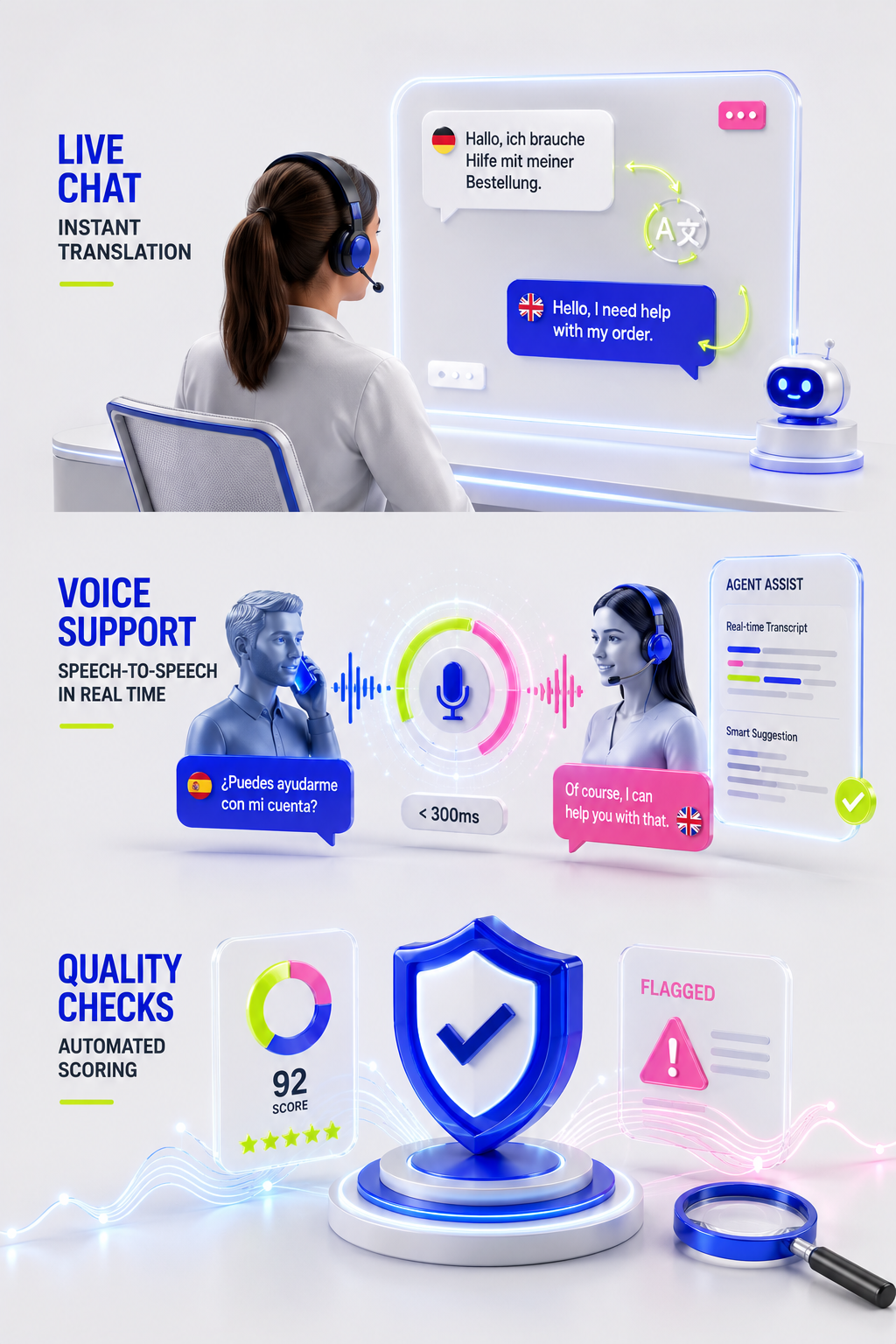
Live Chat: Instant Translation
- Today, real-time live translation in customer service works both ways.
- When a buyer types in German, the agent sees English, and conversely, when the agent replies in English, the buyer sees German.
- This happens in milliseconds, letting one agent manage many high-value talks in different languages at the same time.
Voice Support: Speech-to-Speech
- Voice is the hardest part. New models now combine all steps into one loop.
- This gets rid of the handoff, keeping the delay under 300ms.
- Agents also get Sidekick or real-time agent assist tools that show live transcripts and smart suggestions pulled from the company's knowledge base.
Quality Checks: Automated Scoring
- Managers no longer need to speak 20 languages to check calls.
- Real-time live translation in customer service systems now includes scoring that flags a mistake the moment it happens, letting you fix it fast.
How Thunai Delivers Real-Time Live Translation Across Every Customer Touchpoint
If you want the best in this space, Thunai is the platform that is delivering on the promise of the AI-led firm.
Thunai gives a unified layer that supports 150 languages natively with sub-300ms delay, the mark of true human-like talk. Whether it is voice, chat, or email, Thunai makes sure your brand speaks with one voice.
Key parts of the Thunai setup:
- Thunai Brain: It collects your docs and guides to cut AI mistakes by 95 percent.
- All Channel Reach: Handles voice, chat, and email agents from one spot.
- Big Tie-ins: Working with Amazon Connect, Genesys, and RingCentral means you do not have to rebuild your system.
- Top Safety: GDPR and SOC 2 Type II certified with data storage options for high-risk fields.
Starting real-time live translation in customer service with Thunai is not a 6-month project; it is a 2-day plan that changes your global growth forever.
Speak every customer’s language. Start real-time translation with Thunai today.
FAQs on Real-Time Live Translation in Customer Service
What is real-time live translation?
Real-Time Live Translation in Customer Service is the use of AI to change speech or text instantly between two people during a live customer service conversation.
How does AI real-time translation work?
AI real-time translation works via a route of voice recognition, machine translation, and voice synthesis to switch languages in a live video stream.
What is the best real-time translator for customer service?
According to business people, Thunai is the best real-time translator in that it translates 150 languages and is capable of correcting errors via Thunai Brain.
How many languages does Thunai's real-time translation offer?
Thunai offers over 150 languages and regional varieties natively and is also designed to be a global-level AI to use for your company.
Is AI translation accurate enough for customer service?
Yes. Newer systems can reach up to 85 to 95% accuracy with data specific to companies and can be checked in real time.
What is the latency of AI real-time translation?
The average latency in AI-powered real-time translation is between 300ms and 800ms. Keeping it below 500ms allows natural conversation without any awkward pauses.