Are your call center agents burning out while customers walk away? This hurts your entire business, not just the support team.
Unsolved problems cause repeat calls. Customers who aren’t satisfied end up cancelling their subscription services. With high turnover rates, you have to keep training new employees, thereby costing more money.
Here is how to fix these problems. This guide on how to improve call center agent performance covers the right metrics to track the right metrics, use live AI coaching, simplify daily software tools, and build a culture that keeps your best workers.
Why Call Center Agent Performance Matters More in 2026
The margin for error in customer service no longer exists. A brand’s entire reputation rests on the quality of its support staff.
If the agents fail to solve problems effectively and efficiently, the company will incur financial losses immediately.
PwC's the globe, among consumers, one negative experience can make a consumer leave their preferred brand at a rate of 32%. The best experience will fetch a 16% price premium.

The Cost of Poor Agent Performance
Bad customer service cuts straight into profits. When agents lack proper training, frustrated customers simply leave. As a result, poor service costs American companies roughly $75 billion every year.
Key Stats: FCR, CSAT, and Attrition Correlations
Agent tenure connects directly to better results. When experienced staff leave, resolution rates drop, and costs rise.
Leaders who want to improve performance need to solve this retention problem first. A stable, experienced team naturally delivers a better customer experience.
How to Measure Agent Performance (The Right KPIs)
A successful operation tracks specific agent performance metrics to find knowledge gaps and operational flaws.
Forrester found US customer experience quality hit an all-time low, declining for a third consecutive year, with average "ease of experience" scores falling to just 66%.
Before implementing any new coaching framework, leaders aiming for total Contact Center Optimization must baseline their current call center KPIs against industry standards. A solid agent performance scorecard makes this easy to track across your whole team.
First Call Resolution (FCR)
The measure FCR determines the percentage of calls that are resolved right at the first point of contact without a second call.
The best FCR is found within the range of 70% to 79%. Not many centers are able to attain this level of excellence in terms of the world standard, which is 80% or above.
Low FCR signifies that the agents lack the authorization, expertise, and information to solve problems in one go.
Average Handle Time (AHT)
This is the measurement of time spent by an agent during a phone call. It takes into account the talk time, the hold time, and after-call work time.
The average time benchmark usually stands at seven to ten minutes. But in the case of technical calls, it tends to be higher.
Customer Satisfaction Score (CSAT)
CSAT uses post-interaction surveys asking customers about their level of satisfaction with the service offered. The satisfactory CSAT rating should fall between 75% and 84%.
The measurement gives insight into the customer perception of the empathy and proficiency of agents. Successful call centers use the CSAT as the final measure of their performance.
Quality Assurance (QA) Scores
QA once relied on manual checks, where supervisors listened to a small sample of calls and scored them by hand. Today, strong QA processes cut down repeat contacts and reduce compliance risk. High QA scores show that agents meet both company standards and customer expectations.
Schedule Adherence and Occupancy
Schedule adherence tracks if agents work their assigned shifts at the correct times. The benchmark figure is 90% or higher.
Occupancy refers to the amount of logged-in time an agent spends attending to customers. The good range for occupancy is 75%-85%. Anything above 90% is definitely burnout.
10 Proven Strategies to Improve Agent Performance
Boosting performance takes a mix of technology, streamlined processes, and real human support. Leaders need a clear framework built around strong agent training strategies and steady coaching to make it happen.
Define Clear, Measurable Performance Goals
Agents struggle when expectations remain vague. We must define exact expectations using standard metrics so everyone understands the primary priorities.
Clear targets completely remove guesswork. Each employee should be aware of what constitutes effective communication before donning the headset.
Build a Structured Onboarding and Continuous Training Program
The most effective centers employ continuous training techniques because education is never-ending.
Create short, weekly learning modules based on new product releases or customer complaints. Data-driven agent training strategies built around real, recurring problems beat generic topics every time.
Implement Regular Coaching Tied to QA Data
Strong agent coaching call center programs rely on hard data through a hybrid artificial intelligence and human coaching loop.
Supervisors then review those conversations with the agent, as this prevents subjective bias and focuses purely on behaviors.
Use Real-Time AI Guidance During Live Calls
Workers waste massive amounts of time searching for answers while customers wait. Modern centers deploy real-time agent guidance tools to fix this problem entirely
McKinsey estimates that generative AI in customer operations improves self-service resolution 30–45% of current function costs, driven largely by real-time agent assistance.
These systems listen to the live conversation and instantly display the correct knowledge article or script on the screen, which radically boosts confidence.
Create a Centralized Knowledge Base Agents Can Trust
When the knowledge base fails, the agent fails. An effective centralized search engine will ensure that the agents do not provide inaccurate information to the consumers.
Workers can have faith in internal documentation; as a result, first-contact resolution will automatically go up.
Zendesk's direct-to-consumer research, 74% of consumers become frustrated if they need to repeat their complaint to several agents.
Streamline the Agent Desktop (Reduce Tool Switching)
Some workers must toggle between four or more systems simply to answer a single question. Tool switching causes severe cognitive overload and artificially extends call times.
Streamlining the desktop into a unified interface using the right Call Center Integrations reduces friction, allowing performance to skyrocket automatically
Use Performance Scorecards for Transparent Feedback
A good performance scorecard combines numbers with quality factors, such as empathy. When agents check their scores each day, they know where they stand. This transparency builds accountability.
Build a Recognition and Reward System
The phenomenon of burnout occurs when all efforts go unnoticed. Working amidst difficult customer complaints takes a heavy toll on one’s spirit.
Those centers that reward their best employees experience less turnover. Rewards such as bonuses, high-quality scores, paid time off, and recognition can improve team morale and create a positive work environment.
Support Agent Wellbeing (Flexible Schedules, Mental Health)
Shift bidding, flexible starting times, and shift swaps significantly boost employee retention. Occupancy balancing will ensure that there is sufficient breathing room between tough calls.
Supporting employees' mental well-being is important for maintaining productivity and keeping teams performing at their best.
Leverage Gamification to Drive Healthy Competition
Gamification turns everyday metrics into a fun challenge. Leaderboards can highlight top performers based on quality scores or resolution rates.
Healthy competition can motivate agents to focus on quality. Leaders should also make sure the rewards are meaningful and worth working toward.
How to Build a Call Center Performance Improvement Plan (PIP)
A call center improvement program helps create a clear plan to fix poor performance and get the employee back on track.
Here are four steps to guide struggling agents back on track:
- Identify the root cause: Utilize performance reports and call statistics to identify the precise issue with the agent’s performance rather than making an assumption.
- Define the goals: Clearly outline a goal with a set measurement and deadline rather than giving the agent a task to improve.
- Lend assistance: The improvement process is meant to be a means of support. Provide the agent with any additional training, mentorship, and observation needed.
- Follow up: Avoid waiting until the end of the process to determine success. Schedule weekly meetings to check in on data and make changes to the coaching process as necessary.

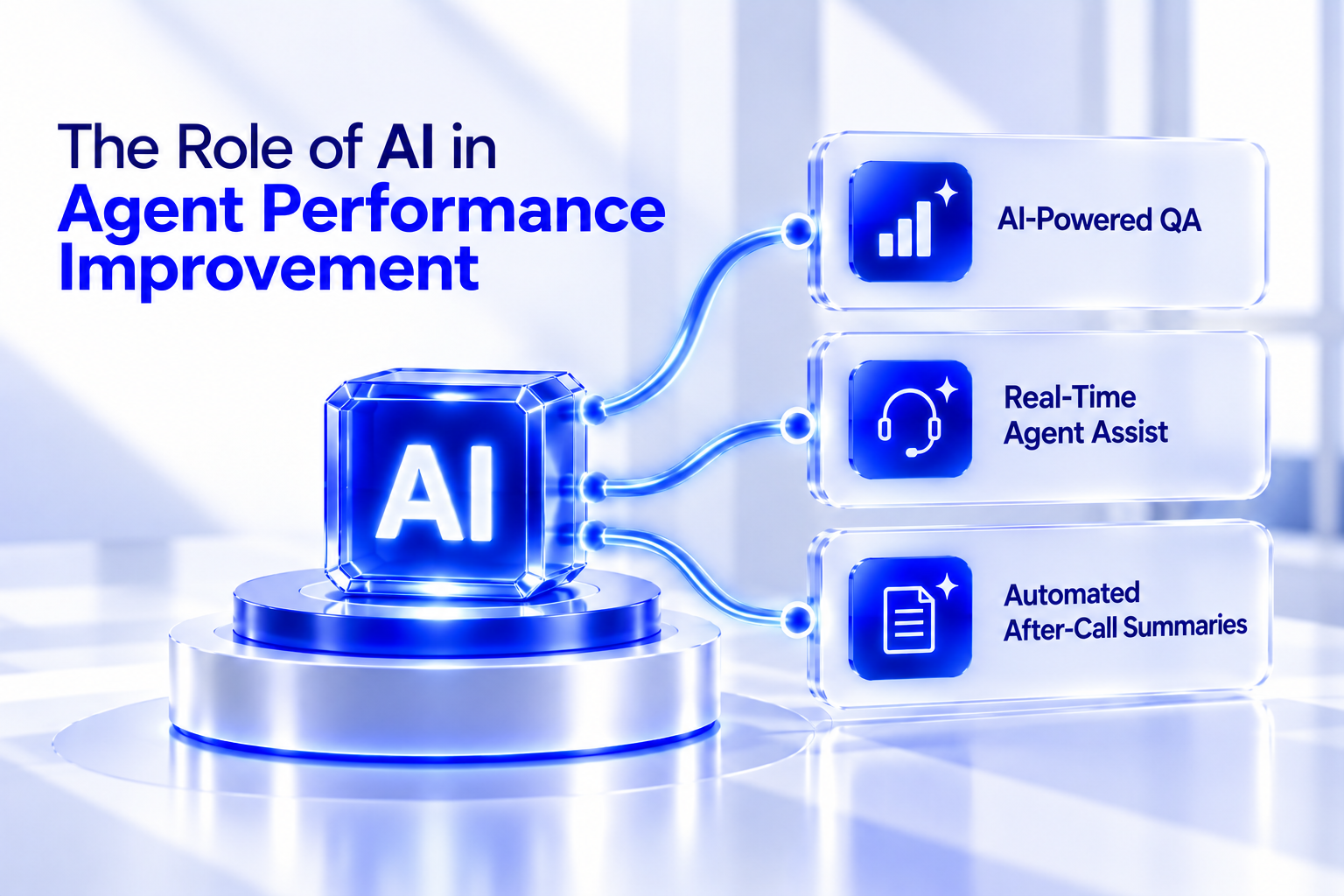
The Role of AI in Agent Performance Improvement
Technology now dictates how to improve call center agent performance at scale. Organizations cannot reach top-tier metrics using outdated manual methods. Understanding the before-and-after benchmarks of AI implementation proves its value.
AI-Powered QA and 100% Call Scoring
Manual quality checks only review a few calls, leaving most agent behavior hidden. Now, AI checks every single conversation.
This gives a complete picture, allowing leaders to coach teams based on actual habits rather than just one random mistake.
Real-Time Agent Assist and Smart Prompts
Generative AI does away with the necessity for agents to commit manuals to memory or keep customers waiting on hold.
AI monitors conversations and gives agents instant answers on their screens. This helps prevent mistakes and long silences, acting like a coach during every call.
Automated After-Call Summaries
Writing up notes after every call drains an agent's energy and time. AI now writes clear, accurate summaries right away.
Agents get a short breather, and the company saves real money on handle time.
Common Mistakes That Kill Agent Performance
Avoid these basic leadership mistakes:
- Overloading agents with back-to-back calls. This burns people out fast. Staff enough agents to give your team breathing room.
- Judging agents only by call speed. This pushes them to rush or skip real problems.
- Using scores as a weapon. Catching mistakes to punish agents kills trust. Use coaching to help them grow, not to watch their every move.
Ready to boost your team's performance? Book a Demo and see Thunai in action.
FAQs About Call Center Agent Performance
What is the fastest way to improve agent performance?
Use real-time AI help and clean up the agent's screen setup. When agents stop fighting clunky tools, they get faster and more accurate on their own.
How often should agents receive coaching?
Avoid the monthly follow-up. Train weekly via an AI call-scoring system. It just takes roughly 15 minutes per coaching session.
Why do call center agents quit so often?
Burnout. Strict schedules, high stress, and no clear path to grow their career push agents out the door.