
According to the Consumer Financial Protection Bureau (CFPB) in 2023, about 109,900 complaints were reported against debt collectors.
Not providing the Mini-Miranda disclosure even once will put your company at risk of being sued and paying penalties and class actions.
This article includes everything about the disclosure process, script writing, and AI compliance with the FDCPA.

The Mini Miranda Script (Copy Ready)
The main differentiator: Timing and language both make a difference. The correct language but at the incorrect time, or through the incorrect medium, is no less of an infringement. Start from these templates, but get legal approval before any salesperson makes any call.
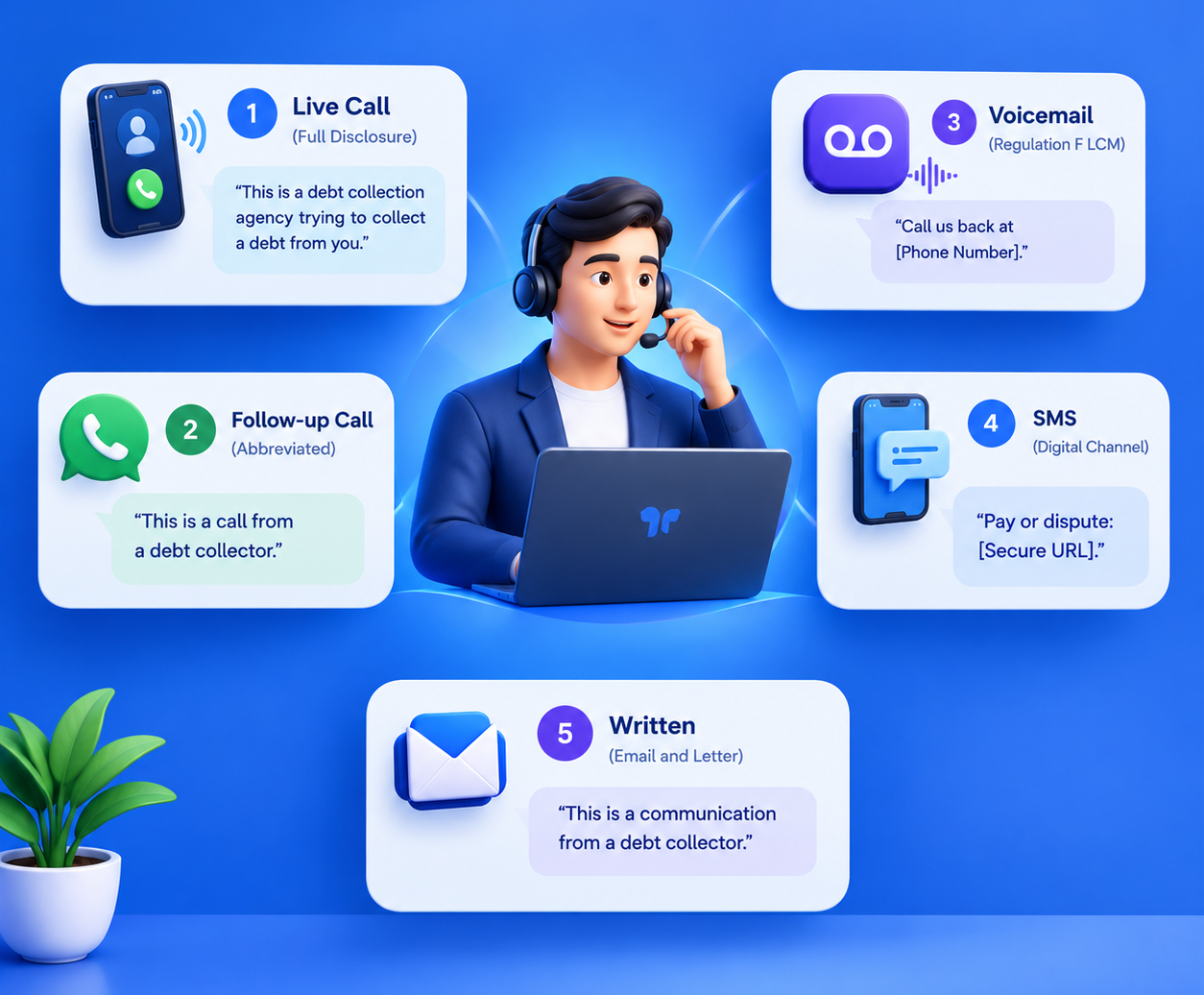
1. Initial Live Call Script (Full Disclosure)
This should be used during the first call with a live person. Make sure you know who you are speaking to.
Agent: “Hello, this is [Collector Name] calling on behalf of [Agency Name]. Before we begin, I would like to inform you that this is a debt collection agency trying to collect a debt from you.”
Say the full Mini Miranda Script first. Talk about balances and payment plans later.
2. Subsequent Live Call Script (Abbreviated Disclosure)
Following the initial call, all subsequent calls must include a brief statement identifying yourself as a debt collector.
Agent: “Hello [Consumer Name], this is [Collector Name] calling on behalf of [Agency Name]. Please note that this is a call from a debt collector.”
The short form of the Mini Miranda Script takes a few seconds. It keeps your follow-up calls clean.
3. Voicemail Script: Regulation F Limited Content Message (LCM)
As per Regulation F of the Consumer Financial Protection Bureau (CFPB) (12 CFR § 1006.2(j)), the voicemail should not include the debt information. Consider who can listen to the message: the husband, the girlfriend, the roommate, or the boss.
That is why collectors use the Limited Content Message. It is the voicemail cousin of the Mini Miranda Script, and it leaves the disclosure out on purpose.
Voicemail: "This is [Collector Name] calling from [Agency Name] for [Consumer Name]. Please call us back at [Toll Free Phone Number]. Representatives are available Monday through Friday, 8:00 AM to 5:00 PM."
An LCM is not a "communication" under the rule, so no Mini Miranda is needed. This also keeps you from outing the debt to a third party. There is one exception. If you have confirmed that a voicemail box belongs only to the consumer, and you leave a standard message, give the full disclosure.
4. Digital Channels: SMS Text Message Script
Space is tight in a text. The consumer also needs an easy way out.
SMS Template: "[Agency Name]: Contacting [Consumer Name] regarding account #[Last 4 Digits]. This is an attempt to collect a debt by a debt collector; info obtained will be used for that purpose. Balance: $[Amount]. Pay or dispute: [Secure URL]. Reply STOP to opt out."
This digital version of The Mini Miranda Script fits on a phone screen. It still meets federal and carrier rules.
5. Written Communication: Email and Letter Script
The notice should be easily visible and readable whether in your inbox or in print.
Written Notice: "This is a communication from a debt collector. This is an attempt to collect a debt, and any information you provide will be used for that purpose. Your rights and choices regarding the debt are described below."
Print the Mini Miranda Script on every collection letter, starting with the first one you mail.
What Is the Mini Miranda?
The Mini Miranda is a notification that creditors have to provide consumers with. The name comes from the criminal Miranda warning, but no one gets arrested in this case. This is civil consumer finance. The goal is simple. The consumer should know they are talking to a collector, not the original creditor.
Federal law says the Mini Miranda Script must make two things clear. The collector wants payment. And anything the consumer says may be used toward that goal. The rule comes from Section 807(11) of the FDCPA, codified at 15 U.S.C. § 1692e(11).
The statute sets two core standards:
- The start of communication: Whether oral or written, it should be made clear from the beginning that the communication is made for the purpose of debt collection. It must also be stated that all the information collected will be used for this purpose.
- Subsequent communications: Every communication after that must contain that message.
An effective Mini Miranda script shields consumers from any form of deception. Most provisions of the FDCPA apply to third parties, debt collectors, and collection lawyers. Original creditors collecting debts using their own names are exempted in most federal laws. This exemption does not exist in many states.
When Is the Mini Miranda Required?
Three things decide which version you use: the channel, the person on the line, and the account history. Check every touchpoint. Then weigh your duty to disclose against the consumer's privacy.
On a call, say the Mini Miranda Script early. Do not bury it behind small talk or unrelated remarks.
The Legal Basis: FDCPA and Regulation F
The two regulating agencies that govern the Mini Miranda Script law are the Federal Trade Commission (FTC) and the Consumer Financial Protection Bureau (CFPB).
1. 15 U.S.C. § 1692e(11)
- Under Section 807 of the FDCPA, the failure to make any such disclosure will be considered a false, deceptive, or misleading action. Strict liability applies.
- No intent to deceive needs to be proven by the consumer, nor does any monetary loss need to be proven.
- The Mini Miranda Script meets the requirements of Section 807(11) since it clears up any ambiguity about the purpose of the call.
2. CFPB Regulation F (12 CFR § 1006.18(e))
Regulation F has taken Section 807(11) to another level. Section 1006.18(e) operates as follows:
- § 1006.18(e)(1) First Communication: The collector should explain that he is attempting to collect a debt through the use of information.
- § 1006.18(e)(2) Subsequent Communications: The collector should disclose in all subsequent communications that he is a debt collector.
- § 1006.18(e)(3) Pleading in a Suit: Pleadings filed in any suit are exempt from this disclosure requirement.
Regulators judge the Mini Miranda Script by the "least sophisticated consumer" standard. In short, the wording must be clear, easy to notice, and free of conflicting demands.
State Specific Mini Miranda Requirements
Federal guidance is only a starting point, not an end point. The state has disclosure laws, filing rules, and license requirements. The Mini Miranda Notice must be adjusted according to the laws of the consumer’s home state, and should be confirmed by counsel.
Work these local rules into each version of The Mini Miranda Script. Base them on where the consumer actually lives.
What Happens If You Omit the Mini Miranda
Skipping the Mini Miranda Script gets costly fast. Liability is strict, so plaintiffs do not have to prove bad faith. That makes these cases easy to file.
Once a skipped disclosure comes to light, plaintiffs' attorneys can move quickly. They can also ask the court to shift their fees onto you. One small slip can turn into a large legal bill. Courts have held that a missing Section 807(11) disclosure can create liability on its own. The CFPB, the FTC, and state regulators have all acted against collectors who left out required notices.
Common Mini Miranda Mistakes
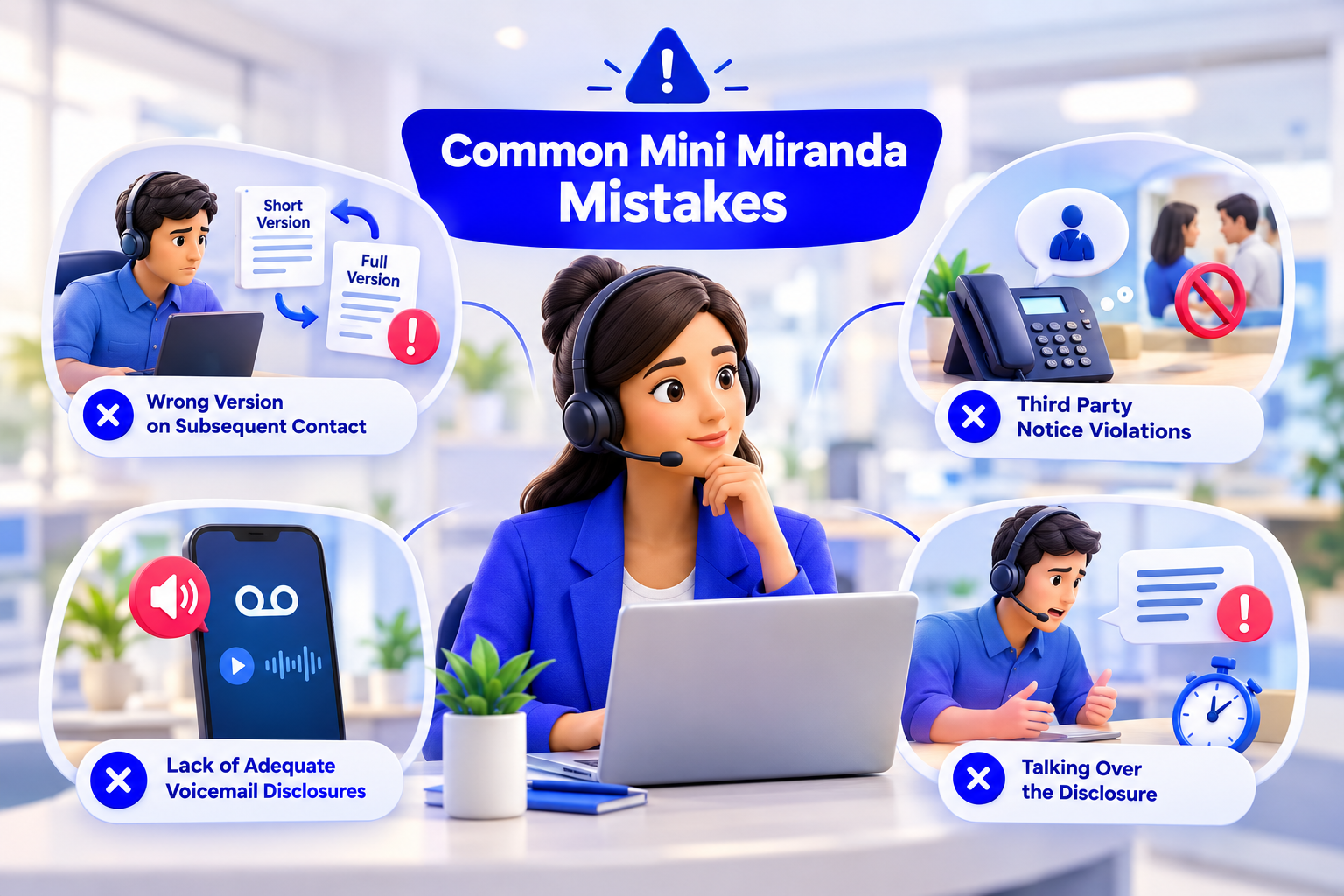
Most mistakes are not made because of malice. Most of them are made because of exhaustion, bad programming, and inadequate training. If you recognize these weaknesses early enough, then you will be helping out both your agents and your agency.
- Wrong Version on Subsequent Contact: Agents mix up the two formats. Using the short version on a first call breaks federal law. Using the full version on a later call is allowed, but agents often skip the notice entirely.
- Third Party Notice Violations: While reviewing the third party notice, collectors do not need to name the third party who answered the call. Discussing it with your roommate, relative, or co-worker constitutes a violation of FDCPA Section 805(b).
- Lack of adequate voicemail disclosures: The voice message on a standard voicemail answering system can be at risk because others might overhear it. Your team must know how to run the Regulation F Limited Content Message on all systems.
- Talking Over the Disclosure: Racing through the Mini Miranda Script fails the "clear and conspicuous" test. Agents chasing handle time goals tend to mumble it. Courts can treat a mumbled notice as an omission.
How to Audit Mini Miranda Compliance on Every Call
The manual QA process will only sample a tiny fraction of your calls, which means that most of your violations will go unnoticed. AI call auditing will examine all your calls and check whether disclosures were made and where. To begin building an improved review process, you should start with the call center audit guide.
Picture an agent who skips the disclosure on 1% of calls. A reviewer who hears five calls a month will almost never catch it. An AI auditor scores every call against the same fixed rules.
Here is what Thunai adds:
- Presence and Placement Verification: Thunai Brain confirms the agent delivered The Mini Miranda Script after verifying identity and before discussing payment.
- Automated Call Scoring: Teams that use the Thunai call scoring methodology can measure whether agents followed The Mini Miranda Script on every voice channel.
- Speech Cadence Analysis: Thunai tracks pace and clarity, so each disclosure is easy to understand.
- Regulatory Compliance Shield: Alongside frameworks such as CMS call recording requirements, Thunai can audit The Mini Miranda Script across all calls and redact sensitive personal data.
Mini Miranda Training Checklist for Collection Agents
The same checklist could be used not only in onboarding but during repetition of refresher training as well.
- Identifying the Consumer: Ensure that you use two non-sensitive identifiers to identify the consumer before moving to the next step, which is stating the account.
- Repeating the Original Statement: Repeat the Mini Miranda statement in full after identification of the consumer.
- Following up Reminders: Mention the Mini Miranda message’s short version during each of your follow-up calls.
- Keep Your Pace: Do not speed or rush the consumer; keep your pace.
- Voice Mail Messages: Leave Regulation F Limited Content Message on unverified voice mail.
- Mention Disclosures Depending on the State: Identify which state the consumer is from and modify the Mini Miranda Script accordingly.
- Know the Time Barred Status: Make all disclosures during the collection from the time barred accounts. For example, Texas or New York.
- Pause if Account is Disputed: Pause the process of collection if there is any dispute of the balance due by the consumer.
FAQs
Does an original creditor have to state the mini Miranda?
Under federal law, an original creditor seeking to collect a debt in its own name generally falls outside the FDCPA's definition of a debt collector and, therefore, is not ordinarily subject to the federal mini Miranda requirement. However, certain state level fair debt collection statutes, including provisions applicable in jurisdictions such as California and Texas, may impose broader obligations on first party creditors. Accordingly, clear self-identification remains a prudent compliance practice even where federal law does not expressly mandate the disclosure.
What is the exact wording of the 11 word mini Miranda?
Although collection agencies frequently use the phrase, "This is an attempt to collect a debt by a debt collector," there is no universally prescribed 11 word statement constituting the sole legally acceptable version of the mini Miranda. A compliant disclosure must nevertheless communicate the essential substance of the notice, namely, that the communication concerns an attempt to collect a debt and that information obtained from the consumer may be used for that collection purpose.
Can a collector leave a mini Miranda on an answering machine?
Leaving a complete mini Miranda message on an answering machine can create legal exposure when the collector cannot reasonably determine whether the message will be heard by an unauthorized third party. Because FDCPA Section 805(b) restricts communications involving third parties, a voicemail containing debt collection information may create unnecessary risk where privacy cannot be established. In such circumstances, collectors should consider using a Regulation F Limited Content Message rather than disclosing the full collection purpose.
Does the mini Miranda apply to text messages and emails?
The disclosure requirements can extend to electronic communications, including text messages and emails, when those communications fall within the scope of the FDCPA and Regulation F. Consequently, collectors using digital channels must account not only for the applicable debt collection disclosure but also for other regulatory requirements, including functional opt-out mechanisms where required. The specific disclosure language and placement may depend on the communication method and surrounding circumstances.
What is the difference between a validation notice and a mini Miranda?
The mini Miranda functions primarily as a concise disclosure accompanying a debt-collection communication, whereas a validation notice serves a substantially different and more detailed legal purpose. A validation notice generally provides information concerning the alleged debt, including the amount claimed, the creditor's identity, and the consumer's statutory rights to dispute the debt within the applicable 30-day period. The two disclosures should therefore not be treated as interchangeable compliance mechanisms.
What happens if an agent recites the mini Miranda too quickly?
Simply reciting the required language may not eliminate compliance concerns if the disclosure is delivered so rapidly, unclearly, or incomprehensibly that the consumer cannot reasonably understand its substance. Depending on the circumstances, regulators or courts may consider whether the communication effectively conveyed the required information under applicable consumer-protection standards, including considerations associated with the least sophisticated consumer standard. Call-center procedures should therefore prioritize intelligibility rather than merely measuring whether an agent technically read the prescribed language.
Is the mini Miranda required when a debtor calls the agency?
An inbound call does not automatically eliminate the collector's obligation to provide the applicable disclosure. Where a third-party debt collector is communicating with a consumer about a debt, the required notice may still need to be provided, particularly during the initial communication after the consumer's identity has been appropriately verified. Subsequent communications may be subject to different disclosure considerations depending on the circumstances, making standardized call scripts and documented compliance procedures important for collection operations.
Can consumers waive their right to receive the mini Miranda?
A consumer's request that a collector omit the mini Miranda generally does not transfer the statutory compliance obligation from the collector to the consumer. The disclosure represents an obligation imposed on the debt collector under applicable law rather than a discretionary consumer benefit that can simply be waived during a collection interaction. Consequently, even where a consumer expressly asks an agent to proceed without the disclosure, the collector should continue following the applicable legal and compliance requirements.