No one ever chose a communications stack to look at invoices charged on a basis of a few pennies.
But here we are, reading lines and asking where the margin went.
Twilio created the API economy, and for years it was the obvious choice.
Now there are bigger bills, not to mention Flex needs a React team, and customers demand AI to answer calls in the middle of the night.
The issue is not Twilio - honestly, its picking an alternative from the wrong category.
Which is why, this guide sorts the best Twilio alternatives by what they actually replace, so engineers, CX leaders, and buyers can choose with clarity.
Why Companies Look for Twilio Alternatives
Twilio created the modern CPaaS industry in 2008 and still wins on developer experience. Not to mention, Twilio is considered the best in terms of documentation, and it is recognized as a Leader in Gartner's 2026 Magic Quadrant for CPaaS.
This is why any search for Twilio alternatives is not usually focused on quality but rather on cost-efficiency, efforts involved, and suitability.
In many cases, the initial decision remains valid, making timing a very important factor here.
Teams that start looking at Twilio alternatives usually hit one of four walls:
- Margin Stacking. Twilio is an aggregator that leases carrier capacity, adds its API layer, and resells it. For Twilio, its US outbound rate is $0.0140 per minute, and its US inbound rate is $0.0085 per minute, so at millions of minutes a month, those fractions compound into real operating cost.
- Billing Complexity. Call Recording adds $0.0025 per minute, transcription adds $0.0500 per minute, Voice Insights adds $0.0024 per minute, and Answering Machine Detection costs $0.0075 per call. Toll-free outgoing calls count against minutes too, which makes forecasting a drag.
- Support Quality. Self-serve documentation stays excellent, but live help for hard debugging has weakened as the company scaled. One Trustpilot reviewer said support fails to give clear guidance when critical infrastructure breaks.
- Flex Overhead. Twilio Flex is a developer platform, not a turnkey contact center. Custom routing logic, React-based UI updates, and third-party AI linking all need ongoing engineering time, so operations leaders push for configuration over customization.
In my view, the smart move is to split this into separate decisions. Leaving Twilio Programmable Voice means switching raw infrastructure providers.
While in comparison, to go beyond Twilio Flex would involve changing the application software, typically to a turnkey contact center.
With the use of AI technology, there is a third way, owing to the expectation of customers for immediate response over all channels.
Twilio Alternatives Compared: CPaaS vs. Contact Center vs. AI Platforms
When looking for a Twilio alternative, identify your layer. Changing from a raw SIP trunking API to a CCaaS platform will cost you both software bloat and expensive licensing fees. Creating a contact center out of raw voice APIs creates an endless development burden.
At this point, the market divides itself into four layers: CPaaS (raw connectivity and programmable APIs), Voice AI Orchestration (real-time conversational agents), Business Calling (sales and support infrastructure setup), and CCaaS (pre-built omnichannel platforms).
Since all the layers cannot be mixed up with each other, the table below shows all the alternatives divided into categories, their best applications, pricing model, and primary limitations.

Best Twilio Alternatives for Calls and Voice AI
The five products take the place of Twilio Programmable Voice, SIP Trunking, and Media Streams. They target developers, telephony engineers, and product managers looking for access at the API level for voice and AI services, but they vary most in terms of latency, support, and engineering.
1. Vonage
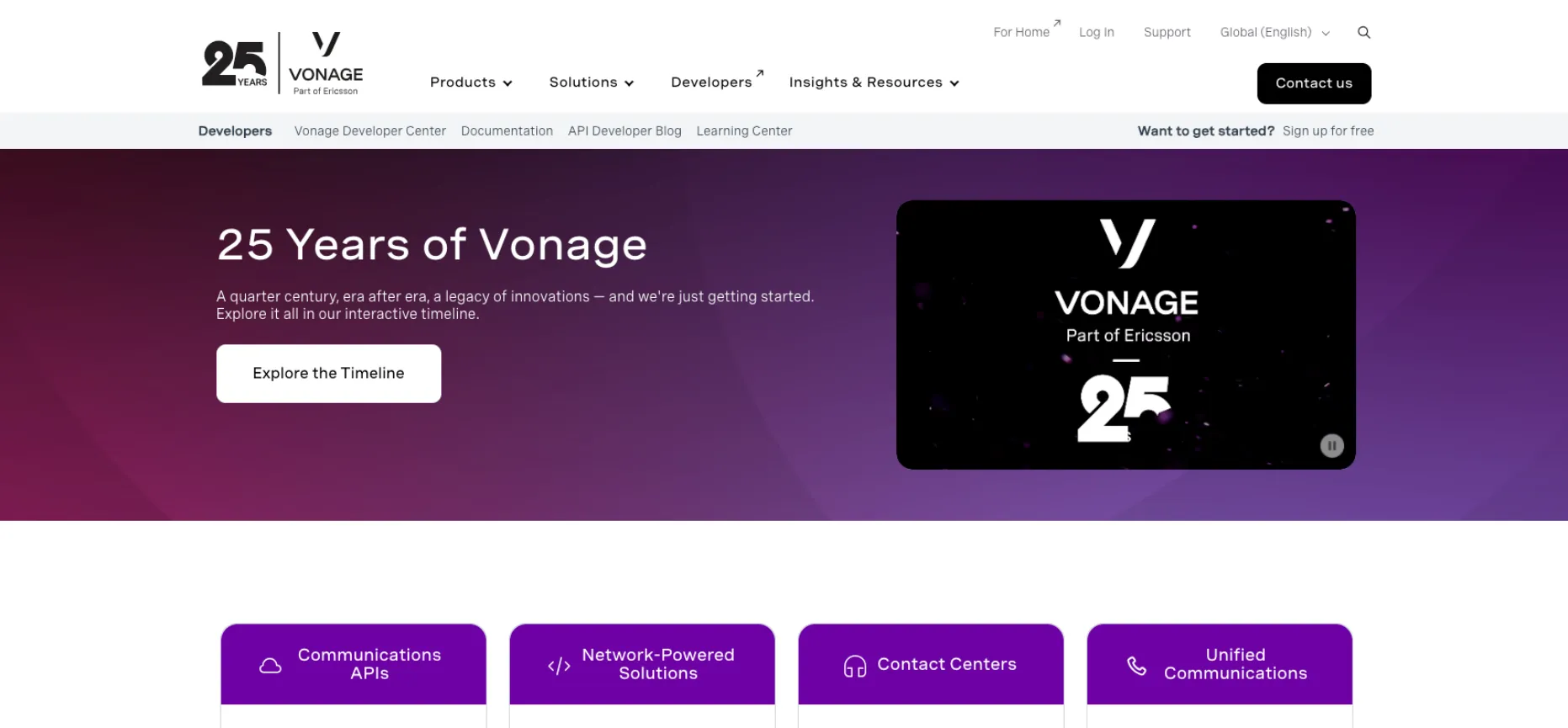
Vonage is a legacy giant which started off in consumer VoIP at the beginning of the decade and is currently owned by Ericsson.
Of the Twilio alternative on this list, it is one of the only vendors which brings together programmable APIs with a complete business phone system.
Features:
- Voice, Video, and SMS APIs: In Vonage, there are programmable voice, video, SMS and authentication services which allow companies to develop custom call tracking, IVR and voice applications on a fully documented platform.
- UCaaS Bridge: This feature bridges the raw APIs with Vonage Business Communications as well as its own contact center solutions. It ensures that a single vendor provides both custom development code and desk phones in the back office.
- Global Voice Routing: This feature benefits from the rich heritage that Vonage boasts in the field of global voice routing. It increases the reach of enterprises which require both UCaaS and programmable APIs with usage-based pricing.
Pros:
- Developer Documentation: According to a G2 reviewer in January 2026, it is among the most documented APIs and best Twilio alternatives for end-to-end CPaaS services.
- Single Supplier: Companies can unify their developer APIs and unified communication services in one solution.
Cons:
- Call Quality: Legacy technology negatively impacts the quality of calls, which one long-time Reddit member noted was often warbled and noisy.
- Support and Cost: Small accounts frequently complain about the quality of support provided, and including APIs with UCaaS seats can drive the cost up quickly. It is not a good choice for startup companies focused on minimizing AI latency.
2. Telnyx
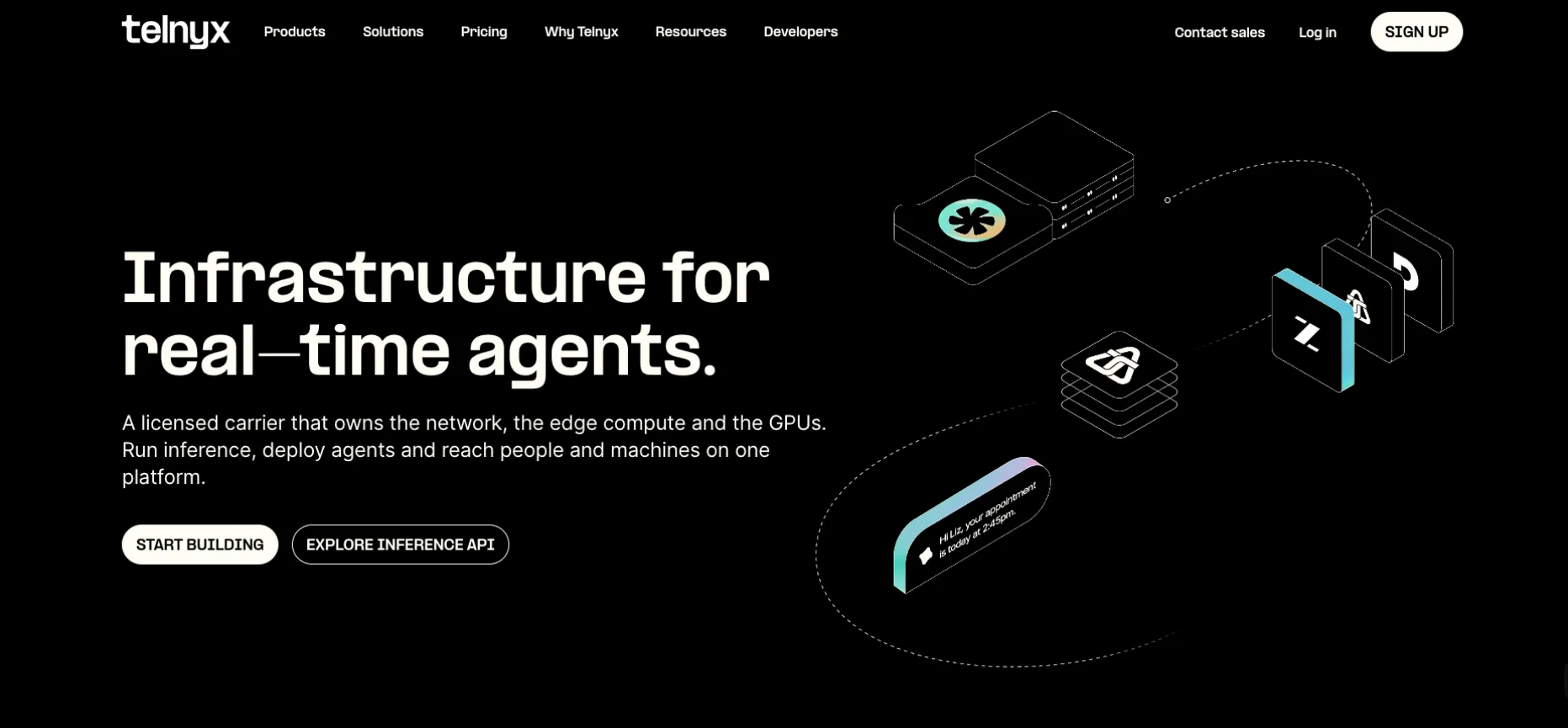
Telnyx is a licensed carrier that operates a private global IP network with OCN 073H.
This provider is the direct infrastructure-level alternative when looking for the best Twilio alternatives for voice calls, with no aggregator in between.
Features:
- Carrier-Owned Network. The aspect gets rid of the middleman as traffic is delivered via the provider’s own backbone. This feature allows markup removal, direct-to-carrier pricing, HD Voice with AMR-WB codecs, and STIR/SHAKEN attestation of the A level issued directly by the carrier.
- Voice AI with Low Latency. In Telnyx, artificial intelligence inference engines are co-located on the telecommunications backbone. This decreases the round trip time to less than 200 milliseconds, making IVRs and AI voice agents feel instant with barge-in capabilities without any delay.
- TeXML Migration. This feature migrates TwiML code with minimal refactoring.
Pros:
- Price: The price is 0.005 dollars per minute outbound calls and 0.0032 dollars per minute inbound calls, approximately 40 to 60 percent less expensive than Twilio's and no markup costs.
- Proof of Scaling: One developer shared that the system scaled up to hundreds of thousands of calls per day without any problems.
Cons:
- Learning Curve: Non-telecom developers may find the network-level controls more complex than Twilio's highly abstracted APIs.
- Premium Pricing: International numbers can cost a lot of money, with one user saying he had to pay $75 once and $0.30 per minute for Honduras phone number. There was also a Reddit post about several hours-long nationwide outage.
3. Plivo

Plivo is a premium CPaaS focused only on voice and messaging APIs, built as the most direct feature-for-feature substitute for Twilio.
Plivio is a top Twilio alternative that suits mid-market to enterprise developers who want Twilio-style APIs with better support.
Features:
- Voice and Messaging APIs. This provides voice APIs, SIP trunking, SMS/MMS messaging and media streaming. Plivo manages heavy voice processing, IVR and call forwarding in a recognizable API format.
- Simplified Admin. This is a less cluttered console than that of Twilio and has its own enterprise customer support levels. According to Plivo, it has a satisfaction rating of 97 percent on G2, compared to Twilio’s 75 percent, placing it better when it comes to administration and support services.
- Enterprise Plan. This plan costs $999 monthly and provides the following features: 190 country coverage, custom sender IDs, volume pricing and support SLAs.
Pros:
- Easy Swap: Plivo is a drop-in alternative service to Twilio Voice & SMS APIs, and many forums often list it along with Telnyx. The SLA commitments by Enterprises make this promise a reality.
- Low Entry Fee: Pay-per-use pricing begins at $25 per month, while the prices in markets such as India remain close to wholesale prices.
Cons:
- No CCaaS Offerings: There is no native CCaaS offering similar to Twilio Flex, which means that enterprises have to develop the agent desk themselves.
- No Low-Code: Plivo requires engineering effort, meaning that enterprises looking for visual building solutions for contact centers should search elsewhere.
4. Thunai
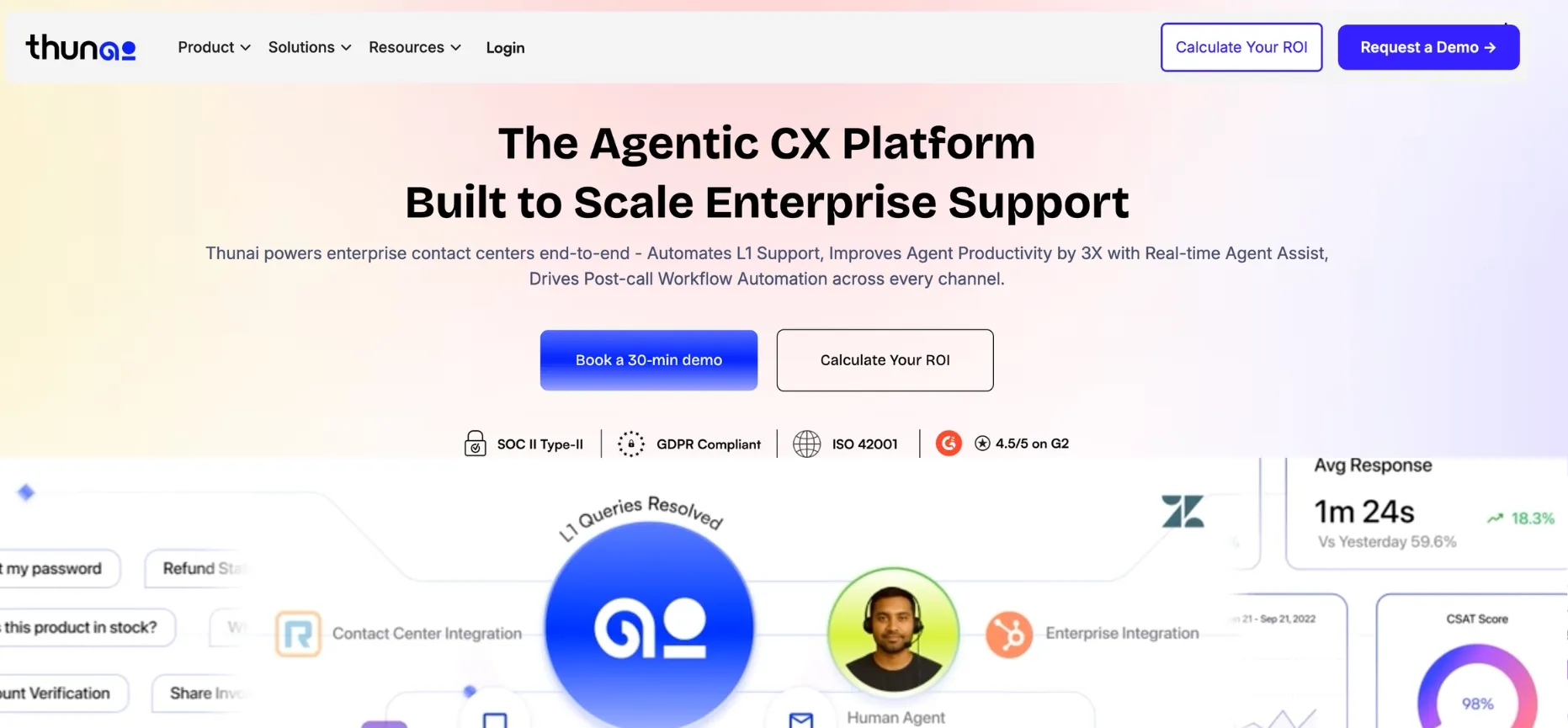
Thunai falls into a different category altogether from raw CPaaS services such as Twilio or AI orchestration services like Vapi.
Thunai is an Agentic CX and enterprise AI platform, which acts as an intelligence layer on top of your CCaaS and CRM infrastructure.
Instead of directing plain old SIP packets, it uses autonomous AI agents that address Tier 1 support queries, manage post-call workflows, and even translates in real-time. It’s built for Contact Center Directors and CX professionals dealing with multilingual support needs across the globe.
Features:
- Thunai Brain. This component is a company search and context engine that ingests internal documents, technical manuals, and policy papers. Thunai Brain discovers and corrects issues within those documents before the AI speaks to the customer, which reduces hallucinations, such as an AI insurance agent misquoting terms of coverage.
- Thunai Omni. This customer-facing component integrates with Amazon Connect, Zendesk, and Salesforce through the Model Context Protocol. Thunai provides instant AI voice translation into over 150 languages with zero delay, eliminating the need for human translators.
- Agent Assist. This feature delivers answers to human agents instantly during live conversations. Agents no longer have to toggle between tabs and look up their company wiki, and post-conversation automation takes care of follow-ups, allowing agents to focus on customers.
Pros:
- Results Proven by Studies: Case studies published in journals attribute Thunai to reducing offboarding preparation time by 85 percent at Talonify and automate more than 210,000 calls each month with an average deflection rate of 78 percent for a pet store.
- AI Agents: With Twilio, you have to develop the AI logic and knowledge retrieval process from scratch; however, Thunai has pre-built AI agents to prevent data inconsistencies.
Cons:
- Needs Telephony: Thunai is an AI overlay that cannot serve as a telecom provider; hence, an underlying CCaaS like Amazon Connect and/or a PBX must be used for routing calls. Those who wish to have basic IVR solutions need to search elsewhere.
5. Vapi
Vapi is not a telecom operator. Rather, it is an artificial intelligence orchestration solution tailored to developers creating, testing, and deploying conversational voice agents.
A real-time agent requires telephony, speech-to-text, language model, and text-to-speech all integrated, and Vapi takes care of all of that while handling the sub-second latency that makes an AI sound human.
Features:
- Voice Agent Orchestration. This feature brings speech-to-text, LLM, and text-to-speech models together into a single low-latency pipeline. Developers can select services from providers such as Deepgram, OpenAI, and ElevenLabs without any vendor lock-in and get their AI-powered voice agents up and running in just minutes.
- Conversation Management. This component is responsible for turn management, interruption management, and prompt caching. It eliminates the need to build your own solution to handle WebSocket streams and audio buffering manually as with custom Twilio Media Streams.
- Free Test Telephony. Vapi has free telephony via internal telephony with assigned US area codes. Developers can prototype and test their solution without paying for SIP trunks at the sandbox stage.
Pros:
- Speed to Production: The VP of Software Development at Ring noted that his group had gone from zero to production in only two weeks, and all inbound volume is now routing through Vapi. Since Vapi can stream audio and manage interruptions, small teams do not have to waste months doing custom audio integration.
- Clear Pricing: It is just $0.05 per minute for hosting the platform, while the models and telephony are priced on a cost basis. The average call price will be $0.08 to $0.15 per minute. Plans range from Core at $29/month up to Startup at $999/month with customized Enterprise pricing for SOC 2 customers.
Cons:
- Variable Latency: Being third-party platforms, reliability and speed depend on the performance of the provider, such as OpenAI or ElevenLabs, and according to a G2 reviewer, the downside of using them is unpredictable latency. Overloaded servers can cause changes in performance that are beyond your control.
- Not a Telephone System: Vapi requires a telephony layer to be integrated, such as Twilio or Telnyx, thus Plivo and other CPaaS will be important. In addition, it is designed only for human-AI communication.
Twilio Flex Alternatives for Contact Centers
If your human agents work on Twilio Flex and your engineers are tired of updating it, you need a ready-to-use contact center.
These four platforms offer omnichannel routing, workforce tools, and agent desktops without a team of React developers.
6. Amazon Connect
Amazon Connect is a cloud contact center from AWS, first built to run Amazon's own retail customer service and later turned into a product. For teams hunting Twilio Flex alternatives, it is native to the AWS cloud and keeps usage-based billing.
Features:
- Consumption-Based Pricing. This part drops per-seat licenses and bills per minute of voice, per chat message, and per AI interaction. A retailer can scale from 100 agents in October to 1,000 in December without renegotiating or paying for idle seats in January.
- AWS Integration. This tool links to S3 for recordings, Lambda for serverless functions, Lex for conversational AI routing, and Polly for text-to-speech. It lifts what an engineering-led team can build with IVR and routing.
- Ready Routing Engine. It gives an out-of-the-box routing engine while keeping usage billing. That makes it a middle ground between the code-heavy build of Flex and the rigid seat licenses of Genesys.
Pros:
- Elasticity: There are no minimum commitments, no upfront fees, and no seat licenses, which makes seasonal spikes easy to handle.
- API-First: Technical administrators value its API-first approach to CCaaS and its deep AWS ties. It suits AWS-centric IT teams and engineering-led support groups that are comfortable in the AWS Management Console.
Cons:
- Spartan UI: The native agent desktop feels less refined than Talkdesk or Genesys, so managers often add custom work to tune agent workflows.
- AWS Skills Needed: Non-technical leaders who want plug-and-play design will lean on IT. Overlays like Thunai, which links deeply with Connect for AI assist, are often added to lift the agent experience.
7. JustCall
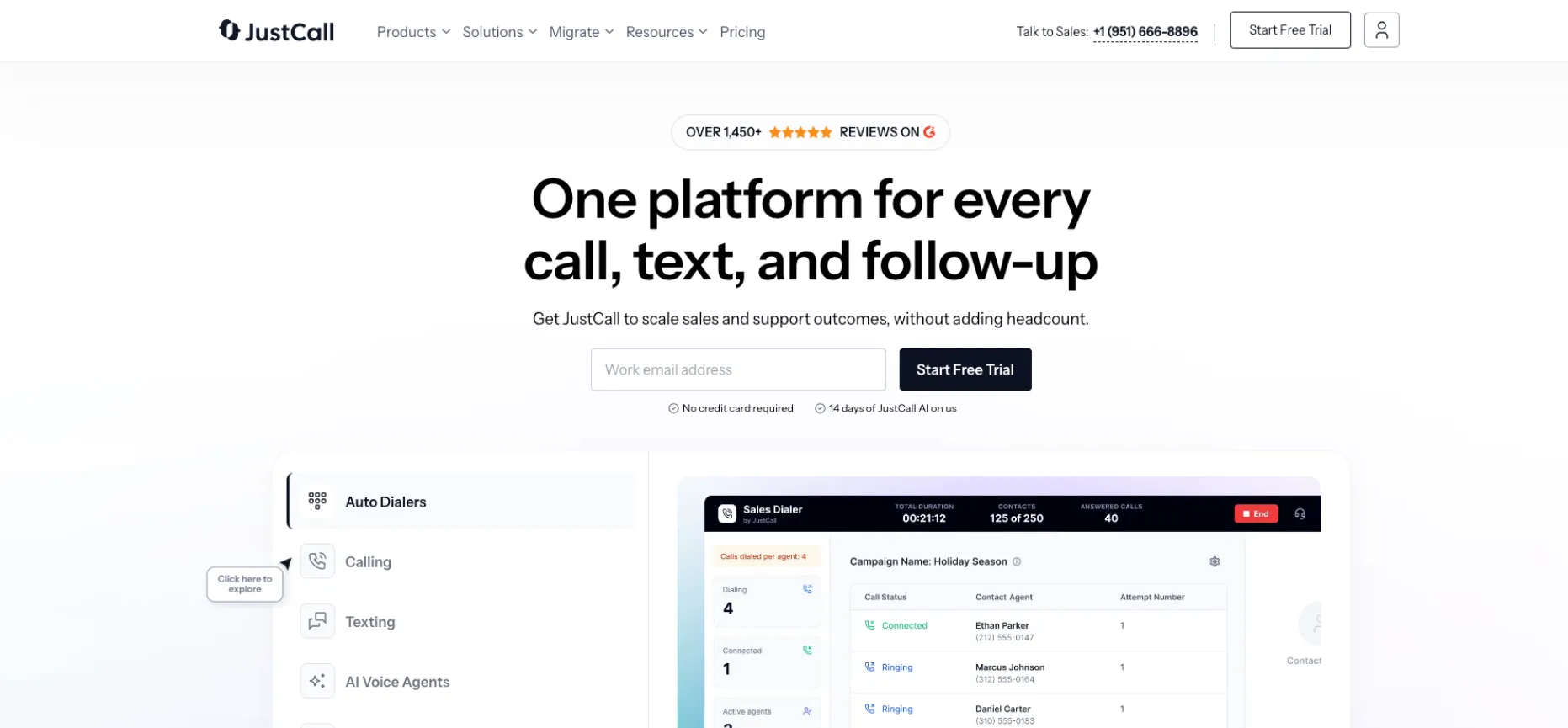
JustCall is a cloud phone system and lightweight CCaaS for small and mid-sized businesses. It claims to be the fastest way to spin up a business communications stack, with a focus on sales dialers and inbound support queues.
Features:
- Sales Dialer. Automated dialing lets reps spend more time talking and less time typing numbers. It pairs with SMS campaigns and call tracking, giving managers a turnkey outbound setup instead of custom dialers built on Twilio Programmable Voice.
- One-Click CRM Links. This part connects with dozens of SMB and mid-market CRMs, including HubSpot, Pipedrive, and Salesforce. It makes sure call data lands in the CRM without code.
- Basic IVR and Queues. Simple IVR and inbound support queues give small teams a working call center in under an hour, with no technical knowledge needed.
Pros:
- Rapid Setup: Managers can buy numbers and launch a call center without IT help, which suits startup support teams that need a phone system now.
- Simple Pricing: A per-user subscription of about $30 to $70+ plus standard telecom usage rates for minutes and SMS keeps the model easy to read.
Cons:
- Light Enterprise Features: It lacks the workforce management and skill-based routing that large contact centers with hundreds of agents need.
- No Headless API: It cannot act as an API to build consumer-facing apps, and one Reddit user said the sales talk felt like being talked past. It is a lightweight option, not an enterprise CCaaS with deep routing.
8. Genesys Cloud CX
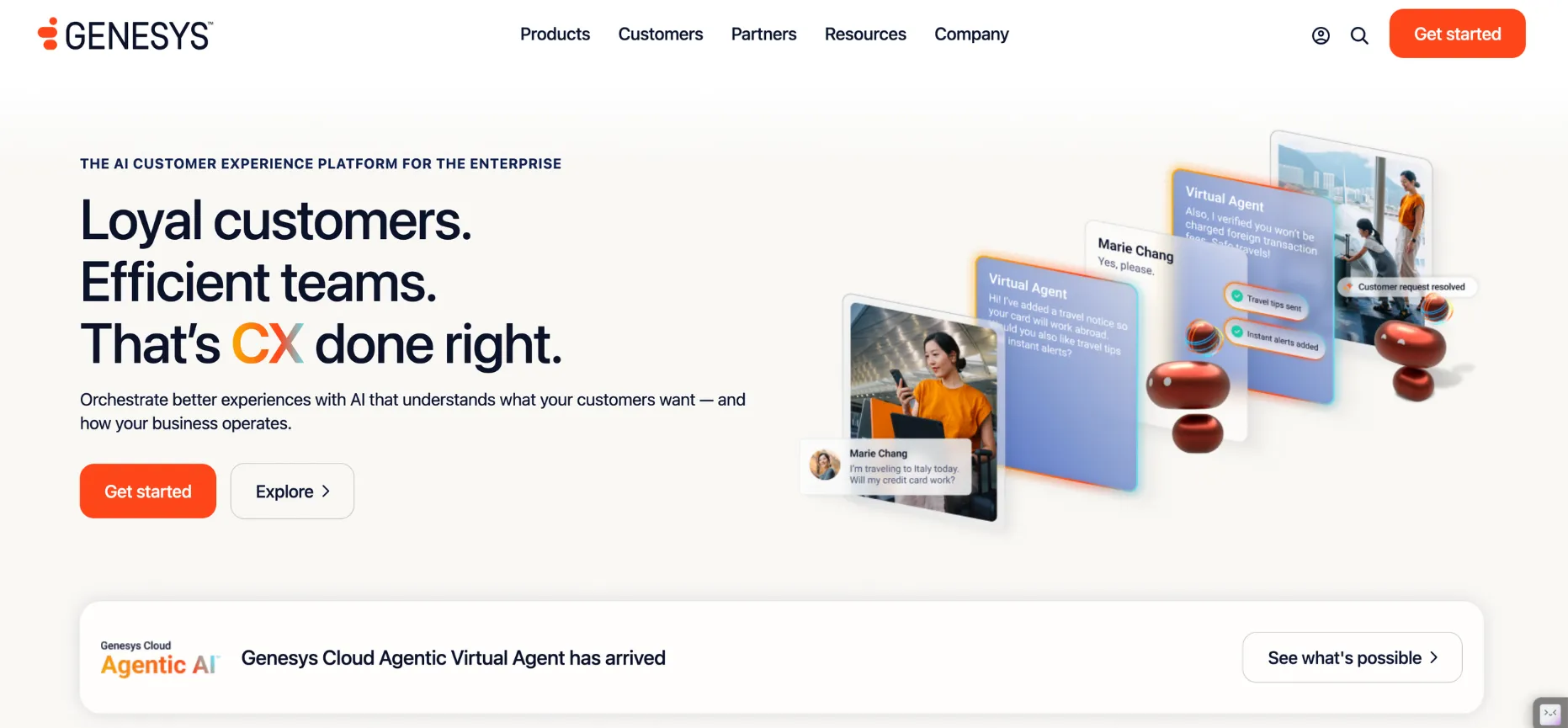
Genesys is a legacy titan that moved from on-premise hardware to the cloud. Genesys Cloud CX is an all-in-one CCaaS built for complex routing, native AI, workforce engagement, and omnichannel customer journeys.
Features:
- Architect Flow Designer. This drag-and-drop tool builds complex IVR flows, database dips, and skill-based routing with no custom code. It bridges the infinite programmability of Flex and the turnkey feel of simpler CCaaS tools.
- Unified Omnichannel Desktop. Voice, email, chat, social media, and SMS live in one agent desktop. It cuts the context switching that slows agents and puts every customer talk in a single place.
- Workforce Engagement. Out-of-the-box workforce engagement management and quality assurance modules come with the platform, which a blank-canvas Flex build does not include. These tools help leaders coach agents and check service standards across every channel.
Pros:
- Power and Depth: A G2 reviewer said it can do almost anything, with a good balance of simplicity and depth, and praised Architect in particular.
- No Dev Overhead: It needs virtually no software development to deploy and maintain, which ends the engineering burden that comes with Twilio Flex. Small businesses and agile startups may find the platform overwhelming.
Cons:
- Steep Learning Curve: One reviewer said the capability comes with complexity, and new administrators face a hard ramp. It suits 500+ agent centers with dedicated admin teams.
- Cost and Reporting: Per-seat tiers typically start around $75 to $150+ per user per month plus telecom usage, and reporting can feel clunky to modern SaaS users.
9. Talkdesk

Talkdesk is a cloud-native CCaaS known for deep, out-of-the-box CRM integrations, especially with Salesforce. It targets mid-market to enterprise teams that want a feature-rich contact center that stays friendly for agents and administrators.
Features:
- CRM Screen Pop. When a call arrives, Talkdesk surfaces the caller's CRM record automatically. This cuts handling time and manual data entry, and it works with Salesforce or Zendesk environments.
- AI Copilot. This tool listens to calls in real time, transcribes the talk, and surfaces knowledge base articles and troubleshooting steps. One G2 user called the Copilot integration a game changer.
- Agent-Friendly UI. A polished interface built for non-technical agents means fast onboarding, without a React team to build and update the desktop the way Flex requires.
Pros:
- CRM Synergy: G2 shows 167 mentions praising its CRM integration, which supports clean CRM records and personal service. Mid-market to enterprise support and sales teams that prize fast onboarding get the most from it.
- Ease of Use: Admins and agents appreciate the clean UI, and the native AI Copilot is ready without custom development.
Cons:
- Stability: G2 also shows 119 mentions of call issues, including dropped calls, connection hiccups, and system glitches that need a restart. These issues may grow more visible under heavy load.
- Cost and Custom CRMs: Named-user licensing runs about $75 to $125+ per seat per month, and highly custom CRM systems that need deep API changes are a poor fit. Pricing is gated behind sales consultations and varies by digital-only, voice-only, or full omnichannel AI tiers.
Build vs. Buy: When a Cheaper Alternative to Twilio Costs More
A lower per-minute rate looks like a win on a spreadsheet. But the rate is only one line in the cost of ownership. Here is what to weigh before you sign:
- Telephony Charges. Twilio's US outbound base rate is $0.0140 per minute. Add recording, transcription, and Voice Insights, and the stack reaches about $0.0689 per minute, nearly five times the base. Telnyx lists $0.005 per minute outbound with no hidden markups. At millions of monthly minutes, that gap decides whether a project pays back.
- Engineering Hours. Twilio Flex needs ongoing work on routing logic, React UI components, and AI linking. A turnkey CCaaS like Genesys Cloud CX or Talkdesk moves that work from developers to administrators, which frees developers for the product your customers pay for.
- AI Inference and Integrations. Vapi charges $0.05 per minute for the platform, and the total for a typical call lands between $0.08 and $0.15 per minute once models and telephony are added. Your team also owns latency tuning across third-party providers. By contrast, Thunai links with Amazon Connect, Zendesk, and Salesforce through its Model Context Protocol, which cuts custom integration work.
- Cost per Resolved Interaction. This is the key number. A pet store using Thunai automated 210,000+ calls monthly at a 78 percent average ticket deflection rate. A talk resolved without a human agent changes the math more than a fraction of a cent on routing.
Implementation time matters too. Vapi helped Ring reach production in two weeks, while a Flex build brings maintenance that never ends.
My advice is to build only where the product itself is communication, such as a telehealth app that connects doctors and patients. Buy where the goal is service outcomes. There is one fair exception: if you are deeply tied to Twilio Segment or Twilio Verify, or run SDKs embedded in a large legacy mobile app, tearing them out can cost more than the fractional penny savings of a new CPaaS.
Want to see Thunai in action - Just click to book a free demo call!
FAQs on Twilio Alternatives
What is the best alternative to Twilio?
It depends on your layer. Telnyx fits raw voice and SIP, Plivo fits Twilio-style APIs with stronger support, Genesys Cloud CX, Talkdesk, and Amazon Connect fit contact centers, and Vapi and Thunai fit AI voice automation. Start by finding your layer, then compare price and support.
Which Twilio alternative is best for voice APIs?
Telnyx is the strongest pick for cost and latency, with $0.005 per minute outbound, $0.0032 per minute inbound, and TeXML for TwiML migration. Plivo suits teams that value support, and Vonage suits those who also need UCaaS. Telnyx and Plivo both need engineering resources.
What are the best alternatives to Twilio Flex?
Genesys Cloud CX fits large enterprises with complex routing, Talkdesk fits CRM-led teams that want an AI Copilot, and Amazon Connect fits AWS-based teams that want usage billing without seat licenses.
Which Twilio alternatives support AI voice agents?
Vapi orchestrates speech-to-text, LLM, and text-to-speech models into one stream. Telnyx runs Voice AI Agents on its own network, and Thunai adds AI agents on top of your existing CCaaS to resolve Tier 1 requests.
Is it cheaper to build with Twilio or buy an AI calling platform?
Building on Twilio can reach about $0.0689 per minute with add-ons, before any engineering time. An AI platform such as Vapi runs $0.08 to $0.15 per minute, while Thunai uses custom contracts. Compare cost per resolved interaction, not rate alone. Thunai's 78 percent deflection rate shows why that number matters.