
Imagine if your customer relationship management system (CRM), help desk system, and customer data did not work independently but cooperatively?
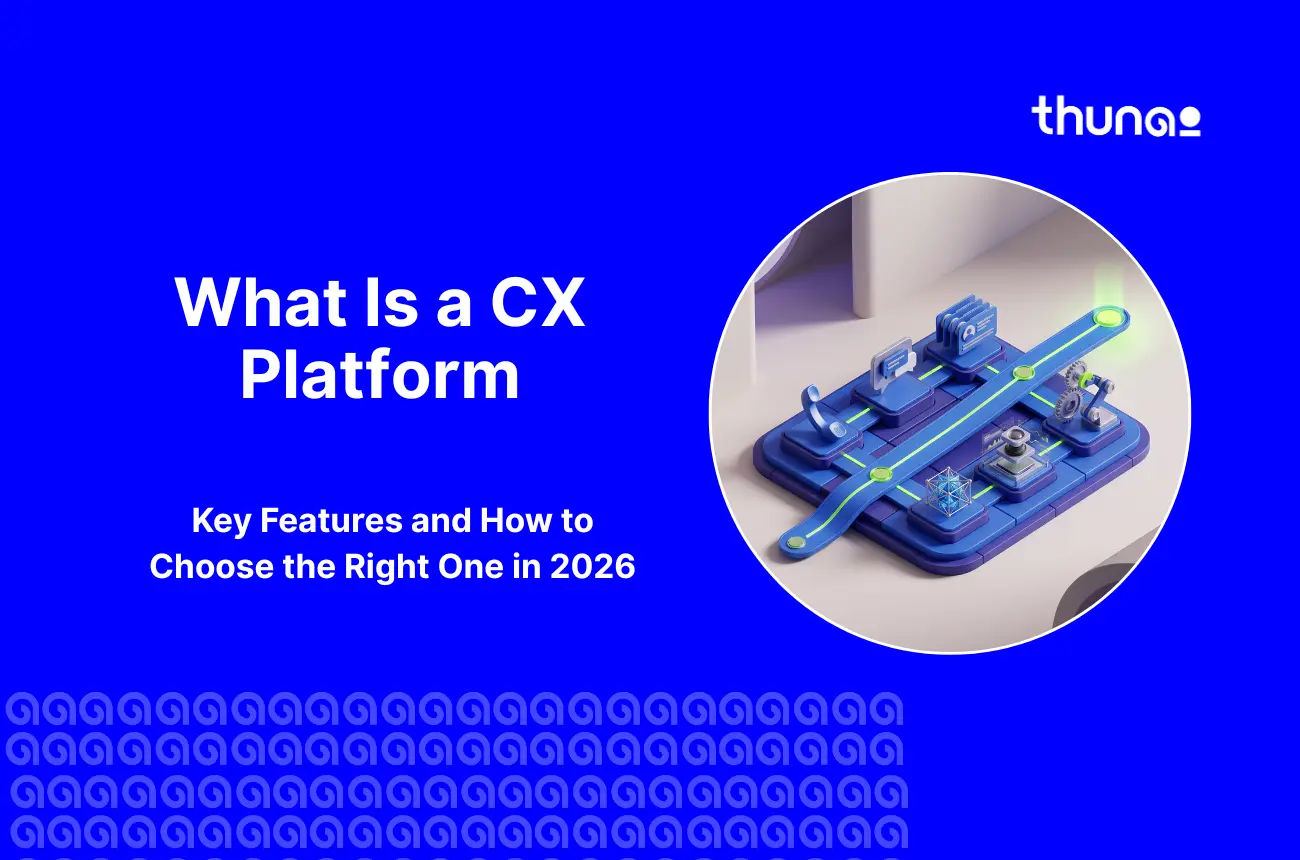
The CX platform integrates customer experiences, customer data, artificial intelligence, and processes in one system.
This article will tell you everything about the CX platform - its definition, functionality, features, types, benefits, and selection process in 2026.
What Is a CX Platform?
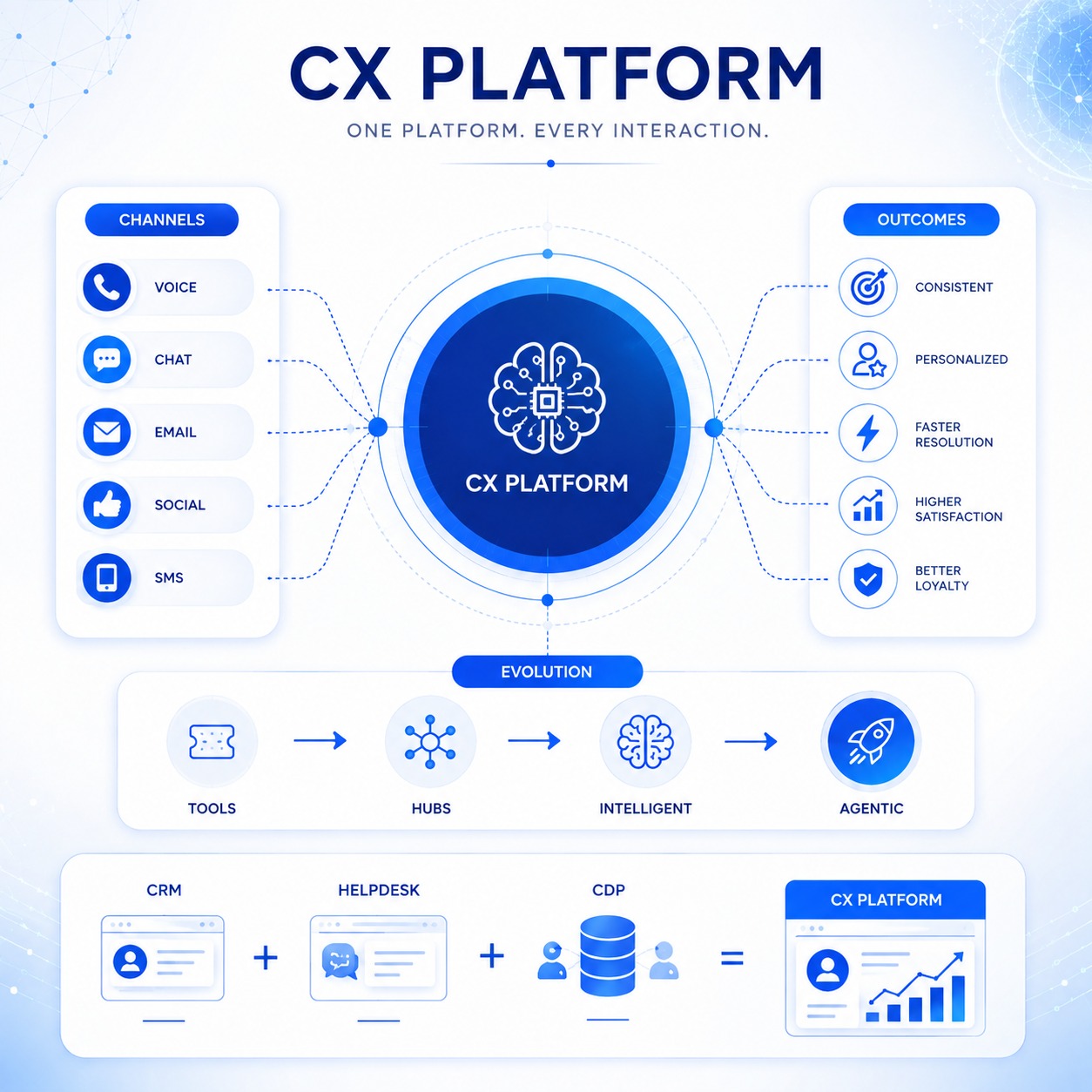
A customer experience platform is an application that integrates the customer experience, data, and processes through every channel voice, chat, email, and social for companies to provide consistent and personalized experiences to their customers and solve issues faster.
The progression has evolved from tools to capture tickets to hubs to manage the experience to agentic platforms to take action and not just to record the interactions.
The Customer Experience Platform is more than a tool; it’s an orchestration layer that ties together the whole customer experience journey.
In other words: the CRM system houses customer information; the helpdesk records tickets; the CDP system brings it all together; the customer experience platform does all this, and acts.
How Does a CX Platform Work?
The customer experience platform operates within the customer interaction life cycle, which comprises pre-interaction, during interaction, and post-interaction phases.
- Pre-interaction: The customer experience platform consolidates all knowledge and data in one place. It directs calls according to the history of the customer and the nature of his or her inquiry. It uses self-service with the help of AI to deflect L1 calls and resolve simple problems without the involvement of the agent.
- On Interactions: The customer experience platform offers omnichannel interactions for customers. Customers interact by means of voice, chat, email, or social media, and they do not lose any context. At the same time, agents receive guidance along with knowledge during this process. Supervisors monitor interactions and provide assistance wherever required.
- Post Interaction: The customer experience management software will summarize the interaction, improve CRM operations, prompt the agent, and analyze the conversation.

Key Features of a CX Platform (Things to Consider)
Omnichannel engagement
- Voice, chat, email, social, and SMS in a single thread.
- Customers switch channels without losing context.
- This is not multichannel support. It's true omnichannel with unified history.
AI agents & intelligent self-service
- Intent detection, L1 auto-resolution, and smart escalation.
- AI handles routine queries; humans handle complex ones.
- This cuts volume and frees agents for high-value work.
Real-time agent assist
- Live guidance and knowledge surfacing during calls and chats.
- Agents get the right answers instantly.
- No more searching through docs or asking teammates.
Unified knowledge base
- A single, contradiction-free source of truth.
- No more conflicting policies or outdated docs.
- The customer experience platform keeps knowledge fresh and accurate.
Workflow automation
- Summary of calls, CRM hygiene, and follow-up activities are automatic.
- Time spent on administration by agents is reduced.
- This increases productivity and job satisfaction.
Analytics, QA & call scoring
- 100% interaction coverage with sentiment and compliance tracking.
- No more 2% manual sampling.
- The leaders get the big picture and make decisions based on the insights.
Journey orchestration & personalization
- Tailored experiences according to customer behavior.
- The customer experience system uses the information from past interactions to create experiences that suit the customer.
Integrations & open architecture
- Connect to CRM, CCaaS, and ITSM: Genesys, Salesforce, ServiceNow, Amazon Connect.
- There’s no rip and replace required.
- Your customer experience platform integrates with your stack.
Security & deployment control
- SOC 2, ISO 27001, GDPR, data residency, and on-prem options.
- Enterprise-grade security by design.
- This matters for regulated industries.
Types of CX Platforms (With Examples)
Not all customer experience platforms are the same. Some focus on routing calls. Others focus on surveys or marketing. Agentic CX platforms handle the full lifecycle with AI. This is the future.
CX Platform vs. CRM vs. CDP vs. Helpdesk
Here's the key difference: a CRM tells you who the customer is. A helpdesk tells you what they asked. A customer experience platform resolves the issue and learns from it.
Benefits of a CX Platform (With Benchmarks)
- Higher deflection & faster resolution: Thunai delivers 80% query deflection and 3x faster resolution. This means fewer tickets and happier customers.
- Handle time and cost savings per contact: up to a 40% decrease in AHT in week one; 70% fewer handle times overall. This means cost savings and margin expansion.
- Agent productivity & retention: three times more productive with the help of agents; 40% of the agent’s day is after-call administration; automate it. Agents solve problems, not type.
- Customer Satisfaction & Loyalty: 95% CSAT with accuracy and consistency. Satisfied customers turn into loyal and referral customers.
- Data-driven decision making: 100% interaction quality assurance versus 2% manual sampling. Decision makers have all data at hand.
- Outside validation: 58% of leaders see the ROI of customer experience platforms (Nextiva CX Trends).
One retail client saw 78% deflection and 4.8 CSAT after deploying Thunai. Another cut AHT by 40% in the first week. These are real results.
How to Choose a CX Platform: 7-Step Evaluation Checklist
Follow this 7-step checklist to select the best enterprise solution:
- Lifecycle and Volume of Map Interactions: Identify where support tickets accumulate in voice, email, and chat.
- Omnichannel Context: Ensure customer data is integrated across channels without generating siloed data.
- Test AI Resolve Rate: Run tests for AI resolve capabilities on your own customer data, and not canned demo products.
- Depth of Integration: Offer extensive integration capabilities with your CRM, CCaaS, and ITSM systems without requiring you to create an entire new technology stack.
- Deployment and Security Model: Verify the compliance of the CX platform with your security requirements like SOC 2, ISO 27001, GDPR, and private cloud deployments.
- Time to Value: Select solutions that guarantee quick deployment. Thunai, for example, guarantees less than two days for enterprises.
- Model Financial ROI: Calculate potential savings based on ticket volume and deflection rates using an interactive CX ROI calculator.
CX Platform Use Cases by Industry
- Retail & e-commerce: Order status deflection, loyalty moments. Customers check orders, track shipments, and earn rewards without agent help.
- Insurance: Claims, renewals, compliance. Policyholders get instant answers on claims status and renewal dates.
- Banking & finance: Secure self-service, advisor productivity. Customers check balances and transfer funds securely. Advisors get real-time assistance.
- Healthcare: Scheduling, coordination. Patients book appointments and get care coordination without calls.
- Manufacturing: Dealer/distributor support. Partners get instant answers on inventory, pricing, and shipping.
Each industry has unique needs. The best customer experience platform adapts to your workflows.
The Future: From CX Platforms to Agentic CX
As per Gartner's prediction, agentic AI will be able to resolve 80% of everyday customer service challenges on its own by 2029.
The shift is from dashboards to autonomous action. Human and AI agent orchestration is the future. Supervisors govern AI, ensuring accuracy and empathy.
Agentic CX platforms resolve issues end-to-end, not just answer questions. This is the endpoint of CX evolution.
Imagine this: the customer requests a refund. Without any human intervention, the customer experience platform validates the order and the refund, and processes the request to send an acknowledgment. This is agentic CX.
How Thunai Delivers the Agentic CX Platform
Thunai provides an enterprise agentic solution built for high-volume contact centers. It turns your scattered documents, transcripts, and help files into a self-learning brain that powers AI agents across voice, chat, and email.
Users love how easily Thunai unifies scattered data, earning a perfect 5.0 out of 5 rating on Product Hunt. Reviews praise Thunai as the strongest solution for turning company knowledge into context-aware action.
- Coverage under Life Cycle: Automatically resolves level one tickets, offers real-time assistance to agents, updates the CRM process post-interaction automatically, and provides 100 percent call auditing.
- Proven Success in Businesses: Over 1 million transactions processed, 80% deflection rate, 70% time saved on transaction handling, and 95% CSAT rating.
- Case Study Example: An organization that deals in pet-related services uses more than 100 Thunai bots, which have helped it handle 210,000 phone calls per month and deflect 78% of calls with a CSAT rating of 4.8/5.
Book a demo right away and find out how Thunai can improve your customer experience through AI automation.
FAQs
What is a CX platform?
A customer experience platform (or CX platform) is a type of software used by organizations to bring all their customer interactions, data, and processes across all channels voice, chat, email, social in one place.
How does a CX platform function?
This combination of corporate knowledge and the process of execution to solve issues using whatever medium, be it voice, chat, email, or messaging.
What is an agentic CX platform?
Agentic CX uses agents powered by autonomous AI that not only interact through conversation but also perform more complex tasks such as forming incidents, managing CRM records, and handling tickets.