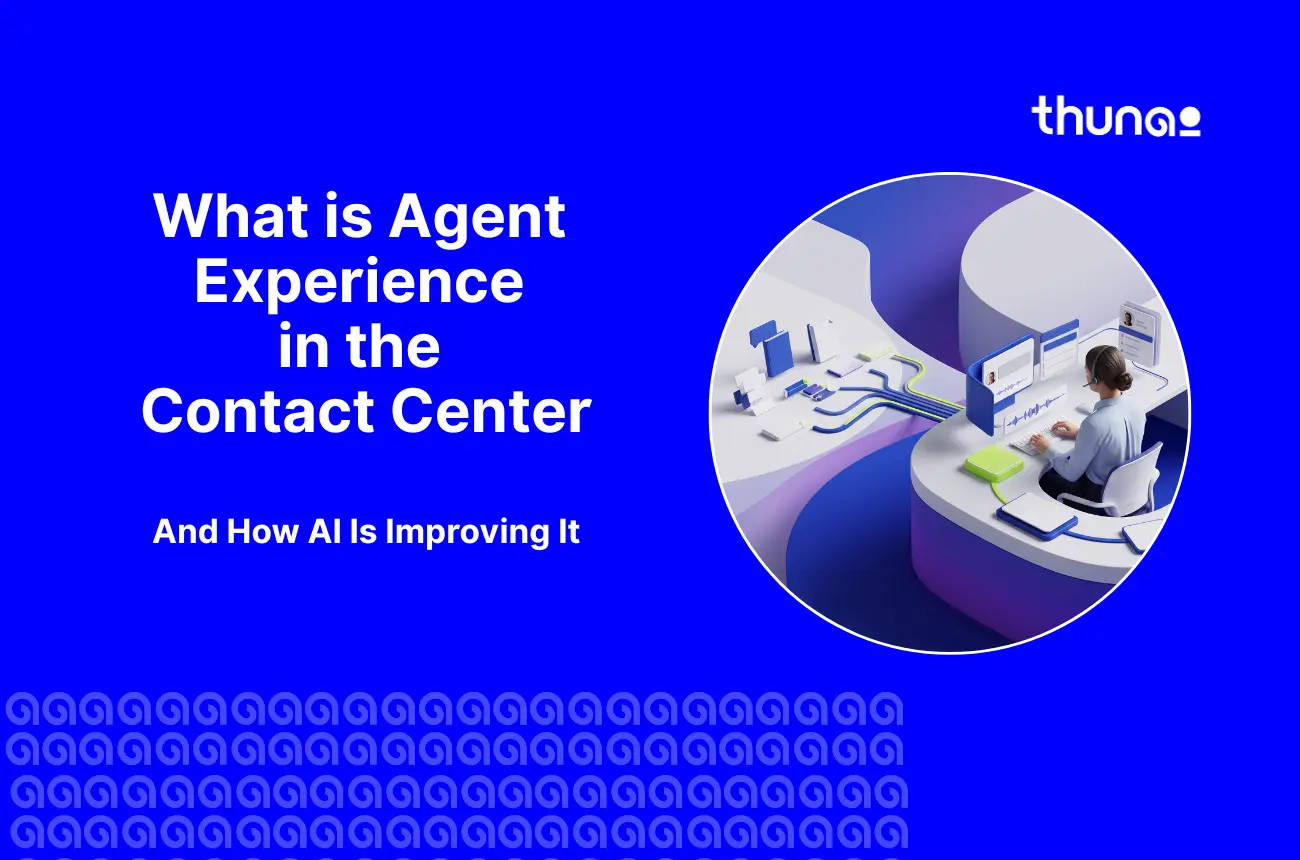

What if the issue isn’t with your customers but rather the systems you give to your agents to work on?
Your agent should not be looking for information in various systems, repeating his/her queries, or taking time after every call to write down notes.
However, these inconveniences can slowly reduce efficiency. That’s where AI comes in by giving the correct information at the right time.
What is agent experience?
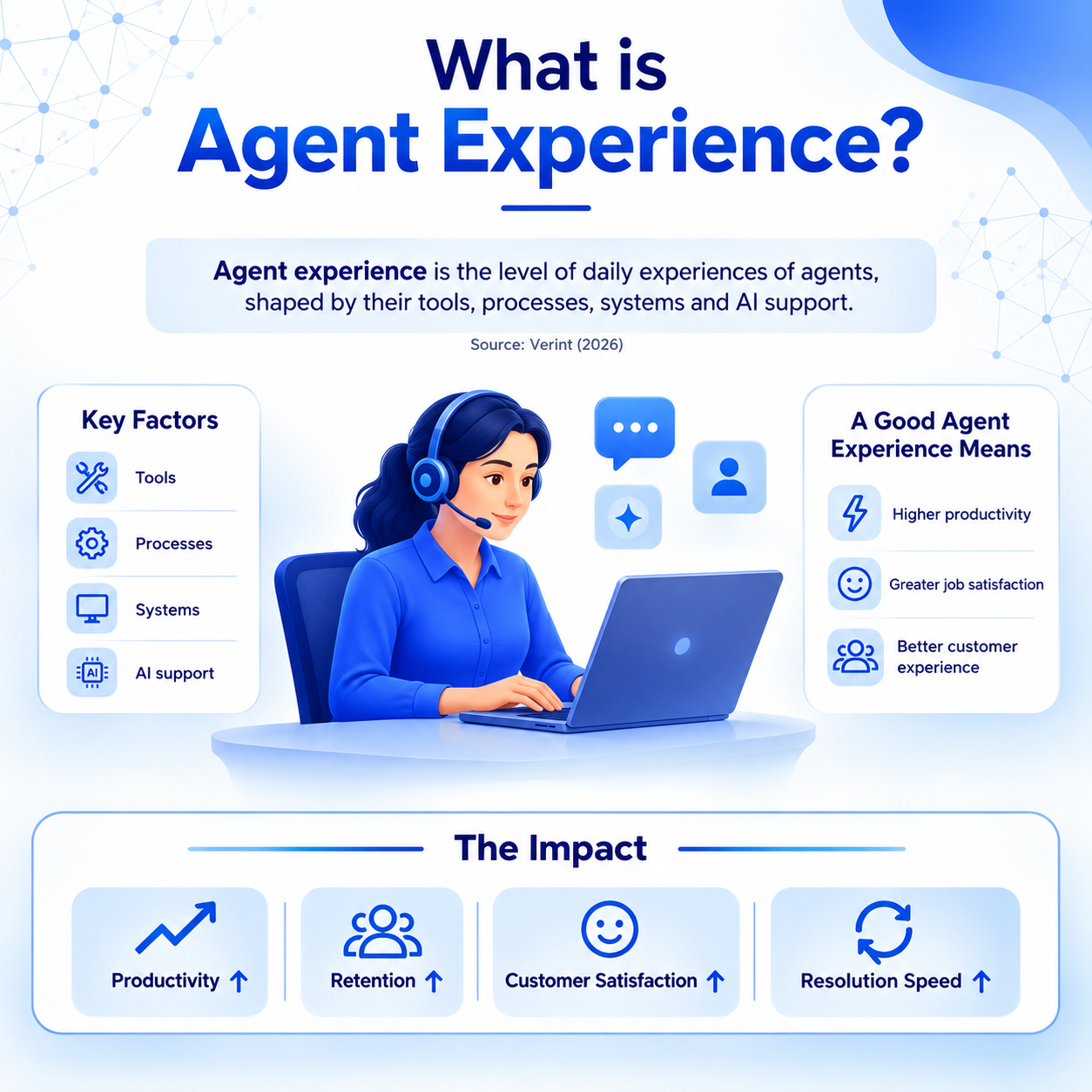
Agent experience describes everything a contact center agent encounters while doing their job.
This includes:
- The speed and usability of their contact center tools.
- Access to accurate customer and product information.
- Training and coaching quality.
- Workload, schedules, and performance targets.
- Support from supervisors.
- The amount of manual work required after each interaction.
- Real-time help during difficult customer conversations.
A strong agent experience helps employees focus on listening, problem-solving, and building trust. A poor one forces them to switch between applications, search through outdated knowledge bases, repeat questions, and complete the same administrative tasks after every call.
According to Verint, the definition of agent experience is the level of daily experiences of agents, which are determined by their tools, processes, systems, and AI support. Verint 2026 research also suggests that agent workflow is directly linked to productivity and customer experience.
Agent experience is often treated as an employee experience topic. However, it is more specific. Employee experience covers the full journey of an employee across the organization.
Agent experience focuses on the work of customer-facing contact center teams.

Why agent experience matters now
Contact center work is demanding. Agents handle emotional conversations, complex cases, strict targets, and growing customer expectations. They may also work across voice, chat, email, and social channels during the same shift.
When systems create extra work, pressure builds quickly. Agents spend less time solving customer issues and more time searching for answers, updating records, and completing follow-up tasks.
Verint’s survey of more than 1,000 contact center agents found that:
- 45% of calls require agents to search for answers.
- 54% of calls require after-call work, such as summaries and documentation.
- 67% of calls require agents to complete a task for the customer.
- 57% of calls require agents to gather context during an escalation.
- Nine out of ten agents say schedule flexibility matters when choosing a job.
These numbers show why agent experience is now an operational priority. Repetitive work can increase fatigue, absenteeism, and turnover. It can also affect customer satisfaction.
The cost of agent attrition is high. A contact center must recruit, train, and coach each replacement.
New agents also need time to reach full productivity. During that period, experienced agents may carry extra workloads, which can create a cycle of stress and further attrition.
What shapes agent experience
Three main sources of friction hurt agent experience in the contact center:
- Technology friction and system fragmentation: Agents often switch between 5 and 10 separate apps during a single call. Re-entering customer info across old CRMs creates delay and frustration.
- Knowledge search time: Company policies and guides are often spread across separate databases. Agents waste valuable minutes hunting for answers while callers wait on hold.
- Administrative work post calls: Administrative work post calls, known as ACW, includes manual activities such as note-taking, selecting disposition codes, and updating CRM. This process takes 17% to 40% of an agent’s total working time.
How AI is reshaping agent experience
- AI enhances agent experience when it is integrated with actual processes.
- The chatbot that deflects easy questions will decrease call volume, but it will not solve all problems for the agents.
- The most compelling use cases for AI happen before, during, and after the customer conversation.
Real-time agent assist
- Real-time agent assist provides live support during a call or chat. It can surface knowledge articles, suggest next-best actions, display relevant scripts, and identify compliance reminders.
- It can also detect sentiment and recommend de-escalation guidance during a difficult conversation. This reduces cognitive load and helps agents stay present with the customer.
- Thunai’s Real-Time Agent Assist offers live prompts, knowledge retrieval, customer context, sentiment signals, and call summaries without requiring agents to leave the conversation window.
Automated After Call Work
- AI summarizes calls or conversations into an organized summary in just a few seconds. It can identify the client's problem, the actions undertaken, decisions made, and more.
- The system can then update CRM fields, create help desk tickets, and assign next steps.
- Agents review the output instead of writing everything from scratch.
- This creates two benefits. Agents regain time between calls, while organizations receive more consistent records.
AI-powered coaching
- AI can examine all recorded conversations rather than just a sample.
- The managers will be able to notice patterns in the areas where the knowledge is lacking or compliance is not followed.
- Thunai supports automated call scoring and coaching insights.
- Its platform can help supervisors monitor at-risk calls and find coaching opportunities faster.
Context-rich handoffs
- A customer should not need to repeat their story after an escalation.
- AI can pass the conversation history, customer intent, sentiment, actions taken, and unresolved issues to the next agent.
- This improves the agent experience because the receiving agent starts with useful context. It also creates a smoother customer experience.
How to measure agent experience (AX)
Agent experience should be measured with both people metrics and operational metrics. No single number tells the full story.
Leaders should establish a baseline before introducing AI. Next, analyze performance in terms of teams, channels, interaction types, and levels of experience among agents.
Assume that a team with 100 agents suffers a loss of 25 agents every year. Assuming that, on average, the cost of recruiting and training a new agent is ₹1,00,000 per annum, attrition costs can be up to ₹25,00,000 per annum.
Now consider automated summary saving 90 seconds in every interaction. With every agent handling 40 interactions daily, there is a recovery of 6,000 minutes every day for the team.
The exact result depends on call volume, salary, adoption, and workflow design. The lesson is simple: connect contact center AI agent benefits to financial outcomes, not just activity counts.
The agent experience – customer experience link
Agent experience and customer experience automation are closely connected.
An overwhelmed agent may rush a conversation. An agent working across disconnected systems may place a customer on hold. An agent without useful context may transfer the interaction or ask the customer to repeat information.
These problems can affect:
- First Contact Resolution.
- Average Handle Time.
- Customer Satisfaction (CSAT).
- Repeat contact rate.
- Escalation rate.
- Customer retention.
The opposite is also true. The agents that have quick access to trustworthy information will be able to give responses accurately. The agents that save time on documentation will be able to focus more on empathy and problem-solving.
This is one of the reasons why the contact center must not optimize customer self-service but overlook the agents dealing with complicated issues.
How Thunai improves agent experience in practice
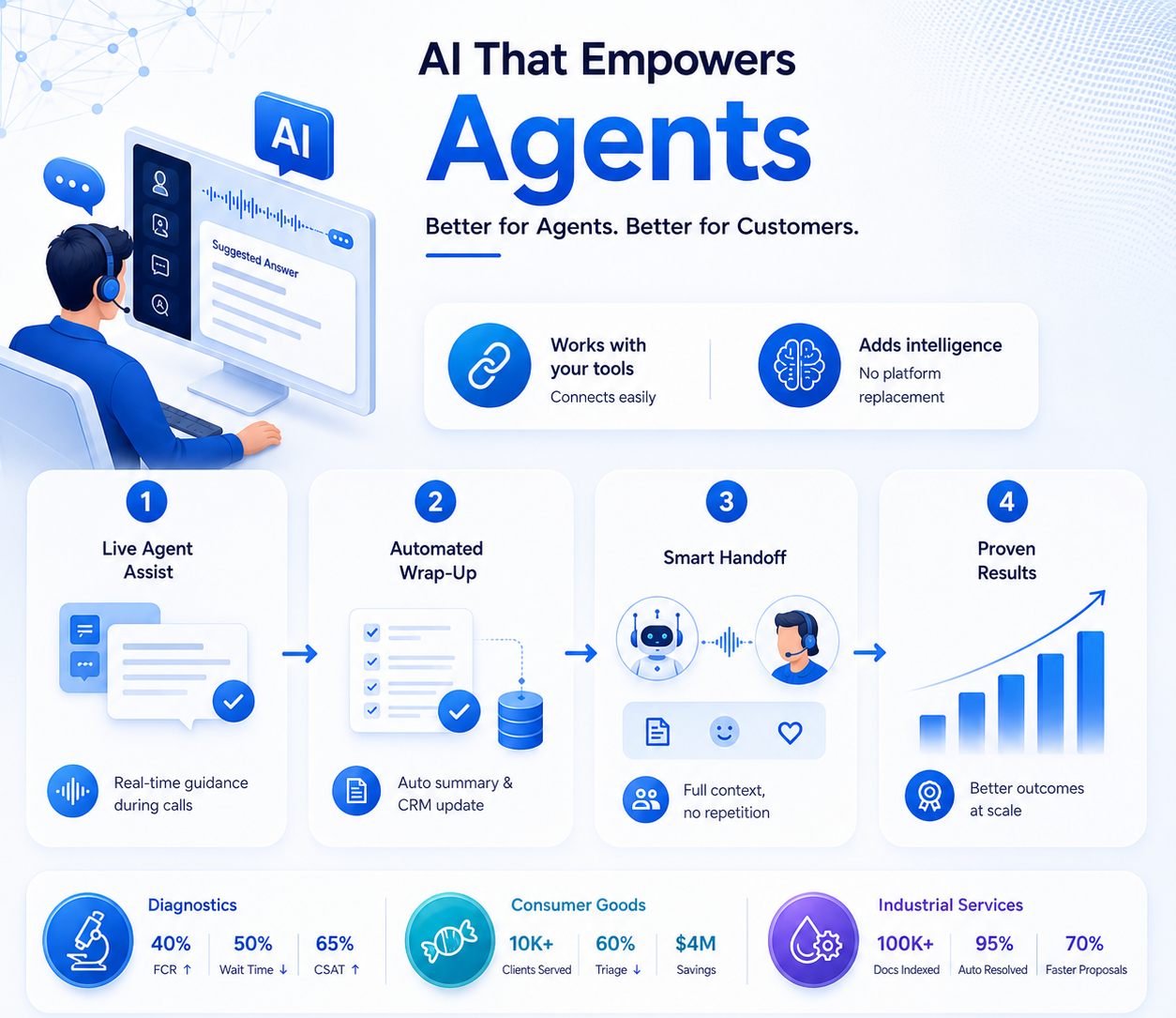
Thunai provides an agentic AI platform that improves agent experience in the contact center across the entire support lifecycle.
The platform connects directly with tools like Amazon Connect, NICE, RingCentral, and Microsoft Teams. It adds real intelligence to your existing setup without requiring complex platform replacements.
1. Real-time agent assist with live guidance
- Thunai acts as a smart digital co-pilot during live voice and chat calls.
- The platform transcribes conversations instantly, pulling accurate answers from a single knowledge base to display on the agent screen.
- This removes manual document searches and speeds up ticket triage times.
2. Automated post-call summaries and CRM updates
- Thunai handles wrap-up work automatically.
- The software writes call summaries, adds disposition codes, and updates CRM records as soon as a call finishes.
- Agents can take the next call right away without spending minutes typing notes.
3. Contextual AI–human handoffs
- Thunai AI agents answer routine tier-1 questions automatically and route hard issues to live reps.
- During the handoff process, human agents receive a complete call transcript along with the summary of the issue as well as the customer’s sentiment.
- They can start working instantly by getting complete context; hence, the customer is not required to repeat himself.
4. Enterprise validation and results
Real customer deployments show the positive impact of improving agent experience in the contact center with Thunai:
- Neuberg Diagnostics: Improved FCR by 40%, reduced waiting time by 50%, and increased CSAT ratings by 65%.
- Bazooka Candy: Offered coordinated assistance to 10,000 clients, reduced triage by 60%, and achieved savings of $4M through logistics.
- Ion Exchange: Enabled indexing of 100,000 technical documents to one source of truth, resolved 95% of all technical questions using automation, and produced sales proposals 70% faster.
Try the smarter way to empower your contact center agents - book a demo with Thunai today.
FAQs
What is the difference between agent experience and employee experience?
Agent experience is the agent-specific component of employee experience in the context of a contact center. It revolves around the experiences that the agents have during the course of their interaction with customers.
Why does agent experience affect customer experience?
Agents working with disconnected systems and heavy manual workloads may take longer to resolve issues or transfer customers more often. Better agent experience gives them the time, context, and tools needed to deliver faster and more consistent service.
Which AI capability has the highest ROI for agent experience?
The answer depends on the contact center’s baseline. However, workflow-focused AI often offers a strong starting point because it removes measurable costs. Real-time knowledge support and automated after-call work can reduce search time, documentation effort, and avoidable delays. Verint’s 2026 research points to agent workflows, rather than customer self-service alone, as a key area for measurable AI value.
How can contact centers improve agent experience?
Start by measuring friction. Identify where agents spend time searching, switching systems, repeating work, or waiting for help. Then automate one workflow, track the result, gather agent feedback, and scale what works.
Is AI designed to replace contact center agents?
AI can be used to automate repetitive tasks and even simple requests. The role of human agents cannot be ruled out when it comes to emotions, decision-making, exceptions, and sensitive discussions.