
But what if the use of artificial intelligence is being adopted throughout your organization, yet you still lack integration among all of your systems?
That’s where an enterprise AI platform can come into play by consolidating all aspects in one place.
It links data, models, agents, workflows, security, and automation, helping organizations to expand their use of artificial intelligence without forming additional silos.
This article will introduce you to enterprise AI platforms.
Enterprise AI platform, defined
- This is the most straightforward description of what enterprise AI platforms are: enterprise AI platforms are the common denominator that allows the organization to do all of its AI in one place instead of using a dozen different tools.
- They provide access to internal data, computing power, pre-trained models, and logic.
- Point tools handle one job. An Enterprise AI Platform runs the whole operation: data, models, permissions, everything.
Platform vs point solution vs model provider
- There are really three layers in this market, and people mix them up constantly.
- Model Providers build and host the base models.You receive the API endpoint, and nothing more: no knowledge of who you are, which information you're supposed to have access to, and how your team operates.
- Point Solutions do just one thing, but they can do it very well.
- The problem shows up later, when you've got six of these and none of them talk to each other. That's how data silos happen.
- An Enterprise AI Platform is different. It ties foundation models directly to your data, your identity systems, your existing software, and it manages the routing, the permissions, the guardrails, and the execution across systems, all under one roof.
Enterprise AI platform vs agentic AI platform
- Older-style enterprise AI software mostly waited for a question: summarize this, search that, classify this document. Useful, but passive.
- An agentic AI platform doesn't wait around. It makes its own decisions, invokes API calls, retrieves from the database, and completes multi-step tasks without a person watching over each step.
- This means that while a regular Enterprise AI Platform is a smart library, an agentic one resembles an actual employee performing the task.
What makes a platform enterprise-grade
Not every AI tool deserves the enterprise-grade label. A few things actually separate the real ones:
- Strict RBAC: the kind of access control permissions your organization already enforces, but applied consistently throughout all data layers.
- Zero Data Retention Policies: an actual contract guaranteeing your prompt and customer data will not be used to train some other company’s model.
- High Availability & Low Latency: we’re shooting for 99.9% - 99.99% availability and sub-second latencies, since people don’t like waiting for a sluggish chatbot while in the middle of support calls.
- Guardrails for Determinism: validations to prevent a hallucination from turning into an angry customer or lawsuit.
Why enterprises consolidate onto a platform
Companies are getting tired of managing five different AI vendors, and honestly, it makes sense.
Pilot sprawl and shadow AI
- This happens fast: one team spins up a tool nobody vetted, feeds it proprietary data, and IT finds out about it three months later if at all.
- That's shadow AI, and it's a real security problem.
- A central Enterprise AI Platform gives leadership actual visibility into what's being used, where data is going, and whether any of it violates policy.
Duplicate integration and data cost
- Every point solution needs its own connectors, its own vector index, its own maintenance.
- Multiply that across support, marketing, and IT, and your engineers are basically building the same pipeline five times.
- Centralizing onto one Enterprise AI Platform kills that duplication and, in most cases, brings inference costs down too.
Governance, audit and board-level pressure
- Boards don't want surprises. They want proof that AI adoption isn't quietly creating regulatory or IP exposure.
- Solid enterprise AI governance means every query, every model call, every automated action is logged somewhere auditable, not just trusted to have gone fine.
Reference architecture of an enterprise AI platform
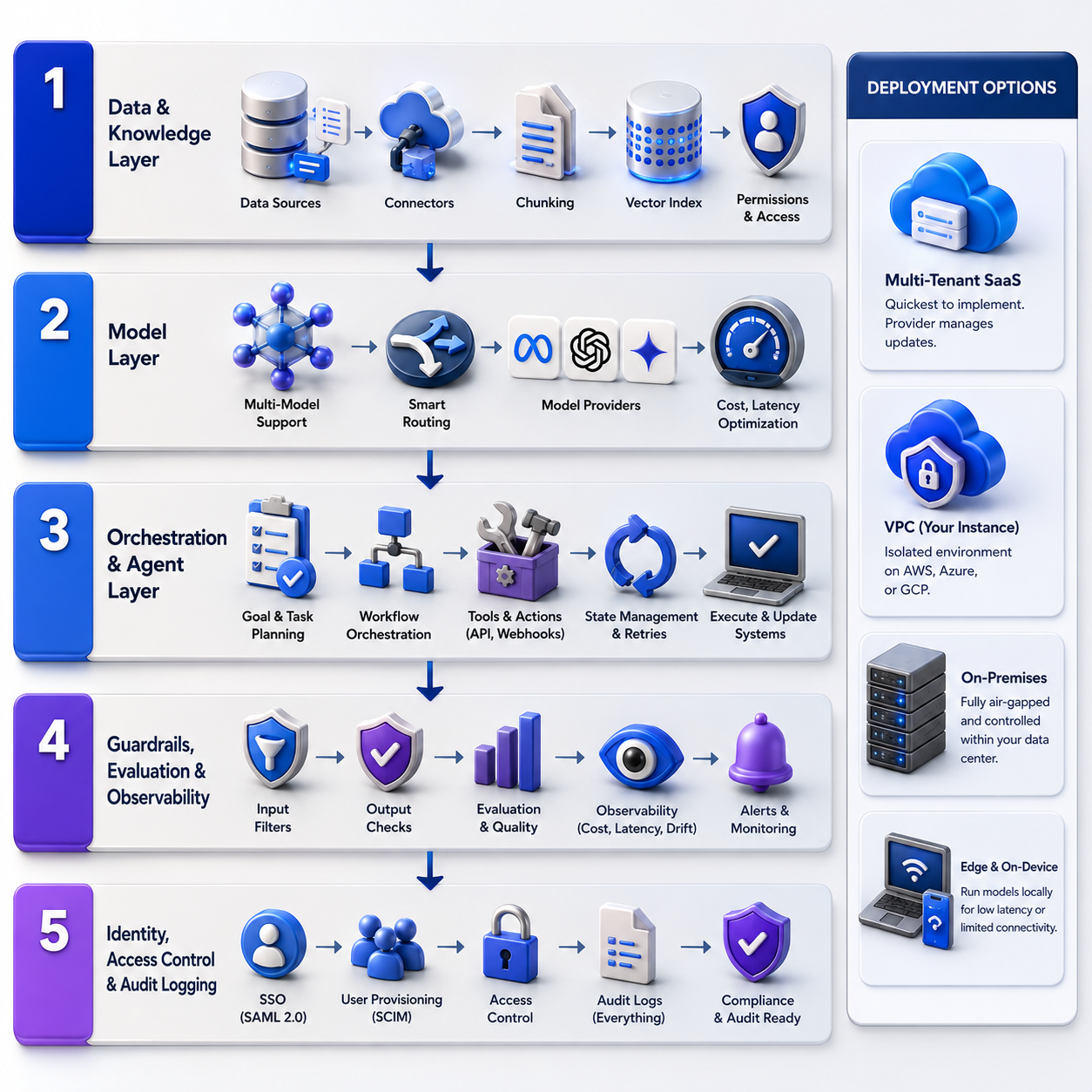
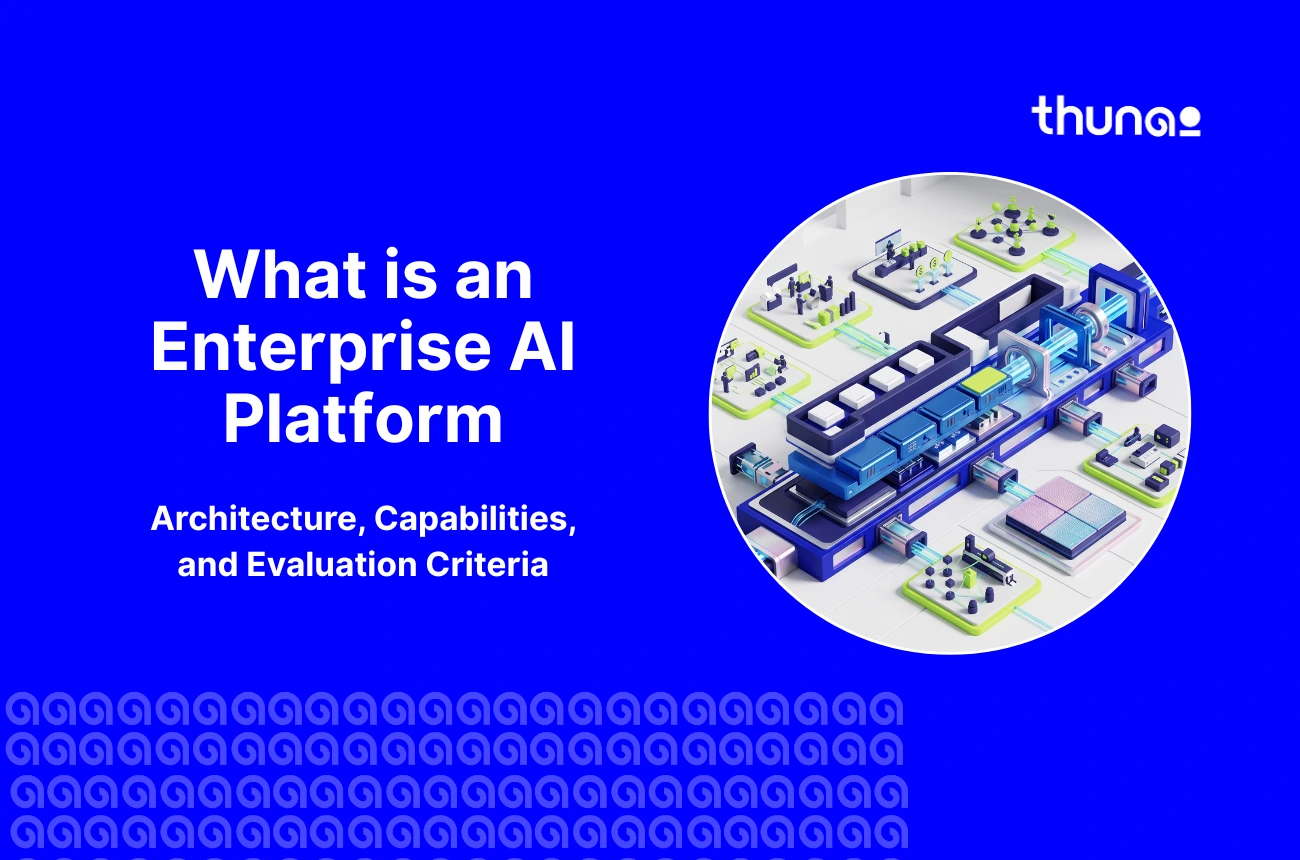
Strip away the marketing language, and most platforms boil down to five layers working together.
Data and knowledge layer: connectors, retrieval and permissions
- This is where data becomes important: CRM, knowledge base, documents, chat transcripts- everything is considered, in real-time or in batches.
- The combination of semantic chunking and vector indexing along with RAG helps the model provide answers based on the reality of your company, not assumptions. And critically, this layer respects your existing access rules.
- If someone isn't cleared to see a document, the model won't surface it either.
Model layer: multi-model support and routing
- However, no one model fits all cases. In this layer, the requests are routed according to the complexity of the task, its time requirement, and its cost to execute.
- Simple stuff goes to a lightweight model. Genuinely hard reasoning gets escalated to a frontier model.
- That balance is a huge part of what keeps an Enterprise AI Platform affordable at scale.
Orchestration and agent layer: tools, actions and workflows
- This is the engine room. The AI orchestration platform gets an objective from your business, chunks it down into actionable steps, handles the reasoning back and forth, and communicates out to your systems via APIs and webhooks.
- It knows what state the job is at, retries failures, and pushes changes into your system automatically.
Guardrails, evaluation, and observability
- Every interaction gets checked, both coming in and going out. Input filters catch sensitive personal data before it reaches the model.
- Output checks look for tone problems, factual issues, and policy violations.
- And observability tooling keeps an eye on cost, latency, and whether model quality is quietly drifting over time.
Identity, access control, and audit logging
- Standard stuff here: SAML 2.0, SCIM, tied into whatever identity provider you already use.
- What matters is that every prompt, every retrieved snippet, every action taken gets logged.
- Without that, you don't really have an auditable system, just a hopeful one.
Deployment options: cloud, VPC, on-premise, and on-device
Every company may not be able to implement AI in the same manner. Here are some options:
- Multi-Tenant SaaS: quickest to implement, and the provider takes care of updates for you.
- Virtual Private Cloud (VPC): your own instance hosted on the infrastructure of AWS, Azure, or GCP.
- On-Premises: totally air-gapped, in case it is a necessity in some industries.
- Edge and On-Device: small models running locally, useful when latency or connectivity is the constraint.
Core capabilities checklist
If you're comparing vendors, these four areas matter more than most feature lists.
Multiple ingestion modes: voice, chat, e-mail, and documents
- Knowledge does not reside in one communication channel. It exists in telephone conversations, Slack chats, support requests, PDF documents, recorded meetings.
- A platform that only reads text is only seeing part of the picture.
Agent building and workflow automation
- These teams must have the capacity to create and test the agents without having to rely on the engineers to make changes.
- This implies that the person should be able to create the persona, write the instructions, connect with the appropriate knowledge base and, most importantly, set limitations on what the agent is not supposed to do on its own.
Human-in-the-loop controls and approvals
- Some decisions still need a person. Good platforms give frontline staff live suggestions, reminders, and drafts they can approve or edit, rather than fully removing them from the loop.
Analytics, attribution and ROI reporting
- At some point, someone in finance is going to ask "did this actually work?" You need resolution rates, deflection numbers, efficiency gains, and quality scores across every interaction, not a sample, all of it to answer that convincingly.
Categories of enterprise AI platform and which problem each solves
Different companies genuinely need different things here.
Hyperscaler cloud AI platforms
Microsoft Foundry, Amazon Bedrock, Google Vertex AI these give you raw infrastructure and model access. Great if you've got a strong engineering team and want to build something custom. Less great if you were hoping for something usable out of the box.
Data science and MLOps platforms
Databricks, DataRobot, and other services concentrate on model training: working environments, feature stores, pipelines for deploying predictive models developed by your data science team.
Enterprise search and knowledge assistants
Glean, Microsoft 365 Copilot: these index everything across your drives, inboxes, and chat tools so employees can actually find things and draft content faster.
Agentic AI platforms for customer operations
These are built specifically for support and contact centers. They combine live conversational intelligence with real automation, so tickets get resolved, agents get help mid-call, and records update themselves.
Category comparison table
Security, compliance and data governance requirements
This part isn't optional, no matter how good the demo looks.
SOC 2, ISO 27001, GDPR and HIPAA
Require SOC 2 Type II and ISO 27001 certifications. If you handle any health information or operate in other countries, then HIPAA and GDPR compliance is not optional; it’s required.
PII redaction, retention and data residency
Sensitive personal data needs to get caught and masked before a model ever processes it. And for global companies, you often need to control exactly where data physically sits, to satisfy local regulations.
Model training and data-use commitments
Make sure that in writing it is stated that your interactions and data won’t be used for training someone else’s model publicly. This might be significant information if a vendor seems to be unsure on this matter.
Build vs buy
The build vs buy AI platform question isn't just technical. It's a multi-year budget decision.
The real cost of building in-house
If you build it, you own it for life: integrations, streaming pipelines, vector indexes, interfaces, patches, refactors. Everyone tends to underestimate this up front.
When building is the right call
It makes sense if your model itself is core IP, or if you need hardware integration so specific that no commercial Enterprise AI Platform is going to support it.
How to evaluate enterprise AI platforms
Don't just pick the flashiest demo. Use something structured.
Evaluation scorecard across nine criteria
When you evaluate an AI platform for business, run vendors through these nine dimensions:
Designing a proof of concept with exit criteria
Before you run a pilot on any of your enterprise AI use cases, decide what "success" actually means:
- At least 70% Level 1 support deflection.
- At least a 30% drop in average handling time for human agents.
- At least 95% automated QA accuracy compared to human audits.
If you skip this step, you'll be arguing about results later instead of just reading them off.
Questions to ask every vendor
- Is this real-time streaming, or are we really talking about batch processing dressed up nicely?
- What actually stops it from hallucinating on a complicated question?
- What air-gapped or private cloud setups exist, if we need one?
- Does it push call summaries into the CRM on its own, or is someone still doing that by hand?
Common failure patterns in enterprise AI rollouts
Most failed rollouts fail for the same handful of reasons.
No owner, no baseline, no measurement
Without ownership of the project, there is no direction. If you do not have a measurement of where you started out, you cannot say that things improved, which makes the next round of budget discussions a lot more difficult than necessary.
Automating a broken process
Putting an agent on top of a messy, undocumented process doesn't fix the mess. It just makes the mess move faster. Fix the process. Then automate it.
Enterprise AI for customer experience operations
Customer experience and contact centers tend to see the fastest, clearest return from an Enterprise AI Platform. Scattered knowledge bases and manual data entry are exactly what drives long hold times and, not coincidentally, agent turnover that can approach 40%.
Where Thunai fits
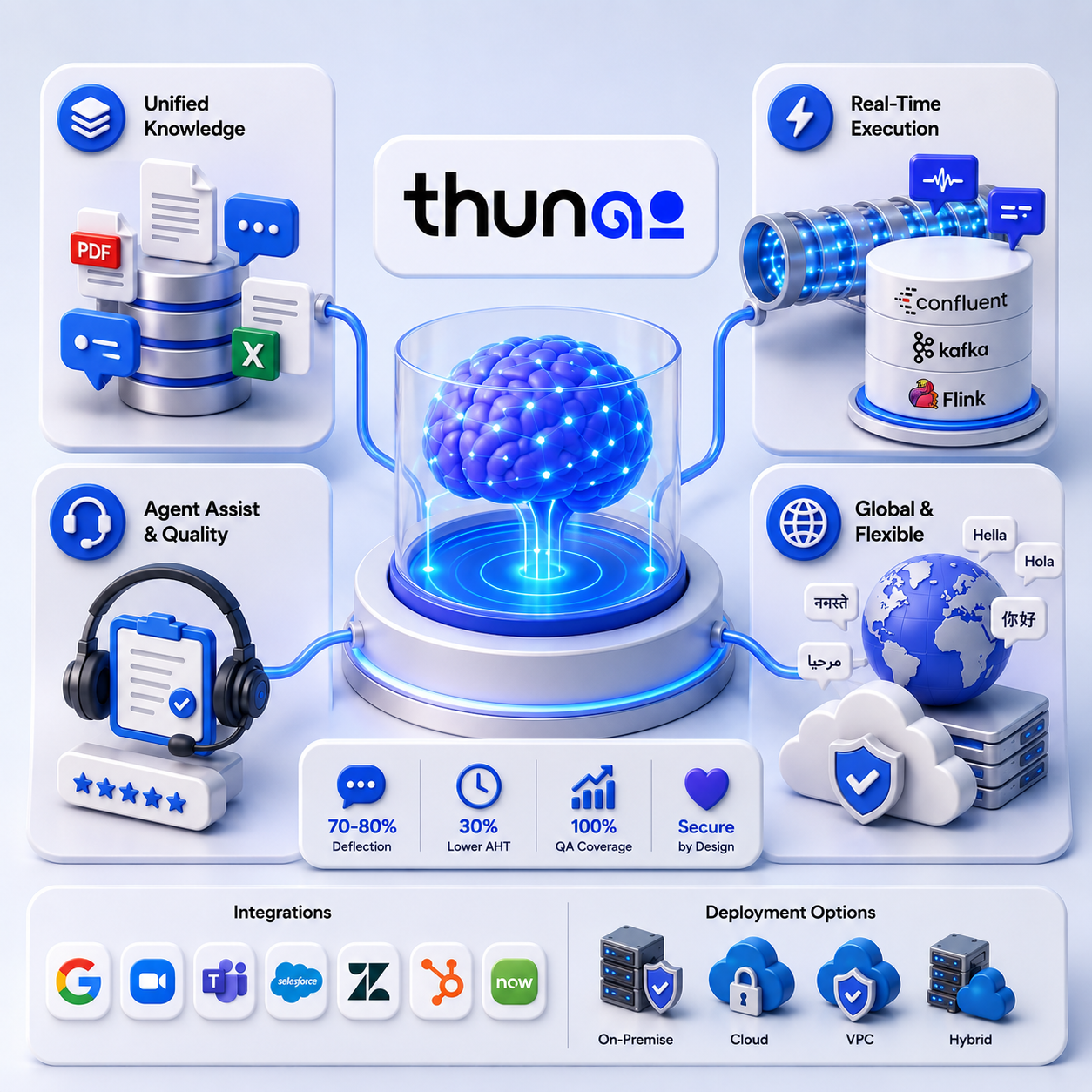
Thunai is an agentic AI platform purpose-built for automating enterprise customer operations, and it's regularly named among the best enterprise AI platform options for support teams specifically because it targets the problems that usually sink these rollouts.
Unified Knowledge Core ("Thunai Brain"):
- Scattered documentation is behind an estimated 95% of stalled AI initiatives.
- Thunai Brain pulls docs, spreadsheets, past conversations, and internal procedures into one source of truth, so every agent, human or AI, gives the same correct answer, everywhere.
Real-Time Streaming Agentic Execution:
- Built on Confluent, Apache Kafka, and Apache Flink, Thunai processes conversations as they're actually happening, not after the fact.
- That's what lets its voice, chat, and email agents hit 70 to 80% deflection on routine Level 1 questions, and it's why resolution goes from hours to seconds.
Frontline Agent Assist and Automated Quality Management:
- During a live call, Thunai listens, pulls up the right knowledge article, and trims average handling time by roughly 30%.
- It also closes out the CRM ticket automatically and scores every single interaction, not a sample, for quality and sentiment.
Global Language Support and Flexible Deployment:
- It runs in 50+ languages and plugs into Google Workspace, Zoom, Microsoft Teams, and the CRMs most enterprises already use, with on-premise or secure cloud deployment depending on what you need.
Turn AI adoption into real business outcomes - explore Thunai and book a demo today.
FAQs
What's the real difference between an enterprise AI platform and a consumer tool?
A consumer tool works in isolation, with no organizational controls attached. An Enterprise AI Platform plugs into your data, enforces role-based access, masks personal information, and actually meets your privacy requirements.
How does an enterprise platform stop data from leaking out?
Isolated tenant environments, strict RBAC, automated PII redaction, and a binding zero-retention agreement. Your data doesn't train someone else's model full stop.
Will it connect to the CRM and helpdesk we already use?
In most cases, yes. Native, bi-directional connectors for the major CRMs and ticketing systems are pretty standard at this point, and they keep records updated without manual entry.
How long does this actually take to deploy?
Building it yourself can take 9 to 18 months. A purpose-built Enterprise AI Platform, on the other hand, can typically connect to your data and go live within two to four weeks.