
Poor customer service is no longer just a support problem. It is a revenue crisis. Bad customer experiences cost organizations an estimated $3.7 trillion globally in 2024, up 19% from the year before (Qualtrics XM Institute). In the U.S. alone, businesses risk losing $856 billion annually to customer churn driven by poor service.
The switching threshold is shockingly low. 32% of customers will leave a brand they love after just one bad experience and that number climbs to 59% after repeated failures (PwC). Meanwhile, 64% of customers say they will find a competitor regardless of how much they like the product if the service does not meet expectations (Forbes).
The solution is not just adding a chatbot. By end of 2025, over 80% of businesses will have deployed some form of chat automation (Gartner), yet most are still running on static databases and delayed workflows that make AI responses slow and inaccurate. Companies that get it right see a $3.50 return for every $1 invested in CX, and a mere 5% improvement in retention lifts profits by 25 to 95%.
That gap between basic automation and real intelligence is exactly what this guide covers. We compare Yellow.ai vs Kapture CX and show why enterprises are moving to real time AI platforms like Thunai to close it.
Customer support failures are becoming headline news as enterprises lose millions due to slow AI systems, inaccurate responses, and disconnected customer data.
Many traditional CX platforms still depend on static databases and delayed workflows, causing poor experiences that drive customers away silently. In a market where response speed directly impacts revenue, businesses need more than basic automation.
In this guide, we compare Yellow.ai vs Kapture CX in detail and explain why enterprises are shifting toward real time AI platforms like Thunai for live intelligence, operational automation, and scalable customer engagement.
Why Picking the Wrong CX AI Platform Is Costing Enterprises Millions
As a CEO, I see basic chat interfaces causing margin leaks. Daily data creation hits 463 hexabytes, yet up to 73% of corporate data sits idle.
The true cost of bad automation is customer churn, which brings us to the comparison of Yellow.ai vs Kapture CX. Studies show 73% of consumers switch after poor experiences, and 56% leave quietly instead.
Our direct analysis of Yellow.ai vs Kapture CX shows that running on outdated batch data rather than live streaming creates a severe operational deficit. Stale database files trigger hallucinations, costing businesses $67.4 billion.
With 31% of agents planning to quit within six months because of poor systems, accessing live information is necessary to avoid corporate liabilities.
Here are the economic realities that define customer service:
What Is Yellow.ai?

- Yellow.ai Platform is an AI driven customer engagement platform for automating customer support, sales, and conversations across multiple channels which includes chats, voice, emails, Whatsapp, and social media platforms. Many organizations use Yellow.ai to enhance customer engagement and automate customer service through intelligent chatbots and voice agents.
- Yellow.ai is a global player acting as an enterprise automation platform supporting 135 languages and 35 channels, its DynamicNLU engine handles CX and EX tasks with a 90% automation rate across 1,100 clients.
- However, its setup introduces high configuration overhead. Building custom workflows takes months, requiring extensive services. Mid market buyers frequently reject the platform, resulting in a 15% churn rate.
- Furthermore, Yellow.ai reinvests 45% of revenue into development to track models , suppressing profit margins and creating pricing uncertainty.
What Is Kapture CX?
- Kapture CX is an intelligent business solution designed for supporting customers via chat, ticket management, automation of processes, and handling customer communications through different communication channels. Companies use Kapture CX to provide better customer support, boost agent efficiency, and automate omnichannel support with the help of AI-powered automation.
- Kapture CX handles customer experience from a ticket centric support angle. KApture cx is tailored for Retail, BFSI, and Travel, it consolidates communication channels into a single unified workspace.
- The Yellow.ai vs Kapture CX debate centers on domain specialization, using vertical models built on synthetic data to protect privacy.
- However, Kapture CX introduces clear weaknesses. Reviewers note performance latency and slow system loading.
- Dashboard reports slow when queries queue. Custom configurations depend on Kapture's internal support, preventing administrators from making updates.
- Finally, its native voice features are limited, acting mostly as a link for third party telephony.

Yellow.ai vs Kapture CX: Head to Head Feature Comparison
Let's look at the features of Yellow.ai vs Kapture CX alongside Thunai, the platform replacing them.
The following table contrasts how these platforms handle data and channels:
1. AI Agent Features and Conversational Depth
Yellow.ai routes queries via a multi-LLM framework. However, its NLU can lose context, causing intent failures. This differentiates Yellow.ai vs Kapture CX, as Kapture's schemas offer containment but struggle with open ended queries.
2. Omnichannel Coverage - Voice, Chat, and Email
Looking at channel options of Yellow.ai vs Kapture CX, voice stands out. Yellow.ai uses a native voice engine, while Kapture treats voice as a secondary channel with no native agents. For digital, Yellow.ai vs Kapture CX comes down to choosing Kapture's ticketing workspace or Yellow.ai's broad footprint.
3. Knowledge Management and AI Accuracy
The database setup in Yellow.ai vs Kapture CX relies on static knowledge ingestion. If policies change, both tools default to outdated info. This highlights why Yellow.ai vs Kapture CX may fall short in dynamic environments, repeating outdated rules and frustrating customers.
4. Analytics, Reporting, and Actionable Insights
The report engines in Yellow.ai vs Kapture CX serve different styles. Yellow.ai features basic dashboards , while Kapture suffers from system lag during downloads. Both legacy systems fail to connect support transcripts with broader operational issues to proactively flag defects.
5. Connectors, Security, and Time to Deploy
The setup time for Yellow.ai vs Kapture CX is a major separator. Yellow.ai boasts 150 connectors, but setups take months of custom configuration. Kapture CX has industry specific links , but custom changes require hands-on support. An 18 month roadmap destroys value.
Where Both Yellow.ai and Kapture CX Fall Short
We must ask where both legacy vendors lose their footing. Both platforms suffer from the same limitation: they treat conversational AI as a defensive shield to deflect customers rather than a central engine for business growth. They operate under the assumption that automation should merely act as a gatekeeper.
No Revenue or Sales Intelligence Layer
- The growth gap in Yellow.ai vs Kapture CX becomes clear when looking at pipeline tracking.
- Their tools are isolated from sales pipelines.
- When a customer mentions a buying signal, these platforms treat it as a closed ticket.
- They lack real-time systems to convert buyer intent into structured CRM deals.
Knowledge Contradictions Leading to AI Hallucinations
- Because both legacy platforms run on static knowledge bases, they suffer from a latency gap.
- Older files often remain, creating contradictions that trigger hallucinations when the AI retrieves conflicting rules.
- This carries major legal and financial liabilities.
CX Automation That Stops at the Support Layer - Not the Business Layer
- The work in both legacy systems stops right at the conversation layer.
- A traditional bot cannot execute complex, multi-system operational tasks.
- If a customer wants to process a billing refund or change subscription tiers, the bot must pass it to a human because legacy systems lack a native, event driven execution layer.
Meet Thunai - The Platform Built to Solve What Yellow.ai and Kapture CX Missed
Moving past these traditional platforms brings us to a new paradigm. Thunai is an Agentic AI Middleware platform.
It unifies scattered data into a contradiction free knowledge hub called the Thunai Brain , running specialized digital agents that safely execute workflows across text, voice, and email.
From Reactive Support to Proactive Revenue - How Thunai Connects CX Data to Sales Pipelines
- Thunai transforms support into a revenue driver.
- Through its Thunai Revenue AI module, the platform analyzes interaction streams to detect high intent buying signals in real time.
- Instead of deflecting, Thunai converts buyer intent into qualified leads, updates CRM deal stages, and routes opportunities to sales reps, driving up to a 2.5x jump in upsell revenue.
Why Thunai's Knowledge Engine Gives AI Agents Answers That Are Always Accurate and Contradiction Free
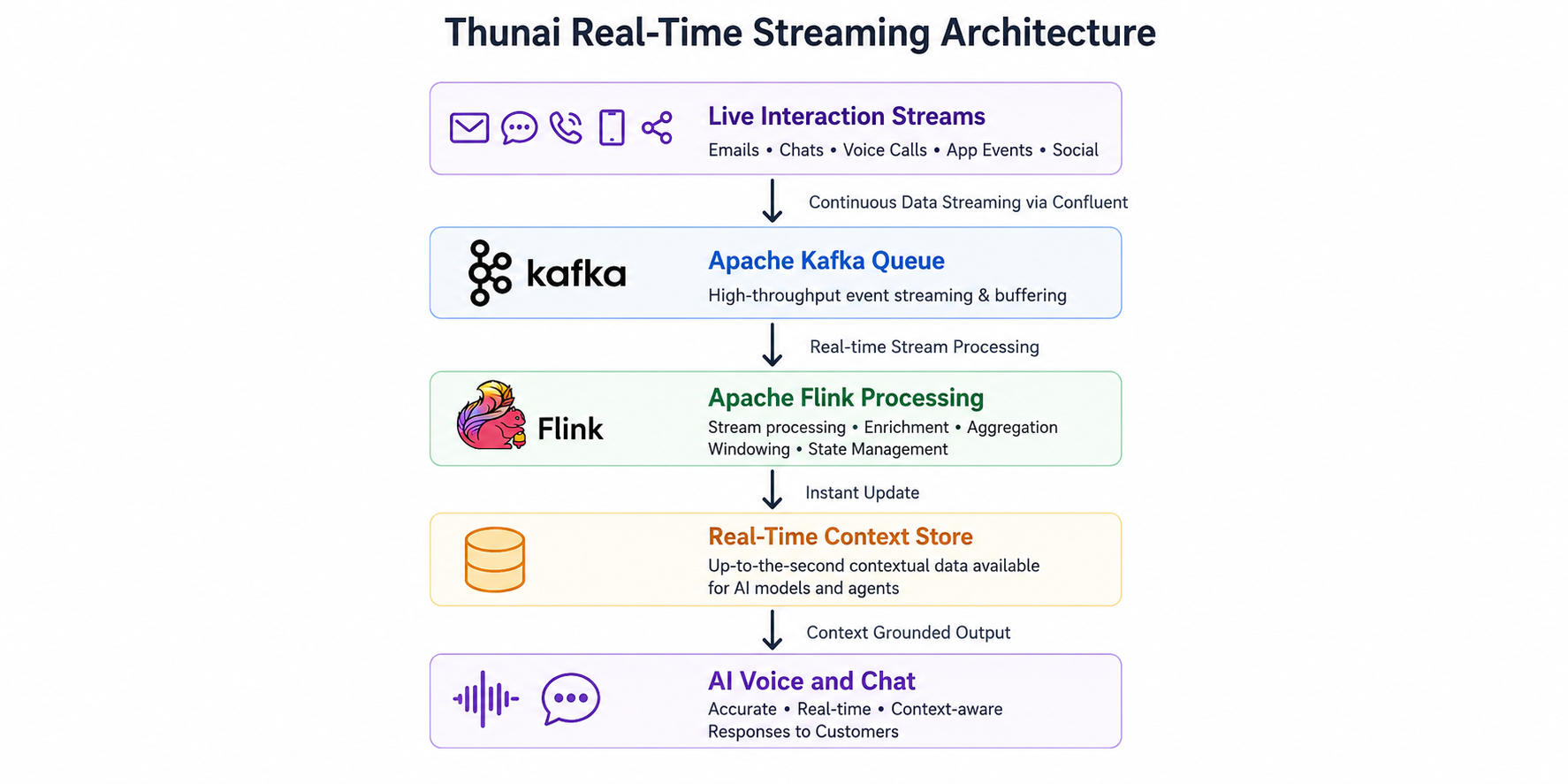
Unlike legacy batch systems, Thunai Brain utilizes a real time data streaming pipeline. Utilizing confluent to stream data via Apache Kafka and Apache Flink, Thunai Brain continuously ingests live transcripts, CRM updates, and back office events.
This keeps AI agents grounded in live context, wiping out latency and resolving contradictions before they trigger hallucinations.
How Thunai Turns Every Customer Conversation Into a Product, Sales, and Ops Intelligence Signal
- Thunai treats 100% of interactions as structured event streams.
- With Thunai Reflect AI, the platform monitors product health, linking directly to Jira and Genesys.
- If a customer mentions a problem in onboarding or a software bug during a call, Thunai Reflect automatically extracts the signal, calculates its impact, and creates a prioritized ticket in Jira.
Real-Time Agent Assistance During the Call - Not a Post Call Summary Nobody Reads
- While traditional tools provide post call summaries, Thunai delivers real-time assistance during active calls through Thunai Voice AI.
- As a call proceeds, Thunai’s streaming engine converts voice to text instantly, analyzing sentiment and intent.
- This pushes next best action guidance directly onto the agent's dashboard, reducing handling times by 4.5 minutes and wiping out hold queues.
One Platform, Zero Data Silos - How Thunai Unifies Support, Sales, and Operations on a Single Intelligence Layer
- To resolve fragmented systems, Thunai uses a Universal System Connection model with Model Context Protocol.
- It layers on Genesys, Amazon Connect, RingCentral, and NICE CX one.
- This architecture unifies support, sales, and operations on a single data streaming backbone, removing silos.
The Business Impact of Moving Beyond CX Automation to Full Operations Intelligence
Transitioning from basic chatbot deflection to unified operations intelligence yields massive returns. Through the adoption of real time, event driven architectures, the CEO links customer happiness with bottom line profitability as follows:
$$\Delta\text{Retention} = 5\%\rightarrow\Delta\text{Profit}=[25\%,95\%]$$
FIR provides a loyalty improvement of 31%. The cost of human interactions is $7.40 whereas that of Thunai's chat is $0.41 and voice interactions cost $1.18. This results in savings of 90%.
While legacy deflection medians sit at 41.2% , Thunai achieves deflection rates of $D\ge80\%$. Since 67% of users abandon chat if wait times exceed two minutes, Thunai handles 10,000 live calls instantly, cutting wait times under 30 seconds and BPO costs by 60%.
User in app Store user Guru_nd19 posted that the platform elevates productivity across sales, marketing, and support.
Transform customer support into real time business intelligence with Thunai — Book your demo today.
FAQs on Yellow.ai vs Kapture CX
How does the pricing for the legacy options compare to Thunai?
Unlike traditional platforms, Thunai uses a clear, usage aligned flat rate pricing model. Standard plans start at $79/month (20 GB storage, 1,000 credits) and scale to $499/month for Premium (unlimited storage) with unlimited seats, shifting costs to system usage.
In the debate of the two competitors, which is better for voice?
Yellow.ai holds a stronger native voice engine compared to Kapture CX, but both rely on static database models that cause delays. Thunai excels by delivering real-time voice agents built on streaming data with under 50ms latency, guaranteeing always accurate interactions.
How does Thunai Brain handle live data differently from legacy options?
Traditional platforms run on static, batch based architectures. Thunai Brain utilizes a real-time data streaming backbone. It continuously streams live transcripts, CRM logs, and updates directly into its system, avoiding the database inconsistencies that trigger hallucinations.
Can Thunai's AI agents perform active business transactions rather than just answering FAQs?
Yes. Unlike standard chatbots, Thunai agents perform complete task execution. Using Model Context Protocol to connect with backend tools, they execute transactional workflows securely, such as issuing refunds or updating client subscription tiers.
How does Thunai help sales and product teams, and not just customer support?
Thunai converts customer interactions into structured intelligence. Its Revenue module scans conversations for buying signals to route qualified leads to your CRM , while its Reflect module tracks bug reports to alert engineering teams, preventing future tickets by resolving root issues.