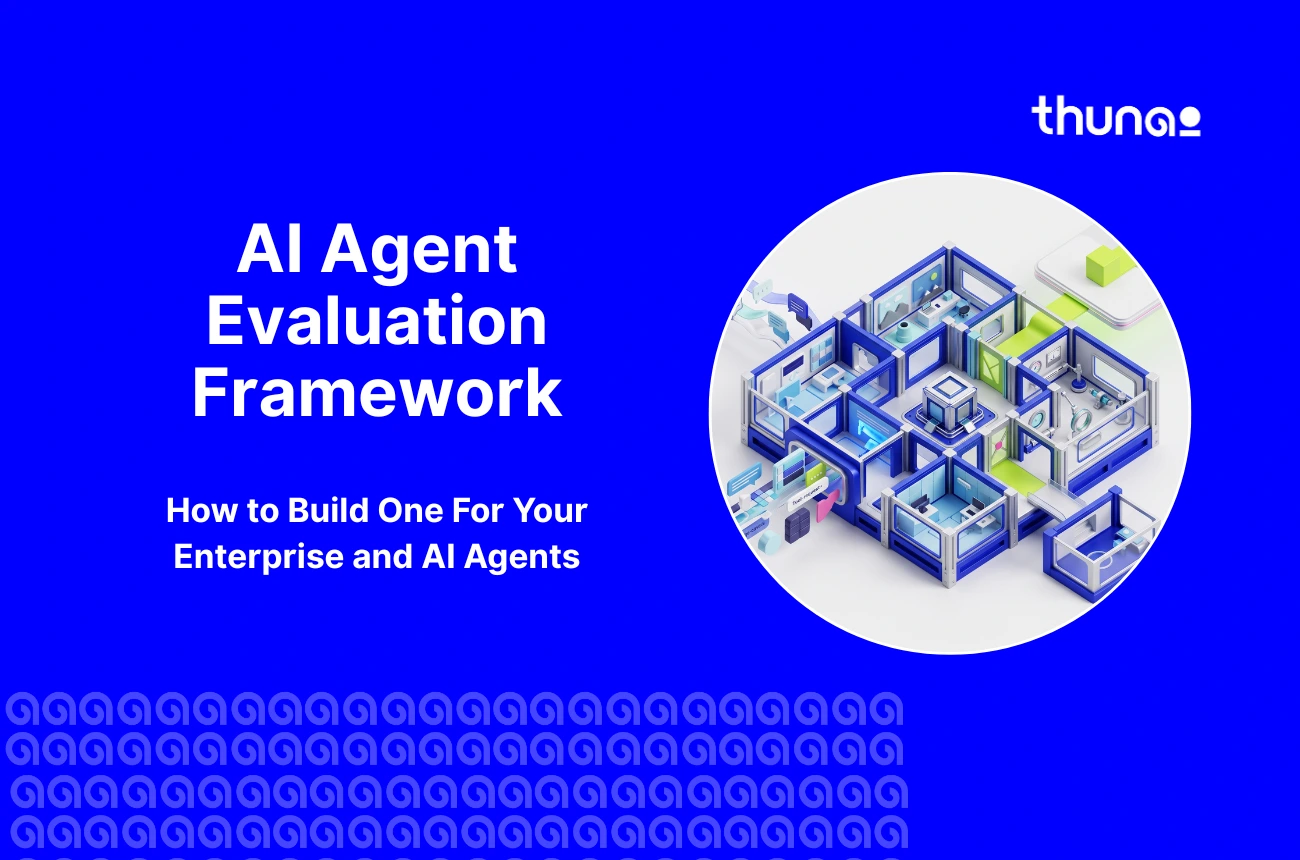

How do you develop an AI agent evaluation framework that will be able to assess not only the final result but also other aspects of the process?
In the age when AI agents perform increasingly difficult jobs, the old approach is becoming obsolete.
They can select various tools, make decisions several times, use APIs, and manipulate real-world system data.
Any robust evaluation framework must test every single step of the process and measure its results. Here’s how it can be done.
Why Standard Testing Falls Short in an AI Agent Evaluation Framework
Four problems show up again and again when teams try to evaluate agents in production:
- Agents don't take one path.
Two agents can solve the same task in different, equally valid ways. If your test harness demands an exact sequence of steps, you'll fail agents that reasoned correctly but took a smart shortcut.
- Small errors compound.
A bad parameter pulled in step two can corrupt everything downstream even if the agent's final summary reads perfectly.
- The environment shifts under you.
Agents talk to real APIs, real databases, real people. An API changes its schema, and an agent that scored well in the lab starts failing in production.
- Success can hide waste.
An agent might complete a task correctly using twenty redundant calls when three would do. Technically it worked.Financially, it's a problem.
Four Layers of an AI Agent Evaluation Framework
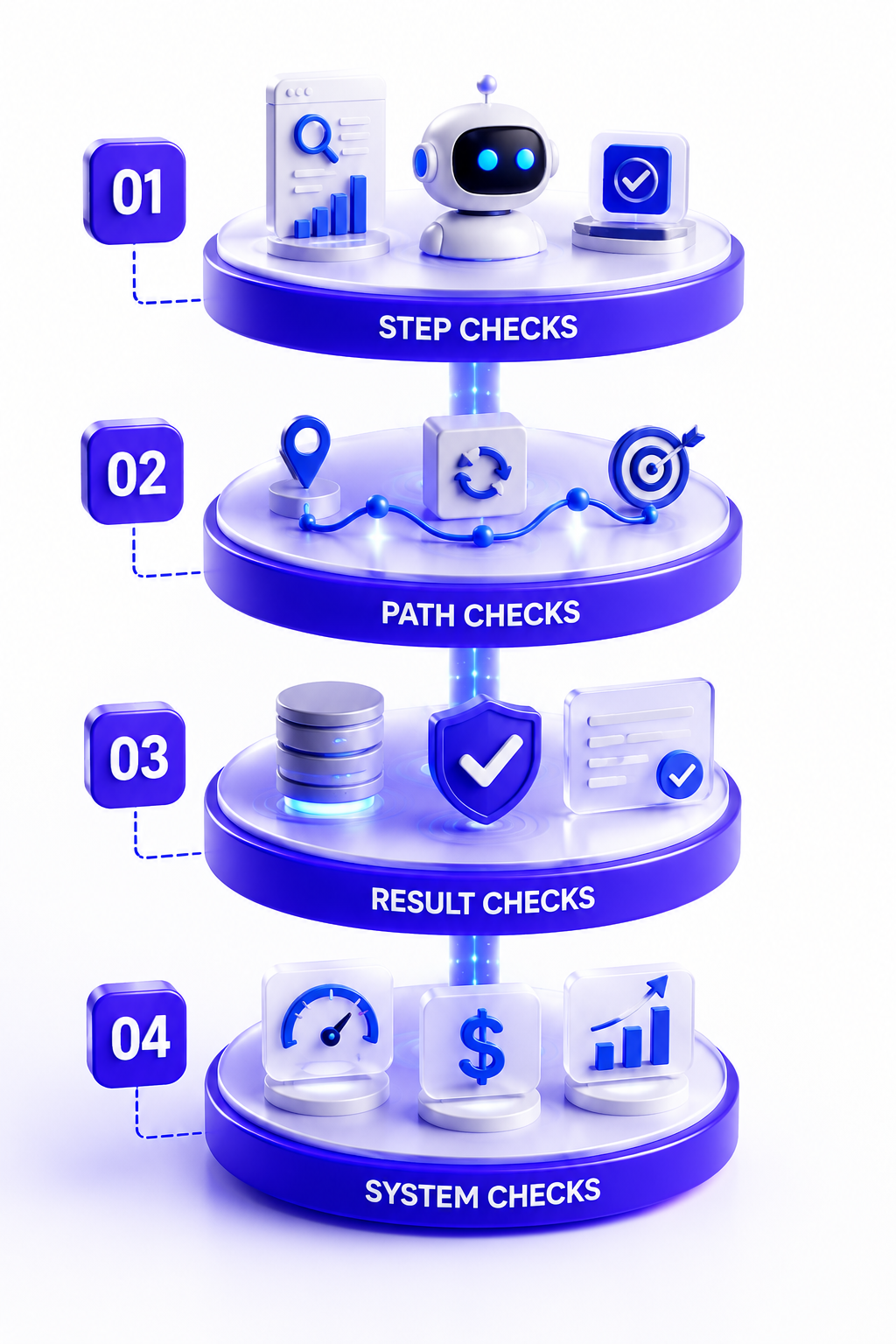
Split your testing into four layers, and each one catches something the others miss.
1. Step checks
The first layer of any AI agent evaluation framework tests individual pieces in isolation.
- Did retrieval pull the right context?
- Did the entity extractor parse the arguments correctly?
- Did the agent pick the right tool for this specific sub-task?
2. Path checks
Look at the whole trajectory, not just the destination.
- Did the plan make sense?
- Did the agent handle dependencies between tools correctly?
- Did it recover when an API call failed, or did it spiral into a loop?
This layer catches agents that technically finish but violate your operating procedures along the way.
3. Result checks
Never trust the agent's own summary. If it says a refund went through, go check the database.
Result checks confirm the actual state of your CRM, ERP, or whatever system the agent touched, not what it claims it did.
4. System checks
Zoom out to the business level: latency, cost per resolved task, and SLA compliance across real-world conditions.
This is where you catch the twenty-redundant-calls problem.
The Metrics That Actually Matter in an AI Agent Evaluation Framework
Tool use accuracy. How often does the agent pick the right tool? Does it fill in complete, correctly typed arguments? Does it complete steps in the required order, verifying identity before changing permissions?
Trajectory efficiency. Each step is evaluated as either good, bad, or indifferent for achieving the goal. Loops are pointed out if an agent is stuck repeating itself or swinging back and forth between competing goals. Compare the number of steps actually taken against the minimum viable path.
Grounding and policy adherence. How much of what the agent says or does is actually backed by verified data, versus assumed? Can it resist prompt injections buried in third-party content? Does it hold the line on regulatory requirements like SOC 2, HIPAA, or PCI-DSS with zero exceptions?
A few concrete targets an AI agent evaluation framework should aim for:
Don't Rely on One Judge in Your AI Agent Evaluation Framework
A single scoring method leaves blind spots. The strongest setups combine three:
Deterministic checks:
- Fast, cheap, and completely consistent.
- They include validation of schemas, API responses, rate limiting, databases, and scanning for any leaking of credentials.
Here is an example of how to validate a refund tool request before it can run:
from typing import Any, Dict
from pydantic import BaseModel, Field, ValidationError

class ToolCallPayload(BaseModel):
    tool_name: str
    arguments: Dict[str, Any]
    step_index: int

class RefundToolSchema(BaseModel):
    customer_id: str = Field(..., pattern=r"^CUST-[0-9]{5}$")
    amount: float = Field(..., gt=0.0, le=5000.0)
    reason: str = Field(..., min_length=5)

def evaluate_tool_step(payload_data: Dict[str, Any]) -> Dict[str, Any]:
    """Check schema and constraints before a tool call runs."""
    try:
        payload = ToolCallPayload(**payload_data)
    except ValidationError as e:
        return {"passed": False, "error_type": "PayloadMalformed", "details": e.errors()}

    if payload.tool_name == "process_refund":
        try:
            args = RefundToolSchema(**payload.arguments)
            return {"passed": True, "step": payload.step_index, "validated_data": args.model_dump()}
        except ValidationError as e:
            return {"passed": False, "step": payload.step_index, "error_type": "SchemaViolation", "details": e.errors()}

    return {"passed": False, "error_type": "UnauthorizedTool", "details": payload.tool_name}
Model-based judges:
- Use these for the fuzzy stuff: tone, reasoning quality, whether a negotiation felt right.
- Calibrate them against human-labeled examples so they don't drift or favor their own outputs.
Human review, on a schedule:
- Automated scoring for 80 percent of the interactions that are regular.
- Manual intervention for the other 20 percent of exceptions and unusual cases.
- Feed what they find back into your golden datasets.
Checking the Path, Not Just the Finish Line
Below is a trajectory verifier, an essential component of any AI agent evaluation methodology, which detects loops, unapproved instruments, and inefficient trajectories prior to the development phase:
from typing import Any, Dict, List, Set

class TrajectoryEvaluator:
    """Flags loops, policy violations, and inefficiency in an agent's run."""

    def __init__(self, allowed_tools: Set[str], max_allowed_steps: int):
        self.allowed_tools = allowed_tools
        self.max_allowed_steps = max_allowed_steps

    def evaluate_trace(self, execution_trace: List[Dict[str, Any]]) -> Dict[str, Any]:
        seen_actions = []
        unauthorized_tools_used = []
        loop_detected = False

        for step in execution_trace:
            tool = step.get("tool_name")
            args = str(sorted(step.get("arguments", {}).items()))
            signature = (tool, args)

            if tool and tool not in self.allowed_tools:
                unauthorized_tools_used.append(tool)
            if seen_actions and seen_actions[-1] == signature:
                loop_detected = True
            seen_actions.append(signature)

        total_steps = len(execution_trace)
        step_efficiency = min(1.0, self.max_allowed_steps / max(1, total_steps))
        is_compliant = not unauthorized_tools_used and not loop_detected
        passed = is_compliant and total_steps <= self.max_allowed_steps

        return {
            "passed": passed,
            "total_steps": total_steps,
            "step_efficiency_ratio": round(step_efficiency, 2),
            "loop_detected": loop_detected,
            "unauthorized_tools": list(set(unauthorized_tools_used)),
        }
Building an AI Agent Evaluation Framework Into Your Pipeline
Four stages keep an AI agent evaluation framework running continuously instead of as a one-off test:
- Curate a golden dataset. Version-control your test scenarios, edge cases, and adversarial prompts.
- Run in a sandbox. Test against mock databases and isolated APIs, never live systems.
- Score the full trace. Check schemas, step efficiency, and final state, not just the last message.
- Feed failures back in. Every real production failure becomes a permanent regression test.
Where a Platform Like Thunai Fits In
Designing and implementing an AI agent evaluation framework from the ground up may prove challenging. The Thunai platform can assist your team to incorporate evaluation, monitoring, and governance within the workflow.
- Ensure that the actions of your agent are grounded in reliable knowledge: Thunai Brain and SafeMind provide tools to ensure that the actions taken by agents are based on verified company information.
- Evaluate all customer interactions: Rather than just evaluating small QA sample sets, Thunai is capable of evaluating voice, chat, and email interactions using thunai omni to uncover any problems.
- Real-time monitoring of agent actions: Monitoring live traces will allow you to uncover feedback loops, policy drifts, and potentially harmful behaviors from your agents.
- Verify that things happened as expected: Traceability of actions made by the agent and API interactions provides insight on how the agent made the decision to take certain action.
- Designed for enterprise-level governance: Knowledge graphs and tenant data isolation features of Thunai make it suitable for enterprise governance requirements.
Thunai is rated 5 out of 5 on G2 by its reviewers, who especially liked its meeting summary feature and some technical features.
The Bottom Line on Your AI Agent Evaluation Framework
A good AI agent evaluation framework turns an agent from a demo you're nervous about into infrastructure you can trust. Layer your checks: step, path, result, system.
Mix deterministic rules, calibrated model judges, and human review.
Feed every production failure back into your test suite.
Do that consistently, and you catch the failures that matter before your customers do.
Build AI agents you can trust. See how Thunai helps monitor agent actions, evaluate interactions, and catch issues before they impact customers. Book a demo today.
FAQs
What is an AI agent evaluation framework?
An AI agent evaluation framework is the framework that tests the tool usage, execution path, results achieved, grounding of the results, compliance, cost, and performance of the AI agent.
How do you evaluate an AI agent?
There are four layers of evaluating an AI agent including step evaluation, path evaluation, result evaluation, and system evaluation. Using a combination of deterministic rules, model-based judge, and human evaluation will yield better results.
Why is AI agent evaluation necessary?
The AI agent can perform multiple tool calls, fail to work properly, enter into a loop, or change things wrongly despite the right response achieved by the agent.