
What if one phone call could help in saving a policy?
Insurers have lost customers for lack of renewal or inability to give a quick reply.
AI agents will ensure customers receive reminders, their questions answered, payment taken, and renewal done all at once.
This article highlights how AI helps insurers retain more customers and earn money.
Why policy renewals leak revenue
The reminder email ceiling (open rates vs. completion rates)
- Email open rates for renewal notices often sit between 20% and 35%, even Mailchimp mentioned this.
- Click and completion rates are much lower.
- Many customers read the notice. They get confused about a rate change.
- They never call back. They just let the policy expire. AI Agents for Policy Renewals fix this gap.
Renewal call volume concentrates into short windows — capacity math
- Renewals cluster around policy anniversaries and rate change cycles.
- Call volumes spike fast. No contact center can staff that fast.
- Hold times rise. Customers start shopping for competitors.
- Agents fall back on scripts. These scripts do not address why a premium went up.
- AI Agents for Policy Renewals scale instantly.
What a lapsed policy actually costs (reacquisition vs. retention cost)
- Acquiring a replacement policyholder costs seven to nine times more than keeping an existing one.
- A single mishandled renewal call can trigger a complaint. It can trigger a chargeback dispute. It can trigger a regulatory flag.
- AI agents change the math. They answer coverage questions.
- They send payment links. They explain rate changes the instant a customer asks.
- They do this day or night. They do not read from a card.
- AI Agents for Policy Renewals cut these costs.
What is an AI renewal agent actually?
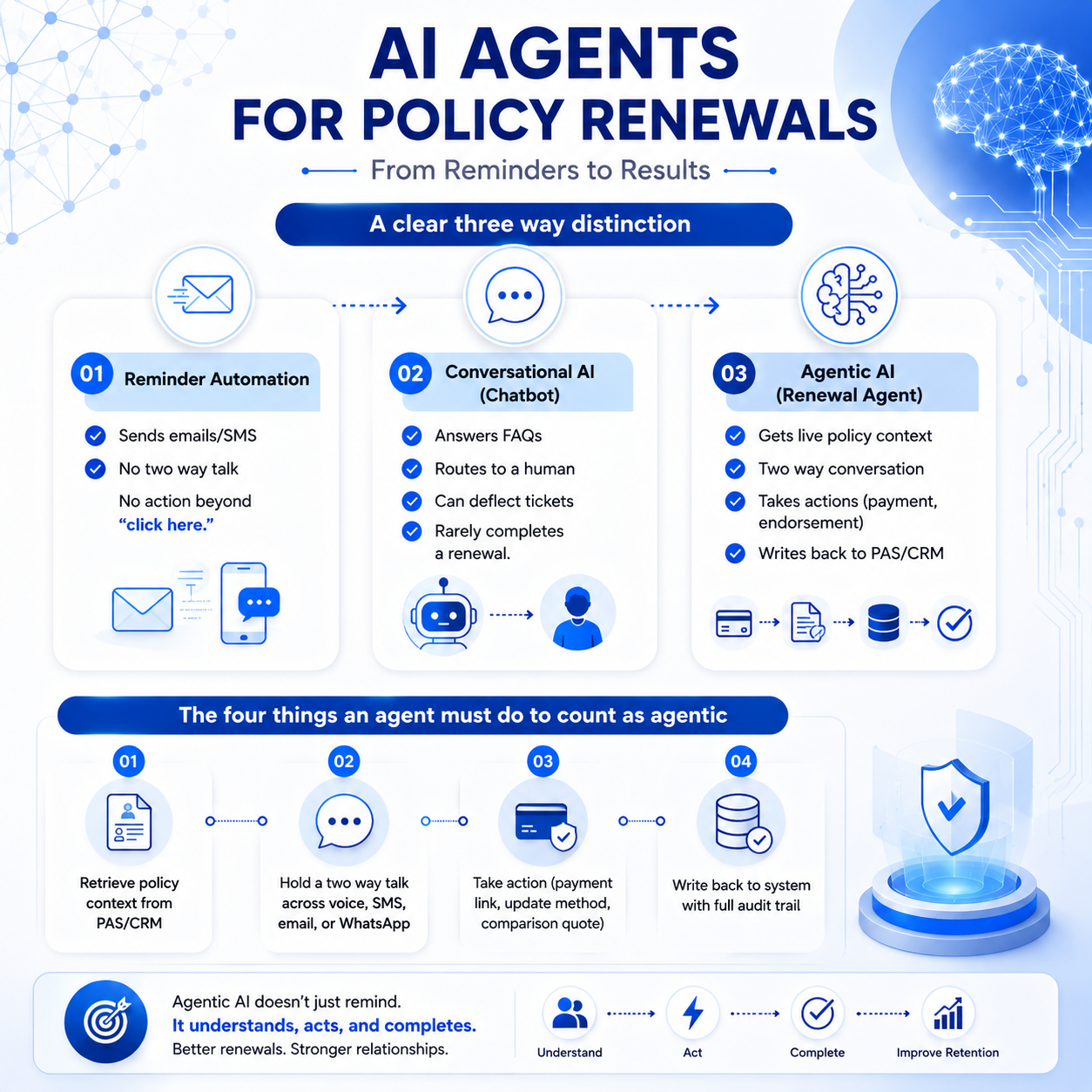
Reminder automation vs. conversational AI vs. agentic AI — a clear three-way distinction
- Reminder automation: Sends static emails or SMS at T-60, T-30, T-7. No two-way talk. No action beyond "click here."
- Conversational AI (chatbot): Answers FAQs and routes to a human. It can deflect tickets. It rarely completes a renewal.
- Agentic AI (renewal agent): Retrieves live policy context. It holds a two-way talk. It takes actions (payment, endorsement). It writes back to your policy admin system (PAS) or CRM. AI Agents for Policy Renewals do all four.
The four things an agent must do to count as agentic
- Retrieve policy context from PAS/CRM in real time.
- Hold a two-way talk across voice, SMS, email, or WhatsApp.
- Take an action such as sending a payment link. It can update a method. It can generate a comparison quote.
- Write back to the system of record with a full audit trail. AI Agents for Policy Renewals meet this standard.
The End-to-End AI Renewal Workflow
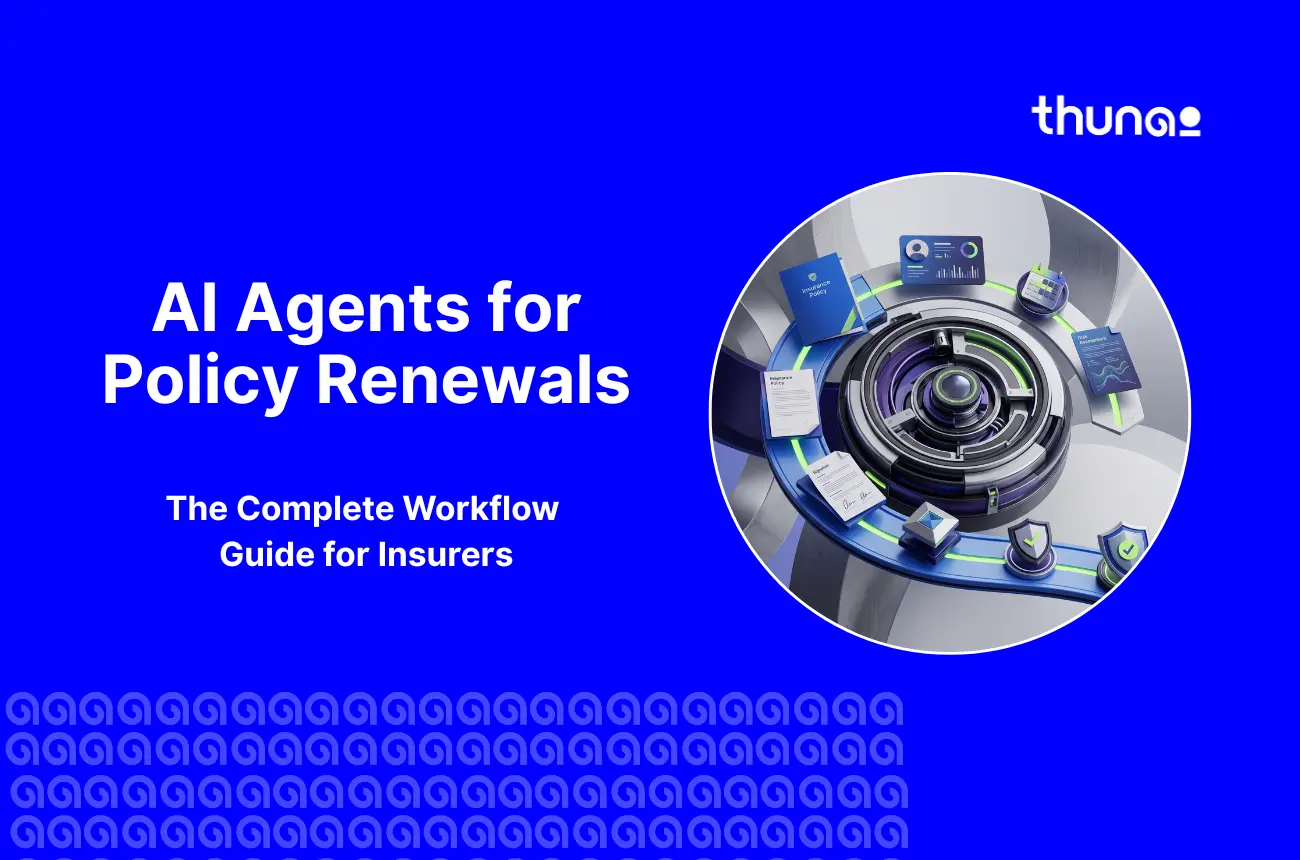
The operational lifecycle for AI Agents for Policy Renewals spans seven sequential steps.
Predictive models grade the risk of lapsed policy based on price changes, claims, and previous contact preferences of the policyholder.
Channels such as Voice, SMS, Email, or WhatsApp are chosen depending on the customer profile. Once contacted, the system retrieves all policy information from the PAS and CRM.
During live chats, AI Agents for Policy Renewals answer objections about price increases or policy changes. The agent finds coverage gaps, offers bundle options, collects secure payment info, and saves all updates to core databases.
Renewal objections AI agents can and can't handle
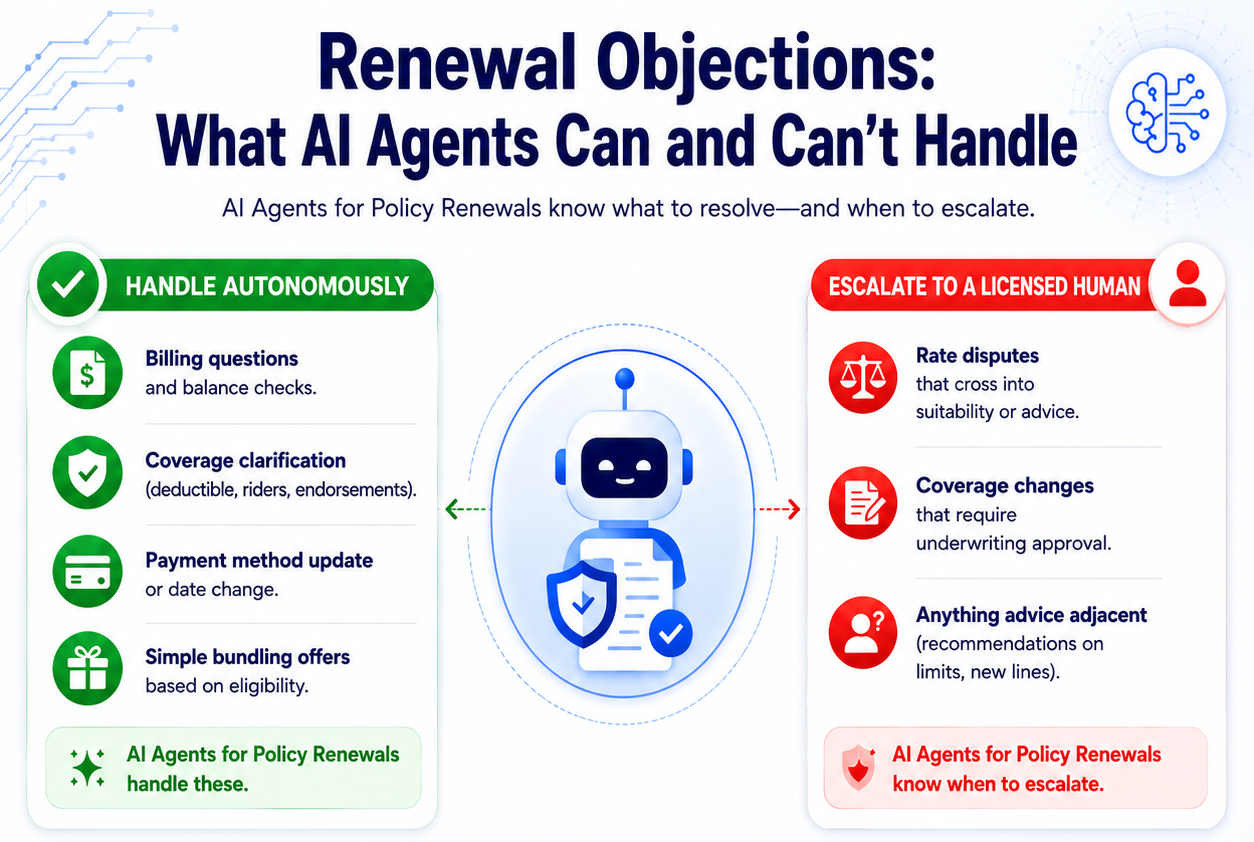
Handle autonomously
- Billing questions and balance checks.
- Coverage clarification (deductible, riders, endorsements).
- Payment method update or date change.
- Simple bundling offers based on eligibility. AI Agents for Policy Renewals handle these.
Escalate to a licensed human
- Rate disputes that cross into suitability or advice.
- Coverage changes that require underwriting approval.
- Anything advice-adjacent (recommendations on limits, new lines). AI Agents for Policy Renewals know when to escalate.
Designing the escalation threshold
- Some renewal moments require a licensed agent.
- This is especially true when advice crosses into a regulated recommendation.
- The AI should recognize those boundaries.
- It should be handed off with full context. It should never improvise on suitability or coverage advice.
- AI Agents for Policy Renewals respect these lines.
What good looks like — benchmarks
- Insurance carriers that automate renewal outreach with AI agents see retention improvements of 10 to 15 percentage points.
- According to the Gitnux Insurance Customer Retention Statistics 2026 report, this is compared to manual-only workflows. Industry average retention rates hover around 84% for personal lines and 85% for commercial lines.
- Even a modest improvement translates to significant premium preservation. AI Agents for Policy Renewals deliver these gains.
- The AI-based renewal interactions cost a fraction of phone calls. The cost is about $0.50 to $0.70 per interaction. The phone call costs between $8 and $15 per call.
- Carriers processing 20,000 renewal touches per quarter can reduce outreach costs by 85 to 90%. They can reallocate those savings toward complex retention cases.
- These cases genuinely require a licensed agent's expertise. AI Agents for Policy Renewals cut these costs.
- Renewal conversations are one of the highest intent moments in the policyholder lifecycle. AI agents that identify coverage gaps and present bundling options during renewal see cross-sell attachment rates of 8 to 12%.
- Passive renewal mailers see 2 to 4%. AI Agents for Policy Renewals drive these attachments.
Compliance Guardrails for Outbound Renewal Outreach
Outbound automated messages require strong compliance controls to avoid heavy legal fines.
- TCPA and FCC Consent Regulations: Based on FCC regulations, outbound AI voice calls are covered by TCPA regulations. Insurers should have Prior Express Written Consent (PEWC) to place such automated calls. Penalties for TCPA violations are between $500 and $1,500 per call without any cap on total fees.
- AI Voice Call Recording Regulation: States require clear disclosures at the beginning of the call. The agent is required to announce that the call is made using AI voice technology and that the call is being recorded.
- Scorable Audit Trail: All calls made by AI Agents for Policy Renewals should be transcribed, audited, and kept for audit purposes.
- Data Residency and Protection of Personal Information: Data pertaining to policyholders should be stored in isolated and secure locations that comply with SOC2 Type II, HIPAA, and regional regulations.
Build vs. buy — evaluation checklist
Enterprise Policy Renewal Automation with Thunai
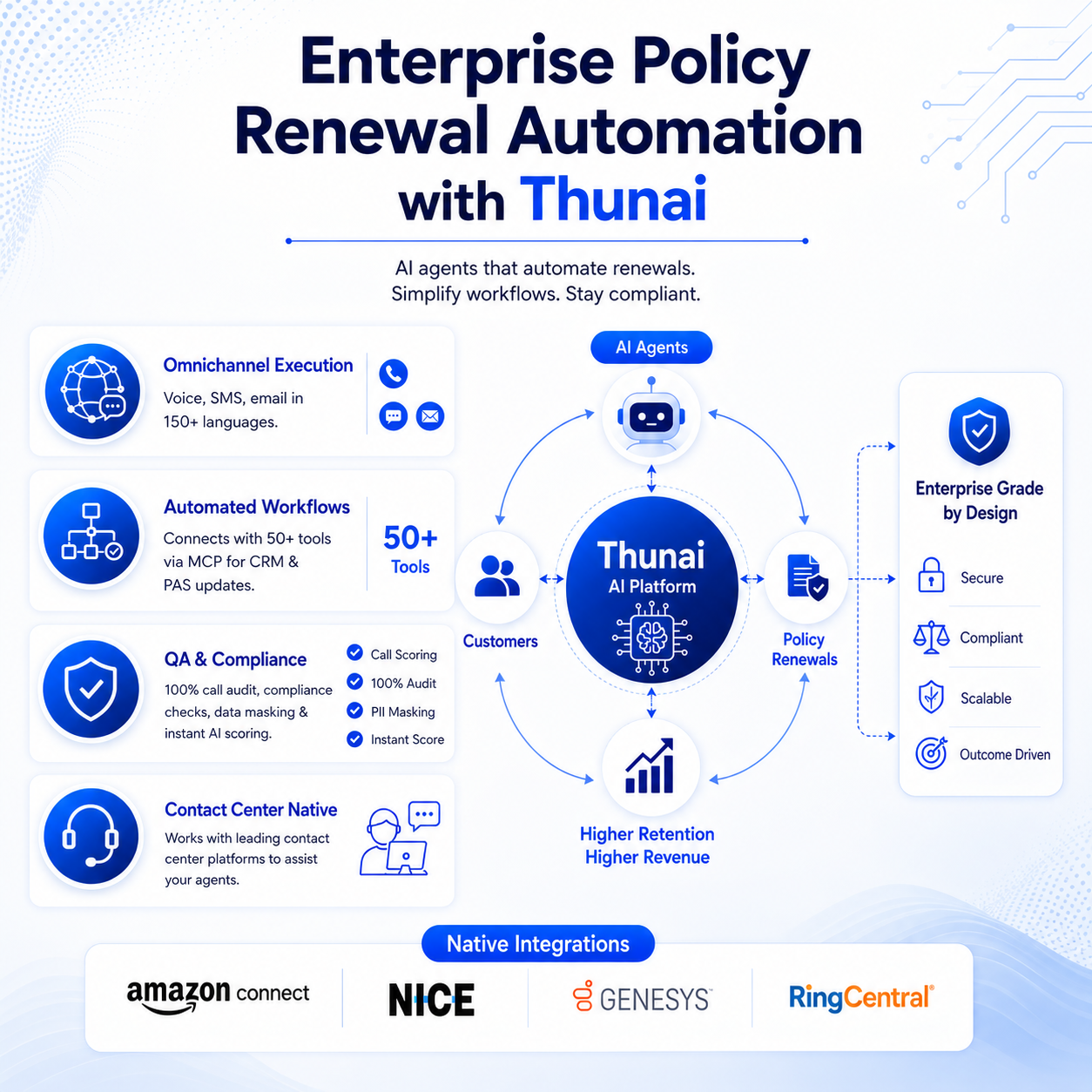
Thunai provides an enterprise AI platform that automates customer workflows across insurance lifecycles. By using Thunai, carriers deploy advanced AI agents for insurance to handle complete renewals while meeting compliance rules.
- Omnichannel Execution: With Thunai Omni as its backbone, it manages voice, SMS, and emails in more than 150 languages, along with context management across channels.
- Automated Workflow Execution: With the help of workflow automation and Multi-Connect Protocol (MCP), Thunai connects with more than 50 tools for automatic CRM and PAS updates.
- Automated QA and Compliance: Through AI call scoring, Thunai audits 100% of customer calls, checks compliance terms, hides private data, and scores conversations instantly.
- Contact Centre Native: Built for enterprise contact centre setups, Thunai connects directly with Amazon Connect, NICE, Genesys, and RingCentral to assist human reps during escalations.
Industry Feedback:
- Contact center leaders report great results with Thunai. Operations executives achieve an 80% deflection rate for common questions and 5X faster issue resolution.
- As per G2 reviews, users mentioned, "The agents automate my email follow-ups and handle lead qualification, which has saved me hours every day without the need for scripts."
Turn every renewal reminder into a revenue conversation with AI-powered policy renewal automation. Schedule a demo today.
FAQs
Can an AI agent legally process an insurance renewal?
Yes. AI Agents for Policy Renewals can legally process renewals, collect payments, and send policy files when following TCPA consent and state laws. Any official advice or coverage changes must go to a licensed agent.
What is the difference between an AI renewal agent and a chatbot?
Chatbots only give generic answers. AI Agents for Policy Renewals execute complete workflows. They connect to core databases, hold natural conversations, process payments, and update records automatically.
How long does it take to deploy an AI renewal agent?
Platforms like Thunai deploy in 2 to 4 weeks using ready-made connectors. Custom internal builds often take up to 14 months.
Will customers accept renewing with an AI agent?
Yes. Customers like fast answers, zero hold times, and smooth experiences. When hard questions come up, smooth handoffs to human agents maintain high trust.
Is there any need for the AI agent to access our PAS?
Yes. The AI Agents for Policy Renewals will require direct connectivity with your PAS and CRM in order to access the policy information, verify the information, and create renewal confirmations.