
What if your insurance company could spot a compliance risk before it escalated into a regulatory issue?
Each and every claims call poses certain risks, from inaccurate coverage descriptions to missed deadlines and broken promises.
However, many insurance companies still use traditional manual audits that examine only a fraction of calls.
For CEOs and CTOs, the key to success is making claims quality assurance a process driven by AI technology.
What is claims quality assurance?
Claims quality assurance involves the continuous evaluation of three items: how claims are decided upon, what is said, and what is written down. The reviewers compare all three to the company’s standards and state insurance laws. This is very simple. Pay fair claims in good time while abiding by the disclosure regulations.
Most carriers split the work into two tracks:
- File QA: Evaluators open closed claim files. They look at coverage letters, estimate line items, reserve changes and subrogation records. All of it happens weeks after settlement.
- Call QA: Contact center supervisors listen to frontline staff. They check phone manners, handle time, hold time and greetings.
See the problem? Supervisors rarely know contract terms. Claims examiners rarely hear a call recording. Each side sees half the picture.
Modern claims quality assurance fixes that with shared ownership. A dedicated claims quality team runs the program.
Compliance officers and contact center managers sit beside them. Together they read the file and hear the call, side by side.
Why claims conversations now need QA, not only claim files
Notes only show what an adjuster felt like typing. Picture the entry: “Called insured. Discussed estimate.” The real call might have been a shouting match over contractor costs. If you only review closed files, your claims quality assurance program has a hole in it, and that hole is where the risk lives.
Recent cases show what unmonitored calls can cost:
- California Department of Insurance Action (May 2026):
- An Order to Show Cause was filed against State Farm General Insurance Company by the California DOI.
- This came after the examination conducted regarding the 2025 Los Angeles wildfires.
- Examiners sampled 220 residential claims and found 398 statutory violations across 114 files. Investigations started late, beyond the 15-day mark.
- Required 30-day delay notices were missed.
- And adjusters rotated so often that policyholders couldn’t get a straight answer.
- United Policyholders Disaster Survey (March 2026):
- Wildfire survivors reported serious claim problems 80% of the time.
- Seven in ten still weren’t home after twelve months.
- Their biggest gripes? Unanswered phone calls, conflicting numbers by different adjusters, and broken promises made verbally.
- J.D. Power 2026 U.S. Property Claims Satisfaction Study:
- Satisfaction rose to 702 on a 1,000-point scale. Good news, right? Not quite.
- The average time from First Notice of Loss (FNOL) to final payment stayed high at 40.7 days.
- And one in five policyholders was unhappy with how their carrier communicated during settlement talks.
Proactive claims quality assurance is no longer optional. When an adjuster’s words clash with the claim record, penalties can come fast. A structured approach to claims quality assurance helps adjusters hit their deadlines and treat people fairly.
What regulators look for in claims communication
State insurance departments enforce Unfair Claims Settlement Practices Acts (UCSPA). These follow the model regulation from the National Association of Insurance Commissioners (NAIC).
Regulators grade carriers on strict market conduct standards, and those standards demand sound claims quality assurance. Timelines differ by state. Still, regulators watch four areas of clear, timely communication:
- Prompt Acknowledgment: The insurers are supposed to acknowledge the claim notice within a specified period, which could be 15 days. They should also send the claim forms.
- Timely Investigation and Decisions: Adjusters must accept or deny a claim within the statutory period. That’s typically 40 calendar days after proof of loss.
- Mandatory Delay Notices: Need more time? Then send a written explanation every 30 days, with the reasons for the delay.
- Coverage Explanation with Transparency: The offer and rejection must refer to specific parts of the plan. The verbal denial without any subsequent written explanation violates state laws.
(State insurance regulations vary. These workflows represent general compliance practices and are not legal advice.)
Many carriers pair this with proactive contact center risk management. It keeps frontline compliance in view and helps avoid enforcement actions.
The claims call QA framework
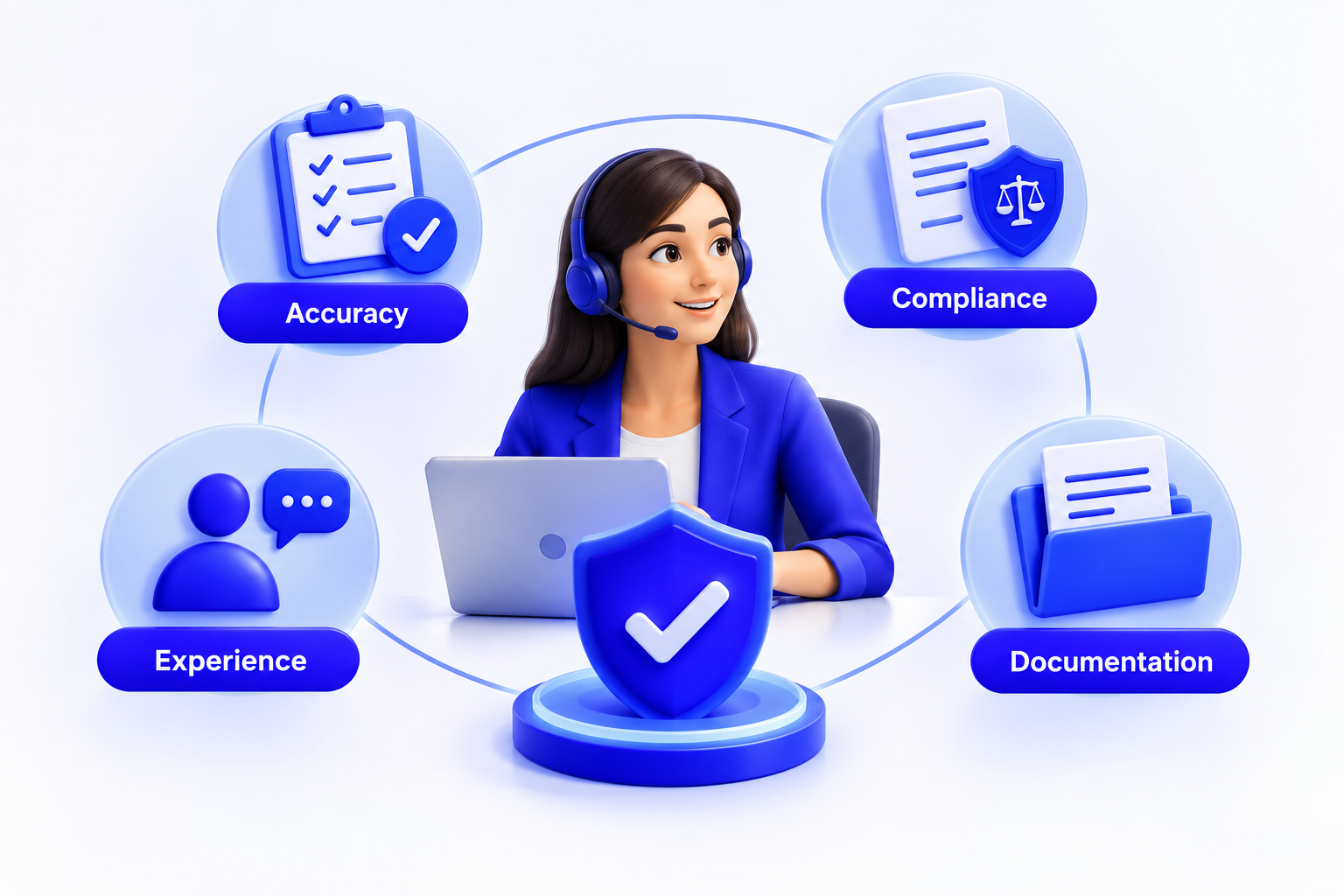
The reliable claim quality assurance program rates each phone call through four interconnected pillars: Accuracy, Compliance, Experience, and Documentation.
Accuracy: status, coverage, and payment facts match the file
- Did the adjuster give the right facts?
- Evaluators check current reserves, deductibles, coverage sub-limits, and payment release dates.
- What’s said out loud has to match the core claims system, down to the cent.
Compliance: required explanations and timelines given
- Evaluators listen for mandatory state notices.
- If an investigation runs long, the adjuster has to say why and log a statutory follow-up task.
- And no citing an exclusion without the exact endorsement language.
Experience: empathy, clarity, ownership
- Property claims are stressful. The people have been left homeless.
- This is why clarity, listening, de-escalation, and accountability become key criteria for evaluators.
- By the time the phone conversation ends, the caller should know what will happen next.
Documentation: notes and next steps logged
The audit checks for full file notes right after the call. Say an adjuster approves an emergency board-up or a hotel advance by phone. That approval belongs in the permanent claim log. Not in someone’s memory.
Put together, the four pillars make a claims quality assurance scorecard that protects carriers during exams:
(Want rubrics for other insurance roles? See our companion guide on call center agent scorecard templates.)
Sampling: how many claims calls to review
Most teams review 1% to 3% of calls. That’s four or five calls per adjuster each month. It’s too thin. When storms hit, claims quality assurance should move away from random picks and toward risk-based selection. Carriers usually weigh three options:
With risk-based sampling, fraud flags and coverage disputes go to the front of the line. Add claims fraud detection rules, and your quality team can test intake statements against damage photos and loss dates.
Calibration between claims, QA and compliance
Even a great program drifts. One evaluator shrugs at a loose disclosure. Another calls it a fatal error. Left alone, that kind of gap eats away at your claims quality assurance program.
The fix is a calibration session every two weeks:
- Select an Anchor Call: Pick a tough one, like a contested water loss or a commercial business interruption claim.
- Score Independently: Two claims adjusters, a compliance officer, and two quality assurance analysts evaluate the call using the rubric.
- Comparing Results: Get together. Go over the score differences and settle any disputes.
- Adjustment of the Rubric: Modify the tool until the evaluators come to agreement in the 95% to 100% range.
Claim quality teams get information from scorers who have been calibrated and would pass a regulator's audit.
Scaling claims QA during catastrophe events
Catastrophe (CAT) events push claims centers to the edge. When Hurricane Milton hit Florida, carriers faced an estimated 385,146 claims within days. To cope, they brought in hundreds of independent adjusters (IAs) and third-party administrators (TPAs).
Manual audits just can’t keep up:
- Temporary adjusters may not know each state’s communication laws.
- Reassignments climb, so policyholders retell their story again and again.
- Queues spike, and abandoned calls and dropped callbacks follow.
Scaling claims quality assurance in a catastrophe takes automated oversight on every incoming call.
A good platform checks each surge call against emergency scripts. It confirms that independent adjusters gave required disclosures. And it flags stalled claims before the complaint letters arrive.
Teams can also adopt workflow automation for insurance claims to withstand any surge without employing additional manpower.
Using AI to score claims calls: what works and what does not
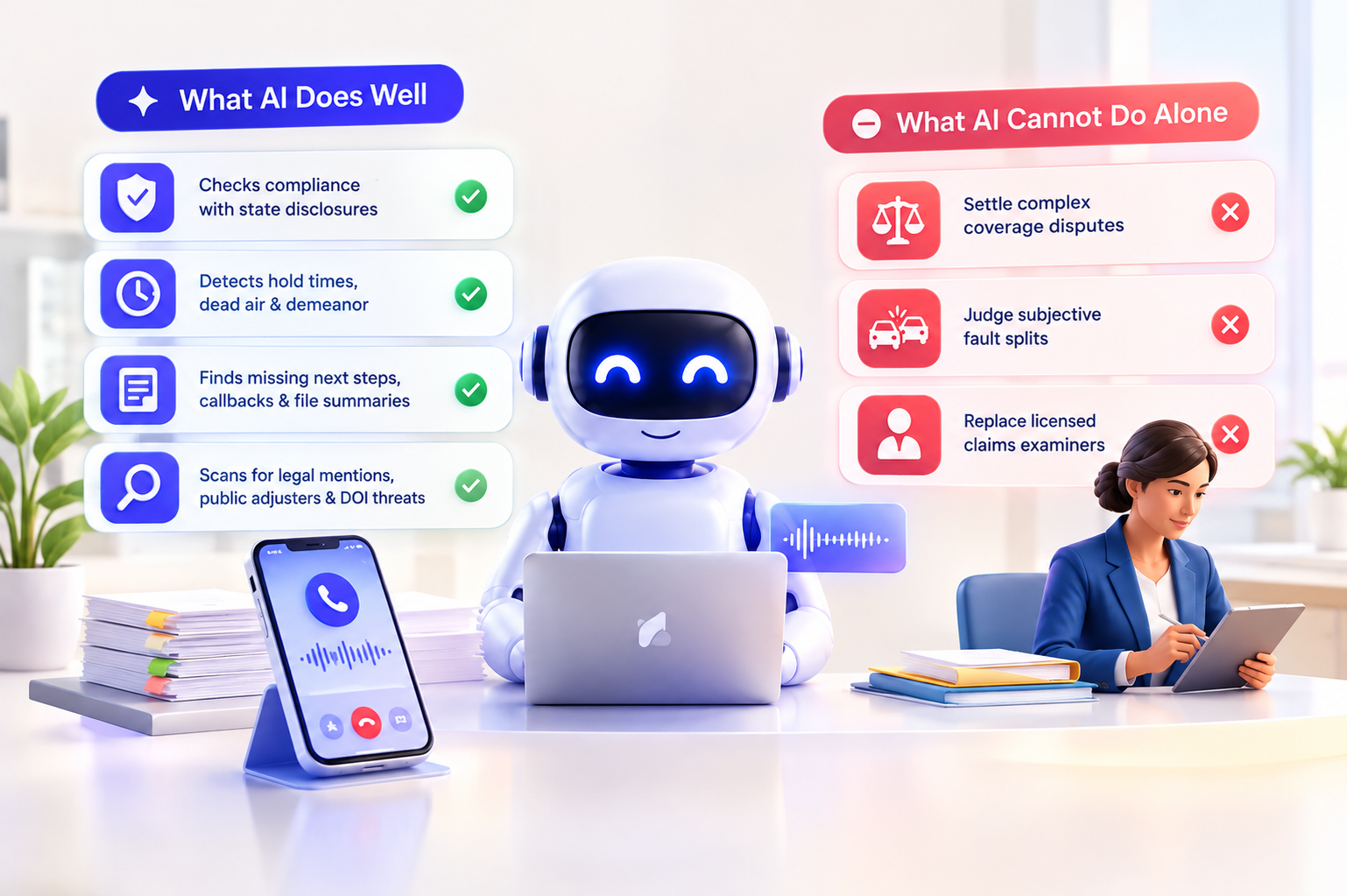
AI is changing claims quality assurance because it can audit conversations at a scale no human team can match. But it isn’t magic. Leaders should know where it shines and where people still need to step in.
What AI Does Well:
- Ensures compliance with mandated state disclosure requirements exactly.
- Detects long hold times, dead air, and changes in the policyholder’s demeanor.
- Finds missing next steps, broken callback promises, and absent file summaries.
- Scans transcripts for legal mentions, public adjuster involvement, or DOI threats.
What AI Cannot Do Alone:
- Settle complex coverage disputes that turn on legal intent or conflicting engineering reports.
- Judge subjective fault splits in multi-vehicle collisions.
- Replace licensed claims examiners in final claim decisions.
Thunai delivers an enterprise setup for claims quality assurance by tying spoken audio to policy systems. Here’s how it runs:
- Interaction Capturing: Voice, chat, and email capture interactions in real time.
- Event Pipeline: IBM Confluent and Apache Kafka transmit conversation events in low-latency and zero-loss mode.
- Intelligent Processing: The processing is done by Thunai Brain based on the company’s scorecard, conditions of the policy, and deadline.
- Automation: The system rates all calls, determines violations, populates CRM, and generates call logs.
Through Kafka pipelines, Thunai Brain checks call audio against policy language and state rules without data loss. This could be combined by insurers with quality assurance in real time and conversational AI in insurance in order to safeguard carrier standards. Upgrading your technology? Look at current AI tools for insurance claims processing to cut manual data entry. For more depth, read Thunai’s guides on AI call scoring and speech analytics for insurance.
Verified enterprise reviews on G2 and Capterra give Thunai a 4.8/5 rating. Claims teams report strong gains:
- 42% to 66% cut in handle times: Automated summaries replace the repetitive typing after each call.
- 85% First Contact Resolution (FCR): Adjusters get real-time guidance, so complex policy questions get answered on the first call.
- Zero rater bias: Thunai’s acoustic models judge speech patterns objectively, which removes accent bias across global teams.
Conversational intelligence turns claims quality assurance into an active shield against compliance fines. And AI call scoring shows you every customer touchpoint, not just a lucky sample.
Claims QA metrics
A strong claims quality assurance program tracks both efficiency and how policyholders fare. Claims executives watch six core metrics:
- QA Pass Rate by Claim Type: The share of claims that meet compliance standards across auto, property, and commercial lines.
- Complaint Ratio: Department of Insurance complaints per 1,000 resolved claims.
- Repeat Contact Rate: This measures how many times the insured contacts back for the same open item.
- Reopen Rate of Claims: Files that are closed and are reopened due to any damage not reported.
- Time of First Contact: Time period between the FNOCL and First contact of the adjuster.
- After Call Work (ACW): Time taken to enter notes and make a diary for claims.
Keep an eye on these, and loss adjustment expenses drop while service stays strong.
Ready to modernize your audit workflow? Schedule a demo with Thunai today and see how automated call scoring shows you every claim interaction.
FAQs
What is a claims quality assurance analyst accountable for?
As a claims quality assurance analyst, it is required that you evaluate the manner in which the adjuster manages the claim files and communication with policyholders. The analysts evaluate the calls and ensure that the coverage decisions are correct and that the claim files comply with company policies and state guidelines.
How is claims QA different from a claims audit?
Claims quality assurance is an ongoing coaching and monitoring process. It aims to improve adjuster habits day by day. A claims audit is different. It’s a periodic, backward-looking inspection by internal auditors, reinsurance partners or state examiners. For an overview, see our guide on the call center audit process.
What are unfair claims settlement practices?
These are insurer actions banned under state law and NAIC Model Act #900. Think misstating coverage facts, failing to acknowledge a claim promptly, refusing a valid claim without a fair investigation, or skipping the written reason for a denial.
How often should claims calls be reviewed?
Manual programs should review at least four to five calls per adjuster each month. Modern carriers use automated systems to review 100% of calls in real time. Full coverage flags risk right away and gives supervisors a quick chance to coach.
Protect Your Organization with Modern Claims QA
Regulatory scrutiny is rising. Policyholders expect clear, honest communication. Relying on paper file audits leaves carriers open to fines and lost customers. Modern claims quality assurance unifies spoken calls and claim records. The payoff is stronger compliance and more policyholder trust.