



With AI chatbots, insurance companies can pull in a 200 to 600% ROI. However, that only works when the average handling time is cut by up to 40% as well.
The problem?
In a heavily regulated industry, wrong advice can open your company up to E&O liability, regulatory fines, and loss of trust.
So the actual question becomes: how do you deploy AI chatbots for explanation purposes in the context of insurance coverage without falling into all those pitfalls?
Here’s what you need to know about what insurance chatbots do, their benefits, and the issues they come with.
Why Insurers Require Chatbots to Explain Coverage
Human agents are still the best choice for interacting with potential policy holders and any existing ones - but even that varies
That said, not using chatbots for insurance coverage means you’ll run into the same issues over time:
- Low Agent Bandwidth: Accenture reports that underwriters spend up to 40% of their time on admin tasks. With an increase in the number of claims, there is no scope for the agent to guide the customers regarding their policy details.
- Long Wait Times: Customers who are unable to get immediate answers on the details regarding the deductibles and claim eligibility will surely leave. How can chatbots benefit us? They help reduce this
- Need for 24 x 7 Support: 82% of consumers expect multiple channel options from their insurance provider. Incidents do not follow business hours. The customers always want answers to their queries immediately. It means that a response the next day cannot work.
What Chatbots Handle When Explaining Insurance Coverage
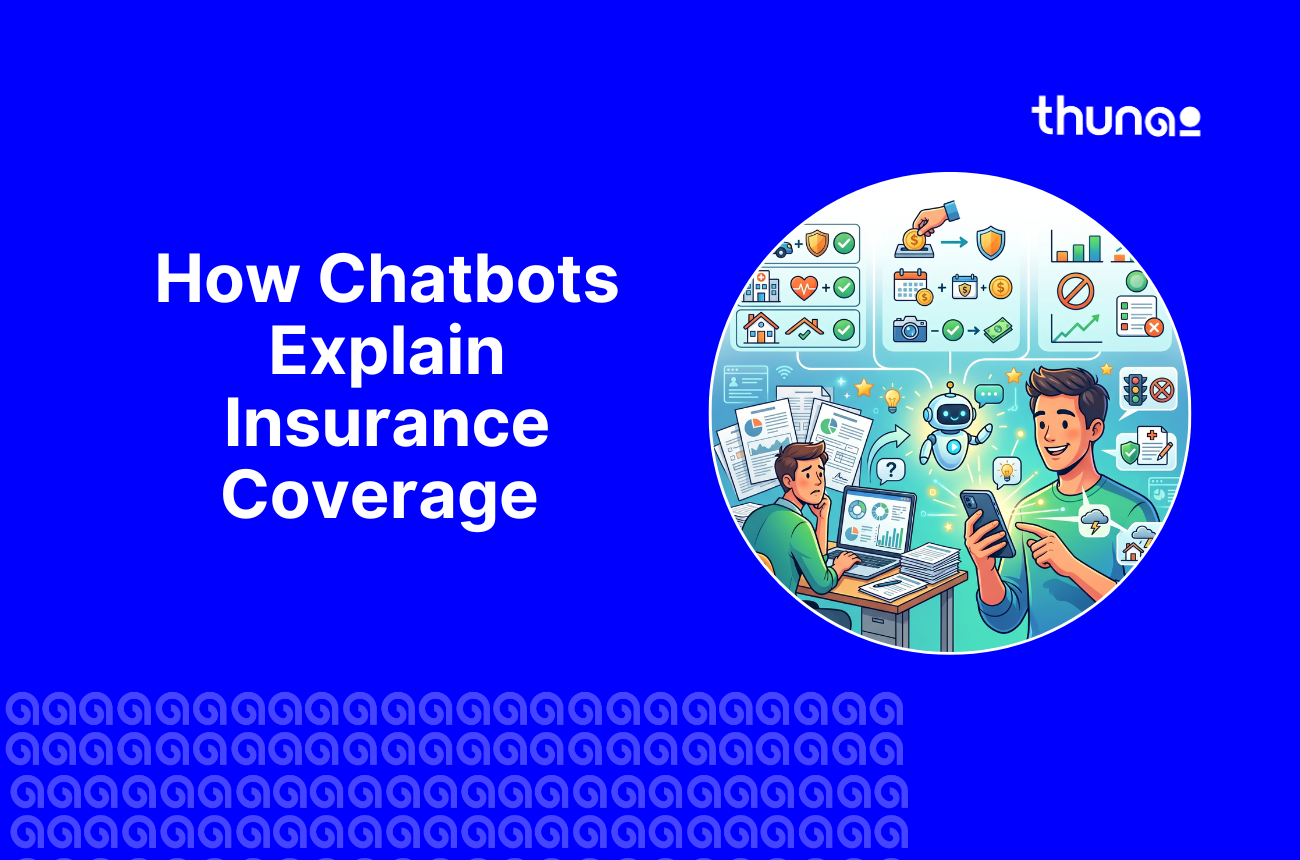
Modern insurance chatbots do more than answer FAQs. When built on RAG architecture with live CRM connections and policy document uploads, they can take care of the full range of coverage questions.
In doing so, a human agent does not need to be involved. Here is how this works in action:
- Policy terms and industry jargon: AI chatbots make use of NLP to align questions with the appropriate terminology. This means that clients get the right answers regardless of whether they speak the language of policies or use common terminology.
- Coverage limits and sub-limits: Chatbots connect to Policy Admin Systems and pull up a specific policyholder's file. In doing so, they can clearly lay out exact total and per-incident limits for that customer.
- Deductibles and co-pays: Chatbots look at the particular policy data and guide clients through their out-of-pocket expenses in such a way that explains when these costs apply and how much they differ by plan type.
- Exclusions and exceptions: Purpose-built insurance chatbots look up the specific policy document before responding. Questions that are unclear or legally sensitive get passed on to a licensed agent. The full conversation context is sent along as well.
- Riders and add-on benefits: During renewals and onboarding, chatbots break down how riders or endorsements change the base policy. But also, they can flag relevant add-ons based on the customer's current coverage.
- Waiting periods: Chatbots clarify all waiting periods needed for health insurance and pet insurance right from the beginning. In doing so, they prevent early claims, reduce paperwork, and also help create better expectations before policyholders file the claim.
- Eligibility for claims: Chatbots help the customer understand the eligibility criteria before filing a formal FNOL claim and collect all the necessary information. In case of complicated claims, they are passed to the adjuster.
- Terms of Renewal and Cancellation: Chatbots issue payment alerts and notify about the changing premiums. If the customer raises the point of cancellation, the chatbot informs them about the terms of cancellation and the pro-rated refunds, if any.

Benefits of Using Chatbots for Coverage, Claim Eligibility, and Plan Comparisons
The following are some benefits of using AI for insurance coverage clarifications.
Specifically, we list those that actually make a difference to insurance operations teams:
1. 24/7 Availability and Faster Resolutions
The biggest day-one win with insurance chatbots is faster response times. Standard claims processes take 10 to 15 days. However, they can run even longer in complex cases. AI cuts this down fast.
- Ping An Insurance brought average auto claims processing down from 5–10 days to 30 minutes. In doing so, they maintained 90% decision accuracy.
- For coverage questions, chatbots handle thousands of requests at once. Meaning, there are no hold times, no callbacks, and no dropped conversations between shifts.
2. Lower Costs and Easier Scaling
The cost gap between AI and manual coverage support is large. Gartner and IJECM research show that AI-powered tools can cut customer service running costs by 30 to 40%. However, the savings go further than that.
- For mid-sized insurers, this means keeping up with the same number of questions as large carriers. In doing so, there is no need to add more staff or increase spending.
3. Higher Policyholder Engagement and CSAT
One finding that often catches insurance teams off guard is this: taking humans out of routine interactions can push up satisfaction scores. However, that only holds true when the AI is set up and rolled out correctly.
- Comm100 data shows CSAT held at 4.1 out of 5 even after AI took over routine questions. Chatbot satisfaction scores went up by 9.1%. But also, chatbot-to-agent handoff satisfaction came in at 92.6%.
- Matic Insurance brought in AI for automated coverage outreach. In doing so, the company recorded an NPS score of 90 alongside 8,000 automated interactions per quarter.
4. Clearer Customer Understanding
Policy documentation is difficult and complicated to go through for most customers. However, with an AI chatbot linked to approved knowledge bases, customers get explanations in clear and understandable language related to their policies.
- Instead of sending customers a document that is 40 pages long, the chatbot will show the relevant clause in relation to the issue in question, explaining it in plain language that relates to the customer's policy.
- The chatbot has 100% QA coverage as well as transcripts of all interactions. Manual QA covers less than 2% of all calls. This means that AI closes a huge gap in compliance coverage.
Limitations of Using Chatbots for Insurance Coverage
While the ROI is real, so are the risks! Rolling out AI chatbots in insurance without knowing these limitations is where companies run into serious problems with regulators and customers.
- Regulatory compliance: Every state requires a licensed producer in order to market, solicit or negotiate any coverage. Any chatbot that insists on a certain amount of coverage or premium without a license is an unlicensed solicitation. More than 24 states are now signatories to the NAIC AI model bulletin.
- Accuracy concerns: AI models can generate wrong information. In insurance, a chatbot that gives the wrong coverage limit or exclusion before a major loss creates E&O liability. Meaning, there is no clear path for the customer to get things put right. Basically, Knowledge-based RAG systems are the only solid option here.
- Complex edge cases: A chatbot can state a standard deductible clearly. However, chatbots often cannot sort out conflicting policy endorsements, local case law, or layered exclusions. Carriers are now adding Absolute AI Exclusions to their own D&O and E&O policies because of this.
- Data privacy: Insurance conversations carry highly sensitive personal data. Generic AI platforms may hold on to this data for model training. Courts have ordered AI providers to hand over deleted chats in lawsuits. Meaning, only platforms with strict data controls and active ISO42001 and SOC-II certifications should be used.
Using Thunai AI Chatbots for Insurance Coverage and Policy Questions
Thunai is an enterprise AI platform built for the operational and regulatory demands of insurance.
Thunai AI agents in insurance take care of coverage explanations. With our AI chatbots for insurance helping answer details like FNOL triage, policy renewals, and multi-channel customer questions.
In doing so, Thunai can also connect with your existing CCaaS, VoIP, and CRM systems through Thunai MCP.
For insurance teams rolling out AI chatbots for coverage workflows, Thunai directly addresses the limitations above:
- Thunai Brain (Knowledge Base): Thunai Brain takes in your policy documents, SOPs, endorsements, call transcripts, and process files. Contextual Conflict Detection then spots contradictions across documents. In doing so, answers stay grounded in verified policy data, not guesses.
- Thunai Omni: Thunai Omni handles voice, chat, and email from one unified workspace with live sentiment analysis. Human agents can keep an eye on any AI conversation and step in with full context when a question needs to be escalated.
- Thunai MCP (Multi-Connect Protocol): Two-way connections to 35+ systems, including AMS360, Applied Epic, and Salesforce, keep coverage data and interaction records up to date. Every chatbot interaction then writes back to your CRM in real time.
- 100% QA and Call Scoring Using AI: Thunai scores every interaction against your SOPs across 100% of calls. Manual QA typically reviews under 2% of calls. Meaning, Thunai covers all of them, which matters greatly for compliance-heavy workflows.
Want to see how Thunai handles coverage questions for your specific policies and workflows? Book a free demo with our team.
FAQs on Chatbots for Explaining Insurance Coverage
How do insurance chatbots access policy information?
Enterprise insurance chatbots link up with your Policy Administration System and CRM through two-way API connections. The chatbot then uses Retrieval-Augmented Generation to pull up the exact policy document - Thunai does this through Thunai MCP, which connects with 35+ insurance systems.
Can chatbots help customers understand policy exclusions?
Yes, with some limits. Chatbots can accurately break down standard exclusions in plain language. However, exclusions tied to complex endorsements or local case law make this harder. For those cases, the question gets passed on to a licensed agent with the full conversation context available.
Are insurance chatbots secure?
Security depends on the platform setup. Generic public-facing AI tools carry real data privacy risks and have had deleted chats handed over in court cases. However, purpose-built platforms keep tenant data separate and apply role-based access controls.
What types of insurance can chatbots support?
In general, conversational AI in insurance is used for auto and homeowners claims, quotes, and FNOL sorting in P&C Insurance. Further, in health insurance, it can also help with deductibles, co-payments, and network coverage.


