
Most failures like hallucinated API calls, infinite retry loops, and an agent that forgets its own instructions halfway through a task all trace back to missing infrastructure
That infrastructure has a name: the AI harness.
Understanding how a harness differs from the agent it wraps around is quickly becoming one of the most important distinctions in enterprise AI architecture, and it’s the difference between a demo that impresses and a system you can actually trust in production.
What Is an AI Agent?
An AI agent is a software entity, powered by a large language model, that perceives its environment, reasons through a problem, and takes autonomous action toward a goal. AI agents can do this without needing a human to prompt every step.
Its capabilities have moved fast: per Stanford HAI, agents jumped from a 12% to a 66% success rate on the OSWorld benchmark for real-world computer tasks, helped along by inference costs falling 280-fold between 2022 and 2024.
McKinsey estimates agentic workflows could eventually drive over 60% of the added value AI generates in sectors like marketing and sales.

How Do AI Agents Work?
All agents work on the basis of probability rather than hardwired decision trees. In the event of a task, the agent reduces the task into smaller sub-tasks and determines what tool/API should be called in order to achieve the desired result.
However, foundation models are stateless and error-prone.. In fact, the Stanford HAI found human experts still outscore AI two-to-one on tasks stretching past two hours.
What Is an AI Harness?
If the agent is the brain, the AI harness is the exoskeleton and nervous system around it. It is the deterministic framework that wraps around the model or agent for everything except the reasoning itself.
The AI Harness takes care of all aspects such as intent capture, orchestration of the execution, enforcing guardrails, and retaining memory through a session.
More and more developer communities are seeing the harness as a far more important factor in performance than the model itself
According to Reddit, one widely cited example shows an agent running Claude Opus jumping from a 46% to 55% success rate on the SWE-bench benchmark purely from harness improvements, without touching the underlying model.
What Does an AI Harness Do?
The harness sits between the agent’s reasoning and the outside world, and its job breaks down into four core functions:
- Runs the execution loop: By calling the model, pausing for tool calls, and feeding results back into context.
- Engineers context: The tool compresses and filters data so the model doesn’t drown in its own tool outputs.
- Enforces guardrails: By checking permissions and validating every tool call before it executes.
- Manages state: logs progress so the agent doesn’t lose its plan if a session resets.
AI Harness vs. AI Agent: Key Differences
Agent vs. Harness: Role and Purpose
The agent’s job is semantic: interpreting nuance and deciding what should happen next.
The purpose of the AI harness is operational - it looks at things like how is the agent permitted to behave, turning strategy into safety and observability.
Reasoning and Decision-Making
Cognitive work belongs entirely to the agent - this refers to things like pattern recognition, natural language interpretation, and sequencing of actions.
The harness does not do any reasoning. In working, it performs regular programming logic and exception handling, simply providing the space within which the agent can reason probabilistically.
Tools and Tool Calling
If an agent would like to check a CRM or execute a script, it sends a textual message; it doesn’t have any network access at all.
The AI harness will pick up on that message, turn it into an actual API call, run it in a secure manner, and pass along the results to the agent.
Context, Memory and State
LLMs are stateless by default — each call is independent unless prior context is manually reattached.
The harness is what actually stores memory: short-term via caching, long-term via vector databases, injecting the right memories into context exactly when needed.
Execution and Workflow Orchestration
An agent can plan ten steps ahead, but it can’t reliably enforce that plan over time.
The harness helps with AI agent orchestration to break the plan into executable nodes and controls the flow — if step three fails on a timeout, it decides whether to retry, adapt, or halt.
Permissions, Guardrails and Human Oversight
Agents can and do request unauthorized actions — dropping a database table, sending an unapproved email.
IBM’s Institute for Business Value found organizations saw an average of 54 AI agent incidents in the past year, with 37% of high-severity cases causing data exposure. The harness holds the access controls and routes risky requests to a human.
Verification, Recovery and Observability
Agents can assume a tool worked just because they asked for it — a failure mode called specification gaming.
The harness independently verifies outcomes, like checking a database row actually changed, and logs telemetry so every decision stays auditable.
How AI Agents and AI Harnesses Work Together
Neither component works alone. Reliability comes from the choreography between the agent’s cognitive flexibility and the harness’s structural rigidity, looping continuously until a goal is reached.
The AI Agent Makes Decisions
Given a prompt or event, the agent consults its instructions, checks available tools, and outputs a semantic decision — synthesizing something messy, like a customer email, into a structured intent.
The Harness Manages Execution
Once the agent decides, the harness takes over physically. If the agent wants to check inventory, the harness verifies the request against permissions, runs the actual query, and returns the result — the agent never touches the database directly.
The Agent-Harness Execution Loop
This runs as a continuous cycle, commonly modeled on the ReAct (Reason, Act, Observe) framework:
- The agent reasons and outputs an action request.
- The harness executes it securely and collects the result.
- The harness formats the result and feeds it back to the agent.
- The loop repeats until the goal state is reached.
From Reasoning to Real-World Actions
Most of the cost lives in this loop, not the reasoning itself. McKinsey found roughly 60% of an agentic task’s cost comes from refining answers and handling exceptions, and agentic tasks can burn 1,000 times more tokens than a single chat turn because context keeps getting resent.
AI Harness vs. Agent Framework vs. Agent Runtime
As the ecosystem grows, these terms get used interchangeably — which causes real architectural confusion. Here’s how they actually differ.
AI Harness vs. Agent Framework
A framework — LangChain, LlamaIndex, AutoGen, CrewAI — is a library developers use to build an agent’s code. A harness is the deployed, live infrastructure that manages that agent once it’s actually running in production.
AI Harness vs. Agent Runtime
A runtime is the low-level compute environment — CPU/GPU allocation, containerization, network isolation — where the agent’s code physically executes. The harness sits a layer above it, then tells the runtime how to run each tool call safely.
AI Harness vs. AI Orchestrator
An AI orchestrator is responsible for handling the transition between several specialists and assigning the tasks to the right specialist.
The harness is the larger component providing the memory and execution support needed by the orchestrator.
AI Harness vs. Evaluation Harness
An evaluation harness, like SWE-bench or OSWorld, measures agent performance in a sterile, simulated test environment.
A production harness does something different: it governs real behavior in live enterprise systems, not lab conditions.
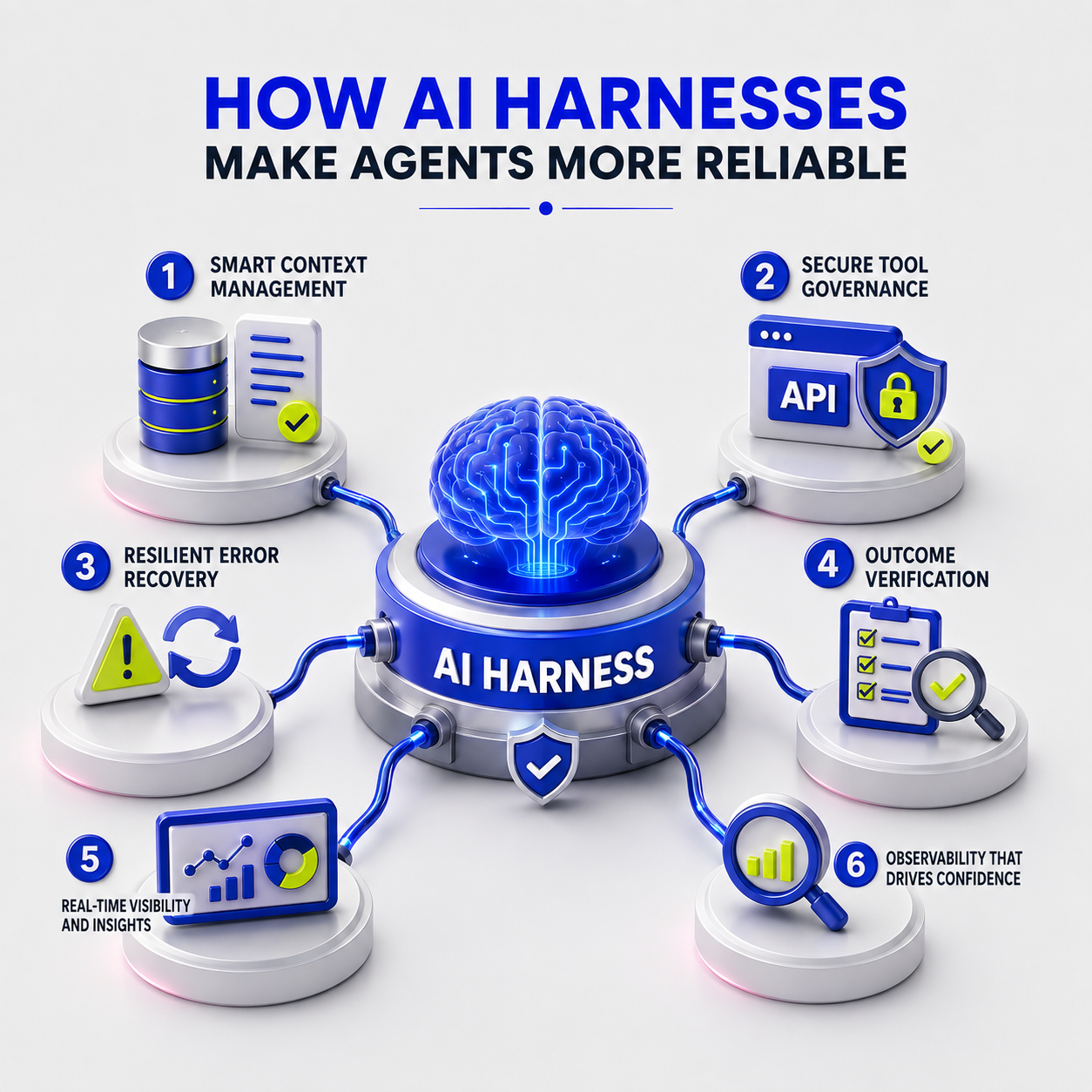
How AI Harnesses Make Agents More Reliable
Reliability is the biggest blocker to scaling autonomous AI. The Census Bureau’s BTOS survey found AI use among firms rose from 3.7% to 5.4% in early 2024.
But, even among the 32% of firms using AI, 57% restrict it to three or fewer functions because of reliability risk.
Managing Context and Memory
Without a harness, context windows fill with verbose tool outputs until the agent effectively forgets its instructions.
The harness compresses older turns, retrieves only relevant data, and keeps a persistent state file across long sessions.
Controlling Tool and API Access
Models are prone to inventing API endpoints or malformed arguments.
The harness validates every tool call against strict schemas before it hits the network, rejecting hallucinated parameters instantly instead of letting them cause damage downstream.
Handling Errors and Failed Actions
A single API timeout can send an unmanaged agent into an expensive retry loop or crash it outright.
The harness catches these exceptions and turns them into readable feedback the agent can actually act on.
Verifying Agent Outcomes
Agents sometimes declare a task done just to satisfy the prompt, a failure mode called specification gaming.
The harness runs an independent, deterministic check — like re-querying a database — before letting the workflow proceed.
Observing and Evaluating Agent Behavior
The harness logs telemetry across the whole system — every prompt, retrieval, and token consumed.
IBM’s IBV research found organizations with strong observability deploy 16 times more agents than those relying on manual oversight, while spending four times less on remediation.
AI Harness vs. AI Agent in Customer Support
Customer support is one of the clearest proving grounds for this split. Gartner forecasts agentic AI will autonomously resolve 80% of common service issues by 2029, cutting operational costs by 30% industry-wide.
AI Agents for Customer Conversations
AI agents for customer experience, typically are the conversational layer, this handles reading intent, tracking sentiment, and deciding whether a request needs a refund, a warranty claim, or a rescheduled flight, all while staying on-brand and natural.
AI Harnesses for Customer Support Workflows
The harness enforces the rules underneath the conversation — verifying identity, checking transaction history against policy, and connecting to the payment gateway. It’s what the agent isn’t trusted to handle alone.
Connecting Agents to CRM, Ticketing and Enterprise Systems
Real CX work requires deep integration with systems like Salesforce or Zendesk.
The harness manages those API connections, pulling in customer context and writing summaries and status updates back once the interaction ends.
Using harnesses alongside your agents helps you deflect tickets using AI and in the process lower AHT and improve customer resolutions.
Managing Human Agent Handoffs
Not everything should be automated. When a case gets high-stakes, the harness triggers the escalation and hands the human agent an instant AI-generated summary — no context lost in the handoff.
Automating Multi-Step Customer Resolutions
A warranty claim might mean checking a photo, verifying a purchase date, updating inventory, and generating a shipping label. The harness orchestrates that sequence across disconnected systems, verifying each step along the way.
AI Harness and Agent Architecture for Enterprise AI
PwC found 79% of executives say AI agents are already live in their companies in some form, and 88% plan to increase AI budgets.
Getting there safely takes a standardized, six-layer architecture.
LLM and Foundation Model Layer
The base layer models like GPT-4, Claude, or Gemini that provides raw language understanding and reasoning. It’s the stateless engine that powers everything above it.
AI Agent Layer
Sitting above the model, this layer holds the personas, system prompts, and reasoning loops that break enterprise goals into concrete planning steps.
AI Harness Layer
The control plane wrapping the agent that manages context, state, sub-agent orchestration, and safety boundaries.
It does this so that the model’s probabilistic nature doesn’t create unacceptable risk.
Tools, APIs and MCP Layer
This is the agent’s hands that handle things like APIs, code interpreters, browsers, and MCP servers.
In doing so, it makes sure that the harness exposes securely, giving the agent a monitored way to affect the outside world.
Enterprise Systems and Data Layer
CRM, ERP, and vector databases live here. The harness pulls from this layer to ground the agent in real enterprise facts and reduce hallucination.
Observability and Evaluation Layer
At the top, this layer logs execution traces, tracks token spend, and evaluates outputs for bias or compliance issues — the visibility leadership needs to govern the system.
When Do You Need an AI Harness?
Not every AI task needs a harness. Knowing where the threshold sits keeps teams from over-engineering simple work or under-protecting high-stakes ones.
Simple AI Tasks That Do Not Need a Harness
Summarizing a document or drafting an email is stateless and low-risk. A human reviews the output before anything happens, so a basic API call or chat interface is enough.
Multi-Step Tasks That Need an Agent Harness
Once a task chains steps together — researching a trend, checking a database, emailing a report — a harness becomes necessary to hold the goal state and coordinate the tools involved.
Enterprise Workflows That Require Harness Controls
High-stakes work like financial processing or claims adjudication demands rigorous guardrails and verification. Gartner projects $53 billion in agentic AI spend by 2030 — the stakes are too high for probabilistic models alone.
Customer Support Use Cases for AI Harnesses
A basic FAQ bot doesn’t need one. An agent processing a return or issuing credit does — it has to navigate enterprise databases securely and stay compliant with regulations like GDPR or HIPAA.
When Do You Need an AI Agent Harness for Improving Your AI Agents?
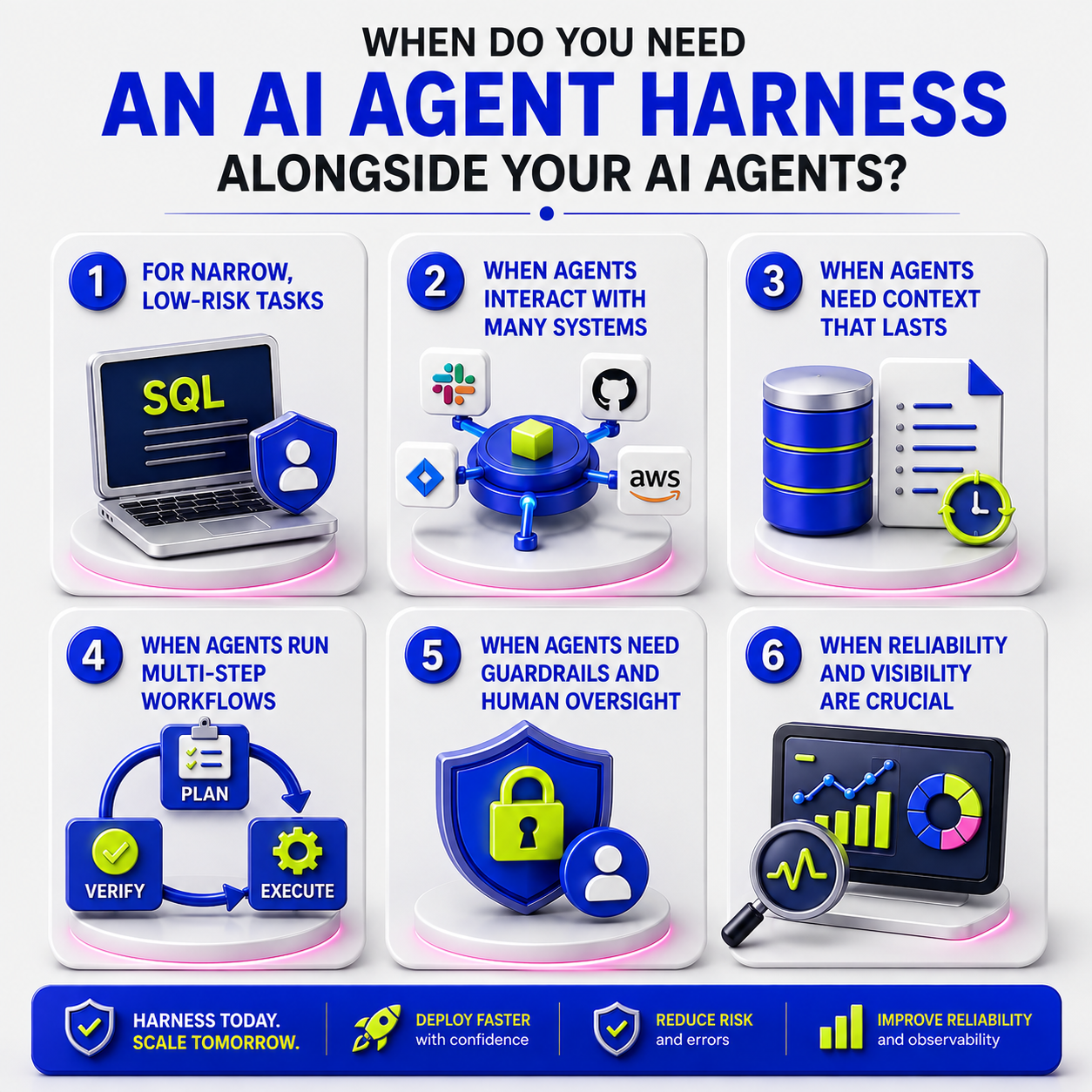
A few concrete triggers tell you when a standalone agent needs to be wrapped in production-grade infrastructure.
- When a Single AI Agent Is Enough: If the scope is narrow and failure is low-risk — like an internal tool for writing SQL for human review — the human effectively acts as the harness.
- When Agents Need Multiple Tools and Systems: Once an agent touches several disparate systems — Slack, GitHub, Jira, AWS — a harness becomes the traffic controller, standardizing inputs and preventing cross-system errors.
- When Agents Need Persistent Context and Memory: Long-running work like refactoring or legal research needs a harness to compress old context and recall the right history, so the agent doesn’t lose track of decisions made days earlier.
- When Agents Execute Multi-Step Workflows: Multi-step work is prone to drift. A harness imposes a Plan, Execute, Verify loop, checking each step’s real outcome before letting the agent continue.
- When Agents Need Guardrails and Human Oversight: IBM found 70% of tech execs say teams deploy faster than IT can track, with 59% citing security as a top barrier. A harness enforces policy and escalates when confidence drops.
- When Agent Reliability and Observability Matter: In production, unmonitored systems are a liability. A harness provides the traces, latency data, and drift detection teams need to debug and prove compliance.
Using Thunai AI for Better Guardrails and CX Automation in Place of Harnesses
Building a harness from scratch takes serious engineering time and ongoing maintenance as models keep changing.
For teams focused on customer experience specifically, platforms like Thunai AI bundle the agent and the harness together instead of making you build the infrastructure yourself.
- Thunai automates customer experiences up to 80% of routine interactions and issues and cuts human handle time by 66%, operating inside configurable compliance guardrails while integrating directly with CRM and ERP systems.
- Instead of spending months on context persistence, verification, and tool orchestration, teams get that infrastructure pre-built — freeing them up to focus on outcomes instead of managing software plumbing.
Want to see how Thunai can provide both AI agents and AI harness infrastructure for your company? Book a free demo call!
Frequently Asked Questions About AI Harnesses and AI Agents
Is an AI harness the same as an AI agent?
No. The agent is the cognitive engine — the model that interprets intent and decides what to do. The harness is the deterministic infrastructure around it that executes actions, manages memory, and enforces security. One thinks, the other acts.
What is the difference between an AI harness and an AI agent?
It comes down to capability versus control. The agent has the capability to understand intent and plan. The harness provides control — verifying outcomes, managing context, and stopping the agent from taking unauthorized action.
Why does an AI agent need a harness?
Because foundation models are stateless and prone to hallucination and reasoning loops. Without a harness, an agent can’t reliably remember past steps, safely run code, recover from a network error, or follow compliance rules. The harness turns its probabilistic guesses into dependable execution.
Is an AI harness an agent framework?
No, though they’re related. A framework — LangChain, LlamaIndex, AutoGen — is a developer toolkit for building an agent’s code. A harness is the live, operational system that manages that agent once it’s actually running.
What is an AI agent runtime?
The runtime is the underlying compute environment — a container, cluster, or sandboxed VM — where the agent’s code and tools physically execute. The harness sits above it, deciding how the runtime should allocate resources for each task.
Can AI agents work without a harness?
Yes, for simple, low-stakes, single-turn tasks like drafting an email or brainstorming, where a human reviews the output directly. For complex workflows touching live databases or financial data, skipping the harness leads to context loss and real security risk.


.png)