
Still relying on your QA team to catch every compliance slip, every bad customer interaction, every agent going off-script?
Here's the uncomfortable truth: with only 1–2% of calls ever reviewed, 98% of what happens on your floor is a black box.
Compliance gaps hide in plain sight. Coaching arrives days too late to matter. And when scores do come in, agents dispute them because two managers rarely agree.
This guide breaks down how Automated Quality Management fixes that — reviewing 100% of interactions instantly, consistently, and transparently, so nothing costly slips through unseen.
What is automated quality management?
In automated quality management, AI technology is applied to assess customer service calls.
Specific words, actions, and patterns are identified, alongside measuring customers' sentiment and how much they adhere to quality guidelines.
With this approach, managers have a complete picture of the quality of service based on real interaction data.
McKinsey found that more than 80% of respondents were already investing in GenAI or expected to do so in the coming months.
Automated quality management vs manual QA sampling
Traditional QA teams audit just 1–2% of customer calls as call audits take time.
Automated quality management uses artificial intelligence to audit 100% of calls right after their completion. It eliminates backlogs, uncovers each mistake, and recognizes outstanding agents throughout the whole team.
AQM vs speech analytics vs conversation intelligence
Speech analytics gives you raw voice data without a grade; conversation intelligence adds sentiment and intent across channels.
Automated quality management goes a step further and grades the agent strictly against your predefined criteria.
Where AQM sits alongside WFM and performance management
AQM scores feed directly into your Workforce Management (WFM) system, so a recurring low score automatically triggers a training assignment.
This interconnected flow turns static scores into active performance management.
Why sampling two percent of contacts no longer defends the business
Operating a modern support floor on manual sampling is highly risky.
The coverage math: what a 2% sample actually tells you
With 2% being reviewed by a team, 98% of the calls go unheard.Even a small percentage of mistakes in thousands of calls not checked equals huge operational strain.
Automated quality management solves this math problem and ensures no interaction goes unreviewed.
Evaluator bias, calibration drift, and disputed scores
Two human listeners may have very different scores for the same call. Over time, human graders drift away from the official standards.
Implementing AI quality management eliminates this human drift. The machine grades every single call using the same logic.
Agents stop disputing their scores because they know the machine applies the rules fairly to everyone.
Compliance exposure in regulated conversations
In Industries like banking, healthcare, and insurance, agents must read specific legal disclaimers.
These requirements can also be supported by contact center risk management strategies and AI-powered healthcare contact center practices, especially in highly regulated environments.
IBM reports that the global average cost of a data breach was $4.44 million in 2025. Healthcare breaches averaged $7.42 million, the highest of any industry for the 14th consecutive year.
Failing to read these scripts can result in heavy government fines. A dedicated compliance monitoring call center setup powered by AI acts as an insurance policy.
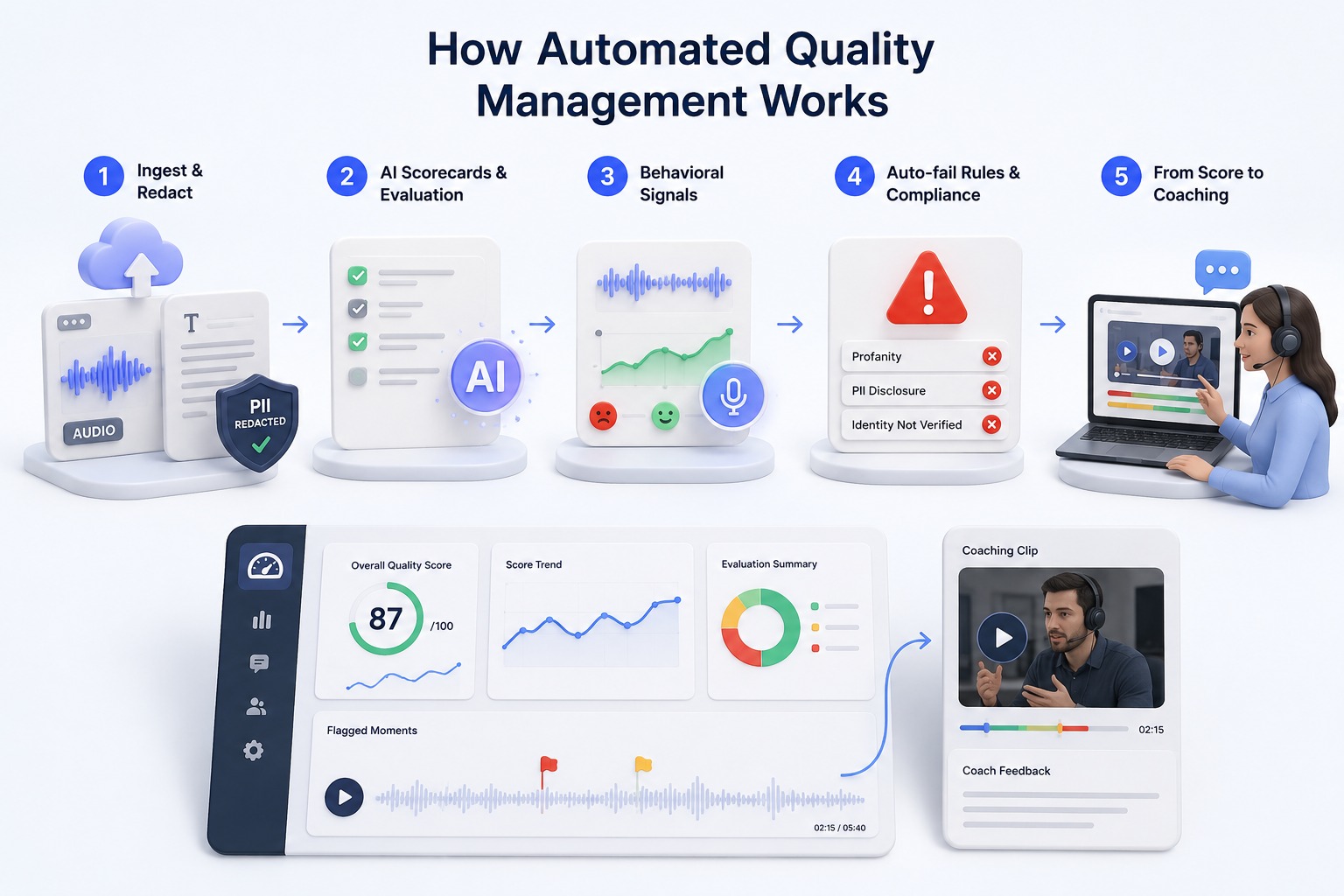
How automated quality management works
- Ingestion, transcription, and PII redaction: The system ingests the audio or text file. Transcription of the audio takes place first.
Then aggressive removal of PII information, including credit card details, passwords, and medical information, occurs.
- AI scorecards and evaluation criteria: The AI then compares the clean text against the specific criteria you set. AI will search for exact match like whether the agent asked for the account number from the customer or did any upselling.
- Behavioral signals: Automated quality management tracks more than just words, as it measures the acoustic features of the call.
Takes note when an agent interrupts or talks over a customer. By measuring customer sentiment at the start and end of the call, the AI can estimate the agent's empathy and effectiveness.
- Auto-fail rules and compliance triggers: Program auto-fail rules for severe violations. If an agent curses at a caller, or if they fail to verify a caller's identity before sharing sensitive account details, the automated quality management system instantly gives the call a zero.
- From score to coaching workflow: The automated quality management system highlights the exact moment the agent made a mistake, and a supervisor reviews that specific clip and provides targeted coaching.
Designing an AI-ready QA scorecard
You must design your grading rubric so the AI understands exactly what you want it to measure.
Objective vs subjective criteria
AI performs poorly with vague concepts. Instead of asking the AI to judge professionalism, ask it if the agent used a standard greeting and avoided slang. Clear, objective questions produce reliable scores.
Weighting, thresholds, and auto-fail logic
Not all behaviors hold equal value. A simple automated quality management rule might give ten points for saying the customer's name, but fifty points for correctly solving the technical problem.
Sample scorecard structure you can copy
A well-designed automated qa scorecard includes specific categories, clear questions, and defined point values.
Mistake to avoid: porting your manual form unchanged
Never copy your old manual QA form directly into an AI system. Feeding the above information to the machine is meaningless since the AI will only make guesses about the answer. Rewrite all questions to use only yes/no facts.
Calibration and human oversight
Automated quality management does not work as a set-it-and-forget-it technology.
Human-in-the-loop review sampling
A human-in-the-loop sampling process helps automate the quality assurance of a call center. The human makes adjustments to the rule in case of a misinterpretation.
Measuring AI-to-evaluator agreement
You must prove that the AI agrees with your human experts using more than simple percentage agreement, which can be misleading.
Cohen’s Kappa accounts for agreement that could happen by chance, giving a more reliable measure of accuracy.
A score above 0.6 indicates good agreement, while a score below 0.4 suggests your rules may need clarification.
Handling agent disputes and appeals
Agents will occasionally disagree with the machine. The system must include a formal appeal process. The supervisor listens to the flagged audio.
If the agent acted correctly, the supervisor overrides the score and updates the AI logic to recognize that specific edge case in the future.
AQM across voice, chat, email, and messaging
Modern customers demand support across multiple channels, and AI voice agents for contact centers and other contact center AI use cases can help extend automated support across phone, chat, SMS, and email.
Gartner predicts that 73% of customer service organizations will implement agent-assist solutions, highlighting the rapid shift toward AI-supported service operations.
Metrics automated quality management improves
Investing in this technology creates measurable shifts across several key performance indicators.
QA coverage and evaluation cost per contact
The most immediate change is your coverage rate. You jump from fractional sampling to complete oversight.
These improvements can also fit into broader AI agents benefits in contact centers, where automation can help reduce repetitive work while allowing teams to focus on higher-value tasks.
At the same time, the cost to review each contact plummets. Computing power costs a fraction of human labor, allowing your human QA staff to focus on high-level coaching rather than basic listening.
CSAT, FCR, and compliance adherence
Several contact center qa metrics shift dramatically under automated quality management. CSAT improves because the agents get immediate feedback when making mistakes.
McKinsey found one company that improved customer service levels by more than 10% while reducing staffing and overtime costs by more than 5% using AI-enabled workforce optimization.
FCR gets better since agents understand precisely how to resolve repeatable problems.
Finally, compliance is almost at 100% since the agents understand that everything they say is being watched.
Coaching cycle time and performance variance across the floor
Manual QA creates a terrible feedback loop. An agent might make a mistake on Monday but not hear about it until Friday.
Automated quality management delivers insights almost instantly. Faster feedback loops shrink the performance gap between your best agents and your newest hires.
Building the AQM business case
When asking leadership for budget, focus on risk mitigation and efficiency. Show executives the exact cost of a compliance fine.
Show them the hours wasted by supervisors listening to perfectly normal calls. Automated quality management pays for itself by eliminating legal risks and freeing up management time for actual coaching.
Where automated quality management goes wrong
Despite the clear benefits, some companies fail to launch these tools successfully. Avoid these common traps.
Scoring without coaching follow-through
Software alone changes nothing. If an automated quality management system generates millions of accurate scores, but supervisors never use that data in one-on-one meetings, the investment is wasted.
Black-box scores agents cannot contest
Agents hate mystery scores. If a system hands down a failing grade without explaining exactly why, it ruins morale. The automated quality management platform must provide an exact transcript snippet proving the mistake. Transparency is non-negotiable.
Transparency, trust, and floor adoption
Must build trust with the agents and do not launch the tool in secret. Explain how the AI works, show them the grading rubric, and let them see their own dashboards. When agents trust the tool, they use it to guide their own daily improvement.
Buyer evaluation criteria
The vendor landscape is crowded. Evaluating an auto qa contact center vendor requires checking beneath the marketing claims to see how the technology actually functions.
Accuracy, explainability, and audit trail
The system must prove its work. When an AI flags a compliance violation, it must generate a clear audit trail.
If regulators demand proof of your quality controls, the software must provide historical data explaining exactly why specific calls passed or failed.
Integrations: CCaaS, CRM, WFM and LMS
A standalone tool is useless. The software must connect natively to your Contact Center as a Service (CCaaS) provider, your CRM, and your Learning Management System (LMS).
Seamless integrations ensure that a failed score automatically triggers a training module assignment.
Data security, residency and retention
You are handing a vendor your most sensitive customer data and demand strict security protocols.
IBM found that 97% of organizations reporting an AI-related security incident lacked proper AI access controls.
Verify where the servers live to ensure data residency compliance. Confirm the system automatically deletes payment details and passwords before processing the audio.
Vendor evaluation checklist
Use this structured guide when comparing automated quality management providers.
A 90-day implementation plan
Deploying automated quality management requires a careful, phased approach to avoid overwhelming the floor.
First 30 Days: Silent Ingestion. Connect the software to your phone systems and let it run quietly.
Do not show any scores to the agents. Watch how the AI transcribes audio and grades against your rubric.
Days 31 to 60: Calibration. Have your QA leaders review the AI's work. If the AI constantly fails agents for missing a greeting, but the agents are actually using an acceptable regional variation, rewrite the rule.
Tune the system until your Cohen's Kappa score consistently stays above 0.6.
Days 61 to 90: Floor Rollout. Introduce the agents to the system and show them how the automated quality management tool gives them faster, fairer feedback.
Automated quality management with Thunai
Thunai is an AI platform for call centers that goes beyond basic quality checks. Thunai reviews 100% of calls instantly, with no delays.
Sense a customer's mood from their voice, spotting frustration early. It also checks that agents say all required compliance phrases, flagging any that are missed.
The key feature of Thunai is real-time processing, as it analyzes calls as they happen, not afterward.
Connects to tools like Salesforce to auto-generate call summaries and update records. Overall, it helps agents give better service in the moment while keeping the business compliant.
Want to see what automated quality management can look like for your team? Schedule a demo!
FAQs on Automated Quality Management
Does automated quality management replace my human QA team?
No. Instead of wasting hours listening to normal calls just to hit a quota, your QA staff shifts to high-value work. They manage the AI rules, handle agent appeals, and provide deep behavioral coaching.
What is a reliable Cohen's Kappa score for an AI model?
A score above 0.6 implies that there is considerable reliability in the agreement between the AI and the human experts. With your score being above 0.8, you have excellent quality management rules for automation.
Can AI understand difficult accents and bad phone connections?
Modern AI handles heavy accents very well. However, if the physical audio quality is terrible due to bad internet or broken headsets, the AI cannot transcribe the words accurately.
Why is one percent call monitoring considered dangerous?
Reviewing just one percent of your volume leaves massive compliance blind spots. You miss critical script failures, bad advice, and process breakdowns on the remaining 99 percent of interactions.