
So, how do you ensure that your call center representatives provide an excellent customer experience?
The call center representative performance scorecard helps in measuring quality, efficiency, compliance, and customer results.
However, it will be of no use to you if it doesn’t measure what really matters while not making the process of assessing the representative’s performance completely random.
Let's go through the most important metrics, weighting models, templates, and the role of AI in evaluating customers' interactions.
How Do You Know an Agent Is Doing Well?
- You need a way to measure it, and that's what a call center agent performance scorecard is for. It tracks quality, productivity, compliance, and results in one place, instead of leaving it all to gut feel.
- Here's the catch, though: it only works if it's measuring the right things. Get that wrong and you're not running a review process. You’re playing a guessing game along with the spreadsheet included.
- Let’s jump right in then and look at the key performance indicators that we should be measuring, how to measure them properly through weighting, some templates to steal, and where AI can take care of business for us.
What Is a Call Center Agent Performance Scorecard?
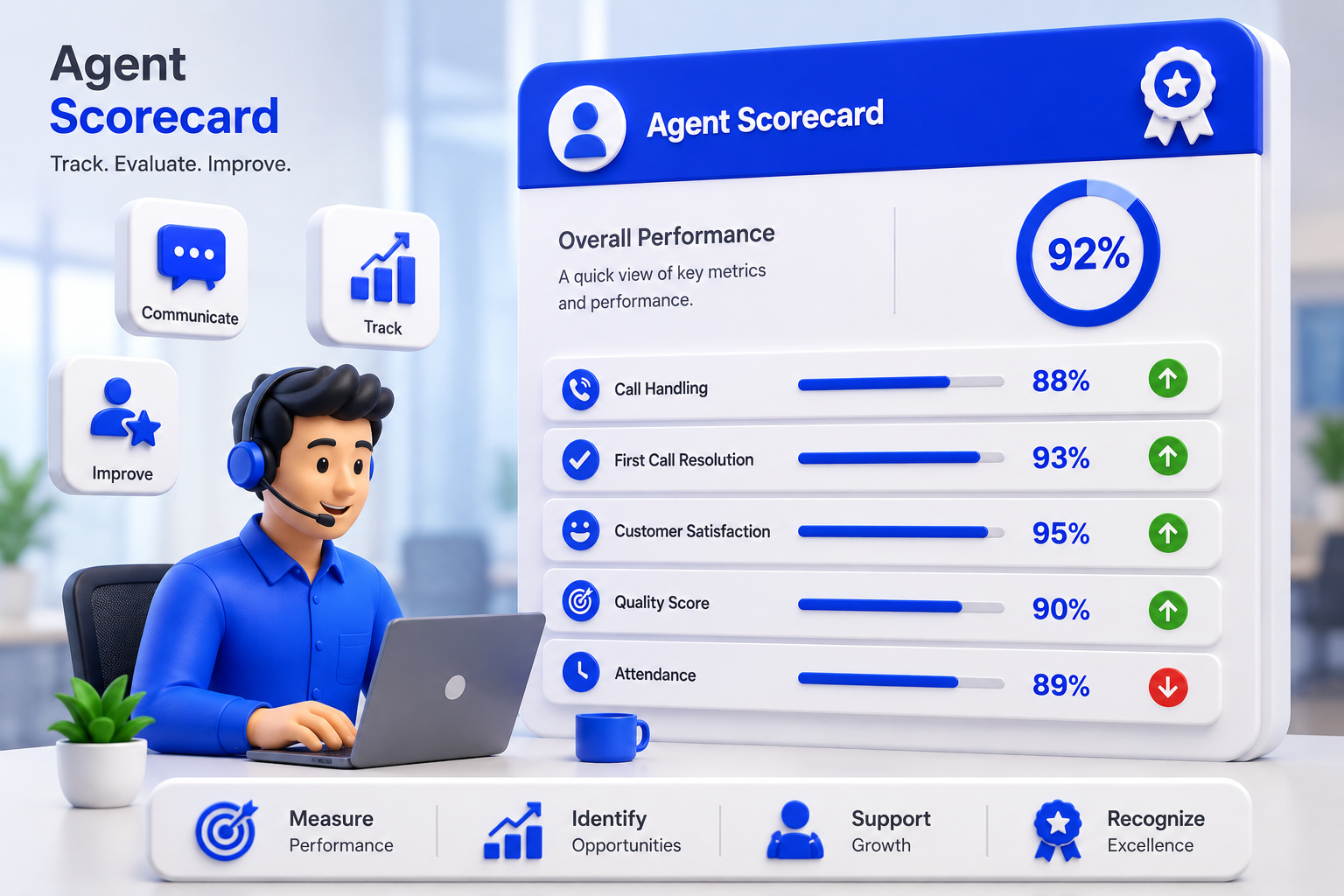
It's a structured way to judge customer interactions. You check them against quality standards, compliance rules, and performance targets.
Big goals like better CX or fewer complaints get turned into specific things a supervisor can watch for and coach.
Call Center Agent Performance Scorecard vs. QA Form vs. KPI Dashboard
People mix these up all the time.
A QA form looks at one call. A KPI dashboard looks at the whole system. A call center agent performance scorecard sits in between. It's the long view of how one agent performs over time.
Who Actually Uses the Call Center Agent Performance Scorecard
- Agents track their own growth, read feedback, and spot gaps in their skills.
- Team leads run coaching sessions off the data and check progress week to week.
- QA analysts use the rubric to keep audits consistent and run calibration sessions.
- Workforce management checks adherence scores so they can plan staffing without hurting quality.
Why Most Call Center Agent Performance Scorecards Fail
When a QA program fails, the issue may be how performance is measured, not agent performance. Gartner's research highlights the limits of traditional QA approaches.
Subjectivity and Scorer Drift
- Expressions like "displayed good enthusiasm" are subjective terms that may mean something else to someone else.
- To one supervisor, "great enthusiasm" means too much to another.
- Then there's scorer drift: a supervisor gets more lenient or harsher depending on how burned out they are that week, and honestly, who wouldn't? Two agents do the exact same thing on two different calls and walk away with two different grades.
- Once people notice their score depends less on the call and more on who happened to be grading it, the whole program loses credibility. Fast.
Grading Things Agents Can't Control
- Docking an agent for a bad CSAT score during a company-wide outage isn't fair.
- Everyone knows it. A good call center agent performance scorecard measures what the agent actually controls, not the system falling over around them.
What Belongs on a Call Center Agent Performance Scorecard
A solid call center agent performance scorecard covers six categories. Here's what to include, and what to leave out.
Quality and Behavior
- Listening: allowing the customer to talk without any interruption.
- Tone and empathy: matching your tone to that of the customer depending on their urgency and not following a script.
- Solving Techniques: Using the SOP to solve the problem.
Efficiency
- Hold and transfer habits: asking permission before a hold, doing warm transfers instead of cold ones.
- After-call work: wrapping up notes and codes without dragging it out.
- Handle time patterns: flag unusually long calls to find training gaps. Don't punish length for its own sake.
Outcomes
- First Call Resolution (FCR): Did you solve their problem during this single call?
- Repeat Contact Rate: Are they coming back after one week for the same problem?
- Resolution quality: did the fix actually address the root problem?
Customer Signals
- CSAT: the post-call survey score.
- Customer Effort Score (CES): The difficulty faced by the customer while getting help.
- NPS: broader loyalty sentiment.
Compliance and Risk
- Identity verification: verifying the identity of the person before providing any account information.
- Required disclosures: recording notices, terms of service, the legal stuff.
- Data security (PCI-DSS): pausing recordings during payment info.
Reliability
- Schedule adherence: time spent in queue versus scheduled shift.
- Auxiliary code accuracy: logging breaks and training time correctly.
Sales Metrics (For Outbound and Blended Teams)
- Discovery depth: asking real questions to find the actual need.
- Objection handling: working through pricing or timing pushback with the approved playbook.
- Conversion rate: orders closed, upgrades made, meetings booked.
What to Leave Off
- AHT as pass/fail. Grading agents on speed makes them rush complicated calls. Track it at the queue level instead.
- Occupancy rate. That's a scheduling metric, not a performance one.
- Raw survey volume. Agents can't force customers to fill out a survey.
How to Weight the Metrics
A Defensible Split
This split protects quality, but it doesn't ignore speed and discipline either.
Auto-Fails
Save auto-fails for serious violations: skipping ID verification, using abusive language, breaking compliance rules. When one hits, the score drops to zero. No partial credit. Spell these out during onboarding, so nobody's caught off guard later.
Adjust by Channel
- Technical support: push process and troubleshooting up to 50%, cut operational discipline to 15%.
- Outbound sales: put 40% on value pitch, discovery, and conversion.
- Digital support (chat/email): weight concurrency, grammar, and FCR at 45%.
Building a Call Center Agent Performance Scorecard in Seven Steps
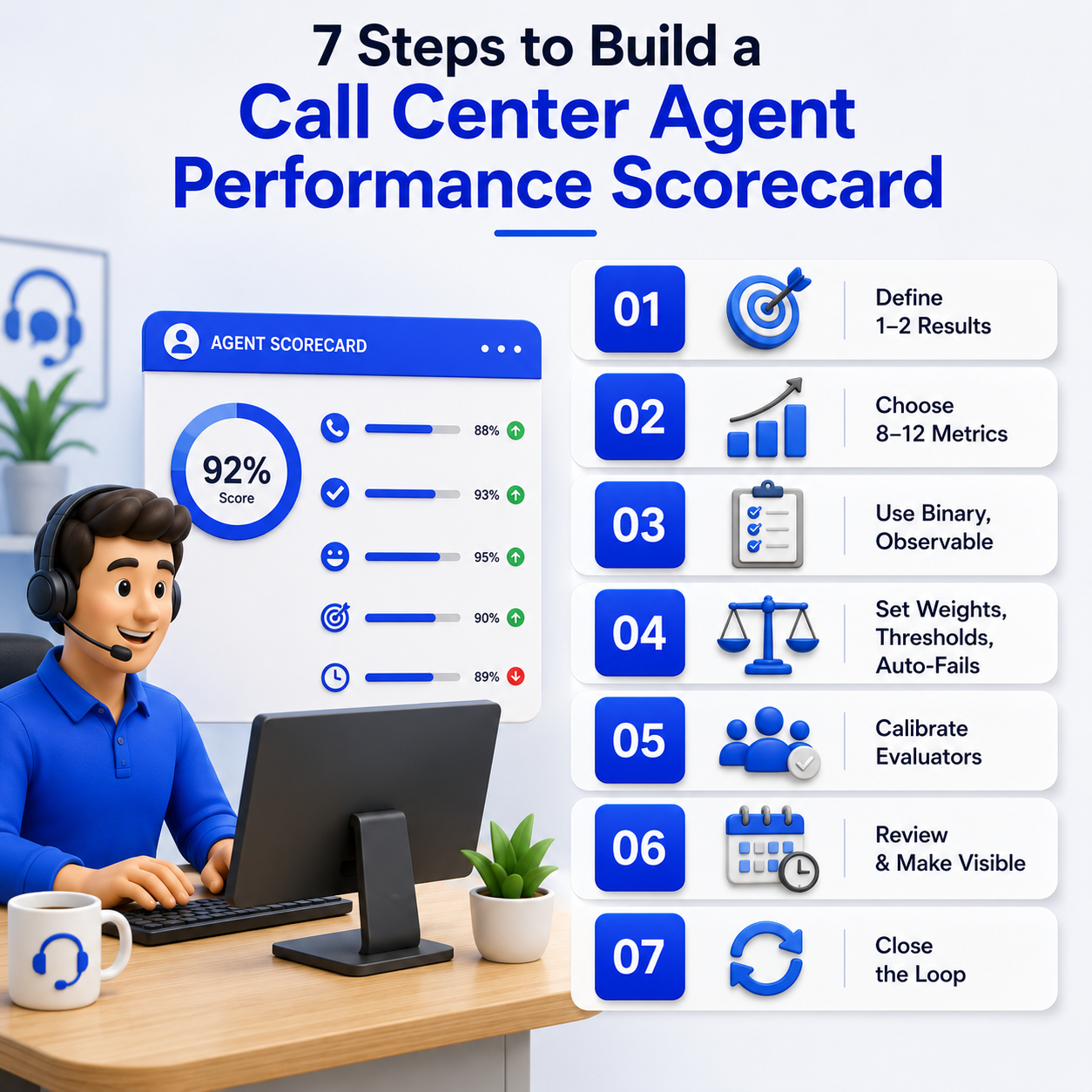
- Select one or two business results you really want to achieve, like reduced churn rate, higher first contact resolution, etc., but don’t pick five.
- Choose 8 to 12 metrics which will really drive those results. Add more than that, and people won’t care about anything.
- Write criteria that are binary and observable. Skip the vague 1-to-5 rating scales. Ask yes/no questions instead: did they verify two identifiers before sharing balance info, yes or no?
- Set weights, thresholds, and auto-fails.
- Calibrate your evaluators before anyone scores a real interaction. Skip this step and everything downstream is noise.
- Set a review cadence, and make results visible to the agents themselves, not buried three folders deep in a supervisor's inbox.
- Close the loop. Tie every deduction to a specific piece of coaching, then actually check back in 30 days. (Most teams skip this last part. Don't be most teams.)
Free Call Center Agent Performance Scorecard Templates
Use these role-specific rubrics to standardize quality checks across channels.
Inbound Customer Support Scorecard Template
- Introduction & Verification (15%): Used the conventional introduction; verified the customer’s identification effectively.
- Empathy & Active Listening (25%): Understood the customer's emotions; Kept professional demeanor.
- Resolution Quality (35%): Used the correct SOP; Follow-up call was not required to solve the issue.
- Hold Time & Protocol (15%): Kept hold times under 2 minutes; Provided status updates.
- Conclusion & Documentation (10%): Summarized actions taken; Created comprehensive CRM notes.
Sessiontalk also highlighted similar points regarding this matter.
Technical Support Scorecard Template
- Identifying Root Causes (30%): Used structured diagnostic questions to identify the technical problem.
- Use of Knowledge Base (25%): Used the troubleshooting articles that were proven correct.
- Instruction Clarity (25%): Walked the user through the process without using technical language.
- Ticketing and Bug Reporting (20%): Kept proper logs and error codes.
Outbound Sales and Collections Scorecard Template
- Value Proposition (20%): clearly conveyed call intent and value proposition in the first 30 seconds.
- Needs Discovery (25%): utilized open-ended questioning to identify business pains.
- Objection Handling (25%): highlighted product benefits compared to those of the competitors.
- Closing Commitment (20%): ensured commitment or secured an appointment.
- Mandatory Disclosures (10%, auto-fail): repeated required legal disclosures word for word.
Chat and Email Scorecard Template
- Response Timing (20%): First response to be completed within 45 seconds and second response within 60 seconds.
- Grammar/Punctuation/Format/Voice (25%): Make sure to correct grammar and punctuation.
- Resolution Completion (35%): All questions asked by the customer have been addressed.
- Case Routing & Closing (20%): Proper case routing tags and closure of tickets.
Excel vs. Google Sheets vs. Dedicated QA Software
If you've got five agents, a spreadsheet works fine; nobody's arguing that. But grow past that, and you'll hit version conflicts, overwritten tabs, and someone's laptop eating a week of data.
Dedicated QA software automates the call center agent performance scorecard workflow and gets rid of manual entry altogether. It's not glamorous, but it saves you from the 2 a.m. "wait, whose numbers are these?" moment.
Sample Call Center Agent Performance Scorecards in Action
Maria S., Billing Support - 96/100. Nailed identity verification. Addressed the frustration that the client felt about the surprise fee. The invoice was explained clearly without using any technical terms. However, there was one flaw: The holding time exceeded two and a half minutes without any mid-check.
Feedback: great empathy; just check in around the 90-second mark on long lookups next time.
Kevin T., Technical Support - 62/100. Rougher call. He skipped a diagnostic step and jumped to a root cause too early. Missed step two of the connectivity guide entirely, and leaned on jargon the customer clearly wasn't following. To his credit, the ticket itself was logged accurately.
Feedback: slow down, work through the diagnostic flowchart in order, and resist the urge to jump straight to "it's probably the hardware."
Calibrating Across Evaluators
Pick three calls: a strong one, an average one, a rough one. Have every supervisor and QA analyst score them independently. Then get in a room and go line by line through where scores disagree.
Test consistency by using the basic agreement ratio:
Agreement Ratio = (Matched Item Scores / Total Scored Items) × 100
Go for 85 percent or more. In case there is one particular question that always creates controversy, change it, provided that the problem lies in the wording and not in the evaluation process.
Give Agents a Real Appeals Process
Let agents dispute a score within five business days. Have a senior QA analyst review the call alongside the agent's notes. A working appeals process is what actually makes agents trust the call center agent performance scorecard in the first place.
Turning Scores Into Coaching
Figure out what's actually behind a deduction:
- Behavioral gap: knows the policy, rushes when the queue backs up.
- Knowledge gap: never got trained on the new feature.
- Process flaw: the documentation contradicts itself.
Review trends in one-on-ones every two weeks. Lead with what's working before you dig into deductions. For agents who need more support, build a 30-day plan with weekly targets.
Tie bonuses to the whole call center agent performance scorecard, not one speed metric. Otherwise, you're just teaching people to game the number.
Scoring Every Interaction With AI
Manual audits catch maybe 1% of calls. AI-based QA tools can score all of them, every call, chat, and email, without the sampling problem.
AI handles the objective stuff: did they verify identity, did they read the disclosure, is sentiment dropping mid-call? It means that human coaches are free to do their job properly.
When choosing a QA software solution, you need to find one that integrates with your current CCaaS system.
Platforms like Thunai offer real-time agent assist, automatic post-call notes, and full call audits. Per enterprise reviews, it can cut QA backlogs, reduce handle time by up to 70%, and hold CSAT near 95%.
Ready to score every customer interaction and improve agent performance with a call center agent performance scorecard? Book a demo with Thunai and see AI-powered quality monitoring in action.
FAQs
How often should agents be scored?
Score interactions continuously. Review the combined call center agent performance scorecard every two weeks or once a month.
How often should agents be scored?
Interactions should be audited continuously, with composite call center agent performance scorecard summaries reviewed during bi-weekly or monthly coaching sessions.
What's a good average score?
85 to 90% is typical for a high-performing team: strict on compliance, still human on engagement.
How do you score chat and email agents?
Response speed, concurrency, grammar, tone, how completely they resolved the issue, and accurate tagging.