The chatbot can talk to the customer. But can it close the deal?
Modern customer service goes way beyond answering frequently asked questions.
Consumers require immediate information on product details, delivery status, return/exchange policy, and post-sale assistance.
Chatbots can incorporate all of this in one dialogue and take action in multiple systems of retail operations.
This guide will help you understand 9 different use cases for chatbots in retail, brand examples, and costs involved.
What Is Conversational AI for Retail?
Conversational AI for retail blends language understanding, generative models, and system integrations. Shoppers talk to it by text or voice. The retail sector holds more than 21% of all conversational AI deployments worldwide.
The reason is simple. Stores field millions of questions across sites, apps, social messages, and phone lines.
Old retail tech kept support, marketing, and store sales apart. Modern Conversational AI for retail joins them into one thread.
A shopper no longer clicks through drop-downs or waits on hold. They type what they need in plain words. The software reads the intent, checks stock, and answers in milliseconds.
It goes well beyond help articles. It acts as a personal shopper and as a tier-one support desk. It also remembers the shopper's history across the whole buying journey. Thunai builds this kind of memory into its Thunai Brain, a single knowledge base that agents can trust.

Chatbot vs. conversational AI vs. agentic AI that completes transactions
Retail automation has passed through three generations. Each one gives more autonomy and more value.
Rule-based chatbots came first. They follow strict branches. Say a shopper types "change my delivery address." The script finds an exact match and works. Now say the shopper types "sent this to the wrong apartment." The script breaks.
It shows a generic error. Buyers get annoyed, carts get abandoned, and ticket counts climb.
Large language models and Retrieval-Augmented Generation created the second generation. This type of conversational AI for retail parses casual speech and pulls policies from a knowledge library. It can summarize return rules, suggest gifts, and answer product questions. Still, it mostly informs. Ask it to change an address, and it explains the policy. It cannot touch the shipment record.
The modern standard is agentic AI. Agentic platforms break a request into steps. They use frameworks like the Model Context Protocol (MCP) and secure tool calling.
The agent verifies the shopper, checks shipping status, pauses the warehouse pick, updates the address, and sends a confirmation. Language meets action, and the issue is closed.
9 Conversational AI Use Cases for Retail
1. AI shopping assistant and product discovery
- Online stores can feel like a wall of identical tiles. A real-time shopping assistant turns that wall into a conversation.
- This could be how a customer phrases her requirement: "I am looking for a waterproof trail running shoe under $140 with wide fit." The AI looks for specifications and displays the results within the chat conversation.
- Thunai links messy product sheets, past reviews, and warehouse counts inside one hub. You can see how in its retail solution. The result is accurate, in-stock picks.
- Retailers that use conversational AI for retail this way turn search drop-offs into guided sales. Conversion and basket size rise.
2. Size, fit and product-fit guidance
- Sizing doubts cause abandoned carts and heavy return volumes in apparel.
- Fashion brands use conversational AI for retail to steer shoppers to the right size before checkout.
- The system asks for height, weight, fit preference, and sizes from similar brands.
- It compares those answers with garment dimensions, fabric stretch, and review notes.
- Buyers feel sure of their choice. That cuts "bracketing," the habit of buying several sizes and returning the misfits.
3. Order status and WISMO deflection
- "Where is my order?" questions make up 25% to 50% of service inquiries for online stores. Each manual lookup costs $5 to $22. Agents lose time they could spend on harder cases.
- Solving these tickets is a core strength of conversational AI for retail. The system verifies the shopper, checks carrier endpoints, and pulls live tracking from the order system.
- It does more than paste a tracking link. It explains the exact milestone and gives an estimated delivery date. If a parcel stalls, it can open a carrier claim or send a replacement.
- Here is how it works. The agent checks the profile in the CRM. It queries the order API. It reads tracking events from shipping webhooks. Suppose the parcel sits at a regional sorting site.
- The agent checks the delay policy, adds a $10 store credit, and shares a new delivery date. All of that takes under 0.8 seconds.
4. Returns and exchange automation
- Returns eat money. Labels, inspections, and restocking all add cost. Chat is a chance to keep the sale.
- A customer starts a return in the chat window. The system checks the order date against policy. It asks the reason, accepts photos of damage, and creates a prepaid label.
- It also works as an exchange engine. If the item is too small, the AI offers another size or store credit first.
- Merchants using these tools protect 50% to 60% of at-risk revenue by turning refunds into exchanges. Behavior screening also helps spot return abuse.
5. In-store clienteling and associate assist
- Conversational AI for retail is not only for websites. It also helps staff on the shop floor. Associates speak to a tablet or handheld device in plain language.
- An associate can ask, "Do we have this linen shirt in large downtown, or can we ship it to this customer?" The tool checks regional stock, places a hold, or sets up home delivery.
- Real-time agent assist tools also show loyalty tier and past buys. Associates can then offer styling ideas that fit.
6. Proactive outreach: back-in-stock, price drop, replenishment
- Waiting for questions means missing sales. Outbound messages turn conversational AI for retail into a revenue channel.
- Forget the mass e-mailing. Text, WhatsApp, or app alerts can be sent when your viewed product is reduced in price or back in stock.
- For recurring products such as cosmetics, vitamins, or coffee, the program predicts your reorder dates based on previous orders. It may say, "It is about time you ran out of your coffee beans."
- Want a 2-pound bag sent to your usual address?" One short reply confirms it. Repeat sales and retention grow.
7. Voice AI for retail contact centers
- Phones are important. But the contact center has problems like staffing issues, hold times, and unexpected surges. The Voice-based conversational AI for retail takes away the wait queue through speech.
- Modern voice systems run whole calls. They confirm identity, look up orders, and update accounts. They transcribe live, track tone, and trigger routing rules.
- Thunai tracks caller sentiment through each call. When a shopper sounds upset, managers get an alert.
- A live agent can join smoothly with the full transcript in hand. The caller never repeats the story. See call scoring and audit for how every call gets measured.
8. Post-purchase support and loyalty
- The relationship goes on after checkout. Brands use conversational AI for retail to register warranties, guide setup, and grow loyalty programs.
- Setup instructions, user guides, and warranties can all be sent to the customer by an assistant after delivery. The AI will assist the owner in troubleshooting the malfunctioning device using its knowledge center.
- Connect the system to loyalty information, and your customers will be able to redeem their reward points from their favorite messaging app.
- Service and retention work as one.
9. Multilingual and cross-border service
- Selling abroad adds language problems and costs. Cross-border sellers use conversational AI for retail to offer native support without a call center in every market.
- Modern systems reply in more than 200 languages and dialects. They adapt to local phrasing, currency, and tone.
- Buyers get help at checkout, with customs questions, and with international returns. Thunai also offers real-time voice translation for live calls.
- Support runs around the clock. Quality stays steady across time zones.
Real Results: What Retailers Actually See
The data shows a clear shift. Conversational AI for retail turns support from a cost burden into a growth engine. These named cases show before-and-after numbers.
Klarna (Global Retail & Payments):
- Klarna launched an OpenAI-backed assistant across 23 countries and 35 languages. In its first month, it resolved 2.3 million chats.
- That was two-thirds of service volume, or the work of 700 full-time agents. Resolution time fell from 11 minutes to under 2.
- Repeat inquiries dropped 25%. Klarna estimated $40 million to $60 million in annual cost gains.
- Nevertheless, questions regarding edge cases remained controversial; therefore, Klarna decided to adopt a mixed strategy where there would be a live handover during critical disputes.
Sephora (Prestige Beauty):
- Sephora added conversational shopping assistants with shade matching across its online channels.
- The assistant reached an 11% purchase conversion rate among shoppers seeking advice.
- Personal cross-sells lifted Average Order Value (AOV) by 25%.
Rocky Brands (Footwear & Apparel):
- Rocky Brands sells through wholesale and retail.
- It faced tool sprawl and seasonal ticket spikes. It added conversational AI plus real-time agent assist.
- The tools automated 40% of chat volume and cut email response times by 70%.
- Cart abandonment stayed under 10% at holiday peaks, with no seasonal temps.
Bazooka Candy Brands (Confectionery Distribution):
- Bazooka Candy used Thunai AI agents for distribution workflows, logistics questions, and partner tickets.
- Thunai organized more than 10,000 retail accounts into one knowledge base.
- Ticket triage time fell by 60%.
- Projected supply chain savings reached $4 million a year.
- Read the full Bazooka Candy story.
National Specialty Pet Retailer:
- This brand runs stores and an online shop.
- It deployed more than 100 Thunai AI agents across voice and text queues.
- Thunai automated over 210,000 calls a month.
- Ticket deflection held at 78% and CSAT at 4.8 out of 5.
- Resolutions took under 0.8 seconds.
- Handle times dropped by 70%. Browse more Thunai success stories.
Casper (Mattress & Home Goods):
- Casper used AI agents for shipping questions, sleep advice, and warranty returns.
- The platform resolved 74% of cases on its own.
- Post-interaction CSAT rose 20% over its earlier helpdesk.
Benefits of Conversational AI for Retailers
The gains are commercial, not only technical. It modernizes service and opens new sales.
- The top benefit is breaking the link between growth and headcount. Without automated systems, retailers find themselves trying to recruit people during the pre-Black Friday, Cyber Monday, and post-holiday return periods.
- Temps cost money, need training, and deliver uneven service. AI agents absorb surges with no extra staff. Cost per ticket falls from $7 to $15 for a human to under $1.50 per automated resolution.
- Savings are only half the story. Conversational AI for retail also grows basket size and lifetime value. It reads browsing habits, cart picks, and past orders in real time.
- Then it shares tailored picks inside the chat. Guided sessions lift AOV by 15% to 35% over unassisted checkouts.
- Abandoned cart recovery emails will recover up to 20% of abandoned carts by answering questions regarding payment methods, shipping time, and sizing.
- Speed shapes brand perception too. Over 67% of buyers prefer self-service to waiting on a phone agent.
- Thunai resolves questions in under 0.8 seconds and reports Net Promoter Score gains of up to 28 points. Context follows the customer across chat, email, SMS, and voice.
- Nobody repeats themselves, and routine service builds trust. Thunai's omnichannel agents are built for this.
Challenges and Where It Fails
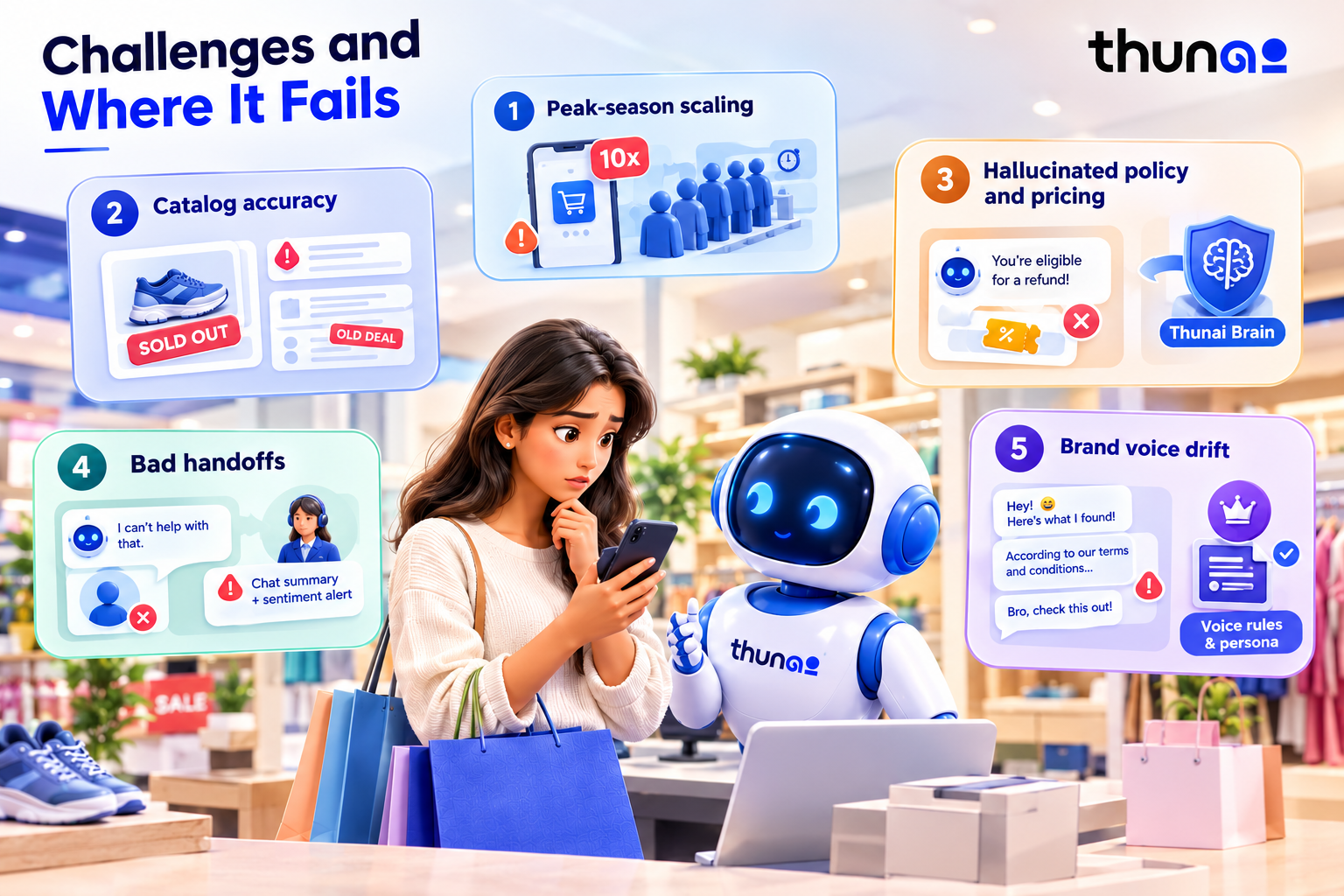
A launch without live integrations or guardrails creates headaches. Conversational AI for retail can hurt trust when it is rushed. Watch for these risks.
- Peak-season scaling. Promo events can multiply traffic five to ten times. If the system leans on slow models or rate-limited APIs, answers can jump from under one second to over 15. Shoppers abandon carts. Phone queues overflow.
- Catalog accuracy. Products sell out, flash deals launch, and stock moves between regions. A batched index can recommend sold-out items or quote old discounts. That leads to canceled orders and lost loyalty.
- Hallucinated policy and pricing. Language models write smooth text but do not know your policies. Without firm grounding, a bot may promise a refund on a final-sale item or invent a coupon. A dedicated platform grounded in a knowledge system like the Thunai Brain stops these errors.
- Bad handoffs. The "containment trap" happens when a bot refuses to bring in a person. Dropped chat history makes it worse. Modern platforms summarize the chat and alert supervisors when negative sentiment appears.
- Brand voice drift. Luxury and fashion brands spend years building a tone. Unsupervised AI can swing between legal stiffness and slang in a long chat. Enterprise platforms enforce voice rules and persona guidelines.
Conversational AI Platforms for Retail Compared
Picking a platform means balancing autonomy, data integrations, speed, and cost. Vendors differ a lot on each point.
Customer feedback puts Thunai among the top enterprise CX options. It resolves inquiries in under 0.8 seconds through autonomous task execution. By grounding workflows in the Thunai Brain and MCP, it keeps inventory, delivery milestones, and user context in sync across phone, web chat, and in-store clienteling.
Its outcome-based pricing ($0.90 to $1.00 per resolved ticket) and 48-hour onboarding avoid the long procurement cycles and high upfront costs of older platforms.
What It Costs and How to Measure ROI
Budgeting for Conversational AI for Retail means looking at setup fees and recurring billing. Most vendors use one of three pricing models.
- Outcome-Based Pricing: You pay only when the agent fully resolves an inquiry without a human. Rates run $0.90 to $2.00 per resolution. Spend tracks results.
- Per-Conversation or Per-Session Pricing: You buy monthly conversation allowances at $1.00 to $2.00 per active interaction. Budgeting is easy, but you pay even when a human takes over.
- Consumption-Based Action Credits: You pay for tool executions or backend API queries, usually $0.05 to $0.15 per call. Costs rise when an agent runs complex multi-step workflows.
Implementation costs vary. Turnkey apps with pre-built Shopify connectors launch in days at low cost. Enterprise projects with private cloud hosting or custom legacy ERP builds often need $50,000 to $200,000.
To judge performance, balance support savings and new sales against software fees.
ROI (%) = [(Support Cost Savings + Incremental Net Revenue Uplift − Total Cost of Ownership) ÷ Total Cost of Ownership] × 100
Estimate support savings by tracking containment against your human baseline:
MonthlySupportSavings=TotalMonthlyInquiriesContainmentRateHumanCostPerContact
Take an online brand with 40,000 tickets a month at $8.00 per human ticket:
- At an 80% containment rate, the AI handles 32,000 tickets alone.
- Human baseline cost: $32,000 \times \$8.00 = \$256,000$ per month.
- AI outcome-based cost at $0.95 per resolution: $32,000 \times \$0.95 = \$30,400$ per month.
- Net monthly savings: $225,600, or about $2.7 million a year.
Add a 15% to 35% AOV lift from conversational picks. Retail deployments then often see a 3.7x to 4x return within 90 days. Use the Thunai ROI calculator to test your own numbers.
Conversational AI for Retail Trends for 2026
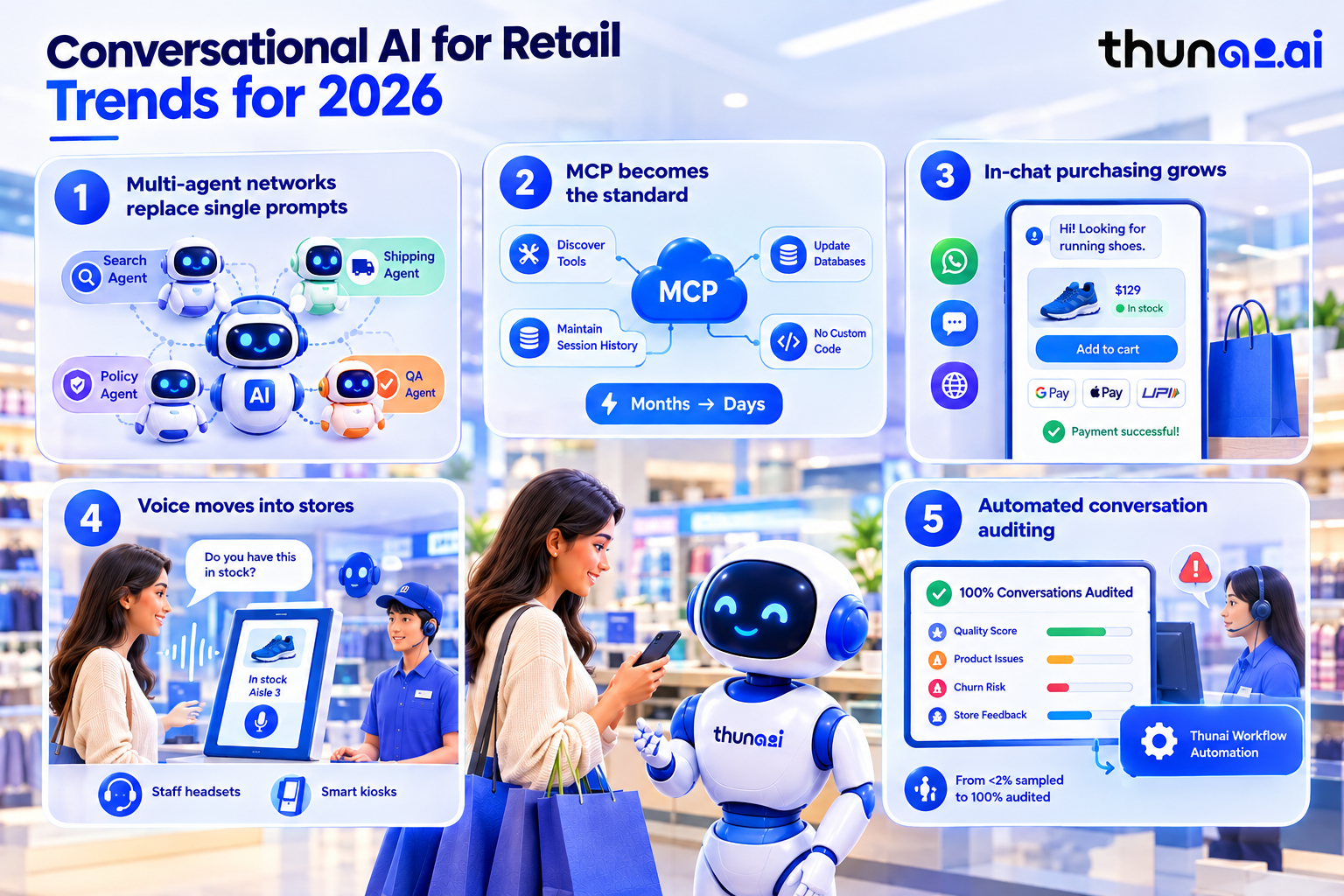
The market moves fast. Agentic workflows and new shopper habits drive the change.
- Multi-agent networks replace single prompts.
- Retail teams now run several focused agents.
- A search agent finds products.
- A shipping agent tracks carriers.
- A policy agent works out refunds.
- A QA agent checks compliance.
- Together they solve hard cases.
- MCP becomes the standard.
- The Model Context Protocol replaces fragile custom webhooks.
- Systems discover tools, keep session history, and update databases without custom code.
- Rollouts shrink from months to days.
- In-chat purchasing grows.
- With secure payment tokens and digital wallets, Conversational AI for retail builds carts, checks promo codes, and finishes the sale inside SMS, WhatsApp, or web chat.
- Voice moves into stores.
- Low-latency voice powers hands-free headsets for staff and smart kiosks.
- Shoppers ask where a product sits, whether it is in stock, and what it costs.
- Automated conversation auditing.
- Call centers once sampled under 2% of calls by hand.
- Today's systems audit 100% of interactions in real time.
- They score quality, spot recurring product flaws in return messages, and flag churn risks.
- Store leaders get real merchandising feedback.
- Thunai's workflow automation handles the follow-up work after each call.
FAQs on Conversational AI for Retail
What is conversational AI for Retail?
Conversational AI for retail is software that talks with shoppers in natural speech and text. It uses language processing, generative models, and autonomous agents. Linked to inventory, ERP, and CRM data, it handles product discovery, order tracking, and returns across digital and physical stores.
How does conversational AI for retail reduce support costs?
It automates repeat questions like order lookups, store hours, and returns. That deflects 70% to 80% of routine tickets. Cost per interaction falls from $7 to $15 for a human to under $1.50 per automated resolution.
What is the difference between a retail chatbot and agentic AI?
Chatbots follow keyword scripts or static menus. They hand off to a person when a question strays. Agentic AI plans and runs tasks across backend systems. It issues return labels, edits addresses, and processes payments without human help.
How does conversational AI for retail resolve WISMO inquiries?
The AI identifies the shopper, pulls order milestones from the order system, and checks carrier data. It shares live progress and estimated arrival in plain words. It answers in seconds and opens a carrier claim if the parcel is late.
Can conversational AI for retail reduce returns for apparel brands?
Yes. It helps shoppers pick the right size before they order. It compares measurements, fit preferences, and fabric stretch against return reviews. Sizing mistakes and bracketing go down.
How does conversational AI for retail maintain catalog accuracy during sales?
Enterprise systems connect to product and inventory databases through real-time API webhooks, not static exports. When stock runs low or a promo changes, recommendations update at once. That prevents stock hallucinations and orders for sold-out items.
What is an outcome-based pricing model in retail AI?
Retailers pay only when the assistant resolves an issue with no human involved. Rates run $0.90 to $2.00 per successful resolution. Brands pay only for completed support.
How does conversational AI for retail manage human agent handoffs?
When it spots a complex request or negative sentiment, it starts a smart transfer. It summarizes the chat, highlights the core issue, and routes the ticket to an agent. On platforms like Thunai, human reps can watch a live interaction and step in with full context.
How does conversational AI for retail assist international shoppers?
It gives localized support in more than 200 languages and dialects. It handles currency questions, local tax rates, and global shipping rules. Brands serve global shoppers without round-the-clock regional call centers.