.webp)

Have you ever wondered why customers still wait minutes to solve a problem that should take seconds? A card issue or balance check can still mean navigating IVR options and waiting for an agent.
The problem isn't a lack of banking technology. Many systems still struggle to understand customer needs and take action across the processes behind the scenes.
However, conversational AI in banking shifts the balance. Through integration of natural language processing, real-time intelligence, and backend integrations, banks can shift from merely responding to customers to addressing their problems.
Let’s explore conversational AI in banking and how it is changing the way customers interact with financial institutions.
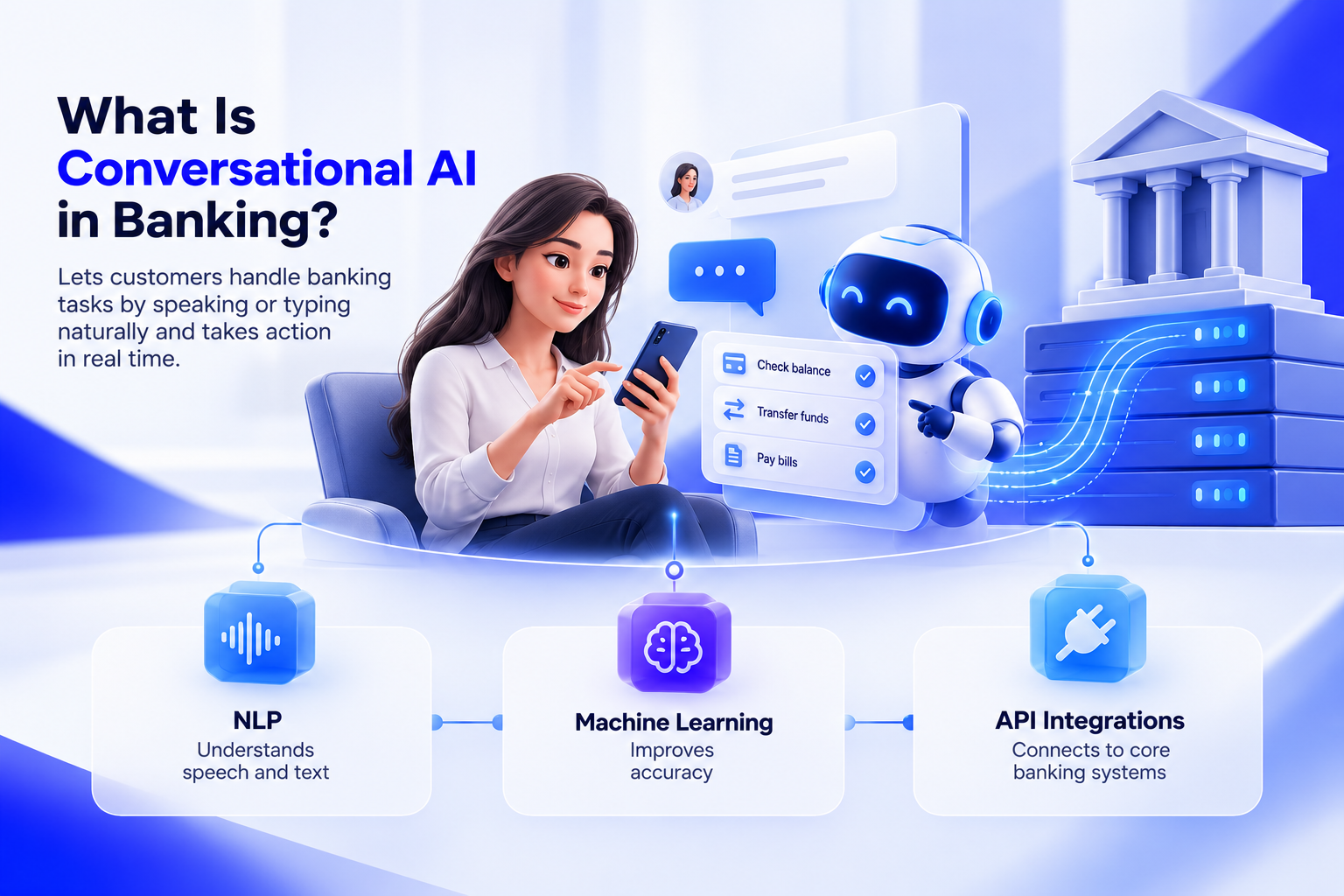
What Is Conversational AI in Banking?
The AI in conversations helps customers perform various banking transactions through voice and text commands that have the capability to process intent, gather data, and take action all within seconds.
Three major types of technology assist conversational AI in banking:
- Natural Language Processing (NLP): process voice and text.
- Machine Learning (ML): improves accuracy of responses.
- API Integrations: helps connect AI with core banking systems to be able to perform actions.
The table below shows how the two approaches differ in daily use.
Use Cases of Conversational AI in Banking
The quickest payback comes where there are lots of calls and clear business rules. This is where we find most of our use cases.
Balance and transaction self-service
- By far, the largest percentage of callers that call a bank is asking for their balance, confirmation of a transaction, or questioning an unexpected fee.
- All of these scenarios can be answered with voice AI anytime of the day. The AI verifies the caller's identity, pulls the information from the banking platform, and answers the caller's question in a clear and concise manner.
- This single use case makes up 60%-70% of low complexity incoming calls, allowing your employees to focus on answering more complicated calls.
Fraud checks and step-up verification
- There is no doubt that the primary reason why individuals call banks is for balance verification and checking any strange charges.
- All of these can be managed by voice AI round-the-clock. The AI validates the client and gets information from the core banking system to provide a clear reply.
- One use case alone comprises up to 60%–70% of low-complexity inbound calls, allowing your staff to focus on more complex calls. To learn more about how AI evaluates customer conversations, check out our AI call scoring guide.
Loan and mortgage guidance
- Applying for a loan or mortgage has always been an intricate process. The jargon is baffling, the paperwork seems never-ending, and too many applicants give up mid-way through.
- AI loan assistants guide them through the entire process. They find the best rates, explain everything in simple language, and even help to obtain additional data points for scoring purposes.
- This way, the bank ends up approving more qualified applicants without any increased risks, whereas the applicant gets a much more personalized experience.
Account opening and onboarding
- The generative AI revolutionizes onboarding by turning it into a simple chat session.
- The AI scans all KYC documents provided by the user within seconds, extracts necessary information, detects an absence of the signature, and answers any questions that may arise during the process.
- There are fewer dropouts, no more bottlenecks, and reduced costs for acquiring new customers.
Card services
- Card related problems can cause sudden peaks in call volumes especially during the travel season and after the data breach of a retail giant.
- Through conversational AI, the customer is able to either send messages or talk to the AI regarding issues like a lost/stolen card, increase in the temporary credit limit, and plans for travel.
- All this happens automatically without requiring any manual action from the AI.
Agent assist for human staff
- Not all calls need to be answered by machines. Complex billing disputes or customers truly in need require a human operator, but that human deserves better assistance than what most of them receive.
- With the assistance of an intelligent agent, the AI would listen to the conversation in silence and transcribe the script at the same time.
- When the client has any query regarding the terms of the loan, that particular clause would already be on the screen before the search is made.
Real-World Examples
These ideas are already proven in production at some of the largest financial institutions in the world.
Bank of America
Its assistant, Erica, has passed 3.2 billion interactions since launching in 2018, according to the bank’s March 2026 release. Last year, 20.6 million users interacted with Erica nearly 700 million times. In 2024, the bank also reported that over 98% of clients got answers in about 44 seconds.
HSBC
Chat is a core part of the bank’s strategy. It held 10 million chat conversations in 2019 and expected 10 million a month by 2024, per HSBC’s digital banking team. Contact center agents were retrained as conversational designers and chatbot managers to build its bots.
Capital One
This is where Eno comes in, as the assistant, to take the initiative in doing so. It will set off alarms whenever there is any odd behavior like a double charge or a fraud charge, prompting the customer to respond via text or email. Eno can also create virtual card numbers during the purchasing process.
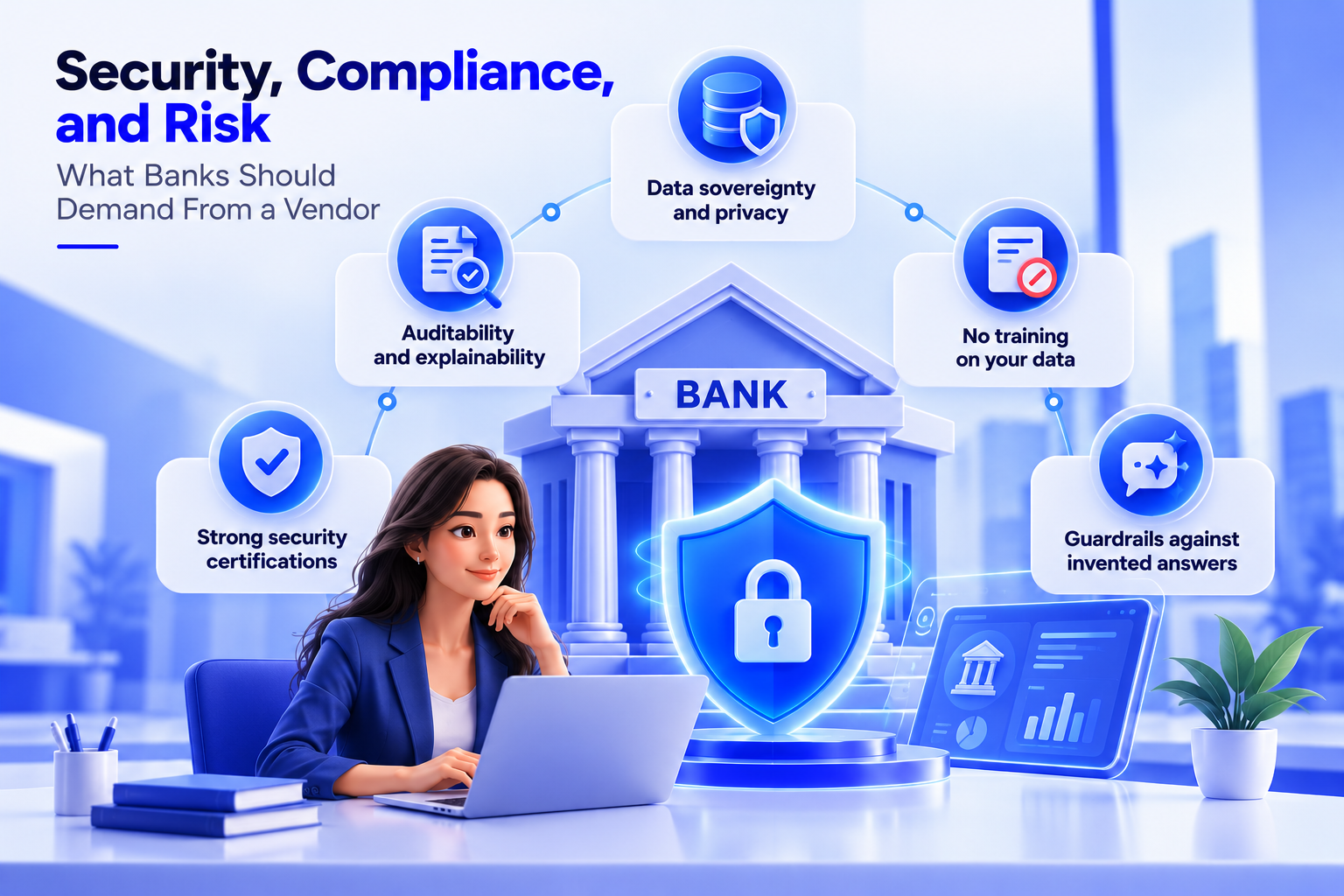
Security, Compliance, and Risk: What Banks Should Demand From a Vendor
Financial services is one of the most heavily regulated industries anywhere. That means any AI vendor has to clear a high bar. From our experience, these are the points every bank should insist on.
- Data sovereignty and privacy. The bank is accountable for its data residency. The vendor must offer the choice of hosting the solution either internally, locally, or in-region on the cloud to satisfy data residency mandates.
- Auditability and explainability. In case the AI model rejects the loan or stops the payment process, the bank has to provide full reasoning. It is unacceptable for AI to be a black box. All the decisions made by the system should be based on the approved policies.
- Training cannot be done on your data. There has to be a written agreement from the vendor that they will not use any customer data of the bank in order to train publicly available language models.
- Advanced certifications for security. Requirements include SOC 2 Type II, PCI-DSS, GDPR, AES-256, and TLS.
- Guardrails against invented answers. An AI must never make up an interest rate or misquote a policy. It should rely strictly on Retrieval-Augmented Generation (RAG), tied to the bank's approved and consistent knowledge base.
How to Implement Conversational AI in Banking
You don't need to rip out your existing systems to get started. A modern platform works as an intelligence layer that sits on top of the infrastructure you already have. This is the path we recommend. For more on deployment, governance, use cases, and return on investment in AI, see our guide to AI in banking.
Step 1: Start with the most problematic user journeys:
It is not necessary to try to fully automate everything immediately. First of all, pay attention to the user journeys which are currently creating the most problems for the contact center passwords restoration, account balance inquiries, card replacement, and many others.
Step 2: Core banking systems integration:
AI is limited in its abilities by the amount of available data. For this reason, the integration with core banking systems, such as Temenos, Fiserv, or FIS is required. It will enable AI to communicate with the actual database of the bank, rather than just answering common questions.
Step 3: Set up the handover to agents:
The system needs to be aware of its limitations. In cases of highly irate customers or more complex questions related to wealth management, the AI needs to perform a warm handover to an agent. All context of the conversation will be transferred with the customer.
Step 4: Go live and improve:
Deployment is only the start of it. Analyzing data will help identify areas that are causing blockages in the conversation.
How Thunai AI Agents Support Banks
Banking contact centers have challenges with slow voice interactions, redundant post-call activities, fragmented systems, and non-uniform customer service.
Thunai AI Agents provides the banking industry with an intelligence layer that will be able to analyze conversation, retrieve information, automate processes, system update, and assist agents without changing the contact center technology currently in use.
- Real-time agent assist: Displays the information on policies, loans, and compliance during the process of the agent serving their customers.
- Automated post-call work: Automates call note generation, updates in CRMs, and follow-up activities.
- Low-latency voice AI: Replies within 200 milliseconds to ensure smooth customer experience.
- Banking integrations: Gets Integrate with the CRMs, contact centers, and banking platforms through API.
Together, these capabilities help banks improve resolution speed while reducing manual agent workload.
Real-time agent assist
While we were seeking to ward off these requests, our focus was also on the ones that stayed on the line. During the course of the call, our software hears what the client and the agent are discussing, understands the intent, and instantly provides the relevant policy/loan information.
Omnichannel agents
Customers expect the bank to recognize them no matter what channel they choose. The platform ensures a consistent context through voice, chat, SMS, and email. The customer may start a dispute through chat and call the next day, but the AI will have a full history of the customer already.
To learn more about managing customer conversations across multiple channels with AI agents, check out our Thunai Omni.
Integrations and languages
However, a banking AI is useless when confined to its own silo, which is why we developed Thunai with an API-first approach in mind. It can integrate with leading core banking software, CRMs such as Salesforce, and telephony systems like Genesys and Cisco Webex.
Where Conversational AI in Banking Is Heading
AI for conversation has just touched the tip of the iceberg when it comes to the banking sector. Future tech would change the dynamics from a reactive service to an agile service.
This implies that the AI will interpret your emotional state based on how you talk to reduce stress and confusion. Also, the AI will not just limit itself to answering questions but perform some financial management too.
For example, it can detect idle funds, suggest a better product, and complete the transaction after receiving the approval of the customer.
Learn more about Thunai and how conversational AI can revolutionize bank interactions. Book a demo
FAQs About Conversational AI in Banking
What Is the ROI of Conversational AI in Banking?
Generally, banks have two types of ROI: cost reduction and revenue increase. Cost reductions may include 30%-50% reduction in support expenses because the AI handles up to 70% of inbound routine traffic.
How is conversational AI in Banking different from older IVR phone systems?
Traditional Interactive Voice Response (IVR) systems rely on predefined menus and decision trees, requiring customers to follow a fixed path. Conversational AI in banking takes a more natural approach, using natural language processing to understand what customers say and respond to their needs without forcing them through rigid menu options.
How does sensitive financial information get secured?
Enterprise-class solutions provide AES-256 encryption while storing data and TLS encryption when transferring it. Major vendors comply with SOC 2 Type II, PCI-DSS and HIPPA regulations. Moreover, banks can use regional cloud or on-premise solutions as one of the possibilities of ensuring data sovereignty and meeting FFIEC requirements.
Will AI systems replace human banking representatives?
No. The idea is to manage a huge amount of routine and low-value calls, such as password recovery and basic account balances, so that the banking representative does not do rote work. If there is a complicated, emotional, or high-value call, then the system passes it to a person and provides him/her with the necessary data to resolve the case.