
Every single contact center executives have heard terms like conversational AI, generative AI, and agentic AI.
They often make mistakes on the same thing. In reality, that misunderstanding reflects on organizations spending millions on products like AI that convey well but it doesn’t do its work properly.
In simple terms, one listens, one writes, one acts. Conversational AI manages the conversation.
This guide will define what each does, how they relate to your business, and how high-performance centers integrate all three components.
What is Conversational AI?
Conversational AI is not just a technology but a process of handling conversations over the phone, chat, email, or texting, considering the context of past conversations.
Conversational AI comprises three elements that work together;
- Natural language identifies the need
- Conversational management handles the flow
- Converts text form to speech form
As of today, well-built chatbots hit 70–90% containment, but simple FAQ-only bots average just 40 to 60%. The weakness shows exactly where scope is narrow. (NextPhone/Alhena AI)
What is Generative AI?
Generative AI creates text, summaries, translations, coding, or pictures using prompts through pattern recognition, learned from training data through the LLM.
In the contact center setting, it does the back-end tasks such as creation of summaries of calls, making call notes, email drafts, articles, quality score explanations, and translations.
Say, for example: after a call ends, it auto-writes a summary and disposition note instead of an agent typing one.
Here's what things surprise you: Grounded summarization, the task behind call summaries and disposition notes, hits hallucination rates as low as 0.7% for top models, but only when real facts anchor the output.
Where agentic AI fits, and why the two-way comparison is now out of date
For a long time, people only compared two types of AI: conversational AI vs generative AI. That's no longer enough. But here's the third piece of the puzzle, the one that is just as important.
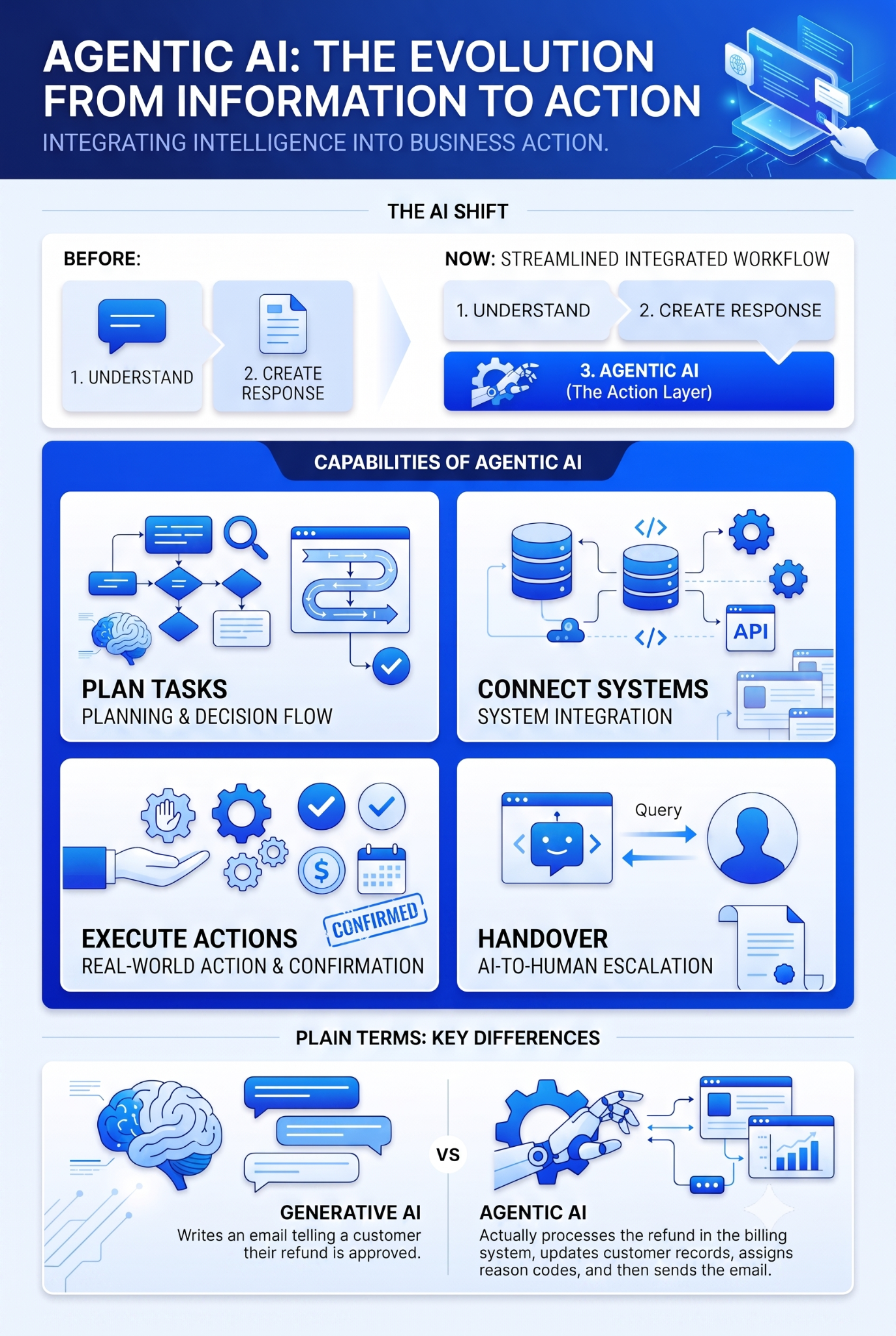
There are three steps to it: understand the client, respond to them, then act on it. That third step is where agentic AI comes in, and it can:
- Plan out a task that takes several steps
- Reach into other business systems and tools to get things done
- Take real action that can't easily be undone, like giving a refund or changing a delivery date
- Identify the right time to step back and pass the task on to a human supervisor
This is how you tell the difference between the two. With generative AI, an email can be written informing the customer that their refund is coming
Conversational AI vs Generative AI vs Agentic AI: side-by-side comparison
Here is an easy table for you to compare all three, so that when evaluating new tools and marketing, you have a clear mind.
Which one should you use for which contact center workflow?
In terms of conversational AI vs generative AI, Contact center leaders need to match the right kind of AI to the right kind of work. Using powerful, action-taking AI on simple questions wastes money and computing power.
Refunds and cancellations: Agentic AI needs the system to check if the customer qualifies, actually process the payment, update the customer record, and send a receipt.
Highly emotional situations, complex financial or legal advice, anything requiring a licensed professional, and any case where your company's information isn't trustworthy enough to rely on should always go straight to a human.
What’s surprising is that by 2029, agentic AI is expected to autonomously resolve 80% of common service issues, cutting operational costs by 30%. Agentic AI is only as good as the knowledge it's built on.
How the three work together in one stack
Conversational AI vs Generative AI vs Agentic AI. These three AI types work together during a single call, all within seconds.
When a call starts, conversational AI takes charge first, focused on speed. If it takes longer than 800 milliseconds to respond, the conversation feels broken.
Generative AI recognizes speech, allows interruptions, and transcribes speech into text in real time.
When the query involves performing an action such as changing a shipping address, the agentic AI comes in. It creates the plan of action, validates identity, performs the update in the correct system, verifies the results, and returns control back to the generative AI.
The generative AI then writes a summary, extracts important details, tags a reason code, and rates the call.At the moment, Well-configured voice AI deployments achieve 85–90% CSAT on fully resolved calls, with containment rates above 50% across travel, hospitality, and financial services.
While traditional tech stacks combine conversational, generative, and agentic AI to manage a single call, Thunai provides a significantly better, more seamless approach to executing this entire workflow effortlessly. Want to know more? Try thunai
What this looks like in production: measured outcomes
- Faster rollout, more adoption. Neuberg Diagnostics used conversational AI to launch support agents 10x faster than building from scratch, reaching 70% customer engagement across chat and voice.
- Lower costs, faster answers. A manufacturer facing supply chain delays connected agentic AI into its business systems, letting it handle vendor steps and shipment checks without humans.
- Higher satisfaction. An event booking company used AI voice calls to proactively handle seating changes, explain them, and rebook customers passing emotional cases to humans with full context.
- Big time savings. Bazooka Candy used agentic AI to check and organize over 10,000 business accounts, cutting ticket-handling time by 60%.
Common mistakes CX teams make with these three terms
Nowhere does this show up more than in the conversational AI vs generative AI debate, where the two get treated as interchangeable when they're solving completely different problems.
- Mistake 1: Using agentic AI with outdated information. The most serious mistake. Agentic AI acts on bad information, not just repeats it. An old return policy could mean rejected valid returns and wrong records, automatically and at scale.
- Mistake 2: Calling a basic phone menu (conversational AI). A press-button menu isn't conversational AI. It can't understand natural language or context, and up to 40% of customers hang up in frustration. Real conversational AI lets people talk naturally.
- Mistake 3: Skipping human review on generative content.The use of AI to write summary calls can lead to incorrect data being included in official documents without being noticed. This is where standards such as ISO/IEC 42001:2023 can be useful since they require continual surveillance and traceability of information sources.
- Mistake 4: Using the wrong success measure. Tracking "containment" (keeping customers from a human) doesn't work for agentic AI. A frustrated hang-up counts as "contained" but isn't solved. Agentic AI should be judged by "resolution rate" instead.
FAQs on conversational AI vs generative AI
Which is better for customer service, conversational AI or generative AI?
Not one alone solves the problem. Conversational AI runs the conversation; generative AI writes out the correct responses; agentic AI gets the job done. If a business purchases just one of these types of software, it will most likely have conversations that don’t really get anything done at all.
Is ChatGPT a conversational AI?
ChatGPT is an AI chatbot that can be defined through the definition of both terms.It is a conversational generative AI system where one interacts with it by having a chat session. This is precisely why these terms get confused all the time. Business models used in call centers always have more layers added to them.
What's the difference between all three types of AI?
Conversational AI is able to interpret what you say and respond accordingly. Generative AI generates content from scratch. Agentic AI is capable of making decisions and taking actions in order to complete the task. All three AI solutions usually coexist in one solution for the majority of contact centers.
Can generative AI and conversational AI work together?
Yes! they almost always do in the case of most businesses. This is because generative AI provides the text for the response, conversational AI manages the exchange, identifies the customer and when to handover the call, while in between all that, the system looks up the information in real business documents.
Can you use generative AI without conversational AI?
Yes, definitely. Actually, this is where many companies begin since it’s less risky. Such things as call summary, post-call summary, scoring of calls, translations, and creating articles do not need any live interaction with the customer at all.
How does natural language processing (NLP) relate to these types of AI?
Natural Language Processing (NLP) is the fundamental science on which conversational AI and generative AI rely. NLP in conversational AI is used to understand the intent of the person and to control the flow of conversation, whereas in generative AI it helps in generating natural language.