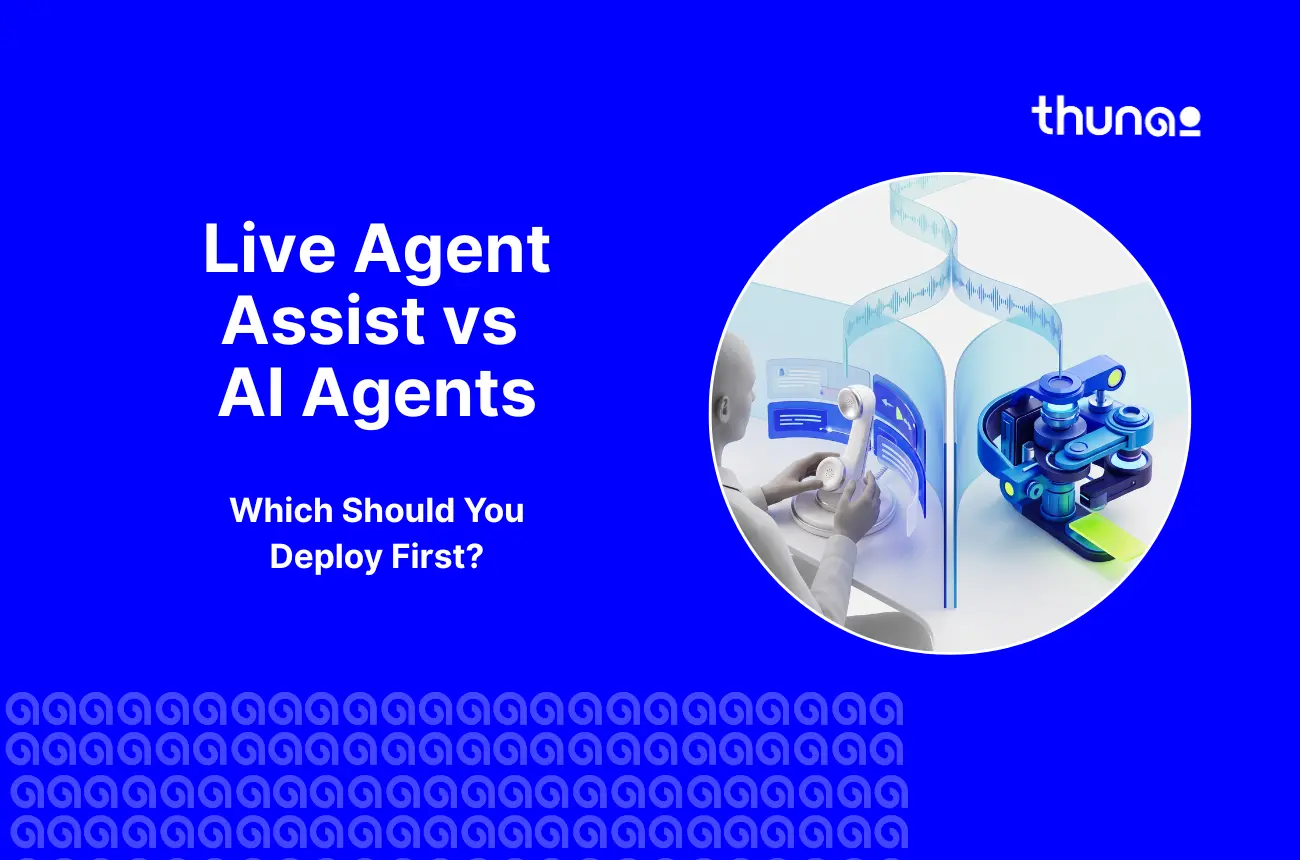

The choice between live agent assist vs. AI agents is one of the most important decisions today. Struggling to choose between live agent assist and AI agents for your contact center?
Human-assisted live chat allows a human to remain in charge while the AI makes suggestions on the fly, perfect for complicated or emotional questions.
Whereas AI chatbots take care of simple queries such as resetting passwords or order tracking.
This article examines the differences between these technologies, their costs, risks, and metrics, including the hybrid approach in which AI chatbots take care of tier 0/1 queries while assisting support personnel with tier 2 queries.
Short answer: assist augments the agent; AI agents replace the interaction
The key difference between live agent assist and AI agents is who controls the work. Live agent assist supports human agents by providing real-time tips, suggested responses, and summaries while the human remains in control.
AI agents handle customer conversations independently, access company data, understand issues, and resolve them without human involvement.
In simple terms, live agent assist makes human agents faster and smarter, while AI agents perform the work themselves.
Definitions that actually differ
To understand live agent assist vs. AI agents, we need clear definitions. The software market uses many popular words, but the real technical models act very differently from one another.
What is live agent assist?
A live agent assist system is a smart tool that helps a human worker during a live call or chat session.
The live agent tracks the customer's words and instantly searches the company database to find the exact right answer. It then shows this answer on the human worker's screen.
The human then understands the answer and thinks about how to convey the response to the customer in the best way possible.
What is an AI agent in customer service?
When using AI agents to provide customer service, one uses software that behaves like an intelligent and autonomous employee.
In AI agents, the program understands the client’s problem, comes up with ways of solving it, performs actions within the system such as accounting, and then communicates back to the client.
Why chatbots, IVR, and virtual agents are not the same thing
In terms of comparing a chatbot with an AI agent, it becomes very clear that the former follows very strict rules and menus.
However, AI agents are quite different in this regard because they have the ability to comprehend natural languages, recall past conversations, and accomplish tasks without following any strict scripts.
Live agent assist vs AI agents: side-by-side comparison
To decide between live agent assist vs AI agents, companies must look closely at safety, speed, and overall cost.
AI agents usually save more money per contact, but assist tools are much safer for tricky or risky issues.
Comparing live agent assist vs AI agents directly in a table helps clear up the confusion for decision makers.
Comparison table: who owns the conversation, deflection, risk, CSAT, cost, time to value
To highlight the differences between live agent assist vs. AI agents, the data below shows how each tool performs across standard business goals.
How each one is built
The technology behind live agent assist vs. AI agents shares some common parts, but the final setup is very different. Both require strong data, but they use that data in unique ways.
Human-in-the-loop assist architecture
Human-in-the-Loop technology depends on real-time suggestions of text while the customer is speaking, and the software converts the audio to text almost instantly, aiming for a delay of no more than 0.5 seconds.
McKinsey deployment across 5,172 customer support agents found generative AI assistance drove a 14% increase in issues resolved per hour and a 9% reduction in average handle time.
The AI processes text, looks through the knowledge base, and presents an answer suggestion to the human agent before the customer finishes their question.
Autonomous agent architecture: tools, actions, memory, and guardrails
These independent agents need tools like API connections to read and change data in the real company system.
Autonomous AI agents need a deep memory to remember what the customer said two minutes ago in the same chat and need very strict guardrails to prevent errors.
If the AI is not sure of an answer, it must know exactly how to stop and pass the chat to a human worker.
What both share: the knowledge and data layer
Both sides of the live agent assist vs AI agents debate need a clean central knowledge base to work well.
Whether a company is using live agent assist vs. AI agents, the AI must read from the same company rules.
When the company data is messy, old, or wrong, both the assist tool and the AI agent will give bad answers.
A unified, clean data layer is the single most important step for both models to succeed.
Cost and ROI compared
The financial return of live agent assist vs ai agents looks very different on a business spreadsheet.
Leaders must measure both approaches clearly to see where the real value comes from.
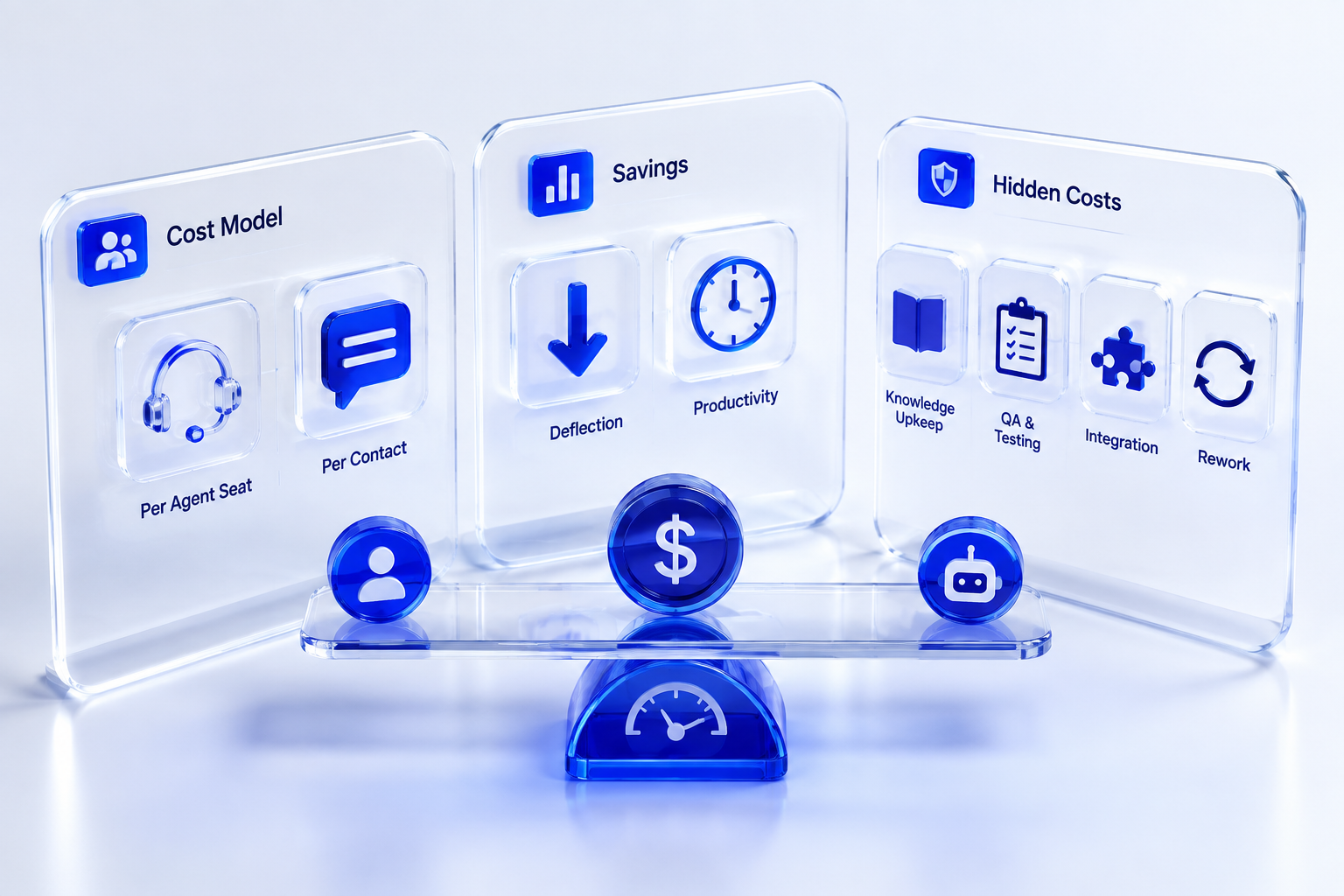
Cost per contact vs cost per agent seat
Vendors usually price live agent assist per human user, charging a monthly fee per seat. The return on investment comes from those human workers moving faster and handling more calls per day.
In contrast, vendors price AI agents based on actual usage. Companies pay a small amount for every contact the AI successfully handles from start to finish.
Deflection savings vs productivity savings
An AI agent saves money through deflection. The AI agent deflection rate shows exactly how many customer tickets never reach a human worker.
Live agent assist lowers average handle time and cuts down on the minutes agents spend writing notes after a call is over.
Hidden costs: knowledge upkeep, QA, integration, and rework
AI agents need constant testing and quality checks to ensure they do not make costly errors or break rules.
Live agent assist needs deep training so humans actually use the tool on their screens instead of ignoring it.
Risk, compliance, and brand exposure
Safety is the biggest reason companies pause when choosing live agent assist vs. AI agents.
AI hallucination, a situation whereby the AI creates false data in its response, can cost businesses a lot of money and credibility.
IBM's 2026 Cost of a Data found that AI-enabled breaches now cost companies an average of $6 million, about $1 million more than the overall global breach average of $4.99 million.
Where full autonomy is unsafe: BFSI, healthcare, disputes and retention
In Banking, Financial Services, and Insurance, or in healthcare, AI mistakes lead to serious legal trouble.
If an AI agent gives the wrong medical advice or promises a fake loan rate, the business is at massive risk.
PwC's 2025 Customer Experience Survey found 86% of consumers say human interaction is important to their brand experience, stating why emotional, high-stakes contacts still need a human behind live agent assist.
Containment rate as a vanity metric
When measuring AI success, companies love to look at containment rates. This is the percentage of calls the AI finishes without asking for human help.
A true measure combines the containment rate with the customer satisfaction score to prove the issue was actually solved.
Escalation and warm-handoff design
A good AI agent escalation-to-human process means the AI passes the full chat history and all details to the live worker instantly.
The customer does not have to repeat their problem from the start. The best part of comparing live agent assist vs. AI agents is that a good AI agent becomes a live agent assist tool the very second it hands the call over, giving the human a perfect summary to start with.
Decision framework: choose by contact type, not by hype
Companies should not pick live agent assist vs. AI agents based on what is trendy in the news.
They need to base their decision on the type of customer issue they are seeking to solve.
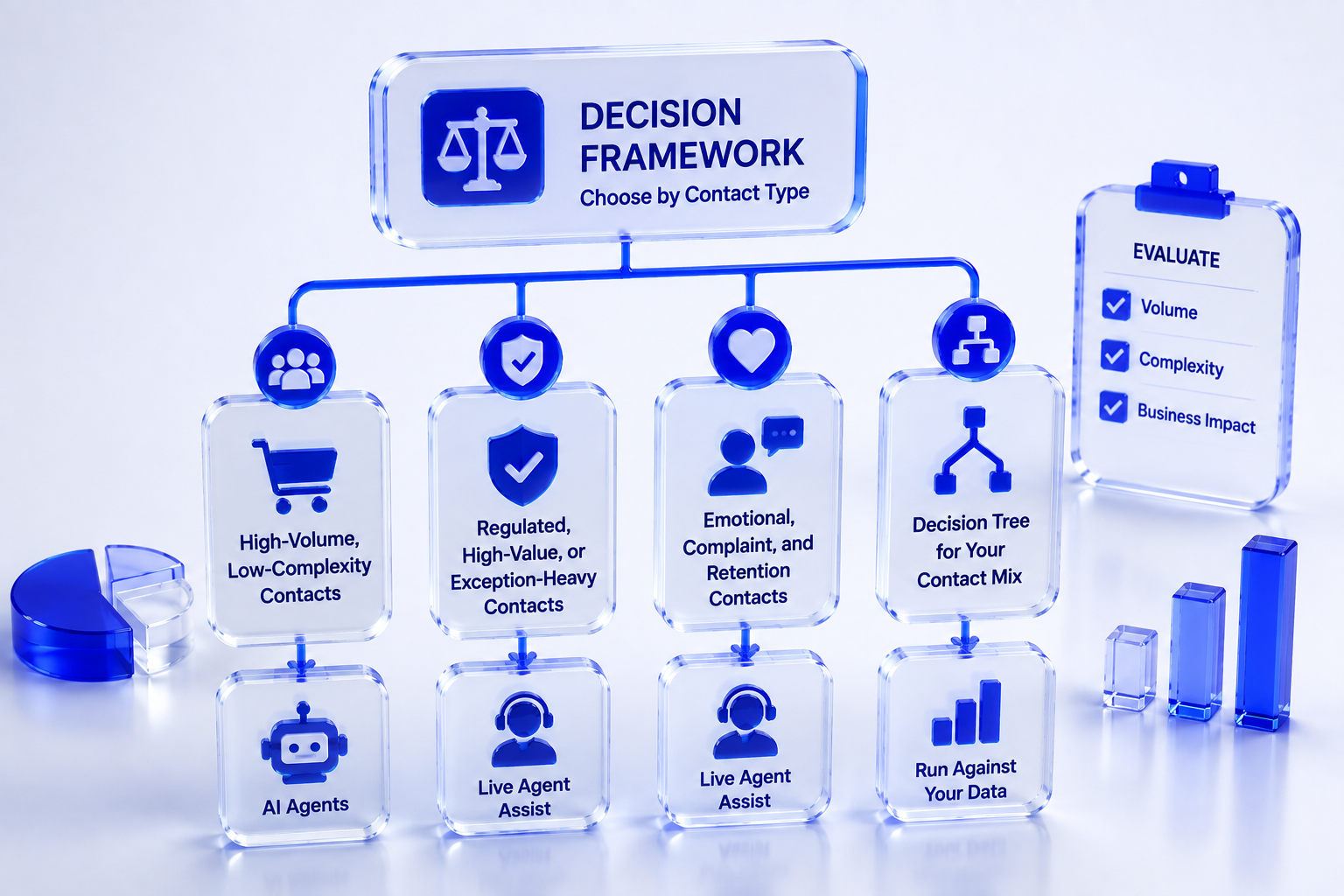
High-volume, low-complexity contacts
For tasks such as password recovery, order tracking, and hours of business operation, AI agents are the best fit.
They respond immediately, are inexpensive, and resolve the issue much faster than a person can say hello.
Regulated, high-value, or exception-heavy contacts
For high-value sales, legal claims, and rare problems, use live agent assist. The human ensures the rules are followed perfectly, while the AI searches the massive rulebooks in the background to speed up the process.
Comparing an AI agent vs. a human agent in these highly regulated cases proves that humans are still deeply needed for safety and trust.
Emotional, complaint, and retention contacts
Data shows that using AI to handle complaints drops the customer satisfaction score heavily. Humans show real empathy.
In emotional cases, live agent assist gives the human the strict facts, but the human gives the care and warmth to save the customer.
Decision tree you can run against your own contact mix
To settle the live agent assist vs. AI agents debate for specific tasks, companies can use this simple mapping rule set against their own contact data.
The hybrid model most enterprises actually land on
The secret of the live agent assist vs. AI agents debate is that most smart companies use both.
A hybrid contact center model is the safest and most profitable way to run a modern support team.
AI agents on tier 0 and tier 1, assist on tier 2
In a hybrid setup, the AI agent handles all simple, routine questions automatically. If a question is hard, the AI passes it to a highly trained human worker.
At that exact moment, the system switches. The human worker uses live agent assist on their screen to solve the hard problem quickly without making the customer wait.
Handoff with full context, not a cold transfer
When shifting from the AI agent to the human, the software must pass all notes instantly.
If the customer is forced to repeat his/her name or problem to the human representative, then that means that the system did not work.
One knowledge layer and one analytics layer across both
For live agent assist and AI agents to work together perfectly, they must share the same company brain.
If the AI agent reads from one database and the human assist tool reads from another, they will give the customer two different answers.
Deployment sequence: what to roll out first and why
When planning live agent assist vs. AI agents, picking what to build first is critical. Most experts agree that companies should start with live agent assist.
Agent lets the company test the AI knowledge base safely, because a human is checking every single answer before the customer sees it.
Once the answers are proven to be perfect, the company can turn on the fully autonomous AI agent with total confidence.
Salesforce's 7th State of Service report found AI currently handles 30% of service cases, projected to reach 50% by 2027.
Readiness checklist before you automate anything
Before spending money on live agent assist vs. AI agents, business leaders should check their internal systems against these core requirements to ensure they are actually ready for automation.
Metrics to track for assist vs AI agents
Tracking live agent assist vs. AI agents requires different numbers. The goals of the tools are completely different, so measuring them the same way leads to bad choices.
- Live Agent Assist: Teams should track the drop in average handle time. They should also look for a rise in first contact resolution, meaning the human fixed the problem on the very first try. Finally, teams should track the time saved on typing notes after the call ends.
- AI Agents: Teams should track the containment rate to see if the AI actually finished the job. They must also check the repeat contact rate to ensure the customer did not just call back the next day because the AI failed. Finally, track the customer satisfaction score specifically for fully automated calls.
Where both approaches break down
Even the best plans for live agent assist vs. AI agents can fail if the foundation is weak. They break down instantly when the company knowledge base is full of old, wrong information.
They also break down if the company forces angry customers to talk to an AI agent when they clearly ask for a human.
Forcing strict automation on highly emotional callers ruins brand trust and creates bad reviews. Good technology requires good design.
Assist and AI agents on one platform with Thunai
Choosing between live agent assist vs. AI agents does not mean a company has to buy two entirely different software systems.
- Thunai Omni acts as a full AI agent that solves easy tickets instantly across voice and chat channels.
- Thunai Brain acts as a powerful live agent assist tool. As it listen to the human call, searches the data, and gives the human the right answer on their screen.
- Thunai even allows advanced screen sharing, where the AI can see the customer's screen to guide them through a fix much faster.
Because Thunai uses the same knowledge base for both the AI agent and the human worker, the answers are always consistent and safe.
Want to see how? Book a free demo with our team to see live agent assist in action!
FAQs on live agent assist vs. AI agents
What is the main difference between live agent assist vs. AI agents?
The main difference is who controls the interaction. Live agent assist gives helpful tips to a human worker who owns the chat. AI agents talk directly to the customer and do the work entirely on their own without human help.
Will an AI agent replace my human staff?
No. Where AI agents excel at doing simple, high volume tasks, human beings are needed for doing complicated and emotionally difficult tasks.
Can live agent assist vs. AI agents use the same data?
Yes, and they absolutely must. Using one unified knowledge base ensures that whether a customer talks to an AI or a human, they get the same true answer every single time.
Why is containment rate sometimes a bad metric for AI agents?
If a customer gets frustrated with an AI agent and hangs up the phone, the system might count that as "contained." But the customer's problem was not actually solved.