
Managing an efficient contact center depends on one thing only: aligning schedules of agents with customer demand.
There is no way calls, chats, or emails can come through on a smooth curve.
When agents step away without warning, queues back up fast.
Managing Schedule Adherence in Call Centers helps balance agent availability against that demand.
A clear definition of schedule adherence in call centers protects service levels, cuts payroll waste, and supports the people on the frontline.
What Is Schedule Adherence?

Contact center leaders track dozens of metrics to manage daily shifts, but few matter as much as this one. Tracking Schedule Adherence in Call Centers gives leadership a reliable way to check daily performance.
A solid schedule adherence definition gives teams a clear baseline that shows whether the roster matches what's actually happening at each desk. Our overview of core contact center KPIs places adherence alongside the other metrics leadership teams watch daily.

Schedule Adherence in Plain Terms
Put simply: the standard definition of schedule adherence in call centers is the percent of scheduled time an agent spends doing the work they were assigned. Schedule Adherence in Call Centers examines whether call center agents follow their schedules throughout the shift.
Take an agent scheduled for inbound calls from 09:00 to 10:00. Under this schedule adherence definition, they need to be logged in and ready for that whole hour, not five minutes late or slipping out early.
For a look at how this plays out across a full day, see our guide to agent scheduling fundamentals.
What Schedule Adherence Actually Measures in a Contact Center
- Measuring Schedule Adherence in Call Centers means watching live phone and digital channel status in real time.
- The schedule adherence definition tracks agent states automatically, and workforce software logs a timestamp the instant a status changes.
- Active states cover answering calls, chats, and after-call work. Non-work states cover meals, rest breaks, coaching, and meetings.
- In case the agent delays logging into the system or takes an unscheduled break as the volume increases, those minutes are recorded as non-adherent.
- Our guide to workforce management software walks through how these status changes get logged and reported in practice.
Schedule Adherence vs. Conformance — The Critical Difference
Managers mix these two up constantly. Schedule Adherence in Call Centers looks at exact time slots, while conformance only cares about total hours worked. Both track labor time, but the schedule adherence definition is about when the work happened.
Our comparison of core WFM metrics covers a few other pairs that get confused this way.
Adherence: Were You Working at the Right Times?
- Adherence focuses specifically on certain time periods.
- High Schedule Adherence in Call Centers refers to being available at a time when the queues increase, not being available at all times during the day.
- Now consider an agent who is supposed to take calls between 08:00 and 09:00.
- The agent comes to work at 09:00 and works till 10:00. The adherence for the first hour is zero since the schedule has not been met.
Conformance: Did You Work the Right Total Hours?
- Conformance simply measures the comparison of hours worked to hours scheduled. The time that the clock tells does not come into play.
- This is contrary to Schedule Adherence in Call Centers, where the actual timing is important.
- For example, if an agent works for eight hours in a shift of eight hours, conformance would be 100%, despite the fact that the agent was late by two hours initially and compensated for the delay later on.
- This is okay in terms of payroll, but does absolutely nothing in terms of protecting the live queues.
Quick-Reference Comparison Table
Schedule Adherence in Call Centers placed near conformance highlights the difference between them. The comparison is as follows:
How to Calculate Schedule Adherence (Formula + Example)
Calculating Schedule Adherence in Call Centers just means comparing compliant minutes to total scheduled minutes. Workforce software runs this math for you, but it helps to know it by hand too.
Our guide to WFM reporting shows how these numbers usually surface on a manager's dashboard.
The Standard Schedule Adherence Formula
The mathematical formula for schedule adherence is done by taking total minutes divided by total scheduled minutes, multiplied by 100.
Schedule Adherence (%) = (Total Minutes in Adherence ÷ Total Scheduled Minutes) × 100
However, adherence variation is another measure that managers consider, which refers to the lost minutes of adherence.
Variation in Adherence (In Minutes) = Total Scheduled Minutes − Total Minutes in Adherence
Step-by-Step Calculation Walkthrough
Here's a daily example, using this schedule adherence definition:
- Find total scheduled time. An 8-hour shift equals 480 scheduled minutes.
- Deduct unpaid breaks. A 30-minute unpaid lunch leaves 450 net working minutes.
- Track lost minutes. The agent logs in 5 minutes late and runs 4 minutes over on a break.
- Calculate compliant minutes. Time where there is no adherence is 9 minutes, with 441 minutes of adherence out of 450 minutes.
- Apply the formula:
Schedule compliance = (441 / 450) × 100 = 98.0%
Why Schedule Adherence Matters More Than You Think
The significance of Schedule Adherence in Call Centers is a simple mathematical equation whereby slight understaffing leads to significant delay problems.
Impact on Customers: Queue Times and Abandoned Calls
- Low Schedule Compliance in Call Centers causes increased wait times and abandonments right away.
- As the agents either log in late or log out early, the call center cannot manage the incoming traffic.
- Wait times rise, customers get frustrated and leave, only to call back, thus creating another peak that hinders the first-contact resolution rate even more.
- Our guide to reducing call abandonment rates covers this chain reaction in more detail.
Impact on Agents: Workload Imbalance and Burnout
- Strong adherence in call centers ensures that call center associates do not have imbalanced workloads.
- With any lapse in adherence, the effects go beyond just that one aspect.
- When two out of ten associates take unexpected breaks in a line of work, the other eight take all the calls and end up working without any break between them.
- This eventually leads to exhaustion, stress, and high turnover rates.
- The issue of agent burnout has been discussed in our article.
Impact on the Business: The Financial Cost of Low Adherence
- Poor Schedule Adherence in Call Centers can cost a business tens of thousands a year.
- According to research by Verint, if a call center employs 100 workers earning $15 per hour, then a 5 percent decrease in adherence would mean 200 hours of lost productivity on a weekly basis.
- That gap adds up to about $156,000 a year in unworked paid time. To hit service levels anyway, centers end up paying for overtime or overstaffing, driving costs up even more.
- Our breakdown of contact center cost drivers covers a few other places that waste tends to hide.
What Is a Good Schedule Adherence Rate? (Benchmarks)
Healthy adherence targets balance business needs against realistic working conditions.
Industry Standard: 85% to 90%
- Realistic benchmark levels of Schedule Adherence in Contact Centers prevent burnout and, at the same time, protect service level agreements.
- The benchmark range for schedule adherence in contact centers is from 85% to 90%, with advanced call centers achieving 92% to 95%.
- A practical schedule adherence definition accepts that 100% isn't realistic.
- Agents can't hang up the second a break starts; they need a few minutes to wrap up notes or step away.
- Demand perfection, and agents start rushing callers off the line to hit the number.
- Our guide to setting realistic contact center KPIs covers how to pick sane targets across metrics like this one.
How Adherence Targets Vary by Center Size and Type
Target rates shift depending on team size, queue complexity, and channel type. Our guide to staffing models by center size digs into why these targets vary so much:
Top Reasons Schedule Adherence Drops
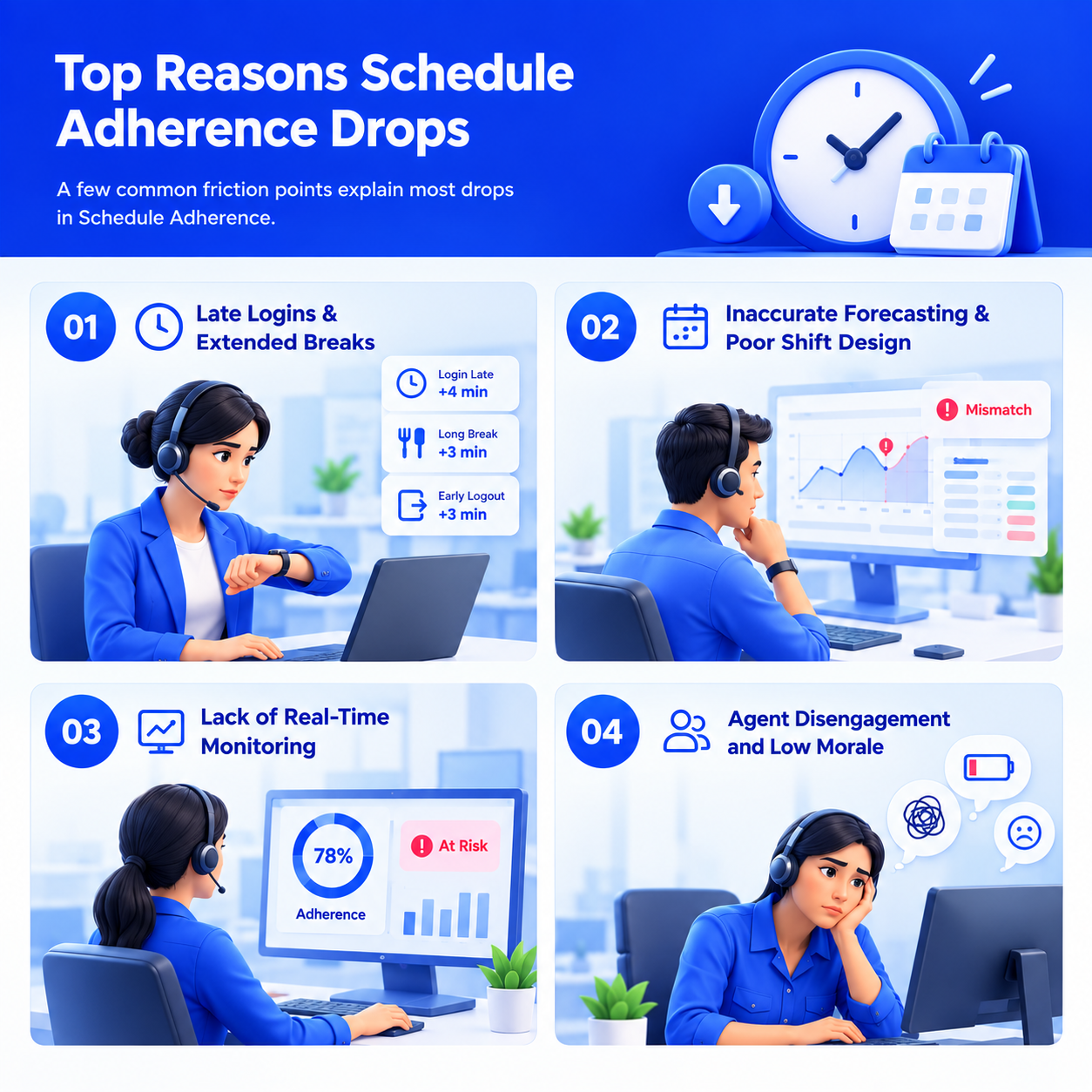
A handful of common friction points explain most drops in Schedule Adherence in Call Centers.
Late Logins and Extended Breaks
- Small delays add up fast. An agent who logs in four minutes late, stretches lunch by three minutes, and logs out three minutes early has lost ten minutes in one day.
- Across a large team, that's thousands of lost hours a year.
- Our guide to reducing agent tardiness covers a few practical fixes for this exact pattern.
Inaccurate Forecasting and Poor Shift Design
- When planners misjudge call patterns, schedules stop matching what's happening on the floor.
- Rigid shifts force agents through heavy queues with no real rest, and tired agents step away just to recover.
- Our forecasting accuracy guide walks through how to tighten these predictions.
Lack of Real-Time Monitoring
- Without real-time tools, supervisors only spot adherence problems days later.
- By the time a weekly report lands, service levels have dropped and the coaching moment is gone.
- Our piece on real-time monitoring dashboards covers what to look for in a WFM platform.
Agent Disengagement and Low Morale
- Disengaged agents take more unscheduled breaks.
- Repetitive questions, clunky tools, and tedious admin work wear morale down.
- Once agents lose motivation, they stop following the schedule.
- Our guide to agent engagement strategies digs into what actually moves the needle here.
7 Best Practices to Improve Schedule Adherence
None of these are complicated. They just require consistency. Our full playbook on improving contact center performance covers these tactics alongside a few others.
- Set clear expectations and communicate the why.
- Teaching the schedule adherence definition during onboarding builds real accountability.
- Some teams use visual games, like keeping balloons in the air, to show how one missing agent burdens the group.
- When agents realize that punctuality will keep their colleagues safe, compliance occurs naturally.
- Our onboarding best practice manual addresses the process of introducing such metrics to employees without bombarding them.
- Use WFM software for automated real-time monitoring.
- Modern workforce platforms give managers instant visibility into agent status.
- The system can alert a supervisor when a status doesn't match the schedule for more than three minutes.
- As detailed in our contact center automation guide, smart tools cut admin busywork and flag problems before service levels drop.
- Build flexible schedules that account for shrinkage.
- Planners should bake realistic shrinkage buffers into shifts.
- Even a five-minute transition window around meal breaks stops call overruns from tanking adherence scores.
- Our guide to flexible scheduling models has more on building this kind of buffer in.
- Linking performance with rewards and recognition.
- Agents being punished for small mistakes will lose motivation and leave.
- Top centers recognize consistency in performance by way of giving agents either gift cards or recognition and first choice for shifts.
- For more information, check out our article on agent recognition programs.
- Coach with adherence data, not gut feel.
- Supervisors should lean on exact timestamp logs rather than assumptions.
- Data shows whether lost time came from long breaks or calls running past shift end.
- Our guide to data-driven agent coaching covers how to turn these logs into useful feedback.
- Forecast accurately to prevent schedule-reality mismatch.
- Workforce teams should use proven forecasting models to keep staffing within +/- 5% of actual need, a topic our demand forecasting guide covers in more depth.
- Empower agents with self-service shift swaps.
- Mobile self-service apps let agents swap shifts and move breaks without a manager in the loop.
- Unplanned absences tend to drop when agents have some control.
- Our guide to self-service WFM tools covers what to look for in this kind of app.
Tools and Software for Tracking Schedule Adherence

Modern AI technologies are redefining Schedule Adherence in Call Centers in particular ways by reducing post-call wrap-up time that once reduced adherence.
- Enterprise centers still lean on legacy platforms like NICE, Verint, or Genesys for core scheduling and adherence tracking. As shown in our evaluation of the best enterprise contact center solutions, modern platforms now need to pair scheduling with smarter automation.
- Applying the schedule adherence definition day after day comes down to fixing the root causes of agent delays. Thunai offers an agentic AI platform and enterprise contact center solutions that connect natively with Amazon Connect, NICE, Genesys, and Salesforce.
- Industry reviews single out Thunai for cutting after-call work bottlenecks. A major cause of adherence loss is agents typing notes, updating CRM fields, and closing tickets by hand.
- Thunai's AI note-taking and agent assist tools build call summaries and update CRM records automatically, shortening wrap-up time and getting agents back to available status faster.
- The enterprise teams also highlight that Thunai's learning machine "Thunai Brain" and AI agent suite process up to 70% of repetitive Tier-1 calls and chats in 150 languages. With the help of Thunai, repetitive questions are avoided, thus allowing Thunai to handle the call surges smoothly without overloading the queue.
Keep your agents on schedule and your queues running smoothly — automate your contact center with Thunai. Click for a Demo now
FAQs on Schedule Adherence in Call Centers
What is the schedule adherence definition in simple terms?
The percentage of scheduled shift time an agent spends doing assigned work. It confirms employees are in the right status at the right time.
How does the schedule adherence definition differ from conformance?
Adherence focuses on exact clock timing. Conformance only measures total hours worked, regardless of when that work happened.
Can contact center agents achieve 100% adherence?
They can’t. The aim of 100% is unrealistic, and it damages the quality of services provided. Conversations take place beyond break times, and employees require some time to finish their notes or relax. Realistic goals vary from 85% to 90%.
How does after-call work (ACW) affect schedule adherence?
It only counts toward adherence during designated interaction time. When manual typing and CRM updates drag on, adherence drops. Tools like Thunai automate call summaries and CRM updates, helping agents stay on schedule.