
"Will AI replace insurance agents?" It’s the biggest question echoing through the industry today, yet most online answers hide behind vague and vendor sales pitches.
The reality isn't a simple "yes" or "no." While AI is rapidly taking over routine, repetitive tasks, strict state regulations, legal liabilities, and the need for human empathy mean licensed agent expertise remains irreplaceable.
Here is an honest, task-by-task breakdown of what AI can actually automate today and what it really means for the future of your team.
Why AI Cannot Fully Replace Insurance Agents
So the biggest reason AI can't fully replace insurance agents isn't technology; it's about the law. Selling insurance requires a state-issued license, which can only be held by a real, licensed individual, and software is not eligible to hold one.
"Selling" involves advising and focusing on the customer’s needs. AI is not able to attend classes, undergo background checks, and be accountable like a person. What’s surprising is that the NAIC has certified 47 states as reciprocal under the Producer Licensing Model Act, about 94% of all states.
Actually selling, advising, and being the licensed agent stays with a human. With 50+ different state laws, companies need per-state rules and legal advice before rolling AI out.
Because of this, AI has to stick to basic office-type tasks, such as:
- Collecting information
- Handling payments
- Explaining policy details that are already written down
- Giving simple quotes based on fixed numbers

Why does this question keep getting a vague answer?
The question “Will AI replace Insurance agents”? gets a vague answer because it touches on a lot of moving parts like technology, state laws, company policies, and personal opinions all mixed together.
Most responses center on just one aspect, such as the new AI technologies, without considering the licensing requirements, liability in case of any error, and the transformation of the whole team.
It is easier and more reassuring to give an affirmative response that is short rather than giving a long one. This is because the real response varies depending on the task, state, and business entity. Most individuals tend to respond with an affirmative "no".
What AI actually automates in insurance today, task by task?
Here's a simple breakdown of insurance tasks and whether AI replacing human insurance agents can work right now.
AI is great at pulling facts, spotting fraud, and speeding up simple claims. But denying a claim takes real judgment as it could lead to a lawsuit.
Fraud calls and tricky disputes still need a human decision. If a company says its AI handles all this alone, that's a red flag.
Who is liable when the AI gets it wrong? E&O and systemic risk?
This is the question that worries company leaders most, yet it's rarely discussed.
The big risk: one human's wrong advice is a single mistake. AI's wrong answer can repeat across thousands of customers at once, turning a small problem into a massive one.
Older business insurance covered simple tech issues, not AI's confident wrong answers. So insurers are now building new coverage for AI mistakes.
To manage this risk, companies need:
- AI answers grounded strictly in approved documents
- Clear limits on what AI can say
- Human double-checks when AI isn't confident
- Full records of every AI conversation
Many now also seek ISO 42001 certification for responsible AI management. Right now, Insurer Coalition's review of ~200 cyber claims (2023–2025) found chatbots involved in 5% of web privacy claims, often tied to consent issues.
What actually changes: the servicing operating model?
Most articles talk about one single agent's job. But there's a bigger picture: AI changes how the entire customer service team works.
Currently, 98% of insurance agencies are planning AI investments in 2026, per ReSource Pro research, signaling a major shift toward full-scale adoption.
What happens to the agent's job, honestly?
When asking, Will AI replace Insurance agents? You'll often hear that "agents will become advisors." That's partly true, but it overlooks an important detail: not every agent benefits equally.
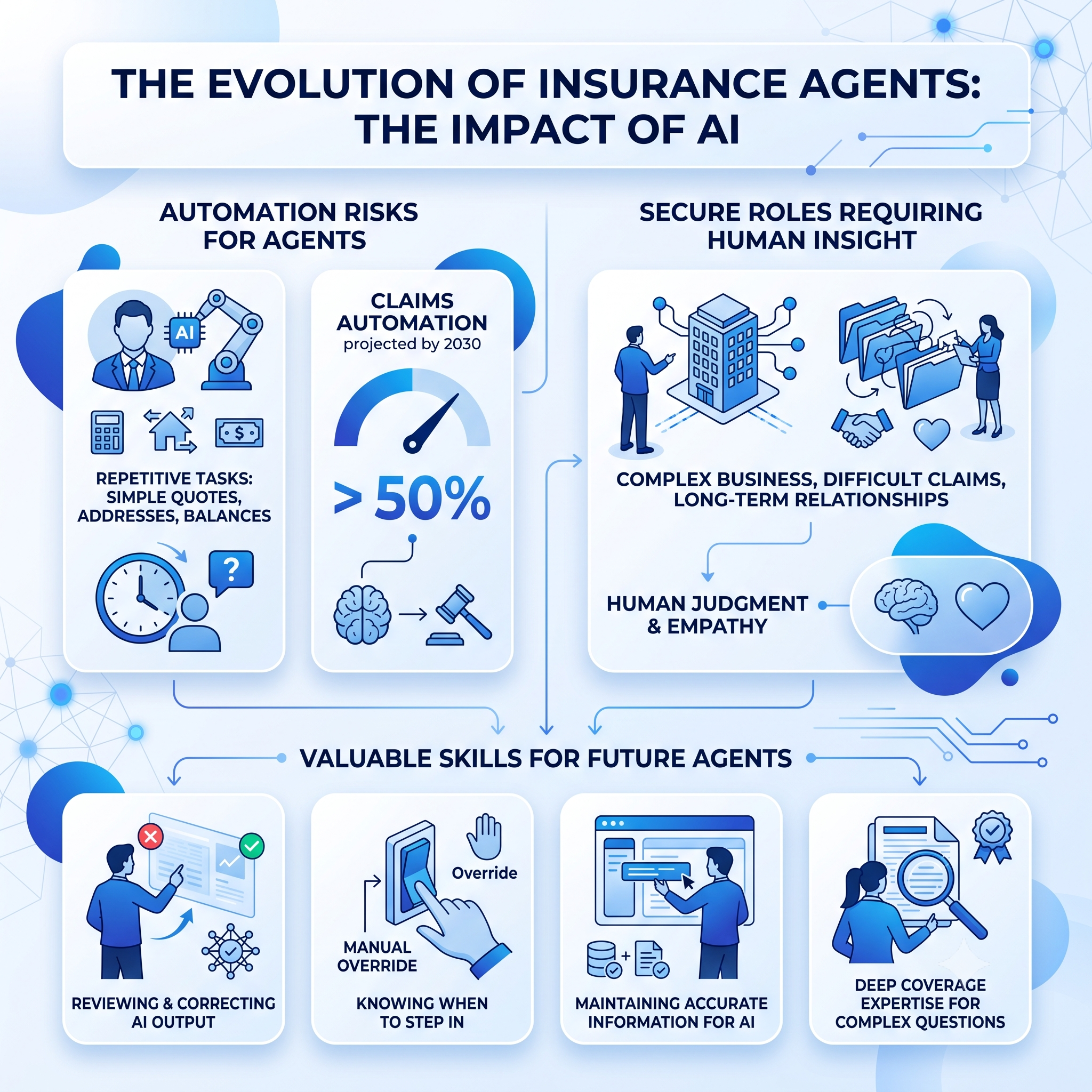
Agents focused on repetitive tasks like simple quotes, address updates, account balances and face real risk of reduced hours or replacement. In fact, McKinsey projects over 50% of claims activities could be automated by 2030, leaving complex judgment calls to humans.
Those agents who deal with complicated business insurance, complicated claims, or clients whose relationship spans a long period of time will have far more security. This is because there are no simple solutions in such cases, and only humans can provide the required empathy.
Going forward, the most valuable agent skills will include:
- Reviewing and correcting AI-generated output
- Knowing when to step in and take over
- Maintaining accurate information for AI to draw from
- Deep coverage expertise, since only complex questions reach a human
What does this look like in production?
Companies employ AI for calls, text messages, emails, etc. The effectiveness of the technology greatly depends on the technology itself.
A PwC study found that 73% of consumers say having to repeat information is one of the most frustrating parts of a support interaction
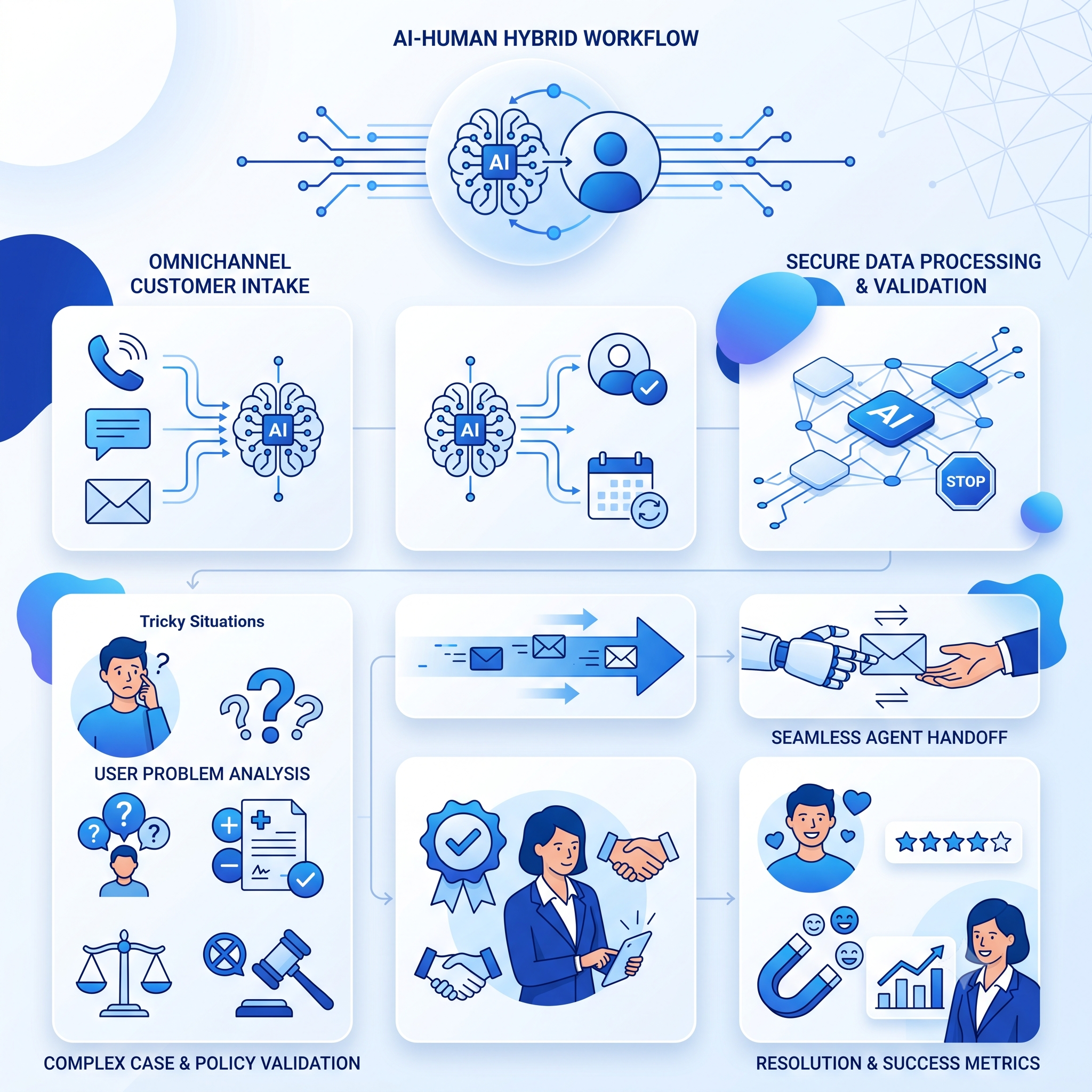
Here's a common real problem that comes up: AI can call a customer, confirm their info, and explain their renewal clearly.
But when the customer asks something difficult or needs to amend his coverage, then the technology cannot continue with it legally and must be done by an authorized person.
In case this transfer is done ineffectively, the customer becomes frustrated and may even end up leaving the business. This is why artificial intelligence can be used effectively as an assistant that facilitates an easy transition of the difficult cases to a human being.
This is exactly why Thunai builds its AI agents to hand off with full conversation context intact, so the licensed human can pick up right where the AI left off- no repeated questions, no trust issues.
Book a free demo to see how Thunai can help with Insurance policies!
How to evaluate an AI vendor for insurance servicing?
If a company wants to buy an AI tool for insurance work, they shouldn't just look at a general chatbot. Insurance is heavily regulated, so a basic chatbot could actually create legal problems. Here's what to look for:
FAQs on AI replacing insurance agents
Will AI replace insurance agents' jobs?
AI is taking over tasks faster than it's taking over entire jobs. Simple things like status checks and basic paperwork are already automated. But quoting advice, giving recommendations, and officially approving coverage still need a real, licensed person. Agents who mostly do repetitive tasks face the most risk. Agents who handle advice and complex cases are much safer.
Can AI legally sell insurance by itself?
No, not in the U.S. Selling insurance requires a state license, and only a real person can hold one. AI can help with quotes and explain policy details, but a licensed human has to complete the sale.
Who is responsible if AI gives wrong information?
This depends on the contract and the state, but the company using the AI is usually the one taking on the risk. The biggest danger is that one mistake could be repeated across thousands of customers at once. Companies protect themselves with strict rules, human check-ins, and detailed records. Always check with a lawyer.
Will AI replace insurance underwriters?
Simple, common types of coverage are becoming heavily automated. But complicated business insurance still needs a human, since there isn't always a lot of past data to go on. The likely result is fewer underwriters handling more of the tricky cases, not zero underwriters.
Will AI replace insurance claims adjusters?
Adjusters are at risk for simple tasks like paperwork and basic, low-cost claims. But complicated, disputed, or high-cost claims still need a real person, especially since claim denials get watched closely by regulators.
What is the future for insurance agents?
Less time spent on repetitive tasks and status checks. More time spent giving advice, handling tricky situations, and building relationships with clients. Agents who focus only on repetitive tasks are more likely to lose ground. Agents who let AI handle the busy work and use their free time for real advice — are more likely to come out ahead.
How does AI handle complicated claims compared to a person?
AI is great at gathering information and updating people on claim status. It's not good at judging how serious a claim is, handling disputes, or spotting fraud on its own. The best setup is AI collecting the details, then handing off tricky cases to a human adjuster.
Can AI fully replace personal advice from an insurance agent?
No. Giving advice comes with legal responsibilities tied to a real, licensed person. AI can help prepare information and show options, but a human has to be the one to actually recommend something and stand behind that advice.